
We’ve looked at degenerate game states and a few board games recently, including Hercules and the 12 Labors.
It’s time to explore a tabletop roleplaying game this week!
Neighborhood Robots, part of the Griot Anthology, uses a solitaire card game at its core to tell a compelling story about community care. It can teach us some design lessons about thematic mechanisms and victory/defeat conditions (or lack thereof).
The Griot Anthology
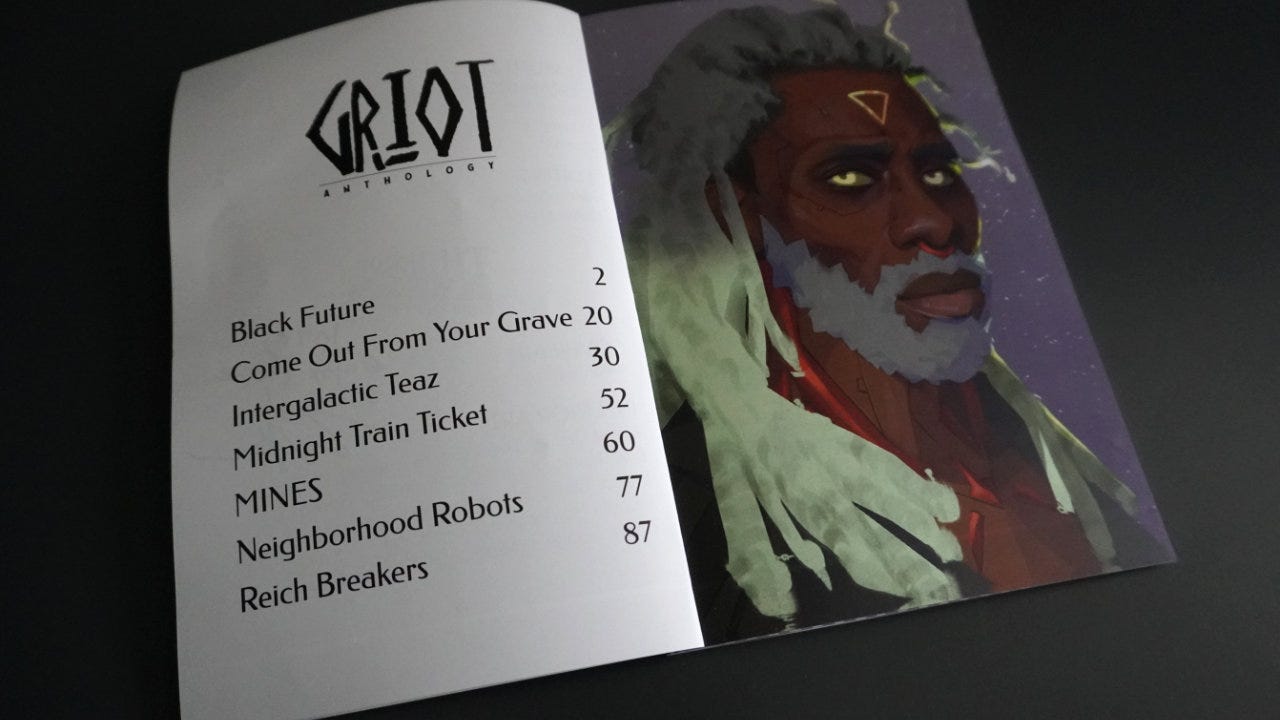
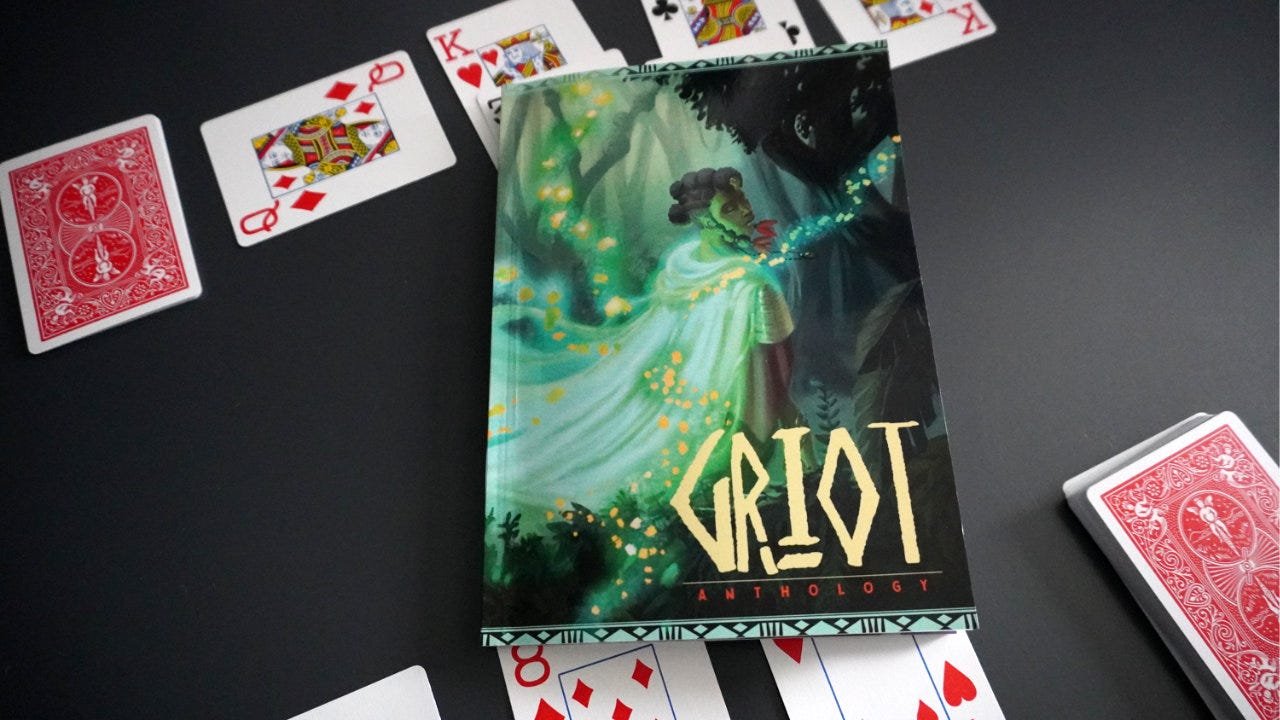
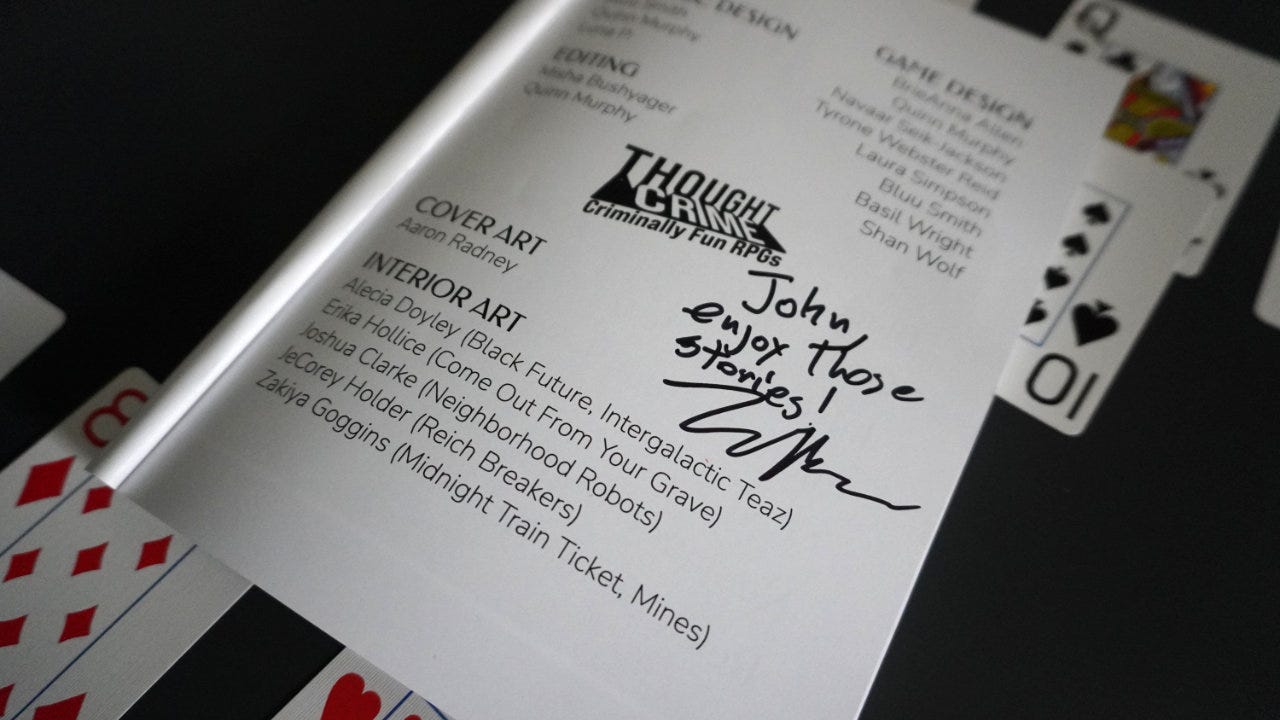
I picked up a copy of Griot Anthology by Thoughtcrime Games at PAX Unplugged last year.1 Edited by Misha Bushyager and Quinn Murphy, it is a compilation of seven tabletop roleplaying games:
Black Future by Quinn Murphy
Come Out from Your Grave by Basil Wright
Intergalactic Teaz by Bluu Smith and BrieAnna Allen
Midnight Train Ticket by Laura Simpson
Mines by Tyrone Reid
Neighborhood Robots by Navaar Seik-Jackson
Reich Breakers by Shan Wolf
Neighborhood Robots caught my attention because it is a solo journaling game, has an interestingly mechanical structure, and includes big stompy mechs.
Its system is based on a card game called Clear the Dungeon designed by Mark S. Ball, but with some important changes.
So let’s start with a look at how that game works.
Clear the Dungeon
I’d imagine most people are familiar with solitaire card games: Klondike (Patience or Solitaire), Freecell, and other similar variants. Using a standard deck of cards, you attempt to complete certain tasks or form card combinations to win the game. Most lack any sort of thematic elements. The gameplay usually involves both skill and chance, but some games are simply not winnable from the start.2
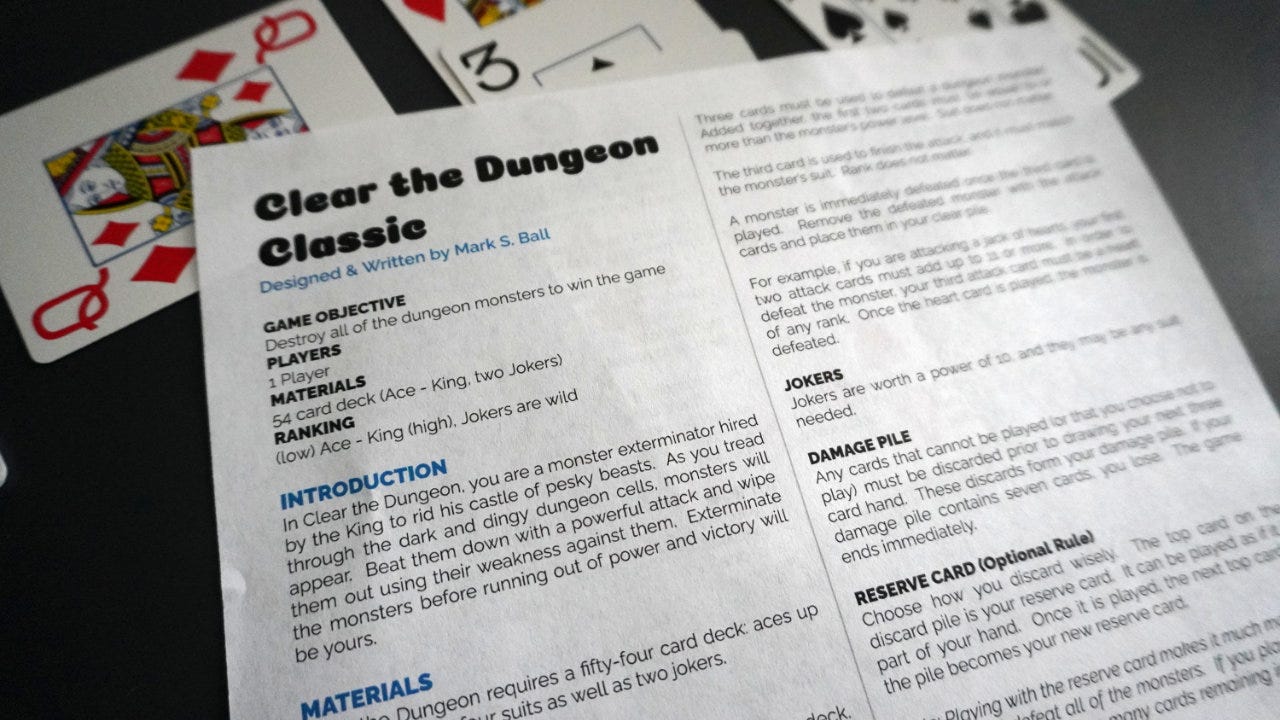
Clear the Dungeon (Ball, 2019) is a solitaire card game that fits in into the same genre as the example above, but with a theme.3 The player is fighting monsters in a dungeon, attempting to defeat them all. Granted, it’s not much of a theme, but it does exist.
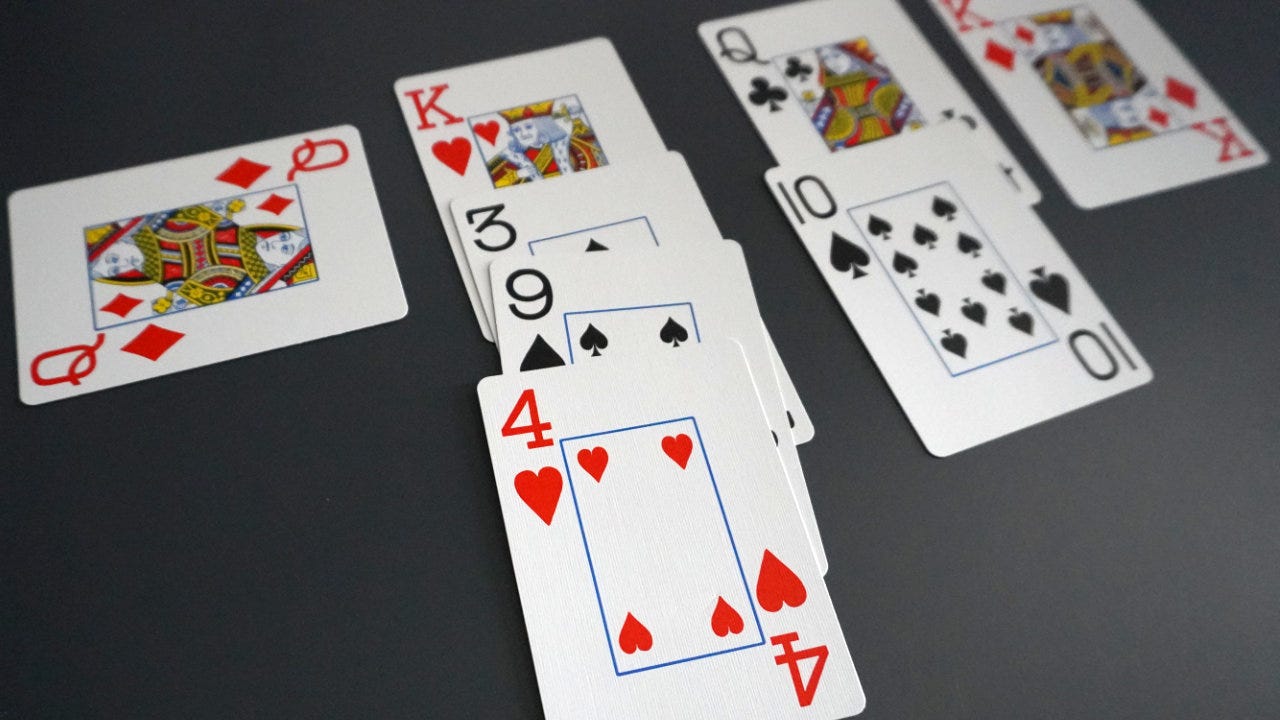
Here’s a quick overview of how Clear the Dungeon is played:
Separate all the face cards into one pile. All the remaining cards go into a separate draw pile.
Make three stacks of face cards (face down) and turn the top card of each face up. There will be three face cards visible representing the monsters.
Each round, draw three cards from the draw deck. Each card must be played or discarded. These represent your attacks.
Cards can be played for their value against any of the visible monsters.
The goal is to have two cards with a value equal to or greater than the target (10-12). They don’t need to be played to the same target face card and they will stay there across rounds.
If a target face card has two cards played, a trigger card of matching suit must be played as the third card. This triggers the attack and defeats the monster.
Play continues until all monsters are defeated or the deck runs out.
This idea of playing cards to beat a target but then needing a “trigger” card is based on the slightly earlier Gridcannon (Francis & Thursten, 2019).
The game creates some interesting choices. If you play an ace (value 1), you lock yourself into needing a 9 or 10 in the future. If you play cards that are too high, you are potentially wasting them. Splitting them up across cards makes sense, but reduces your flexibility in future turns. For a simple game, it’s mechanically interesting.
Neighborhood Robots
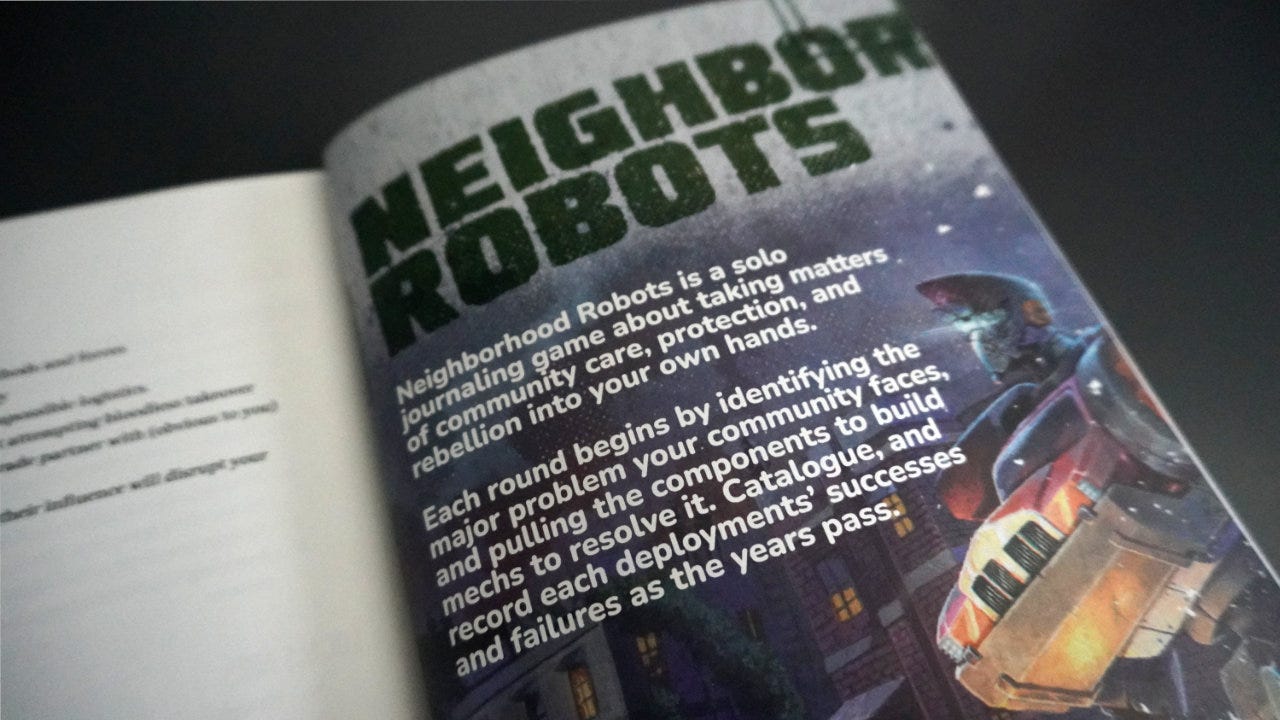
Returning to the Griot anthology, Neighborhood Robots by Navaar Seik-Jackson takes the Clear the Dungeon system (with some modifications) and turns it into a solo journaling game about “taking matters of community care, protection, and rebellion into your own hands.”
It’s the 22nd Century and the government has started a war with the Poreau — aliens who were former allies of us. All resources are redirected to the war effort and military, leaving citizens to survive on their own. Help won’t come from the government. Instead, they must build mechs to fight back and solve problems.
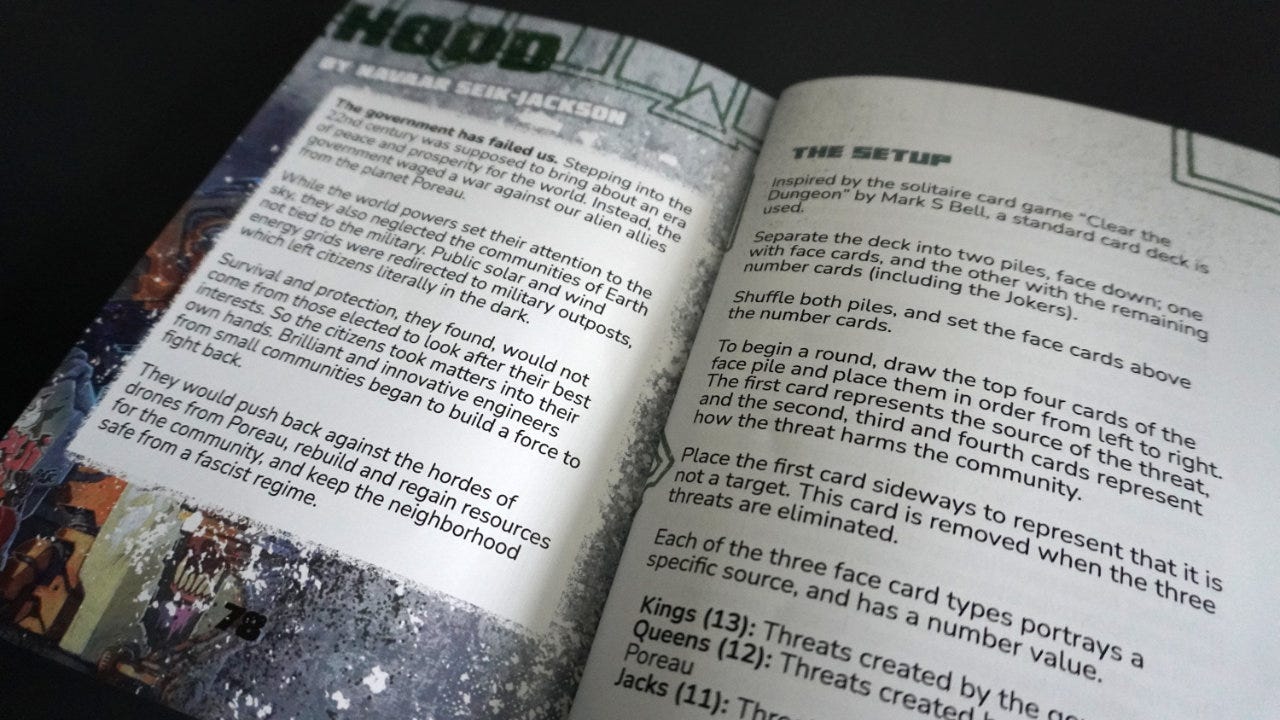
Much like Clear the Dungeon, the face cards are separated out. Four face cards are visible at a time, with the first being a thematic key for the remaining three. The face cards represent the sources of threats to the community and the harms they cause:
Kings: Threats caused by the government.
Queens: Threats caused by the aliens.
Jacks: Threats to the community’s resources.
You won’t be fighting monsters, but instead eliminating threats by constructing task-specific mechs. This is done by playing cards that represent mech components:
“As the chronicler of the events, you decide what each component is. If your water tributary is down, you likely wouldn’t meet it with revolutionary violence like you would the encroaching military, for instance. So placing a ten card would mean different things in each of those situations.”
When the components are in place (i.e. two cards with equal or greater value than the target), they must still be triggered by playing a card of matching suit. This completes the mech and eliminates the threat.
The game adds the concept of a salvage pile. If all three threats have two cards on them and you are unable to play a trigger (i.e. you have no matching suit cards), you can discard to a salvage pile instead. Those cards can be pulled out of the salvage pile in future rounds when constructing new mechs.
The continued fight
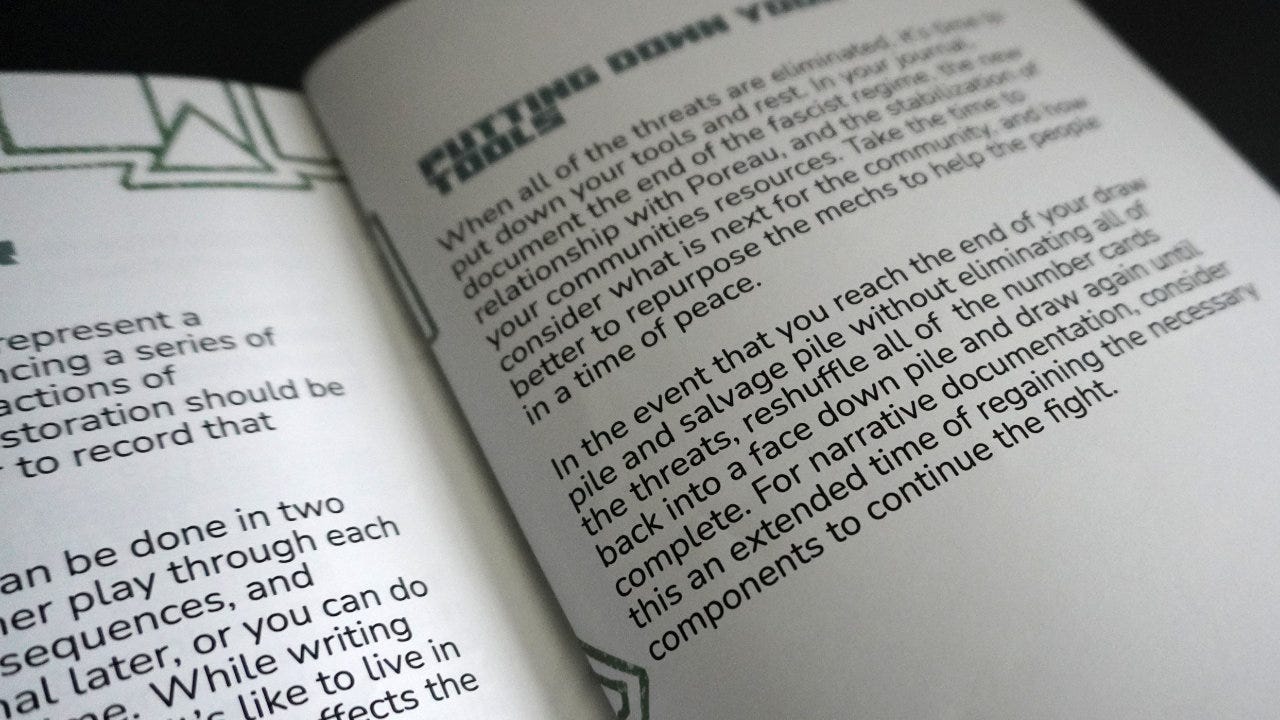
Victory works the same way as Clear the Dungeon, but with the added step of journaling the narrative when complete. Defeat, however, is perhaps the most significant deviation from the original card game.
There is no way to lose.
In Clear the Dungeon, if the draw deck goes empty, you lose. In Neighborhood Robots, however, you continue to play:
“In the event that you reach the end of your draw pile and salvage pile without eliminating all of the threats, reshuffle all of the number cards back into a face down pile and draw again until complete. For narrative documentation, consider this an extended time of regaining the necessary components to continue the fight.”
I think this is perhaps the most interesting twist and change from Clear the Dungeon. Where Clear the Dungeon exists only to be won or lost, Neighborhood Robots exists to tell a story of community response. What would a game ending in defeat mean in this context? Would it mean that the community and all future generations just gave up?
So instead the deck gets reshuffled.
Narrative time passes.
The struggle continues — indefinitely long until victory is achieved.
The mechanical core of journaling games
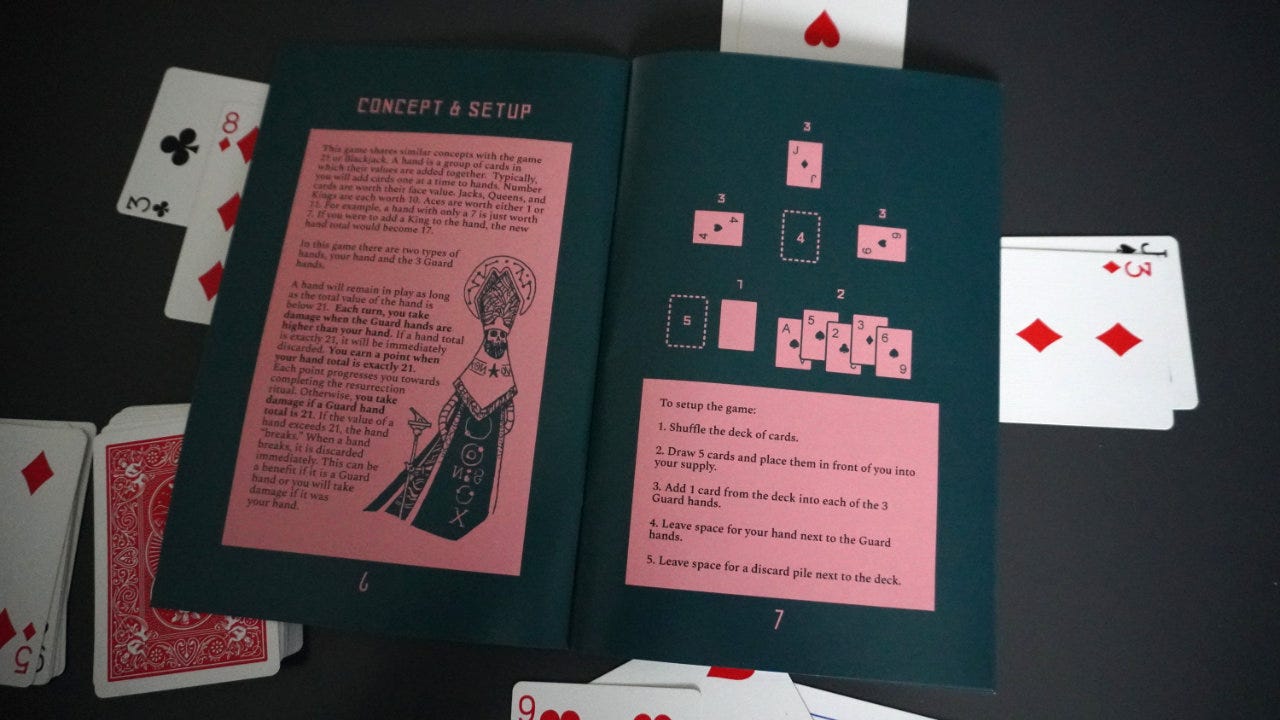
Some solo journaling games don’t have much of what I would consider a “mechanical core.” You roll a die or draw a card and read the prompt. They intentionally keep the mechanical bits to a minimum so as not to overwhelm the story being told. Every new mechanism added to a game risks making it feel less thematic.4
It is possible, however, to have a solo journaling game with a mechanical core that leads to tough (or interesting) choices that help develop the story.
Moon Rings and Necromancer Heretic, both from Junk Food Games, are recent examples that comes to mind. In Moon Rings, while it is based on the Carta SRD, it adds limited resources, a push-your-luck mechanism, and ways to mitigate poor luck. Necromancer Heretic uses blackjack as the core mechanism. Only when your hand of cards reaches 21 do you gain one of the five ritual points needed to win.
Lacksmith is one of my other favorite examples that uses a dice game to tell the story of running a blacksmith shop.
Neighborhood Robots uses a modified version of Clear the Dungeon as its mechanical core to tell a compelling story: When you need that last component to finish a mech or when the mech is ready but you can’t seem to get the card you need to trigger it.
Those moments could be frustrating in an abstract game, but in a journaling game, they actually make it easier to tell a story.
Conclusion
Some things to think about:
Solitaire card games: If you haven’t yet, check out Regicide (Abrahams, Badger, et al., 2020) and then go down the rabbit hole of all the new solitaire card games being developed that use a poker deck. There’s some really interesting innovation happening in that space, and Clear the Dungeon is just one example.
Solo journaling with a mechanical core: If you’ve played Caveat Emptor, you know that I enjoy solo journaling games mixed with board or card game mechanisms. Providing incentives to have the player choose one prompt versus another is really interesting to me. Taking an existing solitaire card game and turning it into a thematic journaling game can be a fun exercise.
The struggle continues: Neighborhood Robots removes the ability to lose the game from Clear the Dungeon. It feels like the right decision given the theme of the game. It puts the story first and the mechanisms exist to serve the story.
What do you think? Have you played any of the games in the Griot Anthology? What do you think about solo journaling games that have a significant amount of mechanical grit? Do you enjoy having tough mechanical choices blended with narrative prompts?
— E.P. 💀
P.S. Want more in-depth and playable Skeleton Code Machine content? Subscribe to Tumulus and get four quarterly, print-only issues packed with game design inspiration at 33% off list price. Limited back issues available. 🩻
Skeleton Code Machine is a production of Exeunt Press. All previous posts are in the Archive on the web. Subscribe to TUMULUS to get more design inspiration. If you want to see what else is happening at Exeunt Press, check out the Exeunt Omnes newsletter.
Skeleton Code Machine and TUMULUS are written, augmented, purged, and published by Exeunt Press. No part of this publication may be reproduced in any form without permission. TUMULUS and Skeleton Code Machine are Copyright 2025 Exeunt Press.
For comments or questions: games@exeunt.press
And was able to get it signed by Quinn Murphy!
Some estimates say that 80% of solitaire are winnable while at least 99% of Freecell games are winnable.
The designer has a how to play video on their YouTube channel.
Of course, well designed mechanisms can make a game feel far more thematic. I recommend you check out the thematic design in Dark Fort and theme vs. mechanism in Inhuman Conditions.
feels very hopeful and timely – the community will persist ^^ i like that change a lot to fit the theme! in general, seems like a wonderful anthology. thank you for sharing <3 it is really cool when mechanisms from other kinds of games get incorporated into another type of game! reminds me of how there's one class in "You Will Die In This Place" by Elizabeth Little (https://liz-shrikestudio.itch.io/you-will-die-in-this-place-free-preview), the Zirbari Headhunter, who essentially plays poker for making their actions ^^ (all the classes in that game have such unique and very different mechanics for making their actions!)