
Last week we looked at degenerate game states which is when the game collapses into a simpler (and often less interesting) form. The article generated quite a bit of discussion, so be sure to check out the poll and comments at the end.
This week we are looking at the dice-based combat system in Hercules and the 12 Labors. It is simple and yet gives the feel of a dungeon crawl without the dungeon. It could be easily modified for use in TTRPGs.
Tumulus Issue 6 “Hammer a nail in the coffin.” is shipping now! Subscribe to get this as the first of your four issues packed with game design and creative inspiration.
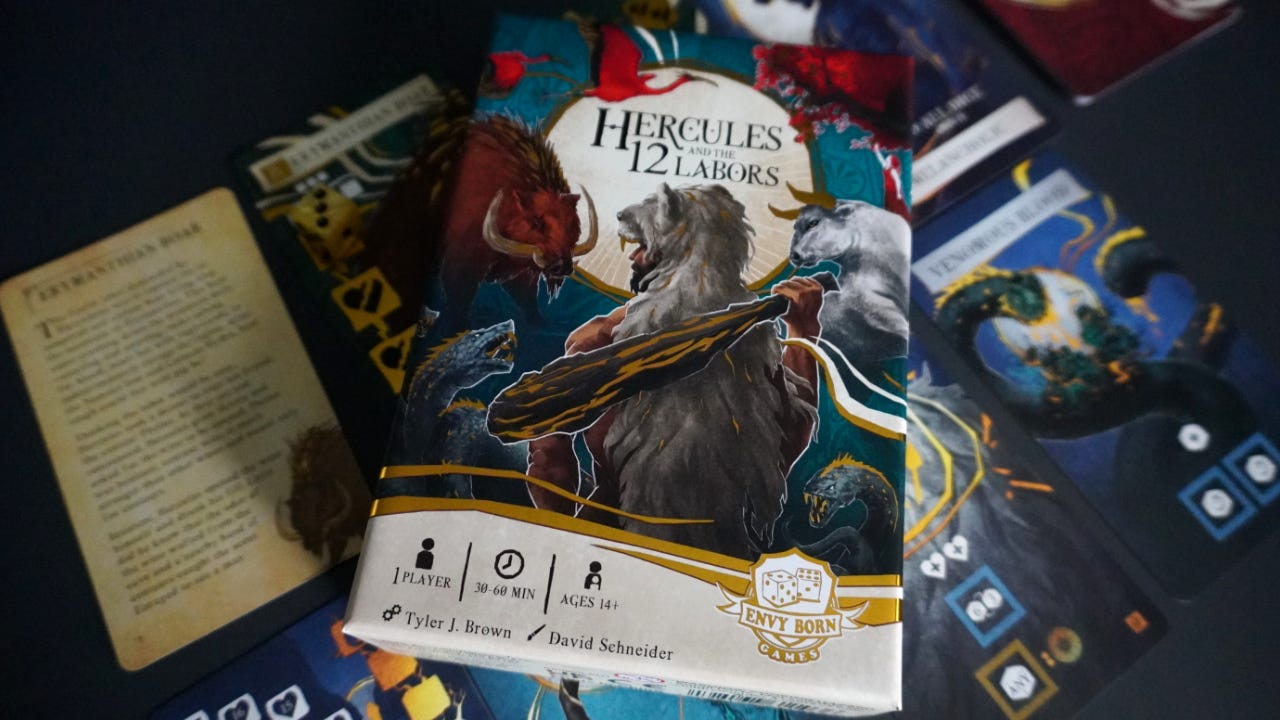
Hercules and the 12 Labors
In Greek mythology, the hero Hercules (or Heracles) was hated by the goddess Hera.1 She caused him to kill his wife, Megara, and their children in a fit of madness. Regretting his actions, he asked the Oracle of Delphi how he could make atonement. She told him to serve King Eurystheus of Mycenae for twelve years and to perform whatever labors the king demanded.
These labors which include slaying the Nemean Lion, capturing the Erymanthian Boar, and cleaning the Augean stables serve as the setting for Hercules and the 12 Labors (Brown, 2025).
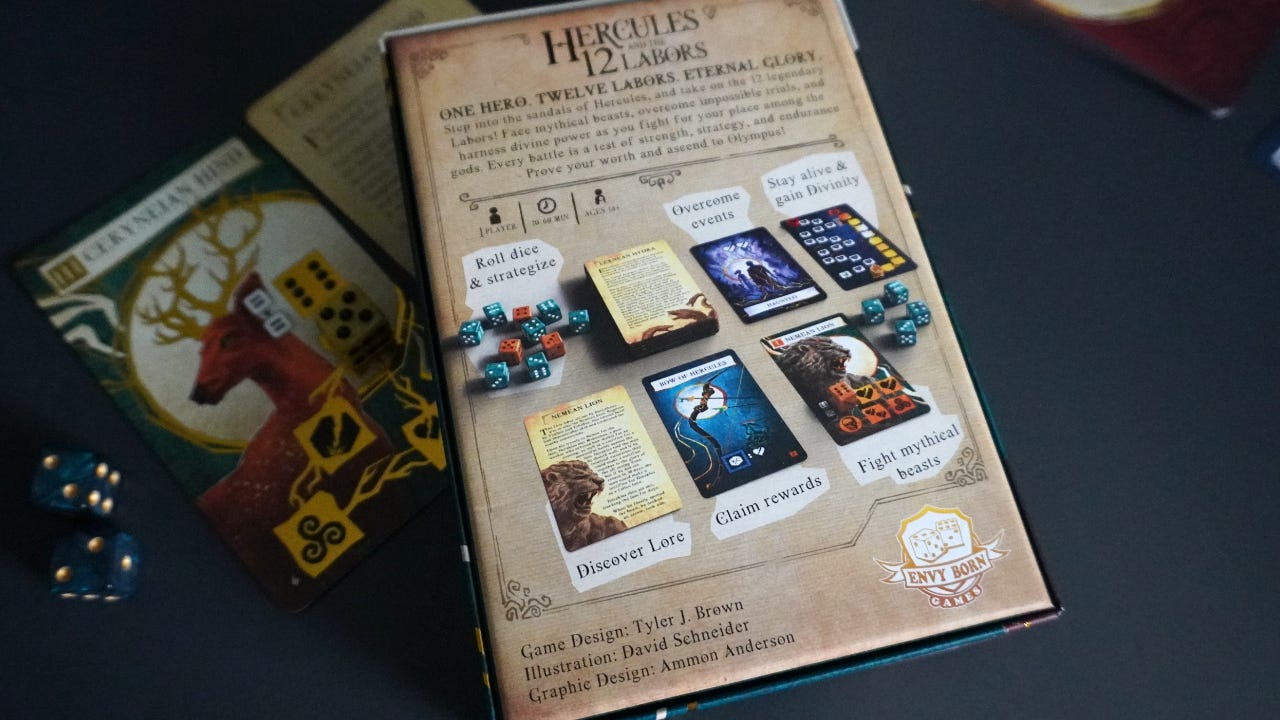
It is a dice game where you play as Hercules and attempt to progress through each of the 12 labors to reach the end of the game. Using a deck of cards that includes a description of the labor, you’ll roll dice, apply damage to the labor, and track your Spirit (health) and Divinity.
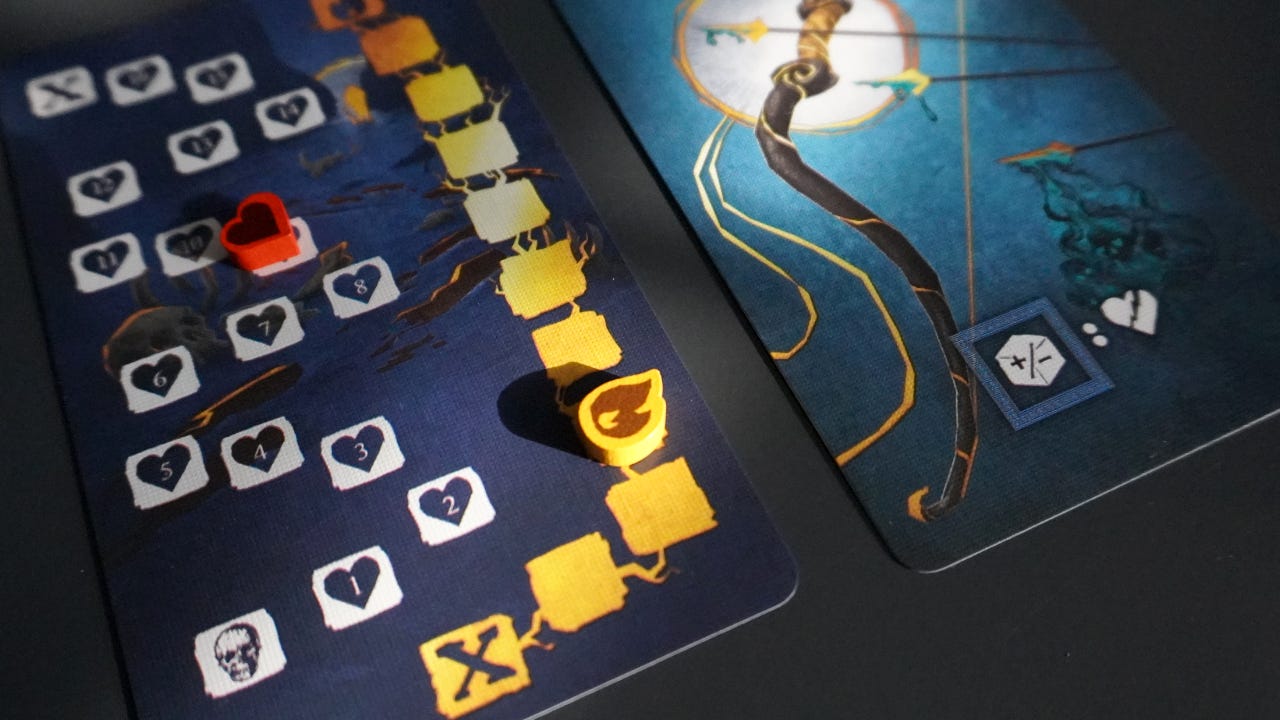
To win the game you need to complete all 12 labors and reach the top of the Divinity (yellow flame) track.
How to defeat the Nemean Lion and others
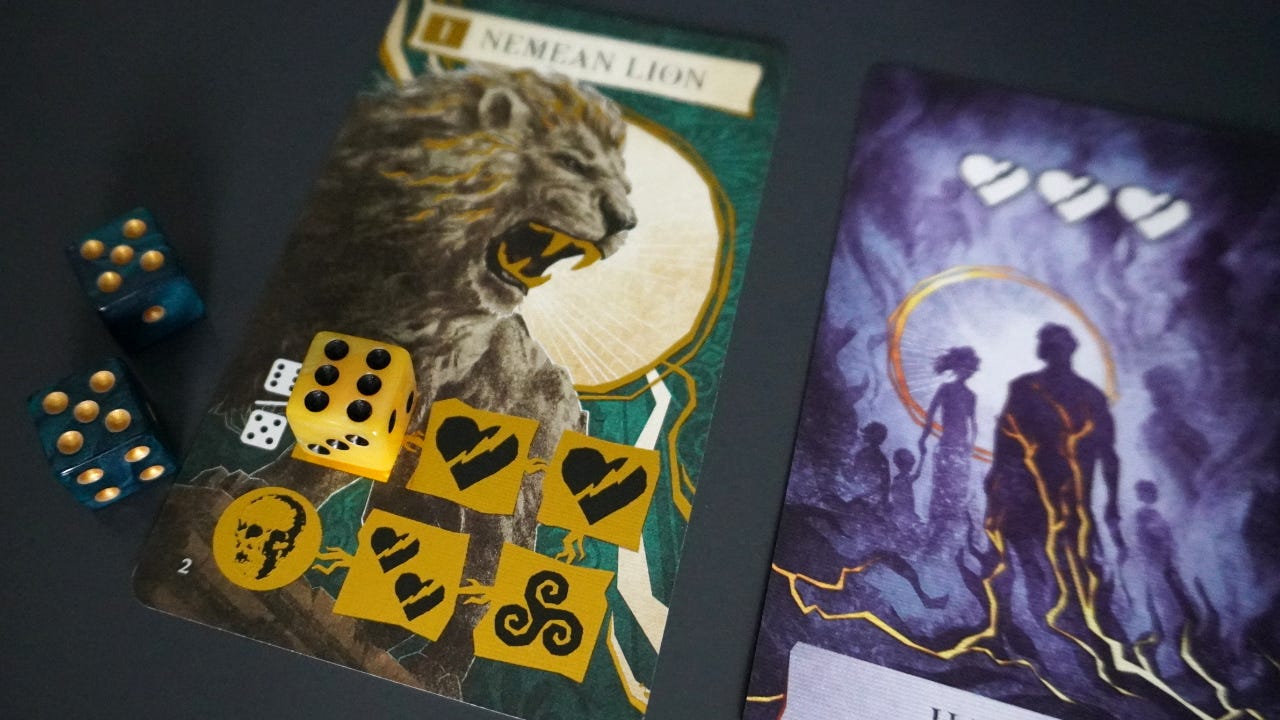
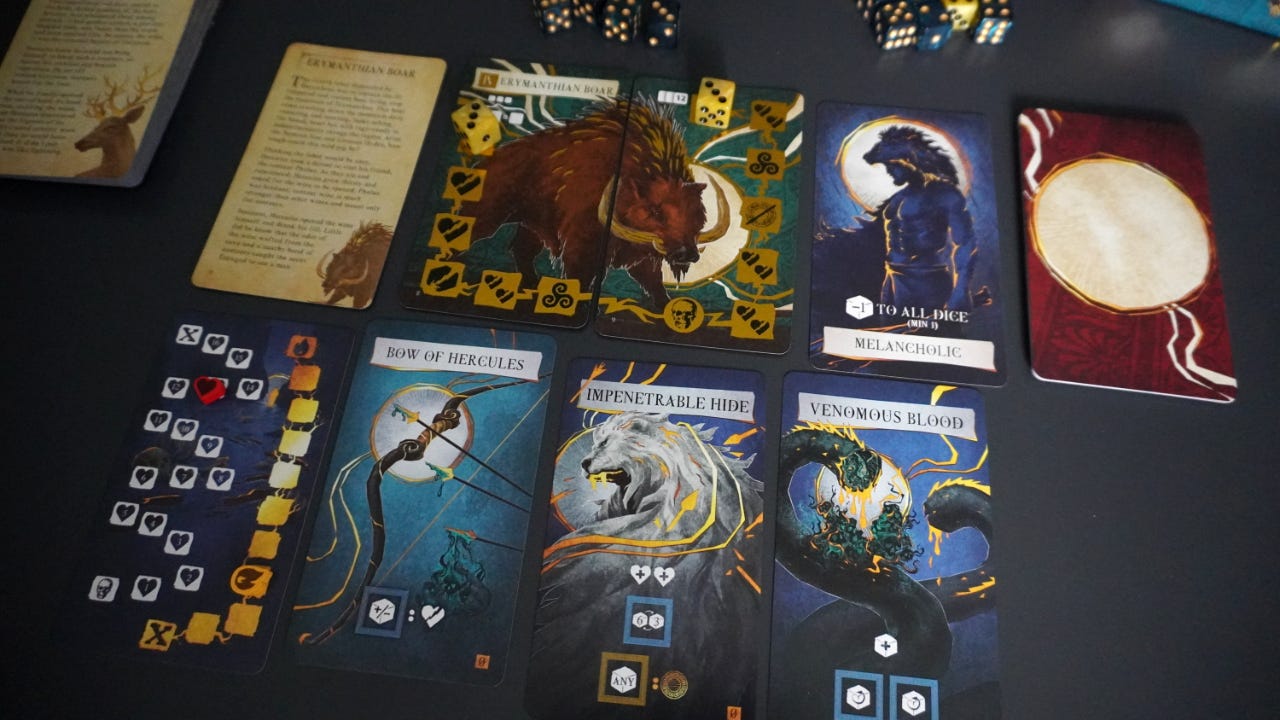
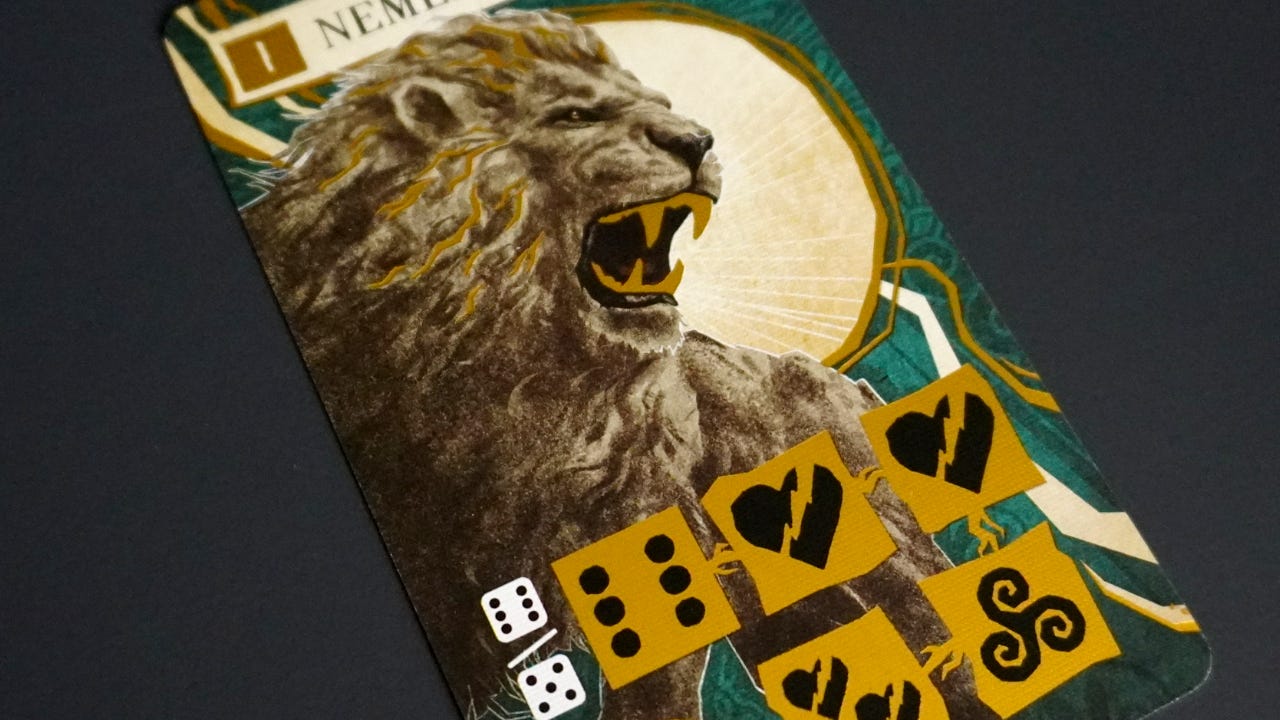
Each labor is represented by one or more cards from a deck. For example, the first labor is the Nemean Lion which is a single card with a single dice track. The Erymanthian Boar spans two cards and has two dice, each on its own track.
The goal is to apply dice to the labor that meet its specific requirements. The Nemean Lion can only be damaged by dice with a value of 5 or 6. The Ceryneian Hind requires pairs of dice with equal values.2 The Augean Stables require dice with a value of exactly 1.
Each time dice that meet the requirements is applied, it reduces the health of the labor. Reduce the labor to zero and it is successfully completed.
This process repeats for all 12 labors.3
The combat game loop
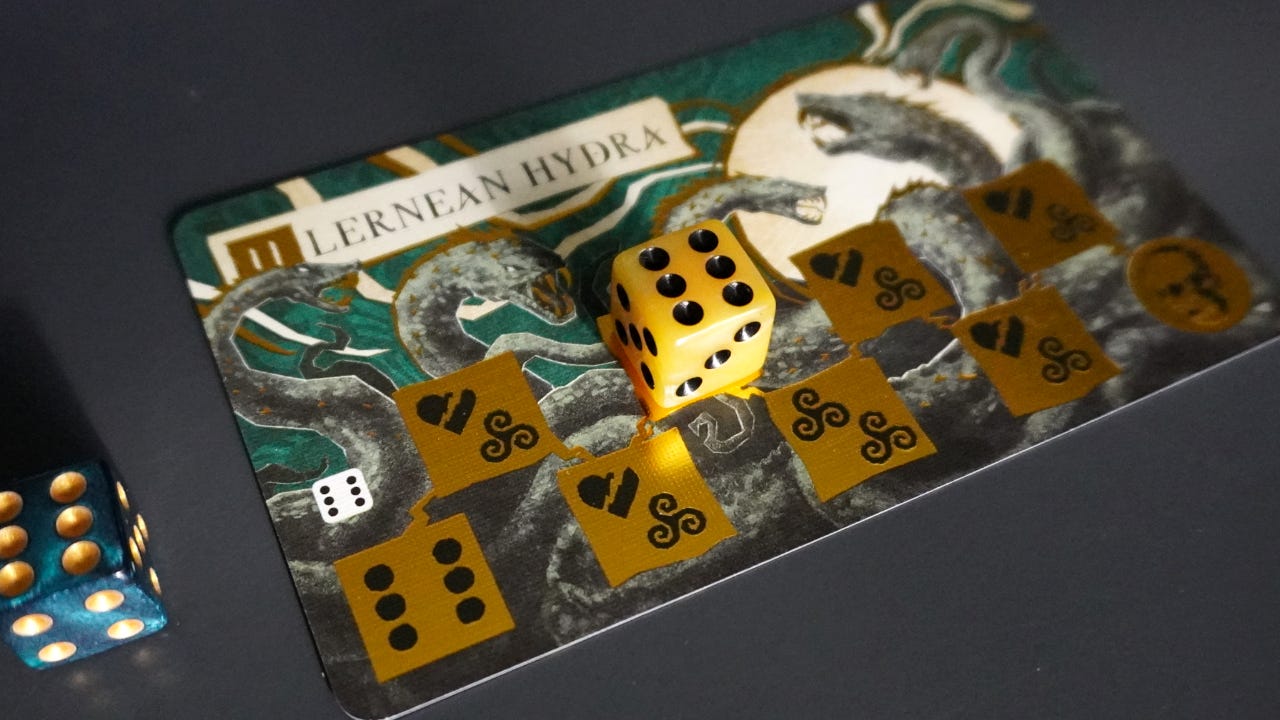
That’s the high level picture of combat, but let’s dig into the actual core game loop.
At the start of each labor, a Mood card is drawn that will apply a lasting effect for the labor. Some are good (e.g. gain an extra die) and some might make the labor more difficult (e.g. all dice rolled are -1).4
Then the player rolls all of their available dice, usually 4-5 total dice depending on the chosen difficulty and bonuses.
After rolling, there’s a chance to mitigate some of the luck by manipulating the dice. There are “blue square” abilities that are usually provided via equipment and rewards from previous labors. Each ability can only be used once and changes the value of the dice in some way: Increase/decrease the value of a die by 1 and reduce Spirit by 1. Turn a 6 into a 3 or a 3 into a 6. Turn an odd die into an even die. Flip a die to its opposite side.
The dice can also be used to block damage, restore Spirit (health), or gain Divinity (required to win the game). Dice used in this way are, however, locked and unable to be used to apply damage for that round of combat.
After everything has been rolled and manipulated, damage is applied to the labor, reducing the labor’s health (tracked by a gold die). If it is reduced to zero, the labor is defeated.
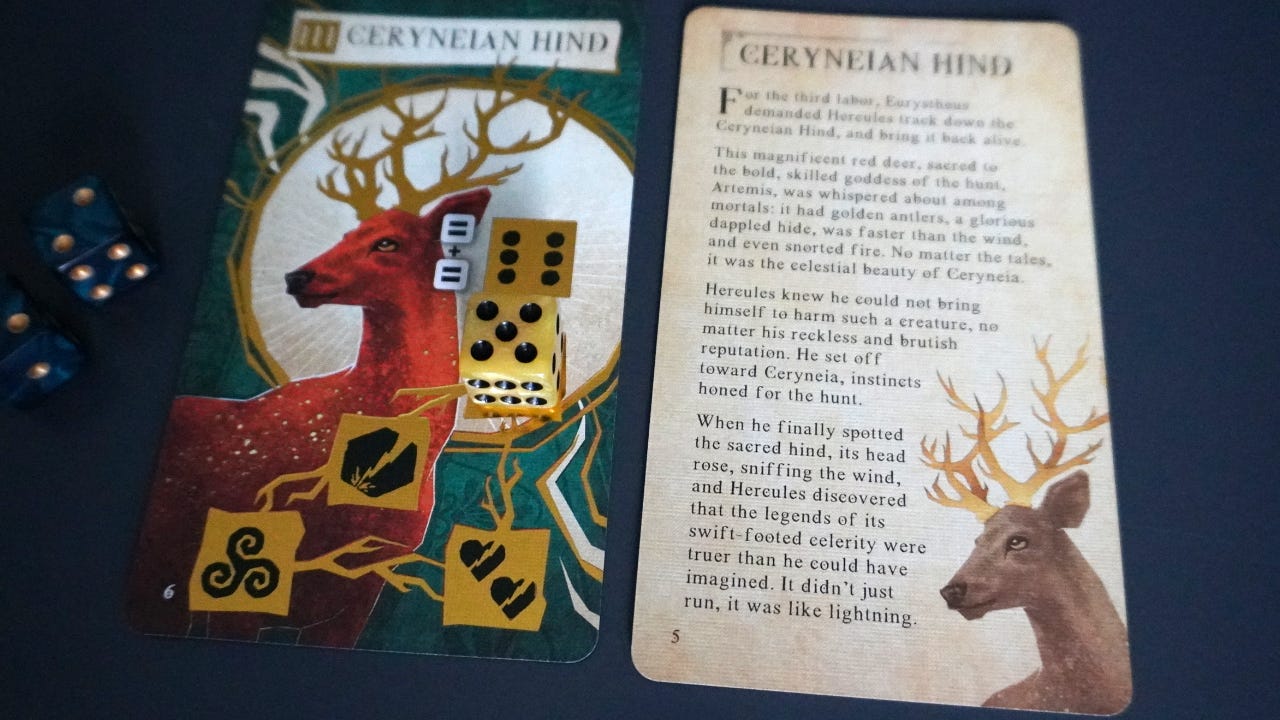
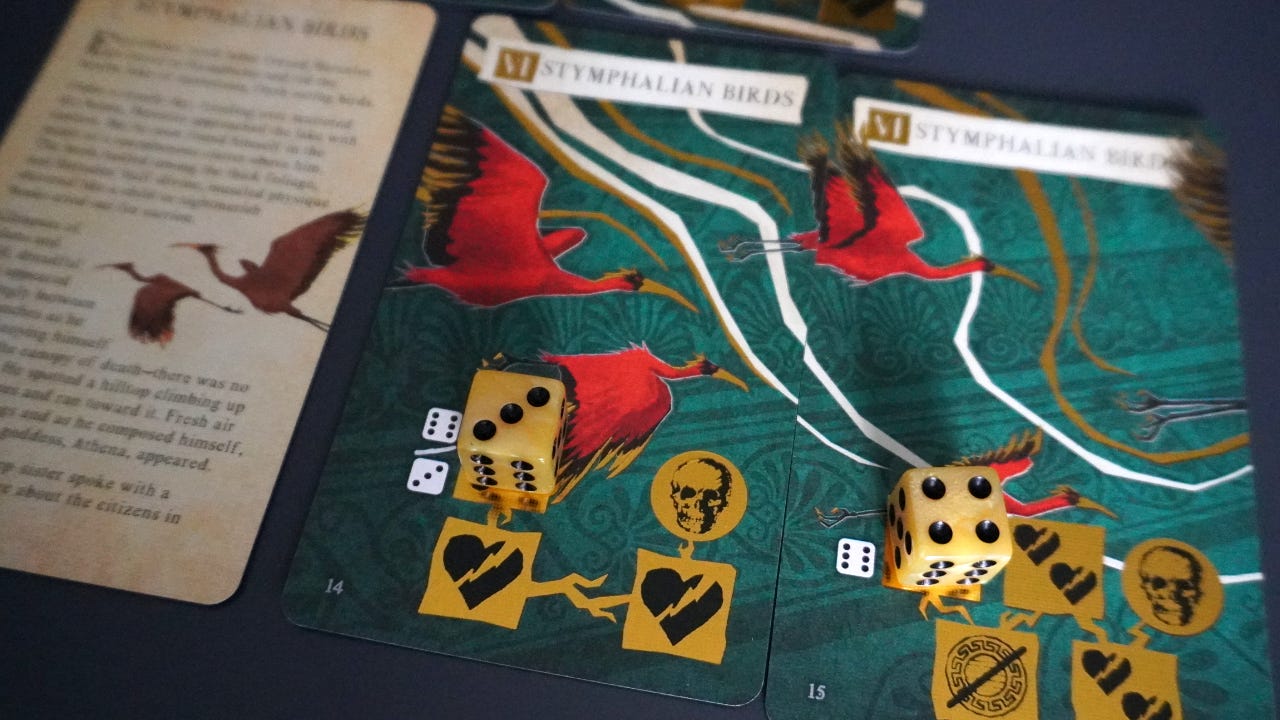
If the labor still has health, the gold labor die is moved along the Labor Impacts track. Each space on the track has an effect which may include losing Spirit, restoring the labor’s health, reducing Divinity, or losing a die. When the gold die reaches the end of the track (marked by a skull), the game ends in defeat.
This system creates a nice visual tension as the tracking die moves with each round. You can see what type of damage is coming next and how many rounds you have left before defeat because it’s printed on the card. While the player’s actions are heavily impacted by input randomness, the enemy’s actions are deterministic.
Progression
The player begins the game with the Bow of Hercules card which allows a die to be modified +/-1 at the cost of reducing Spirit.
With the defeat of each labor, the player gains a reward in the form of a new card they can add to their tableau. It’s the reverse of the labor card that was just defeated. The Nemean Lion yields an Impenetrable Hide card that can both modify dice and block damage. Defeating the Hydra gives the player the Venomous Blood card which allows for two re-rolls.
Gaining cards with new abilities, losing Spirit, and gaining Divinity creates a game arc so that each labor encounter doesn’t feel exactly the same.
A dungeon crawl sans dungeon
Thinking about Hercules and the 12 Labors reminded me of the articles on dungeon crawls that I wrote in 2025. I identified some of the common elements of dungeon crawls, calling out five of the most important ones:
Character progression
Combat encounters
Loot, equipment, rewards
Puzzles and environmental challenges
Randomization and replayability
It’s interesting to view Hercules and the 12 Labors through this lens. It definitely has combat encounters, as that is most (if not all) of the game. The player is rewarded with loot, equipment, and rewards with the completion of each labor. There is character progression in the form of Divinity.
On the other hand, there are no puzzles or environmental challenges to solve. It is simply one labor after the next using the same mechanical combat system.
While there is randomness in the form of the dice rolls, the world in which Hercules operates is not random at all. The labors are always the same and always presented in the same order. The Mood card at the start of each labor is random, but doesn’t really change the world of the game.
Is this game a dungeon crawl?
I’m not sure and I’d offer that the specific answer may not be important. The act of thinking through the question to arrive at answer is, however, useful. It allows us to wonder how far we can strip a dungeon crawl down to its bare essentials. It raises interesting questions like whether or not a dungeon crawl requires a map — something I would have said yes to prior to playing this game.
Trying to make a dungeon crawl sans dungeon can open up some really interesting and creative design spaces.
Conclusion
Some things to think about:
Greek mythology as a theme: You’d think that eventually we would tire of games with themes based on Greek mythology, but we don’t. There is something eternal about the stories that continues to captivate us — especially when combined with beautiful art and spot foil on the cards.5
Dice combat: There are endless ways to implement dice combat mechanisms that are far more interesting than a simple opposed roll. The dice requirement plus labor effect track in Hercules and the 12 Labors is a good example.
Dungeon crawls without maps: While I’m not convinced that Hercules and the 12 Labors is a true dungeon crawl, it can be fun to ask the question. Stripping a genre of game down to its bare essentials can often serve as the base for a new and interesting game design.
What do you think? Could you see this dice combat system being used in a TTRPG? How would you modify this game to make it more like a roleplaying game than a board game? Does it need a map to be a dungeon crawl?
— E.P. 💀
P.S. Want more in-depth and playable Skeleton Code Machine content? Subscribe to Tumulus and get four quarterly, print-only issues packed with game design inspiration at 33% off list price. Limited back issues available. 🩻
Skeleton Code Machine is a production of Exeunt Press. All previous posts are in the Archive on the web. Subscribe to TUMULUS to get more design inspiration. If you want to see what else is happening at Exeunt Press, check out the Exeunt Omnes newsletter.
Skeleton Code Machine and TUMULUS are written, augmented, purged, and published by Exeunt Press. No part of this publication may be reproduced in any form without permission. TUMULUS and Skeleton Code Machine are Copyright 2025 Exeunt Press.
For comments or questions: games@exeunt.press
The rulebook does include a note about the usage of Hercules vs. Heracles or Herakles which includes this: “And while we prefer the Greek spelling and pronunciation — Hera-kles, “the glory of Hera” — and how the name carries connotations of Hera’s hatred toward him, we’ve chosen to use the Romanized spelling “Hercules” to reach the widest audience we could.”
According to Wikipedia: “Euripides says Heracles slew the hind and brought her to Artemis for propitiation. Another tradition says he captured her with nets while she was sleeping or that he ran her down, while another says he shot and maimed her with an arrow just before she crossed the river Ladon.”
I’m intentionally not showing all the labor cards to avoid spoilers. Some of them are more complicated and part of the fun would be discovering this during play.
While I enjoy dice and chance in games, I do wonder if the Mood cards take the randomness of this game one step too far. After a card is drawn and applied, it is shuffled back into the deck for the next labor. This means that one could, presumably, continue to draw the same punishing cards throughout the entire game. Losing a die has a massive impact on the probability of the game.
Illustrations are by David Schneider who was also the artist for Arkwright (2014) and Tales of the Arthurian Knights (2024).
Great overview. The game reminds a bit of Deep Space 6
i love generative questions like this! 100% with you on that the journey to the answer is more important than the answer itself :) really fascinating. and seems like an interesting game, with nice themeing ^^ thank you for sharing <3