
Last week we looked at how Thief’s Market turns the fair division problem and the ultimatum game into a dice game. I learned from the poll at the end that 75% of readers (N=48) would rather get nothing than allow an unfair proposer to gain anything. Read that one and answer the poll at the end if you haven’t already!
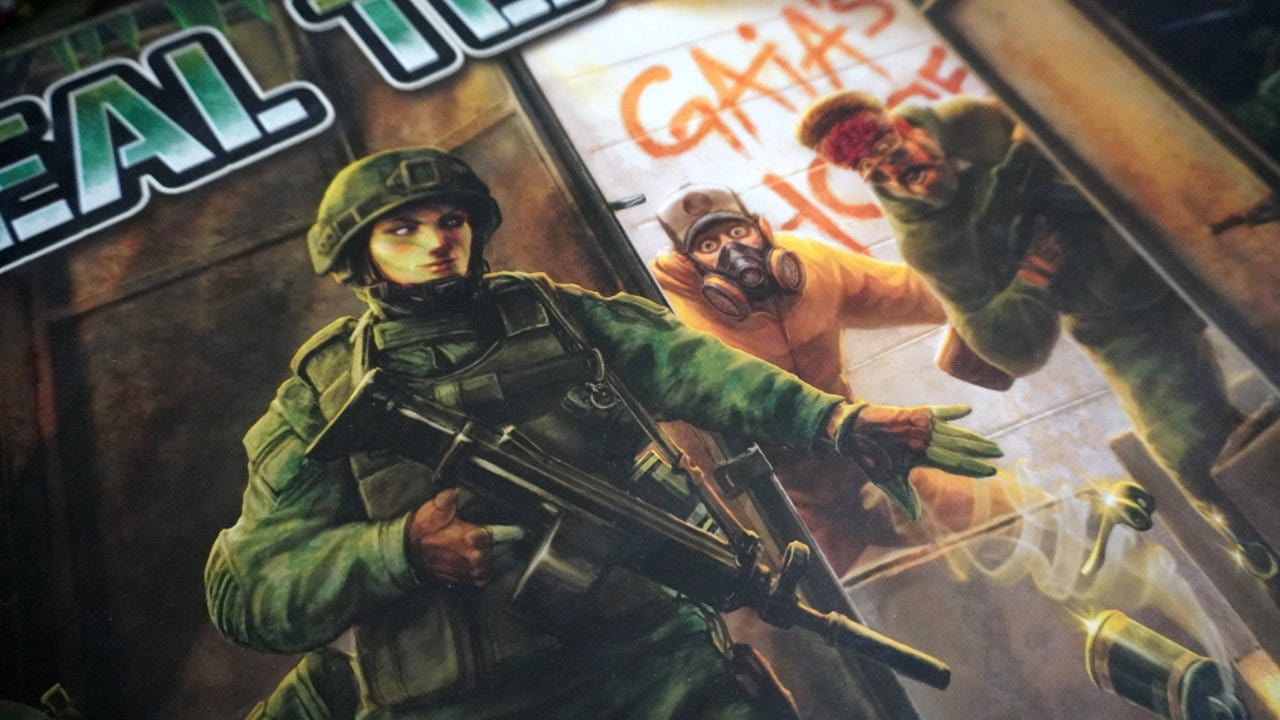
This week we are exploring the stealth mechanism in what the So Very Wrong About Games podcast has called “The Only Game that Matters” — Seal Team Flix.
An elite force of special operators
Seal Team Flix (Ruth & Thomas, 2018) is a “tactical dexterity game” that is likely inspired by first-person and tactical shooter games such as Counter-Strike: Global Offensive (2012), Tom Clancy’s Ghost Recon (2001) and Insurgency (2014).1
The rulebook begins with “The story so far…” which sets the trope-filled and cliche-packed tone of the game:
“The year is 2018, and FBI and NSA sources have intercepted chatter between a violent, fringe eco-terror group called “Gaia’s Hope”, some seedy financiers, and international arms dealer “Mal” O’Dorus. Gaia’s Hope is one of the most dangerous terror groups in the world, with the doomsday philosophy that “man has become a blight upon the planet and must be exterminated”. Supported by satellite imagery that has determined force numbers and patrol patterns, an elite force of Special Operators has been tasked to discover their plan and disrupt their operation.”2
The game includes many of the elements you’d expect in a tactical shooter game:
Counter-terrorist vs. terrorist factions
Modern, floorplan-based maps
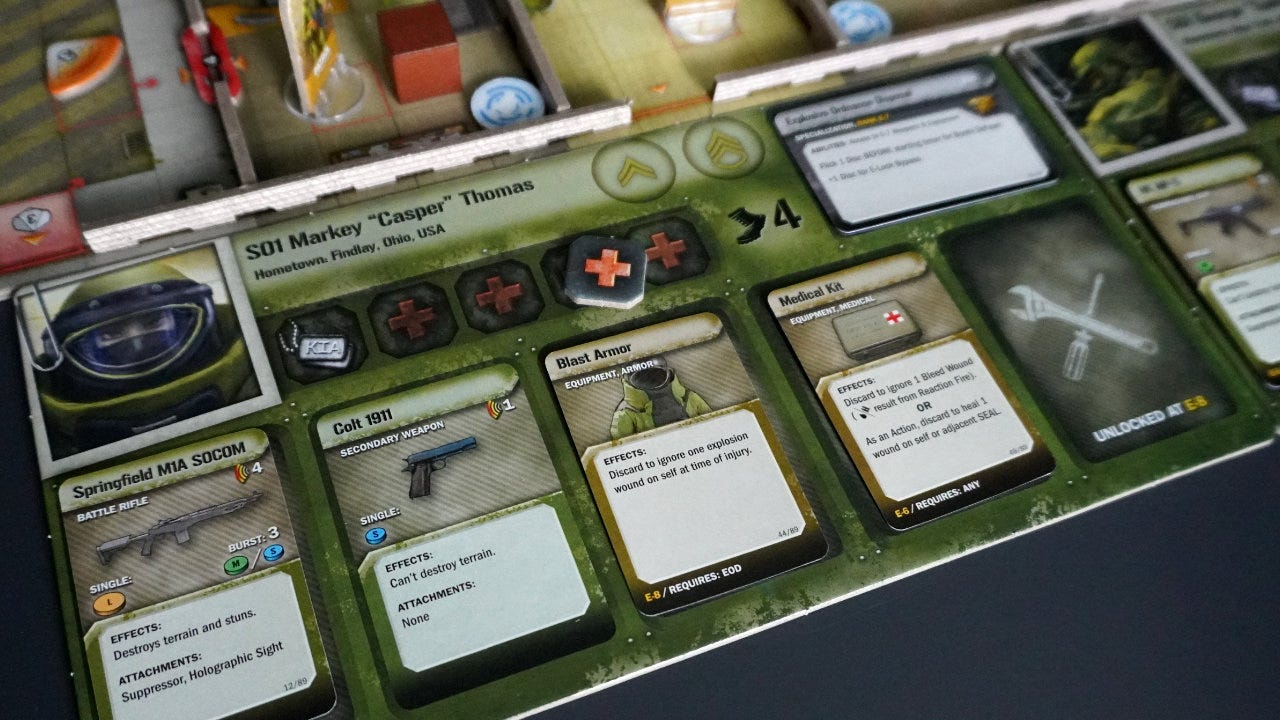
Weapon and equipment loadouts (e.g. MP5 and M1A SOCOM)3
Medical kits that restore health
Armor that reduces damage
Flashbangs, grenades, bombs to defuse, hostages to rescue
The twist is that it’s a dexterity game, specifically a flicking game, which is a genre I don’t usually play often.
As many readers may not be familiar with flicking games, it’s worth taking a short detour to explain how they work.
What are dexterity and flicking games?
While it’s a broad and poorly defined class of games, dexterity games usually include some type of physical component of play that relies on reflexes and/or coordination. Most modern board games include elements of strategic thinking, making choices, memory, and visual pattern matching. They don’t, however, usually include things that make players move quickly or try to carefully stack items.
Crokinole (1876) and Klask (2014) are examples of pure, abstract dexterity games. These games can feel like tabletop versions of air hockey or billiards in how they are played — flicking or moving things toward a goal or target.
Other dexterity games are more thematic like PitchCar (1995), Junk Art (2016), and Rhino Hero: Super Battle (2017).4 Kabuto Sumo, for example, has players competing as sumo wrestling insects trying to push their opponents out of the ring using a slide/push mechanism.
A subset of dexterity games include flicking games — games where players must flick a token with their finger as part of the game. Crokinole, Catacombs: Third Edition (2015), Flick ‘em Up! (2015), and ICECOOL (2016) are perhaps the most popular examples. Players place a flat disc/token on the board and (without moving their hand), flick the disc to hit a target.
How to flick a disc
Seal Team Flix includes a very detailed explanation of how to do this:
“HOW TO FLICK: While shooting or performing some other tasks, you will need to Flick a Disc. To do so, simply place the Disc on the map, curl your index finger, and line it up with the rear (or top, if you’re really good) of the Disc. Line up your arm so that the Disc will slide in the direction you want, and then simply extend your index finger. This is only one of many ways to propel the disc, but the only rule with regard to legal Flicks is that your HAND CANNOT move. You may move your fingers all you want, but your hand must remain stationary.”
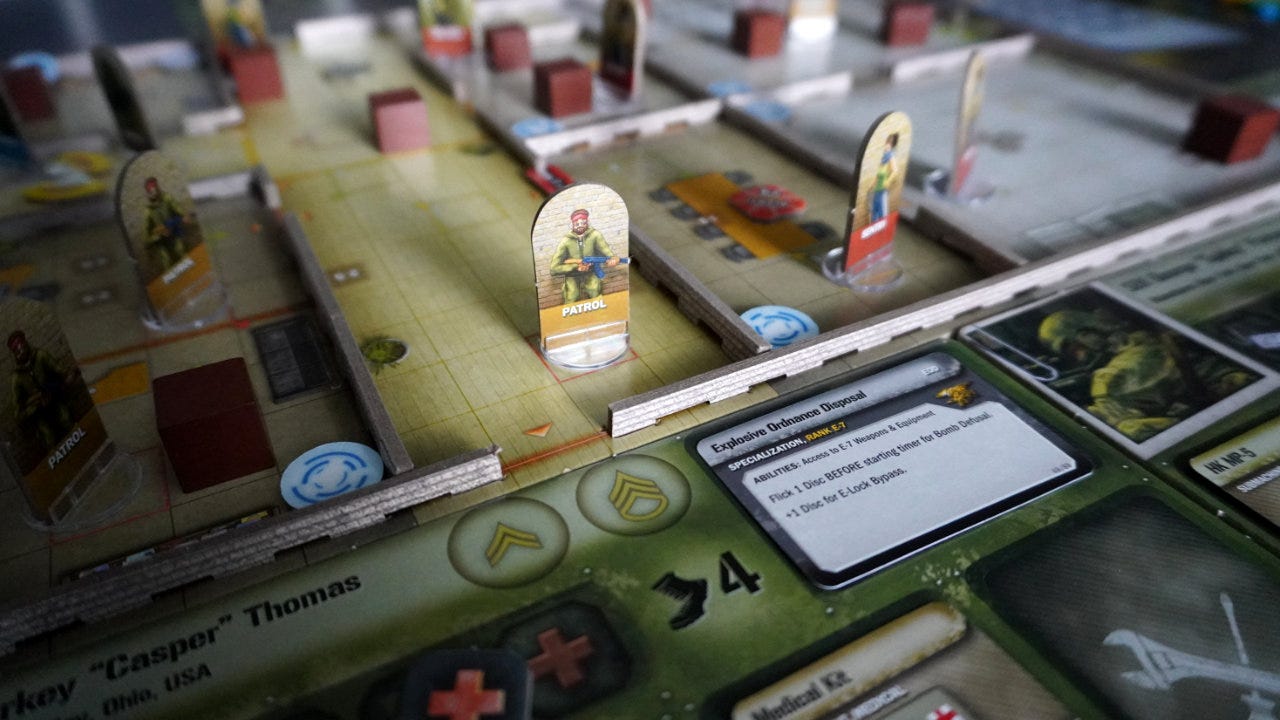
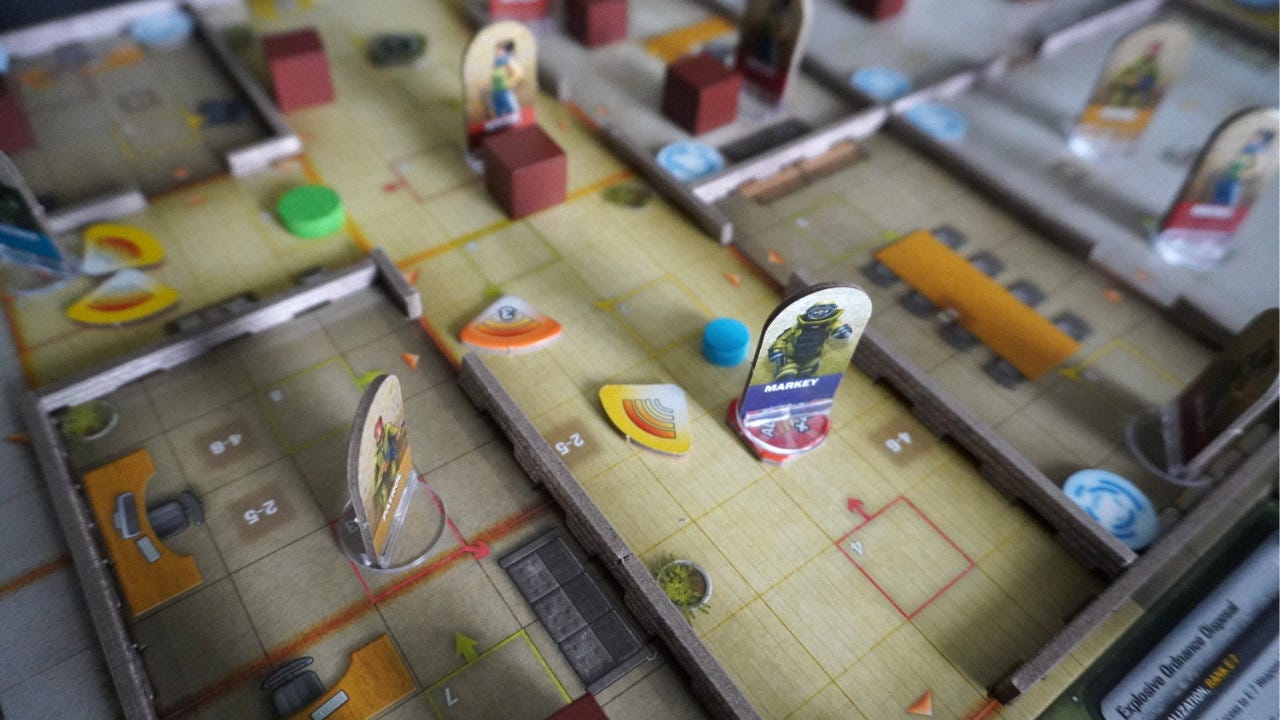
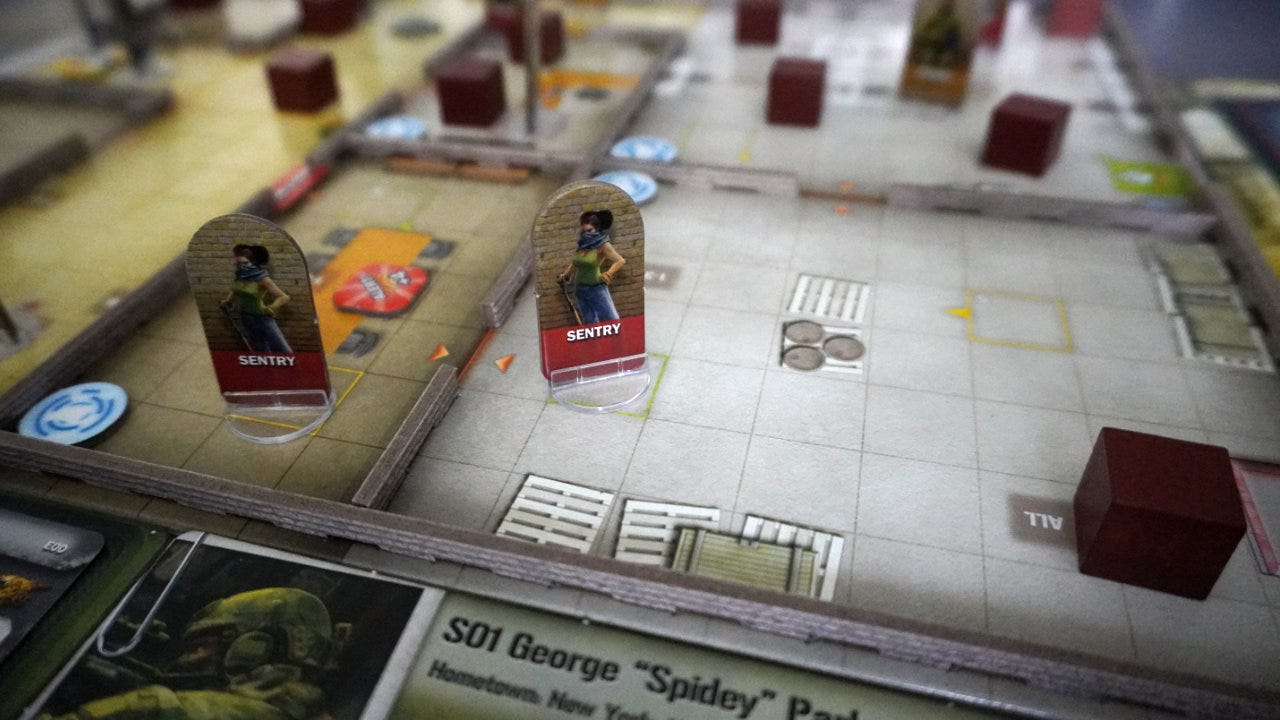
The Seal Team Flix board has little cardboard walls that are matched to the walls printed on the map. Cover boxes (brown cubes) are added to block some shots. Enemies are cardboard standees placed throughout the map.
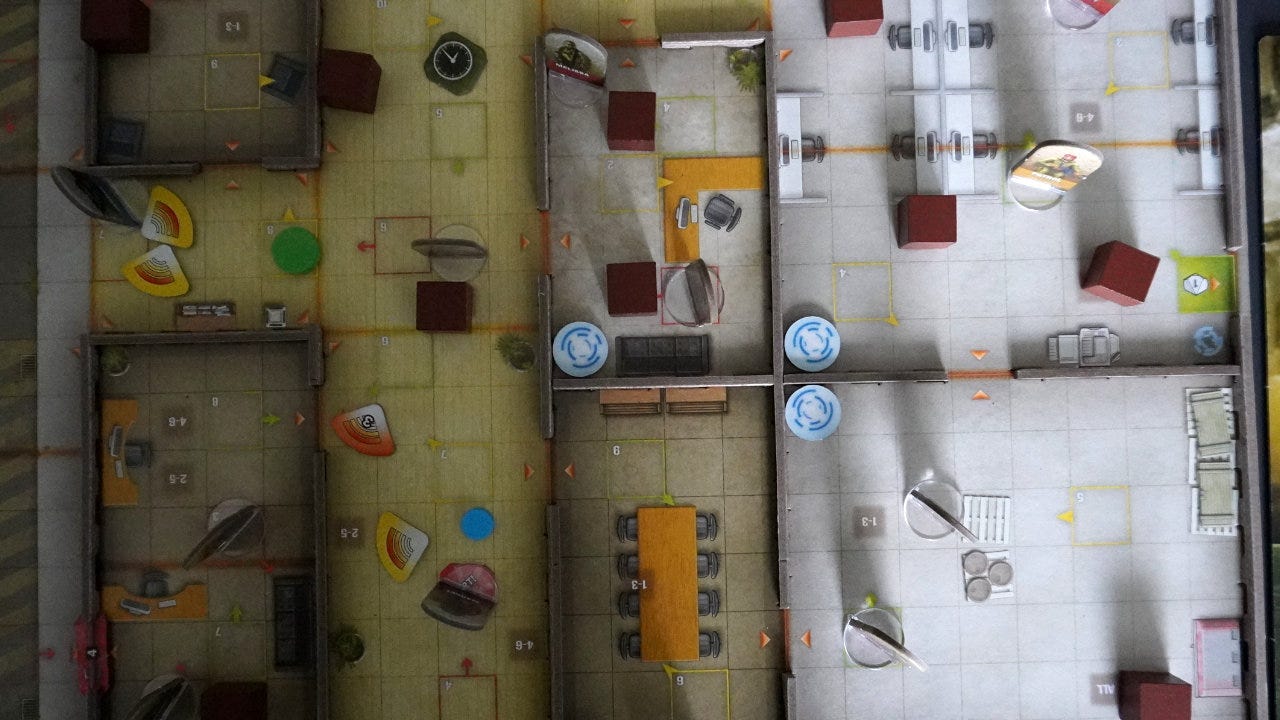
When a player shoots, they take the appropriate number and size of discs (e.g. the MP5 SMG gets 1 medium disc in single fire mode or 2 small discs in burst mode) and flick them at the intended target. If the disc touches the target, it’s a hit and damage is applied.5 Because the enemy targets can’t flick back, dice are rolled to determine return and reaction fire.
The part of Seal Team Flix I found most interesting, however, was how sound is tracked to create a sense of stealth — a concept notoriously hard to implement in an engaging way in tabletop games.6
Simulating stealth and noise
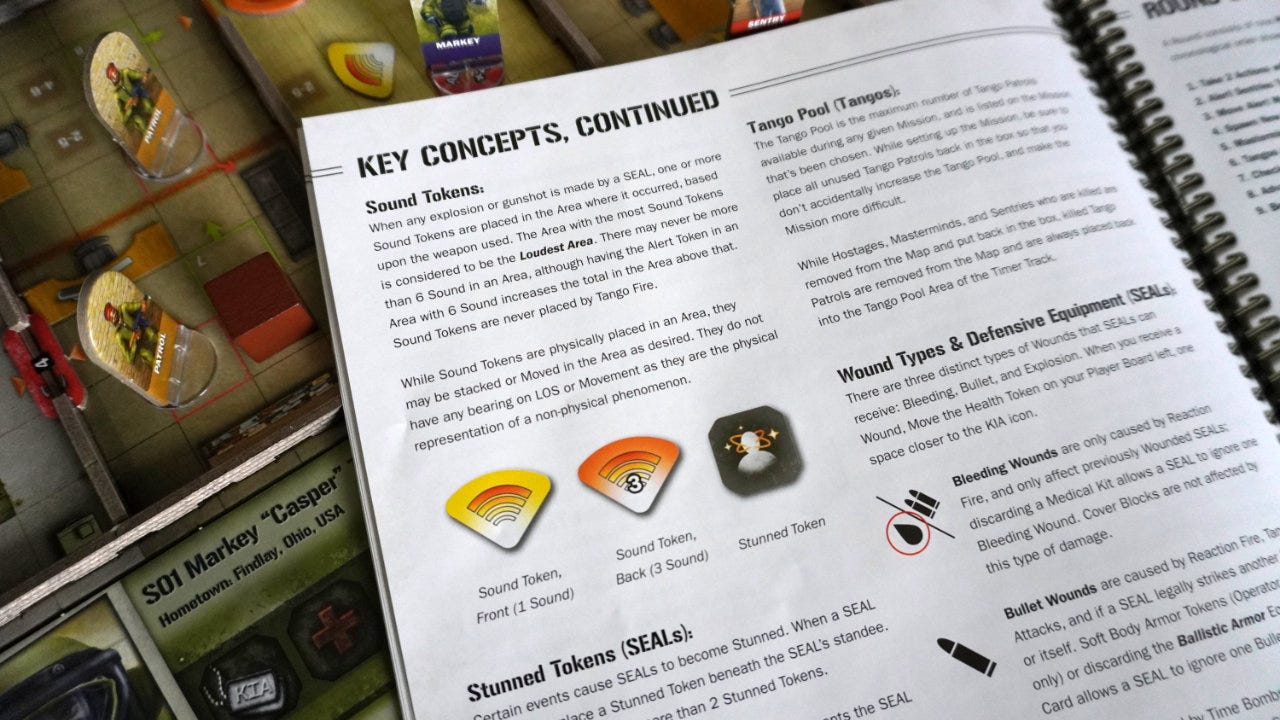
When a player shoots or otherwise makes noise (e.g. grenade) in Seal Team Flix, they place sound tokens at the location of the sound.
Each gun has its own sound level with larger guns making more noise. The springfield 770 sniper rifle is one of the loudest, generating 5 sound tokens. The HK MP5 submachine gun is one of the quietest, generating only 2 sound tokens per fire. Optional suppressors can be equipped which reduces the sound tokens placed by 1 and there’s a dart pistol that makes no sound.7
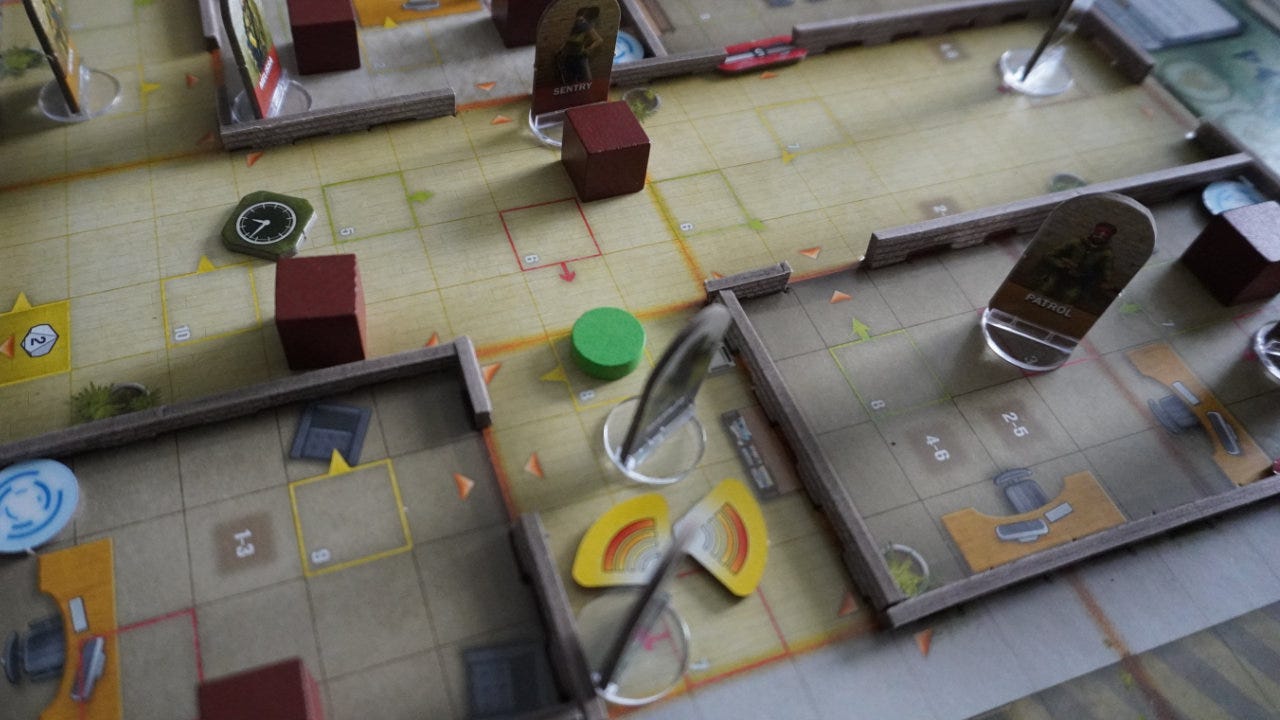
Let’s say you begin the mission and there’s an enemy sentry or patrol right at the start and blocking your path. The team is spotted and an alert marker is placed which adds +4 sound to the area. The first player shoots and misses, adding 4 sound tokens to the player’s area. The second player shoots and hits, but they need to add another 2 sound tokens to the same area for a total of 10 sound.8
The players can move and continue their mission on future turns, but the sound tokens stay in place. This governs how the enemy units move:
Sentries: Enemy sentry units never leave their starting area, but will always move closer to the sound. Once alerted they stay alert and will shoot if they ever have line of sight to a target.
Patrols: Enemy patrols will move one area closer to the loudest sound on the map each round. This might not be toward where the players currently are and instead might be where they generated the most sound.
In addition, the amount of sound determines how many new patrols will be spawned on the map. The sound tokens for each area are added up and divided in half, rounding up. A ten-sided die (d10) is rolled that many times and each roll has a chance to spawn another patrol on the map.
Thematic stealth mechanisms
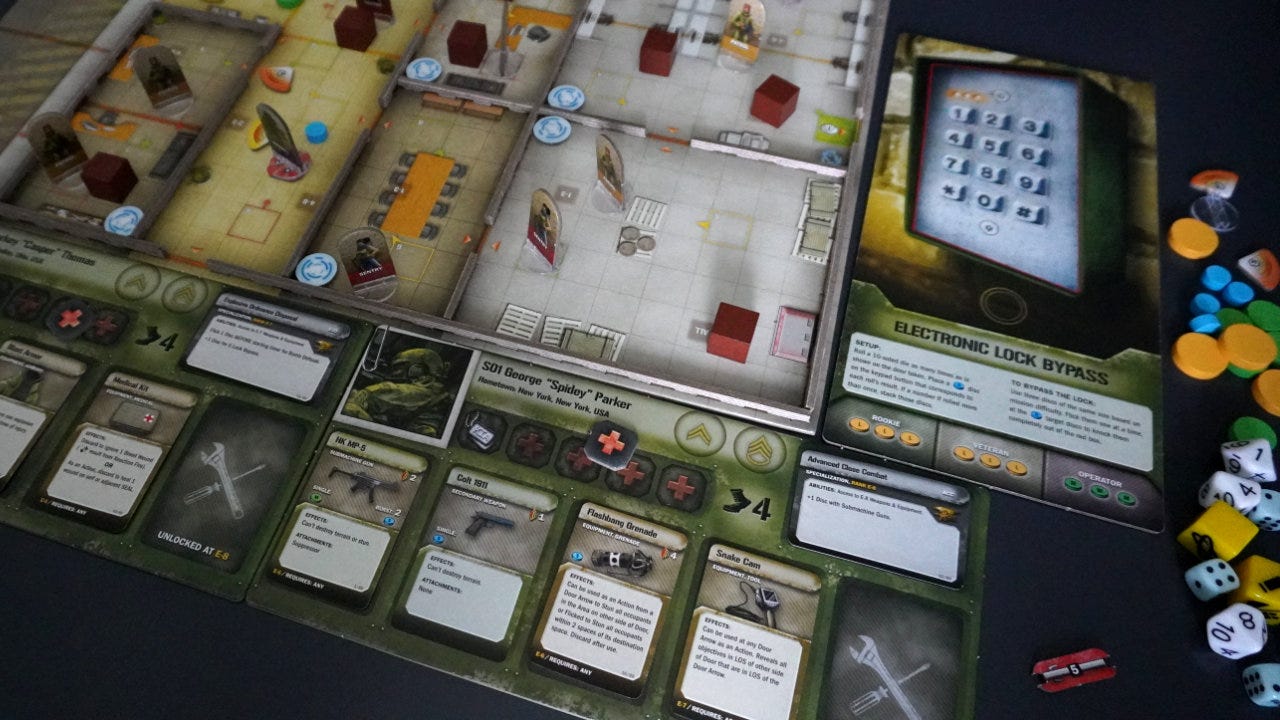
The sound mechanism in Seal Team Flix feels thematically integrated into the game. Player characters start the mission concealed. Sentries and patrols aren’t alerted yet, meaning the team can move without drawing attention. Eventually, however, someone will need to take that first shot — generating sound and alerting nearby patrols.
From that point on, the mission escalates with each new shot generating more sound which generates more patrols and more reason to shoot again. Similar to how missions in Cyberpunk 2077 or Ghost Recon: Wildlands may start as stealth missions, but at some point always seem to turn into a wild gunfight by the end.9
Sound can also be used as a distraction using this mechanism because tokens are placed where the sound is generated and not at the origin. Tossing a flashbang can make a different area the loudest on the map, attracting patrols until those sound tokens eventually fade away.
It’s not a perfect system. Without a “game master” there is no hidden information in the game, meaning that the location of all enemies is always known. There is no “fog of war” either, so the full map is known from the start. This allows players to avoid (or try to avoid) many of the enemies as the move through the map. Is this a bug or a feature? Hard to say.
Extraction Point
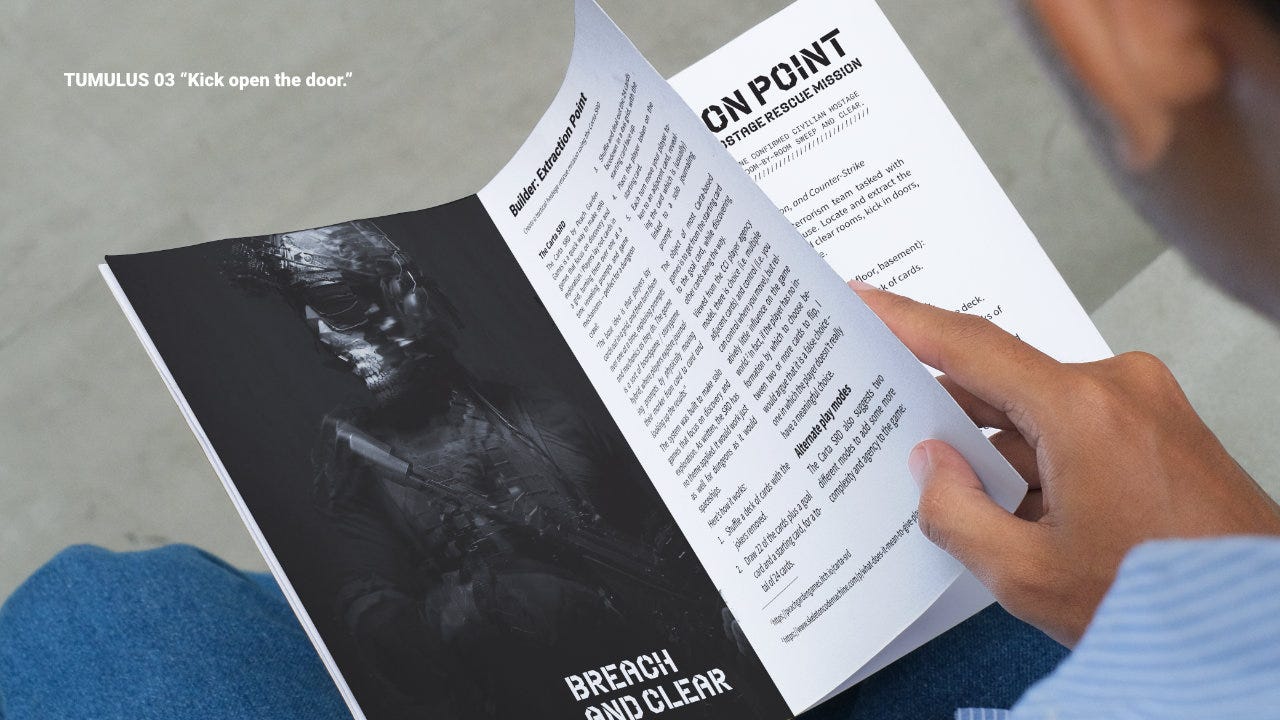
Stealthy tactical shooter games are something I’ve thought about before. Tumulus 03 “Kick open the door.” includes a mini-game called Extraction Point. Based on the Carta SRD, the player uses cards to create a house map with three floors. They then take actions including Advance, Peek, and Breach & Clear that each require different amounts of time.
The idea I wanted to try to capture was that fast actions save time but are more risky, while slow actions burn more time but are safer. It doesn’t use a noise/alert system, but playing Seal Team Flix makes me think one could easily be added.
Like many of the playable mechanisms and games in Tumulus, Extraction Point is intentionally “incomplete by design” with a number of exercises at the end focused on improving the game. One of the exercises mentions how enemies never move or patrol the house, a challenge solved quite elegantly in Seal Team Flix.
Issue 03 is available as a Tumulus back issue while supplies last if you’d like to check it out.
Conclusion
Some things to think about:
Dexterity and flicking games: I’ve played Jenga, Kabuto Sumo, and Jungle Speed previously, all of which qualify as dexterity games. Other than Crokinole, however, I think Seal Team Flix might be the first flicking game I’ve played — certainly the first thematic one. It’s an interesting genre, and I’d be curious if some of the concepts could be integrated into TTRPGs.
Stealth mechanisms are tricky: The easiest way to implement stealth in a game is using a hidden movement mechanism, but this almost always requires two opposing teams or a GM running the game.10 You often need a way to track undetected vs. alert status. Noise tracking can become fiddly and burdensome quickly if extra care is not taken.
A stealth puzzle to solve: When designed well, stealth mechanisms almost feel like puzzles to solve: Should I toss a flash bang over there to draw the enemies so you can move the other way? Should I wait for a patrol to pass before crossing a hallway? It is a careful balance between making the enemy AI predictable enough and yet not so predictable as to be easily avoided.
What do you think? What are some of your favorite stealth or noise tracking systems in games you’ve played? I’m particularly interested in thematic ones that don’t just abstract it away into a single stealth roll. Also, if you love a flicking game, let me know!
— E.P. 💀
P.S. Want more in-depth and playable Skeleton Code Machine content? Subscribe to Tumulus and get four quarterly, print-only issues packed with game design inspiration at 33% off list price. Limited back issues available. 🩻
Skeleton Code Machine is a production of Exeunt Press. All previous posts are in the Archive on the web. Subscribe to TUMULUS to get more design inspiration. If you want to see what else is happening at Exeunt Press, check out the Exeunt Omnes newsletter.
Skeleton Code Machine and TUMULUS are written, augmented, purged, and published by Exeunt Press. No part of this publication may be reproduced in any form without permission. TUMULUS and Skeleton Code Machine are Copyright 2025 Exeunt Press.
For comments or questions: games@exeunt.press
Mark Thomas, one of the designers of Seal Team Flix, posted a clarification on Bluesky (3/24/2026): “And to set the record straight, the biggest influence, for me at least, was Rainbow Six, which in turn influenced Counter-Strike!” I forgot that Tom Clancy’s Rainbow Six came out in 1998, as I’ve only played Tom Clancy’s Rainbow Six: Vegas (2006) and Rainbow Six Siege (2015). Makes sense that R6 was the main inspiration!
At the risk of possible spoilers for a 1995 movie, this sounds quite similar to one of the plot points in 12 Monkeys directed by Terry Gilliam.
Interestingly they are named on the cards as “HK MP-5” and “Springfield M1A SOCOM” which is usually avoided without proper licensing agreements. While the designation is usually free to use (e.g. M1A) the company names (e.g. Springfield Armory) may not. In CS:GO the SMGs that are clearly based on Heckler & Koch weapons are simply called their designations such as MP7 and UMP-45. I’m not a lawyer though, so I might be wrong.
If you haven’t played one of the Rhino Hero games yet, you really should. It’s very silly fun for both kids and adults.
There is no concept of ammo tracking (that I’ve seen so far) in Seal Team Flix. Also, you can bank shots off walls to hit one or more targets, all of which count as full-strength hits. This breaks the simulationist qualities of the game (if they were present in the first place), but does make for enjoyable flicking.
I’ve never been much of a fan of “rolling a stealth check” by itself while attempting to sneak.
The dart pistol replaces the player’s secondary weapon and can only be used twice.
Technically you can never have more than 6 sound tokens in an area, but an alert token can mush the total effective sound above that limit.
I’m not much of one who loves stealth in video games. I always choose the loud method when completing side quests in games.
Black Sonata (Kean, 2017) is a solo deduction game and notable exception.
You should check out Catacombs, the flicking dungeon crawler. It does some very creative stuff with standard fantasy tropes.
The stealth system looks very similar to that used in Black Ops published by Osprey Games. Worth looking at for inspiration on similar ideas.
Same general idea: your units generate sound tokens. The main difference is that Black Ops is a PVP skirmish wargame. The defending player sets his mooks out around the battlefield, and they actually move around randomly on their turn, which could lead them right into the attacker's forces.