
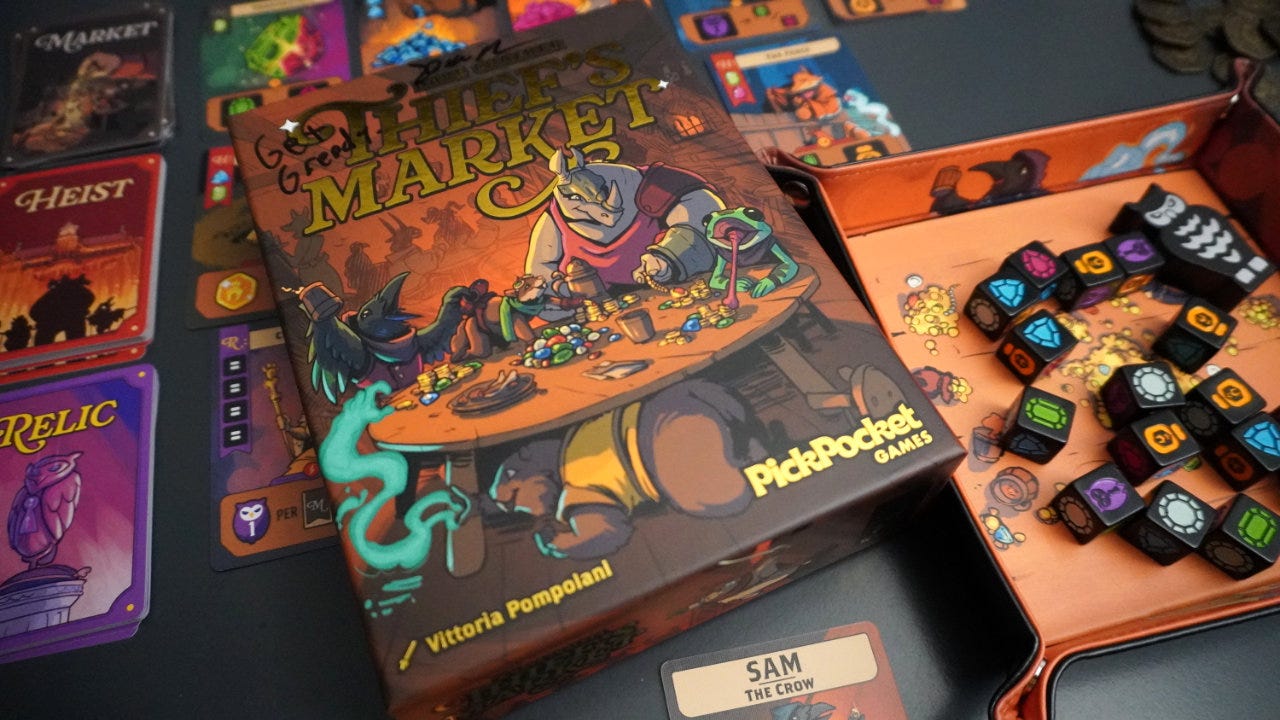
I’ve returned from Unpub Festival 2026 filled with ideas and creativity while also being utterly and completely exhausted. The playtests of Ratsail and Epsilon went really well. My notebook and rulebook are filled with notes and feedback that I’ll need to process this week.
While there, I won two board games as part of the raffles. One of those games was the new edition of Thief’s Market designed by Dave Chalker. I was able to have a very brief chat with Dave about the game and its interesting “pie cutting” mechanism.1
Thinking about this game led me to game theory, something called The Ultimatum Game, and an old mathematics article about pirates. All of that might teach us something about how players make decisions at the table.
Thief’s Market
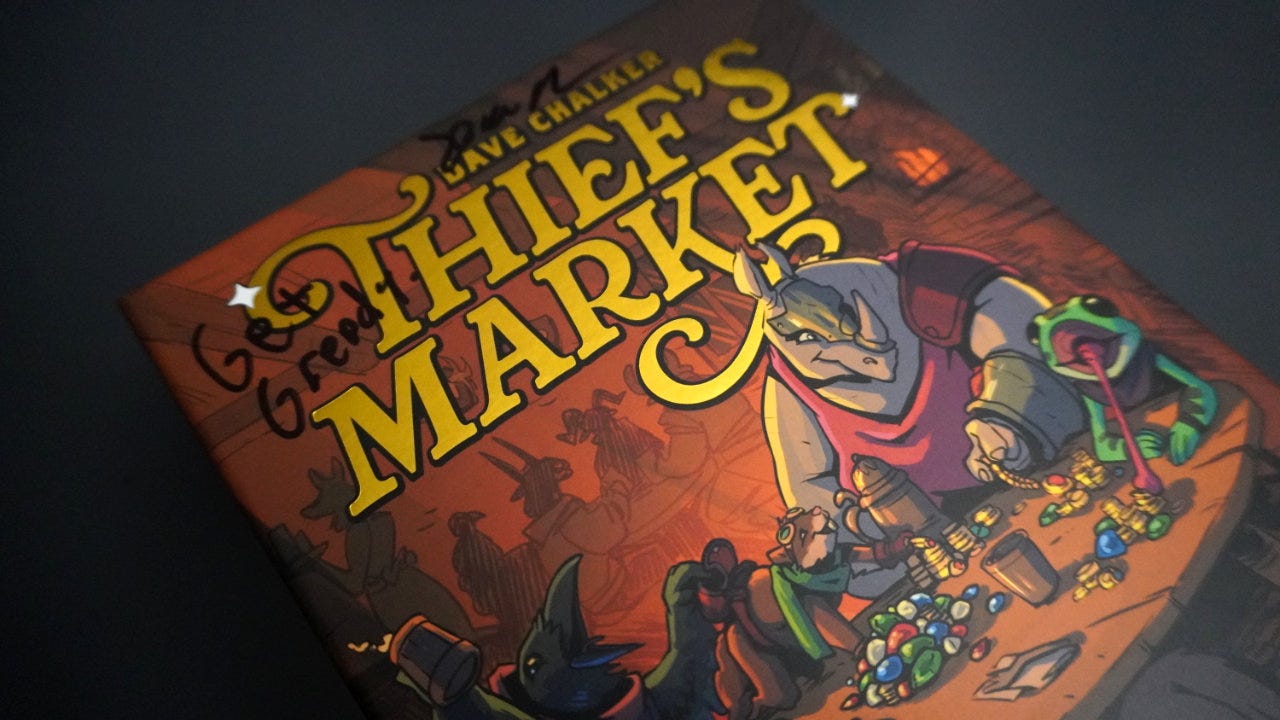
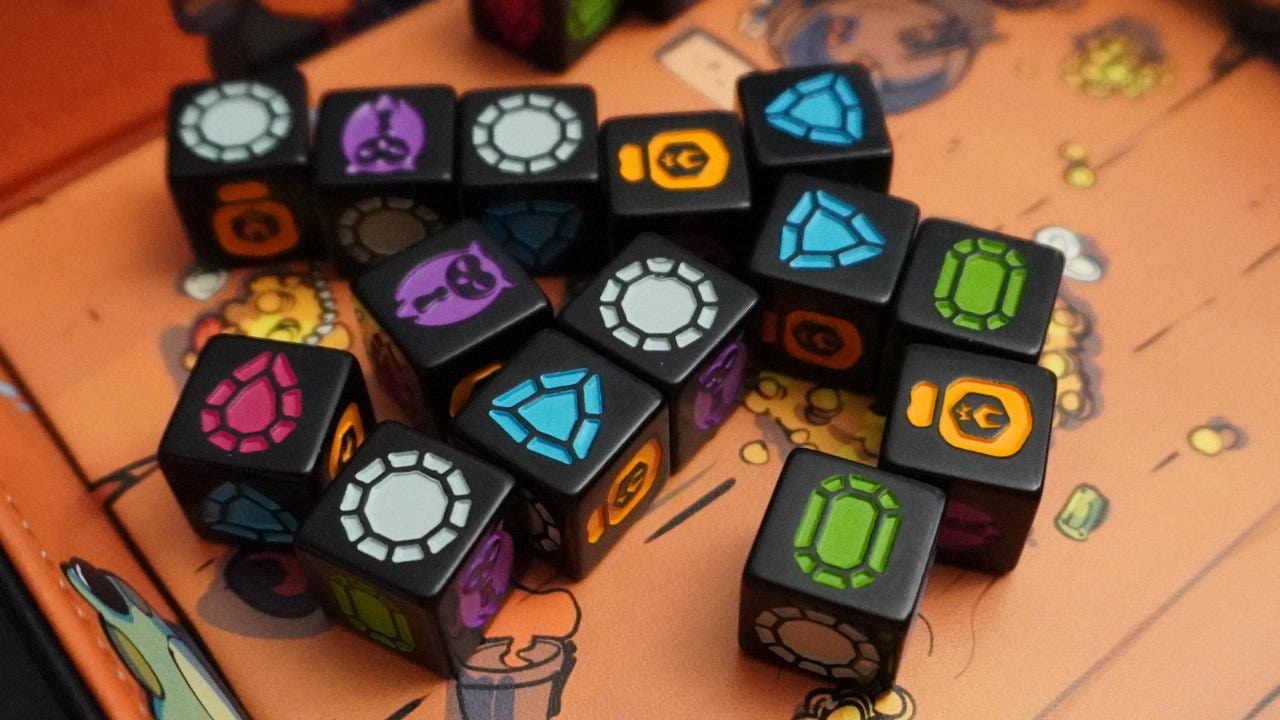
In Thief’s Market (Chalker, 2025), you play as a group of thieves who just pulled off a big heist. The time has come to divide up the loot and then head to the market to make some purchases.
The game is played over a series of rounds with each round being divided into two phases:
The Loot Phase
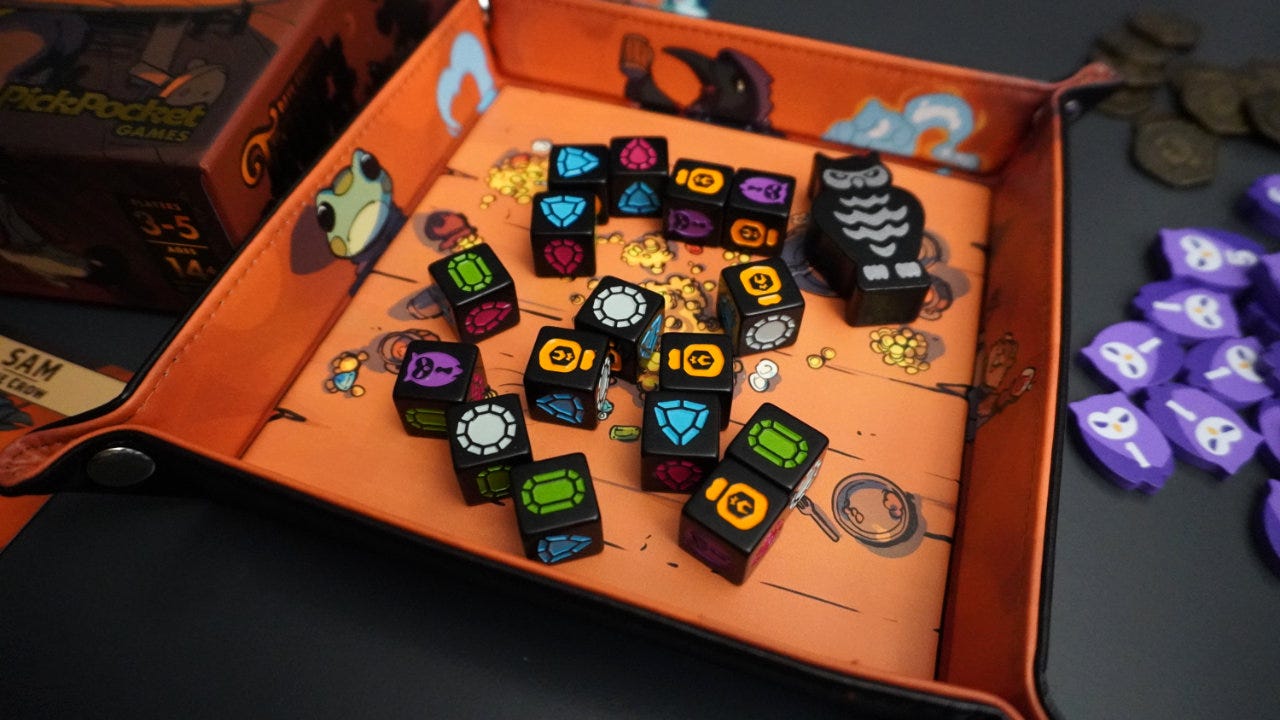
The first player rolls all the loot dice (10-16 dice in total) to the middle of the table. They also add the first player token to the pool of dice.
On each player’s turn, they can either (a) take as many dice as they’d like from the center pool of dice or (b) steal all the items from any player, returning one to the center. The first player token can be taken and stolen as well.
This splitting/stealing continues until every player has at least one item.
The Market Phase
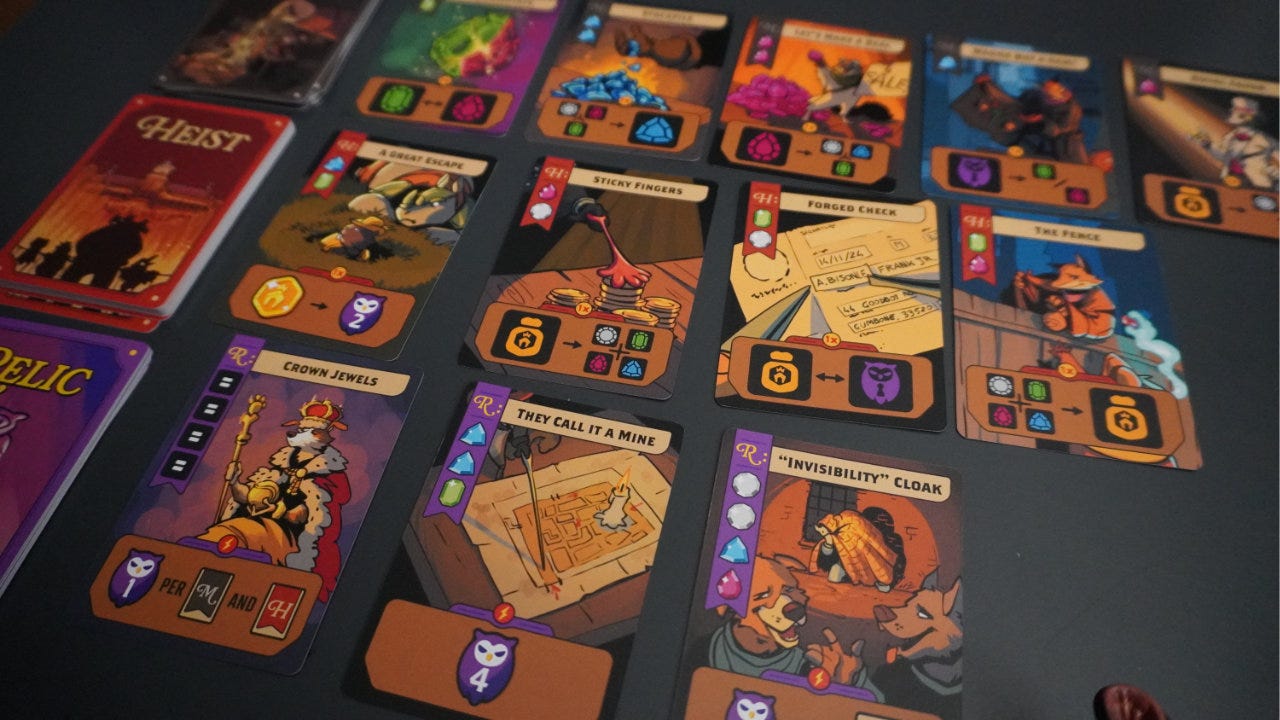
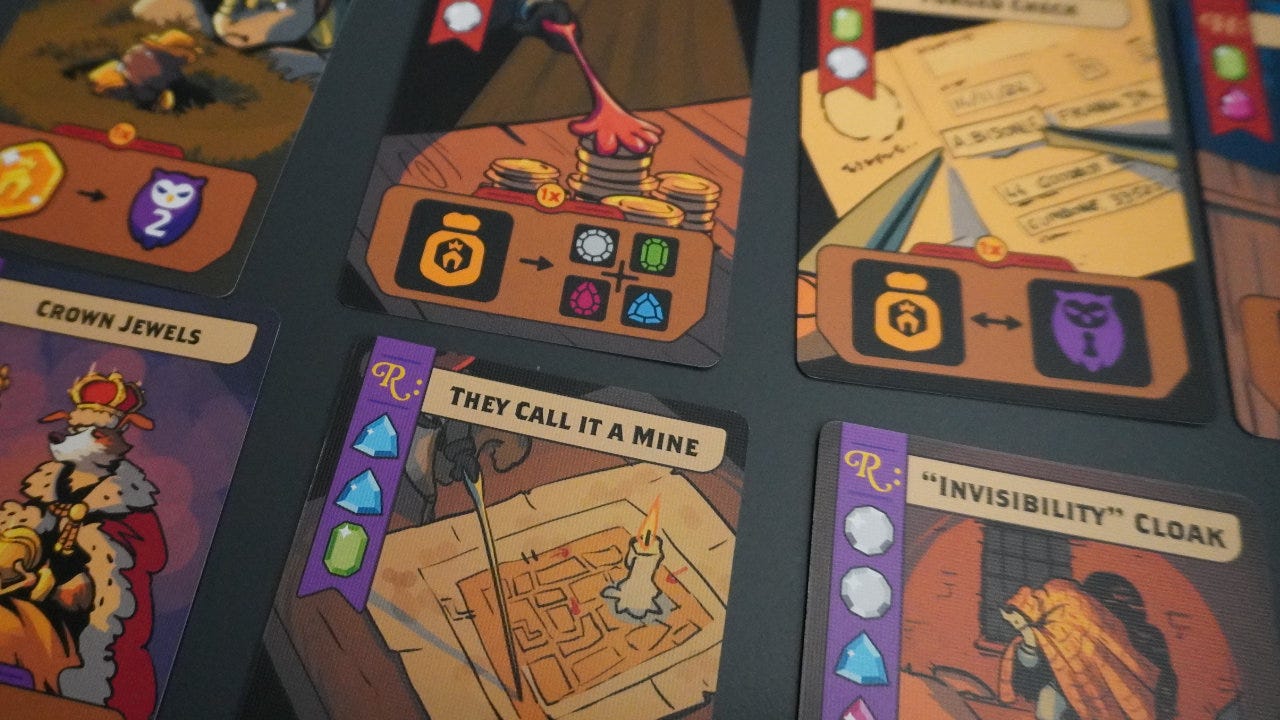
Each player takes turns using their collected dice to purchase cards from the market. The cards represent characters, markets, heists, and relics that allow players to modify dice and gain points in future rounds.
If any player has obtained a total of three relic cards, the game ends.
This is not a full rules teach, but should provide enough detail for use to explore the core mechanism of the game: the choice to either take dice from the center or steal from another player.
Cutting the pie
When I briefly spoke to Dave Chalker about the game, he described it as “cutting the pie” which I think is a good description. We looked at fair cake cutting (i.e. “I cut, you choose”) mechanisms in the past in the context of Pacts (Brin, 2025):
In Pacts, each round one player will draw five pact cards and divide them into two piles of their choosing. In addition, they will also add a 2nd Player token to one of the piles, increasing the desirability of the pile — there’s an advantage to going second. Then the other player will choose one of the piles. Finally both players will resolve their actions — 1st player and then 2nd player order.
In Pact, this fair division optimization problem is upset by having items that are extremely hard to value. It is almost impossible to create two piles of truly equal size or value, making it a really interesting (and sometimes agonizing) choice.
I wouldn’t call Thief’s Market a pure “I cut, you choose” game.2 The difference is that in “I cut, you choose” games, the player is making a split of a pool of items and allowing another party to choose one of the pieces. This strongly incentivizes equal distributions, as the other (rational) player will take the largest piece available.
Thief’s Market instead has the player “cut the pie” with the looming risk of their entire piece being stolen. In Pacts, if you make unequal piles, you still end up with a pile. In Thief’s Market, if you take took many dice, you may end up with no dice at all.3
In some ways, this makes the decisions during the Loot Phase even more complicated. A player must decide if they should take dice from the center, and if so, how many they should take. Or, they must decide if they steal, and if so, who to steal from.
The ultimatum game
While trying to find similar mechanisms in experimental economics or mathematical games, I came across the ultimatum game first described by John Harsanyi in 1961:
The first of two players (Proposer) is given a sum of money and is asked to decide how to split it between themselves and the second player (Responder).
The Proposer makes an offer of a split of the money to the Responder.
If the Responder accepts the offer, they both get the agreed upon amounts. If the Responder rejects the offer, neither gets anything.
I think this touches on something happening in Thief’s Market, but it requires some explanation.
You’d expect that experiments involving the ultimatum game would show that the Responder would accept most offers because their choice is between the offered amount ($X) or nothing at all ($0). It’s almost a Hobson’s Choice.
And yet, experiments have shown this is not the case as Lauren Strano describes at The Decision Lab:
“What actually happens: In real-life experiments, low offers are usually rejected by Player 2 because people value fairness, even at personal cost. Additionally, proposers often offer 30-50% of the money because they assume that completely unfair offers will be punished, and they want at least something out of the proposition.”4
One possible reason proposed for this is that “people tend to reject an unfair offer, even if it means sacrificing their reward.”5
When presented an unfair offer, it would seem that people are quite likely to cut off their own nose just to spite their face.6
Working backward to a solution
So if our thieves are unlikely to be fully rational when making decisions, how can we know what to do in the game? Is there an optimal play that maximizes gain and reduces the risk of being stolen from?
That’s where I came across the “A Puzzle for Pirates” by Ian Stewart in Scientific American which describes a variant of the ultimatum game.7 It directly involves splitting a shared loot pile between multiple pirates:
“Ten pirates have gotten their hands on a hoard of 100 gold pieces and wish to divide the loot. They are democratic pirates, in their own way, and it is their custom to make such divisions in the following manner: The fiercest pirate makes a proposal about the division, and everybody votes on it, including the proposer. If 50 percent or more are in favor, the proposal passes and is implemented forthwith. Otherwise the proposer is thrown overboard, and the procedure is repeated with the next fiercest pirate.”
Much like Thief’s Market, multiple players are involved and the consequences for being too greedy when splitting the loot are harsh. It’s a two-page article that is well worth reading, but here is the bit that I found to be most interesting:
“The secret to analyzing all such games of strategy is to work backward from the end. At the end, you know which decisions are good and which are bad. Having established that, you can transfer that knowledge to the next-to-last decision and so on. Working from the beginning, in the order in which the decisions are actually taken, doesn’t get you very far. The reason is that strategic decisions are all about “What will the next person do if I do this?” so the decisions that follow yours are important. The ones that come before yours aren’t, because you can’t do anything about them anyway.”
So to determine what to do, you need to start with the very last two pirates who are making decisions. Once you figure out what they might do, you can ponder what the one before them would do, given the decision of the first two. This continues all the way up the chain until it reaches you whether it is 10 pirates or 100 pirates.
The actual conclusions in the article are fairly complicated, but it illuminates the exploration of the game in an interesting way. On a player’s turn they need to not only assess the current game state, the value of the loot pile, but also if the next person in line will steal from them.
The player’s choice must involve working backwards from the end.
Additional complexity
Two other factors are worth noting that are important in exploring the gameplay of Thief’s Market:
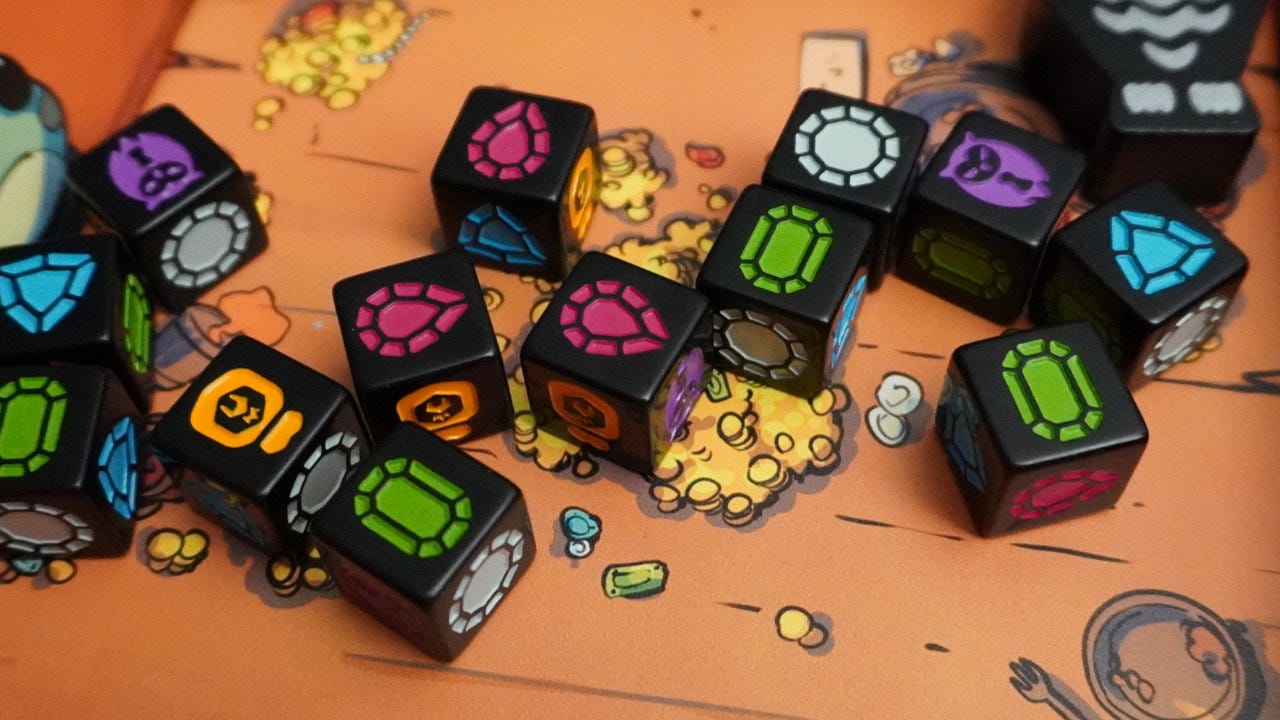
The dice do not have equal value: Each die has multiple faces. The value of each of those faces depends on what each player is trying to purchase and what cards they have that might modify certain dice. Like in Pacts, this inability to easily tie a value to each “pie slice” makes the decision incredibly difficult to just “math out.”
There is a player order token: Just as Pacts includes a 2nd Player order token, Thief’s Market includes a 1st Player token. Almost by definition, these tokens do not have a quantitative value (i.e. one that can be expressed as a fixed number).
Putting this all together, optimal play involves making plans about which cards to purchase, trying to make choices that don’t seem too unfair, and making your best guess at assigning a value to the dice and first player token.
This creates an interesting self-balancing mechanism that has significant dependence on social cues, without being a “social” or “party” game.
Conclusion
Some things to think about:
Fair division optimization problems: In game theory, fair division is when multiple parties are all entitled to a limited resource and need to divide it in a way that is agreeable to everyone involved. These problems are simple to explain but deceptively complex, which means they are fertile ground for game design.
Players are not always rational: As the ultimatum problem may show, some players may be fine getting nothing (rather than something) if it means they can cause someone perceived as acting unfairly to get nothing too.
Make the loot pile hard to value: Both Thief’s Market and Pacts ensure that the limited resources to be split are hard (or impossible) to accurately value. The addition of a non-resource like a player order token compounds this. It switches the game from being “mathy” to being a tough “gut” choice.
What do you think? Do you enjoy fair division problems in tabletop games? How could something like this be used in a TTRPG?
— E.P. 💀
P.S. Want more in-depth and playable Skeleton Code Machine content? Subscribe to Tumulus and get four quarterly, print-only issues packed with game design inspiration at 33% off list price. Limited back issues available. 🩻
Skeleton Code Machine is a production of Exeunt Press. All previous posts are in the Archive on the web. Subscribe to TUMULUS to get more design inspiration. If you want to see what else is happening at Exeunt Press, check out the Exeunt Omnes newsletter.
Skeleton Code Machine and TUMULUS are written, augmented, purged, and published by Exeunt Press. No part of this publication may be reproduced in any form without permission. TUMULUS and Skeleton Code Machine are Copyright 2025 Exeunt Press.
For comments or questions: games@exeunt.press
Dave was also kind enough to sign my copy which I really appreciate. I’ve come to really treasure signed copies of games as it reminds me of the time I met the designer.
BGG does, notably, list I Cut, You Choose as one of the game’s mechanisms. It makes sense in their context, because I’m not sure what else you’d call it.
No dice at all for that attempt. As noted, play continues until all players have at least one item, be it a die or the first player token.
“The Ultimatum Game” at The Decision Lab written by Lauren Strano
There are many reasons this proposed cause may not be valid or may at least not be the only driver of the observed effects. Check out the “The Ultimatum Game” article above for a good discussion of possible confounding issues.
Although Peter of Blois (c. 1130 — c. 1211) is one of the first to document the usage of this idiom, it also shows up in Taylor Swift’s 2019 single “The Archer” from her Lover album.
“A Puzzle for Pirates” by Ian Stewart in Scientific American, May 1999.
I reject the offer and gain nothing in order to punish the cheater (in the hope that in future iterations of such a game they might reconsider their approach) 😄
I read an article somewhere (I can't remember where for the life of me, and Google is no help), about researchers who brought the Ultimatum game to a non-Western culture, and discovered that players usually split the money 80/20 or worse, which the other party happily accepted. The article suggested that what Western academics had thought was a characteristic of human nature was perhaps only a characteristic of Western culture, which puts a high value on egalitarian ideals. The other fun anomaly was a location where players regularly split the money heavily in favor of the other party, and then had their offers rejected -- confusing, until the article noted that in this particular culture accepting a gift put one in debt to the giver.