

The last two weeks, we’ve looked at small, abstract card games — Circus Flohcati and its dynamic market and Soda Jerk with its potentially negative points.
This week we are turning to TTRPGs and how they handle ammunition in games with ranged weapons. Should we track every arrow fired or just when it makes narrative sense? Do we care how many bullets are left in the magazine? Do we even need to track ammo?
But first…
📋✏️ Last call for the Annual Reader Survey
The 3rd annual Skeleton Code Machine Reader Survey is live. Please take a moment to complete it. Let me know what you want to see more (or less) of each week, and also the best new (to you) game of 2025. The survey is open through December 31, 2025.
Ammo in CY_BORG
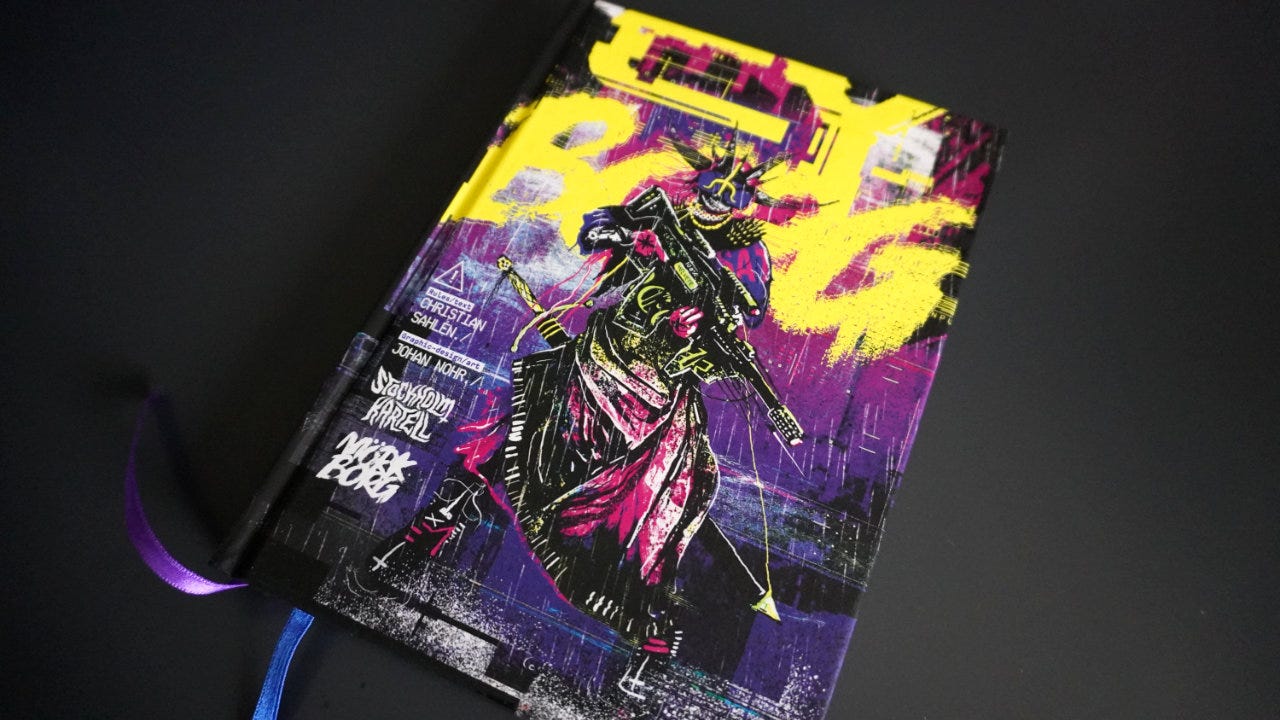
In MÖRK BORG with its dark fantasy and vaguely medieval setting, much of the combat is melee (i.e. hit someone with something). Attacks are resolved with an ability roll (Test) versus a difficulty rating (DR):
Player: “Therg attacks the skeleton with a flail!”
Test Strength DR 12:
Roll 1d20 + Strength Ability vs. DR 12
If the result is ≥ 12, it hits and you roll for damage (d8).
Otherwise, it’s a miss.
The process for using a ranged weapon (e.g. crossbow) is similar, but uses Presence as the key ability for the test rather than Strength. There are no explicitly defined rules for managing ammunition in the game.1 It’s up to the GM to figure out when it makes sense to deal with how many arrows or bolts a player has left.

CY_BORG has a futuristic cyberpunk setting where projectile weapons are the norm — pistols, SMGs, rifles, and rocket launchers.2 With more focus on guns, it makes sense to worry a bit more about ammo management. The game still uses Presence tests for most ranged weapons, but adds the ability to autofire and tracks ammo depletion.
Autofire

Some CY_BORG weapons are capable of autofire, noted with an “a” after their normal damage (e.g. SmartGun d6a). Attacks using autofire use an Agility test rather than Presence for up to three consecutive attacks:
“Test Agility D12 to hit and then roll for damage. Hits also allow a second attack, against either the same target or another one nearby, up to a maximum of three attacks. Check armor for each hit.” (p. 82)
I’d imagine this as spraying bullets in a very John Wick and/or Matrix sort of way.3
Ammo depletion

So with guns all over and the potential for autofire bursts, how does CY_BORG stay “rules light” while tracking ammunition?
Ammo is abstracted away from counting individual bullets. Instead, after the end of each combat encounter, players do a single roll to see if they are out of ammo or not. They roll a d8 for each weapon they fired and on a result of 1-3, they are out of ammo and need to reload. This could be a new magazine or some other method of reloading.
If the gun’s autofire capability was used, a d6 is rolled instead. The same 1-3 results trigger an out-of-ammo reload.
This eliminates the need to track individual rounds, but still gives some sense of expenditure of a limited resource. The combat stays fast and fun while it’s happening, but you might be out of ammo at the end.
It also creates a thematic connection between autofiring and ammo expenditure. A regular gun using a d8 for the ammo check has a 3:8 (37.5%) chance of running out of ammo. An autofired gun has a significantly higher 3:6 (50%) chance of running out.
Other methods of ammo management

I’ll save an in-depth look at ammo management alternatives for future articles, but a few are worth mentioning here:
Every shot: Tactical, simulationist approaches to TTRPGs will often have the player track each individual bullet or arrow. You fire a shot and mark it off, maintaining an exact count. GURPS and Shadowrun are examples.4
Ammo dice: Twilight: 2000 tracks ammo down to the number of rounds left in a weapon’s magazine to set the maximum number of ammo dice that can be used during an attack. Adding more ammo dice might increase damage, but the sum of the dice determines how much ammo is spent after the attack.
Light ammo tracking: Mothership has some suggested house rules in the Warden’s Guide including Light Ammo Tracking: “Players only track ammo when it seems relevant narratively. Then assume the players have 1d5 shots remaining.”5
Usage dice: Perplexing Ruins’ Fallen and quite a few others use usage dice or supply dice to track consumables like ammo. A supply might begin with a d20 that gets rolled after use. On a 1-2 result, the size of the die is decreased: d20 → d12 → d10 → d8 → d6 → d4. After a 1-2 is rolled on a d4, the item is fully consumed and gone. This has the added benefit of being able to start items anywhere along the usage path from d20 to d4.
All ammunition management systems are a balance between tactical simulation (i.e. track every round) and narrative abstraction (i.e. you run out of ammo when it makes sense for the story).
The CY_BORG method of a single ammo check roll with fixed dice (d6 or d8) seems like an elegant solution to a complex design problem. Whether or not that solution works for you and your players depends on the kind of fun you want to have.
Conclusion

Some things to think about:
Ammo tracking is a design choice: There’s no “right” answer when it comes to ammunition tracking in games. It depends on the type of game you want to make, who the game is for, and what type of experience you want to create.
See how others have done it: There seems to be an endless number of ways to solve ammo tracking in tabletop games. Most are a mix of styles and methods, trying to balance simulation vs. narrative. Doing a survey of other systems is a good way to start thinking about your own.
Create thematic connections to mechanisms: CY_BORG’s ammo system is extremely simple and abstract, but it does have a connection between theme and mechanism: autofiring makes it more likely to run out of ammo. It’s not complicated, but it does make sense.
What do you think? Does CY_BORG’s ammo method solve the problem in a simple way or does it abstract away too much? What are some other interesting and effective ways to track ammunition in TTRPGs or board games?
— E.P. 💀
P.S. Want more in-depth and playable Skeleton Code Machine content? Subscribe to Tumulus and get four quarterly, print-only issues packed with game design inspiration at 33% off list price. Limited back issues available. 🩻
Skeleton Code Machine is a production of Exeunt Press. All previous posts are in the Archive on the web. Subscribe to TUMULUS to get more design inspiration. If you want to see what else is happening at Exeunt Press, check out the Exeunt Omnes newsletter.
Skeleton Code Machine and TUMULUS are written, augmented, purged, and published by Exeunt Press. No part of this publication may be reproduced in any form without permission. TUMULUS and Skeleton Code Machine are Copyright 2025 Exeunt Press.
For comments or questions: games@exeunt.press
This is by design. Johan Nohr commented on Discord (2/26/2020): “You are correct. We leave that very much in your capable hands. And we kinda assume the people who buy MB have played dnd and osr games before. Turns out that’s not necessarily true though.”
Want a CY_BORG heist to steal a defective exosuit with a rogue AI that puts your crew in the middle of a revenge plot? Check out BLACKFLOWER from Exeunt Press.
During my most recent play of CY_BORG, I tried to maintain the precedent set in earlier GURPS games with my character — the pirate Lefty Wright armed with twin pistols named Pork & Beans. So I avoided autofire weapons and acquired two “ancient revolvers” which did d8 damage each. Quite the deadly combination!
I own and have read Shadowrun, but I’ve never played it. As far as I can tell, it never explicitly says to count each round but it certainly seems to imply it. It is probably left up to the GM to decide how to handle it, so it depends on who is running the table. If I’m incorrect on this one, please let me know in the comments.
Why 1d5 and not 1d6? I have no idea. I don’t think I own a d5. I think it would work the same if you roll a 1d20 and divide by 2 or roll 1d6 and re-roll any 6 results. A clever person on Reddit suggested rolling a d10 and subtracting 5 from any results higher than 5.
Why 1d5 and not 1d6?
I can answer this one. It's because the "base" die in Mothership is a d10. Almost everything in the game is built around percentile dice or d10 tables (with the notable exception of the d20 Panic Die). To keep the focus on the d10, smaller tables are often based on a simulated d5, much the same way you would make a d3 table for a d6-based game (I tend to divide the roll by 2 and round up).
In my sci-fi game Starguild, running out of ammo is a “yes , but” option. If the skill attempt fails but isn’t a critical failure, the GM can offer an option like “you can choose to hit, but you are then out of ammo for that gun”. The player could accept that, or choose to miss but still have a functioning gun. Worked nicely with no additional rolls to remember.