
Spooky season is over, but the articles remain! Check out a six-word ghost story and how to care for a brain in a jar if you missed them.
This week we are digging into a 2d6 combat system that uses an additional die to give the player a tougher choice to make: the effort die in Slay.
Slay
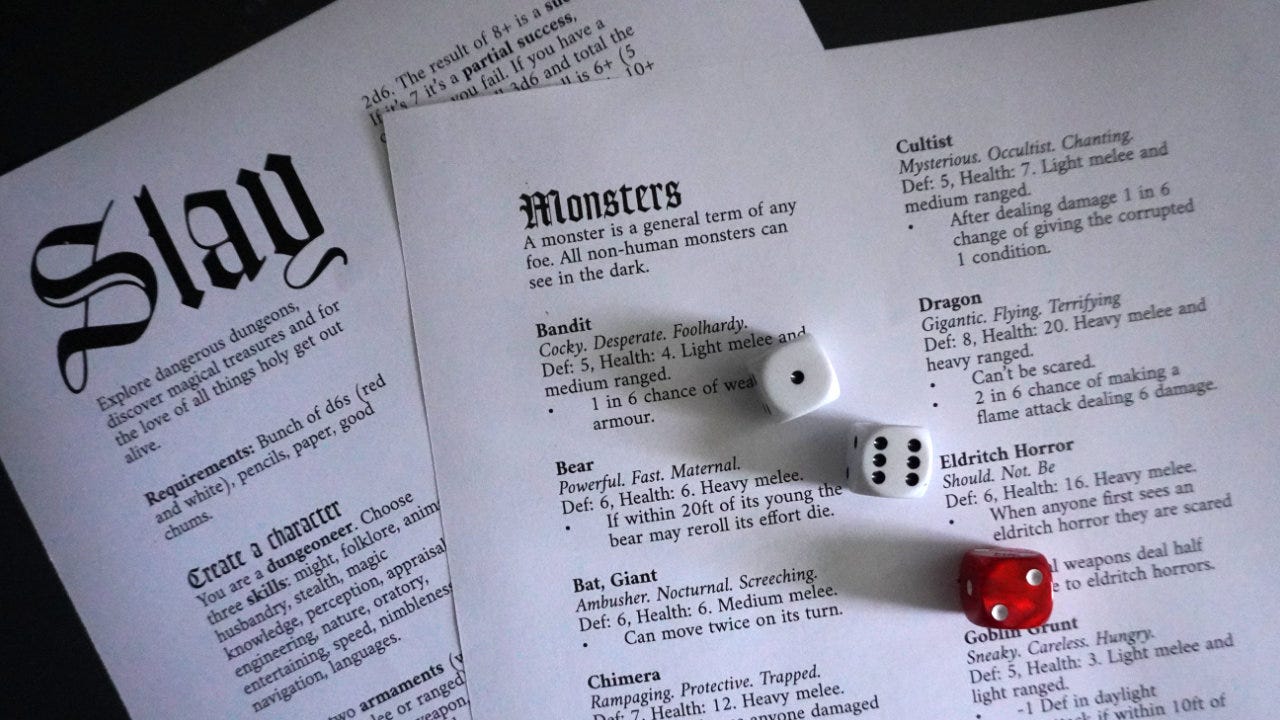
Made by Trollish Delver Games, Slay is a nine-page dungeon-crawling game for 3+ players. The thematic elements are fairly light, with a single-sentence introduction:
“Explore dangerous dungeons, discover magical treasures and for the love of all things holy get out alive.”
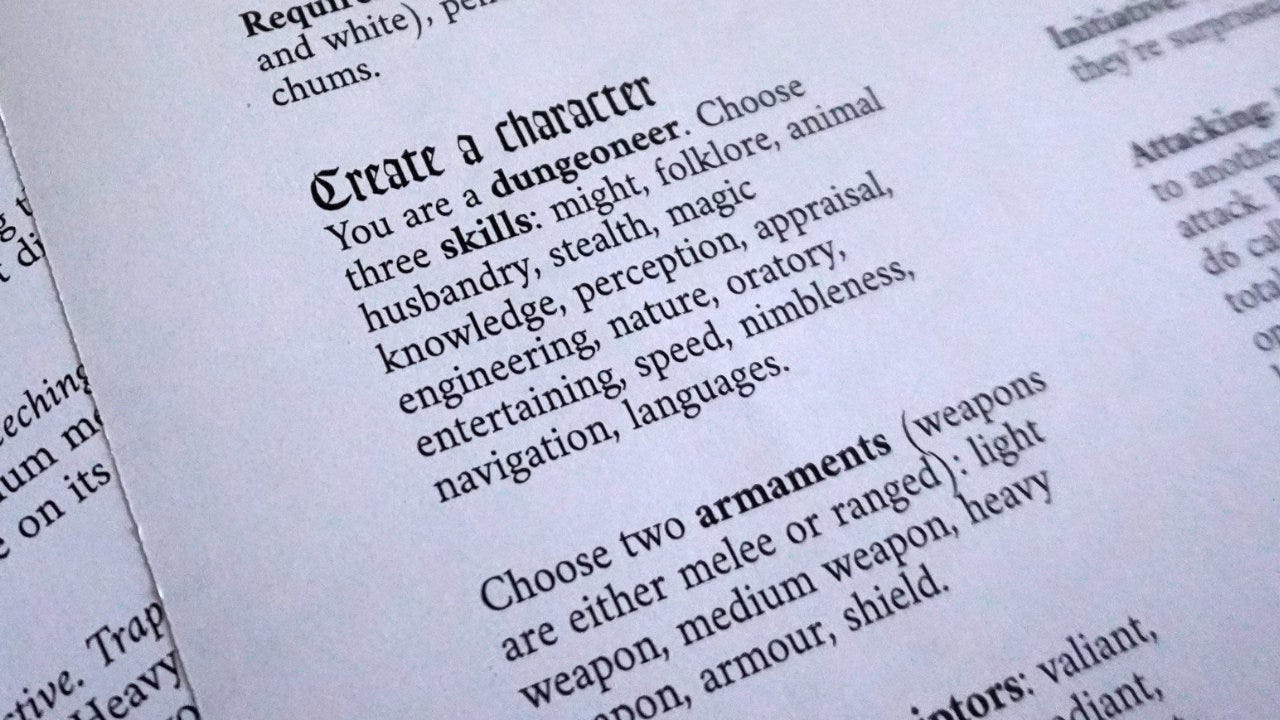
Slay character creation is equally streamlined and made for the classic dungeon setting. You are a dungeoneer with three skills (e.g. folklore, stealth, perception). Pick from light or heavy weapons. Choose some descriptors (e.g. valiant, cunning, stoic). And finally choose spell spheres that each give you access to a domain of magic but also reduce your starting health.
Set your starting Health to 10 (minus magic penalties), Defence to 5, and your Wealth to 1. Then you are ready to play.
Tasks, weapons, and casting spells
As evidenced by my own SHX system, I’m quite partial to core resolution systems that only use six-sided dice.1 In particular, I’m fond of ones that just use a few dice. Slay does this by using just 2d6 for most task resolutions.
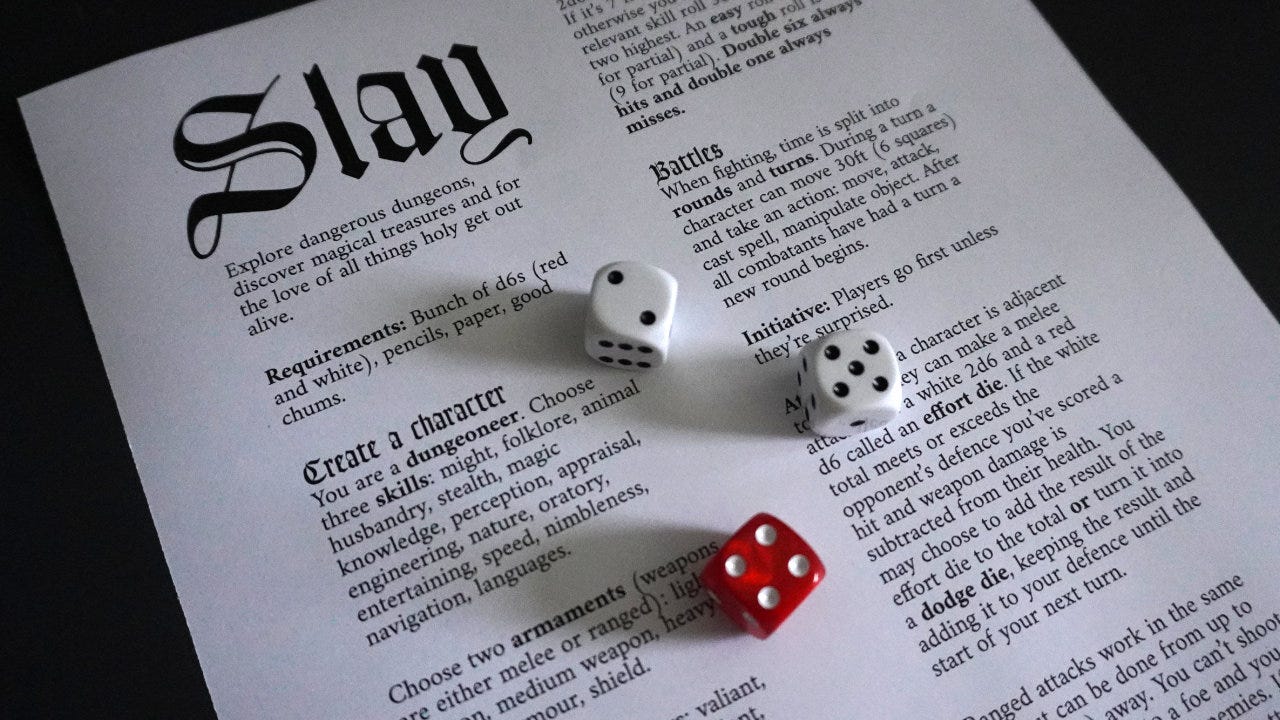
If you need to attempt a task and the outcome is uncertain, you roll 2d6 versus a default target number of 8. Relevant skills let you roll 3d6 and take the two highest instead. If the sum is 8 or higher, it’s a success. A 7 is a partial success. Everything else is a failure.2
As this is a combat-forward game, weapons will be rather important to your character’s survival. That said, they aren’t broken out in detail and damage is largely fixed. Light weapons (e.g. dagger) do 2 damage, medium (e.g. club) do 3, and heavy (e.g. longsword) do 4. Armor and shields add to your Defence.3
Finally, spells are interesting because they never deal damage. Instead, each spell sphere allows you to use magic that applies conditions to the target. There is no list of spells. Instead you describe the effect you want and make a task roll (as above). On success, you can apply an effect like Slowed, Scared, Silent, or Hasted.
There is more to the game in the form of faction ranks, advancement, and other rules. This isn’t a full explanation, but that’s enough background to allow us to look at the combat system.
It’s the combat dice that I think are particularly interesting!
Using the effort die
After determining initiative, battle takes place in rounds and turns.
Players attack using the following process:
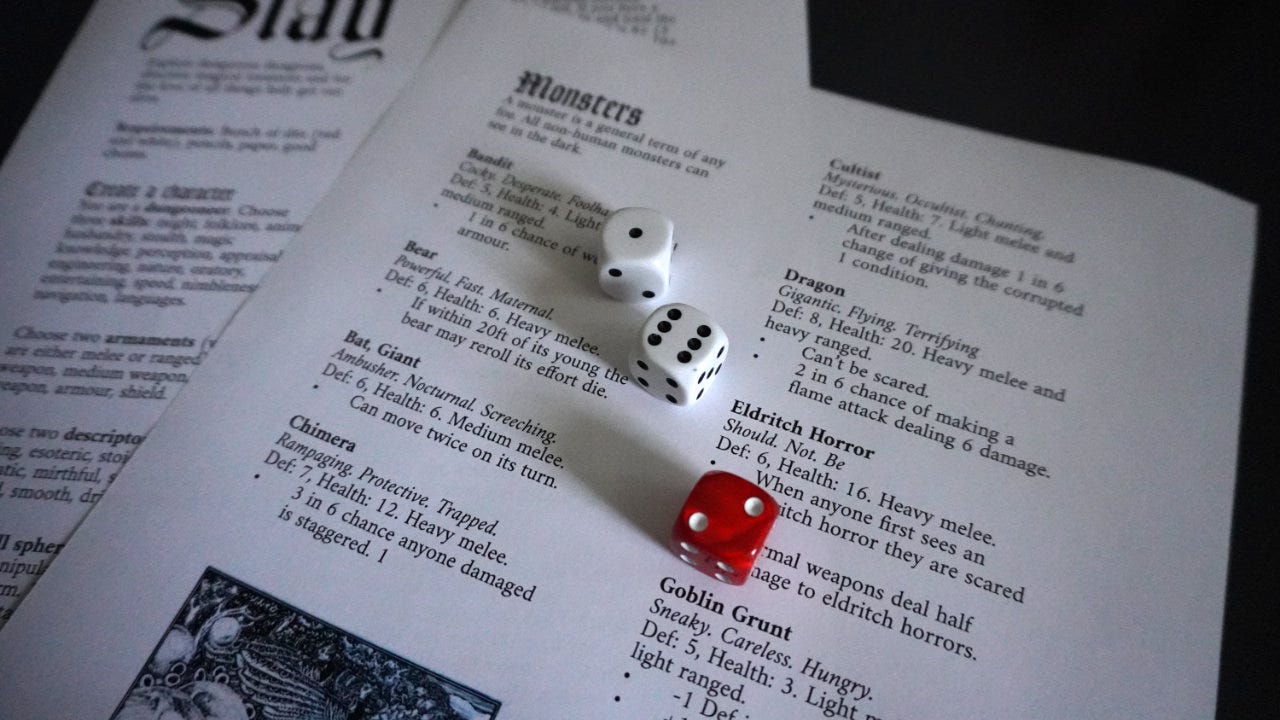
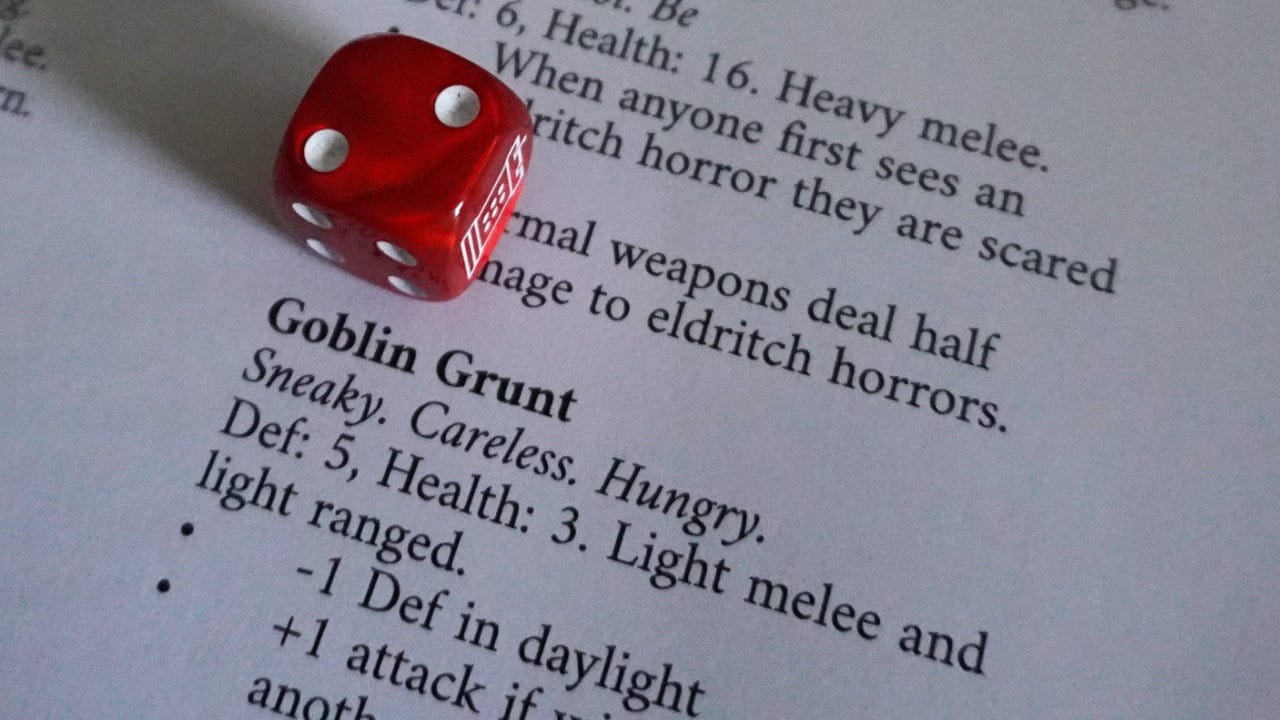
Roll 2d6 white dice.
Roll a single, red effort die.
If the white dice total is greater than or equal to the target’s Defence value, it’s a hit.4 Deal your weapon’s fixed damage amount.
If the white dice total would be a miss (i.e. the sum is less than the target’s Defence value), you can choose to add your red effort die to the total. That might be enough to turn the miss into a hit.
Alternatively, you can choose to save (bank) your red effort die, turning it into a dodge die.5 The die value can’t be changed, but it will be applied to your Defence until the start of your next turn.
So each attack turn, the player gets to make a choice: Use the red effort die to boost their Attack or boost their Defence.
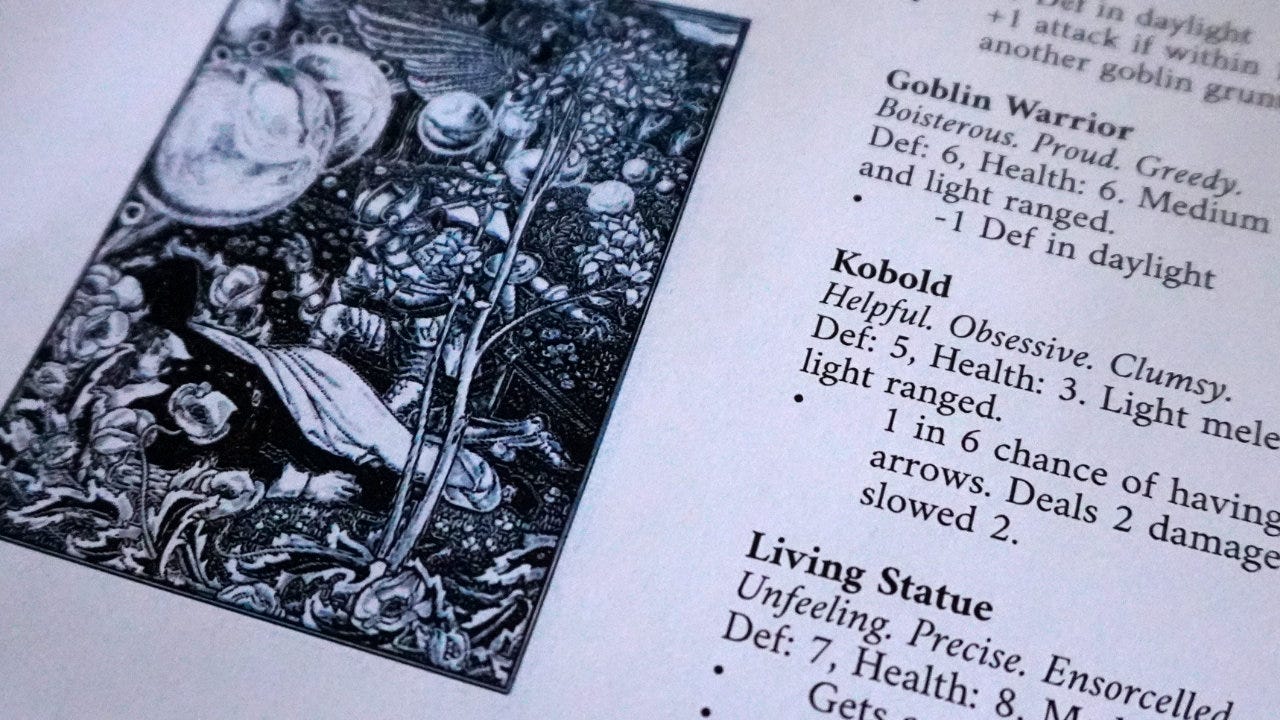
For low-level creatures like a Bandit or Goblin, their Defence value is just 5. Even without adding the effort die, the chance to hit with 2d6 is already over 83%. Applying the effort die to the attack pushes this to 98.1%.6
The system is much more interesting with higher-level creatures like the Living Statue (Defence 7) or Dragon (Defence 8). The default 2d6 roll only has a 41.6% chance to hit the Dragon. Always applying the effort die to the attack raises the hit chance to almost 84%.7
Using the effort die, you’d be likely to hit, but also left largely defenseless versus the Dragon’s flame attack that deals 6 damage. Remember that the default dungeoneer’s Defence rating is 5 — the same as a low-level Bandit or Goblin. It’s quite likely to hit you!
Increasing player agency
I’ve always found misses during battles to be frustrating. I know there are many ways to make a miss interesting: explain how it nearly hit, have it cause some narrative effect, or otherwise have an impact on the game state. For me, however, waiting for your turn just to roll a 2 and miss is just never going to be as satisfying as a hit.
The effort die is an interesting way to adjust the system and allow the player to feel like they have a bit more agency.8 They can significantly boost their chance of hitting, reducing those disappointing misses — but at a significant cost. Saving that effort die for dodging attacks makes you a much tougher target! Spending it leaves you wide open and vulnerable.
The Slay system does this in a way that is, in my opinion, subtly thematic. While not explicitly called out in the rules, I could imagine how the effort die narratively makes sense. Either you put all your effort into the attack (taking more risk and leaving yourself more exposed) or you hedge your attack (instead positioning yourself to handle the next incoming strike).
It’s an interesting case where there are few thematic elements in the game attached to this mechanism. The in-world explanation is left as an exercise for the player.
Conclusion
Some things to think about:
Dungeon crawl innovation: While dungeon crawl games are some of the most popular and widespread types of games, there is always some way to innovate on the tropes. I love a dungeon crawl and am always happy to check out new ones. Don’t write off the genre as cliché or boring.9
Give your players choices: The effort die is an interesting way to give the players more choices. When the effort die roll is high, it forces the player to choose between a guaranteed hit or a much higher chance to dodge the next attack. Make those choices painful!
Thematic mechanisms are tough: It’s relatively easy to come up with dice and card systems to use in battles. Making those mechanisms make sense (feel thematically coherent) is much tougher.
What do you think? Have you seen similar 2d6+1d6 systems used in other TTRPGs?
— E.P. 💀
P.S. Subscribe to Tumulus and get four quarterly, print-only issues packed with game design inspiration at 33% off list price. Limited back issues available. 🩻
Skeleton Code Machine is a production of Exeunt Press. All previous posts are in the Archive on the web. Subscribe to TUMULUS to get more design inspiration. If you want to see what else is happening at Exeunt Press, check out the Exeunt Omnes newsletter.
Skeleton Code Machine and TUMULUS are written, augmented, purged, and published by Exeunt Press. No part of this publication may be reproduced in any form without permission. TUMULUS and Skeleton Code Machine are Copyright 2026 Exeunt Press.
For comments or questions: games@exeunt.press
SHX uses 2d6 as the core dice roll, but also has a Stamina resource that can be spent and applied to the roll. The trick is that you need to decide how much Stamina to spend before you roll the dice, rather than after. It also has a X die that acts as a tracker and gradually increasing cap on your stats. Follow the Exclusion Zone Botanist: Epsilon monthly updates to learn more.
The rules also say that double sixes (12) always hit and double ones (2) always miss. This is pretty common in TTRPGs, but I also wonder why it needs to be said. A sum of 12 would always beat the target number of 8 and a sum of 2 would always fail to beat an 8. There might be modifiers or other things going on that I missed during my initial read of Slay.
The game uses the term Defence rather than Defense, so that’s what I’m using in this article.
It wasn’t immediately clear to me if you can still bank your effort die for Defence if you hit using just your 2d6. If you hit with just the white dice, there would presumably be no reason to spend the effort die on the attack. Does that mean that a natural 2d6 hit also gives you a Defence boost?
The choice is always up to the player. They can turn the effort die into a dodge die (increase Defence) even if that causes them to miss their attack.
These are average probability values, assuming you always apply the effort die to attack and never to defence.
This also assumes you are rolling 2d6 for your white attack dice and never rolling 3d6 due to some other skill or ability.
This is not to say that it provides the player with an interesting choice every turn. You could roll your 2d6 and get a total of 3 vs. a target number of 8. If your effort die is 4 or less, there is no choice to be made. Applying it won’t turn your attack into a hit. Either you waste your die applying it to a doomed attack or save it for your upcoming dodge — something very close to a Hobson’s Choice.
You can read more about the influence of Rogue on dungeon crawls in Tumulus Issue 8. There’s a discussion of Dark Fort, and a no-combat hack of it called Dark Mall. Beware Mr. Bumpy Wheels!