
The last three weeks, we’ve been exploring some big topics! We looked at how antagonistic design tries to frustrate the player on purpose. We pondered how bingo could be used as a TTRPG mechanism. We created a definition for lookup events in games and proposed a way to analyze them.
This week, we are switching gears and looking at a very small game: A Ghost’s Story by Anthony Ortega. It’s a tiny solo journaling game that requires only a pencil and the writing of six words.
You are a ghost
When I saw that Anthony posted a photo of him reading Make Your Own One-Page RPG while hanging out at a park, I was excited to see what he’d make. And it didn’t take long before he shared A Ghost’s Story on itch.io.
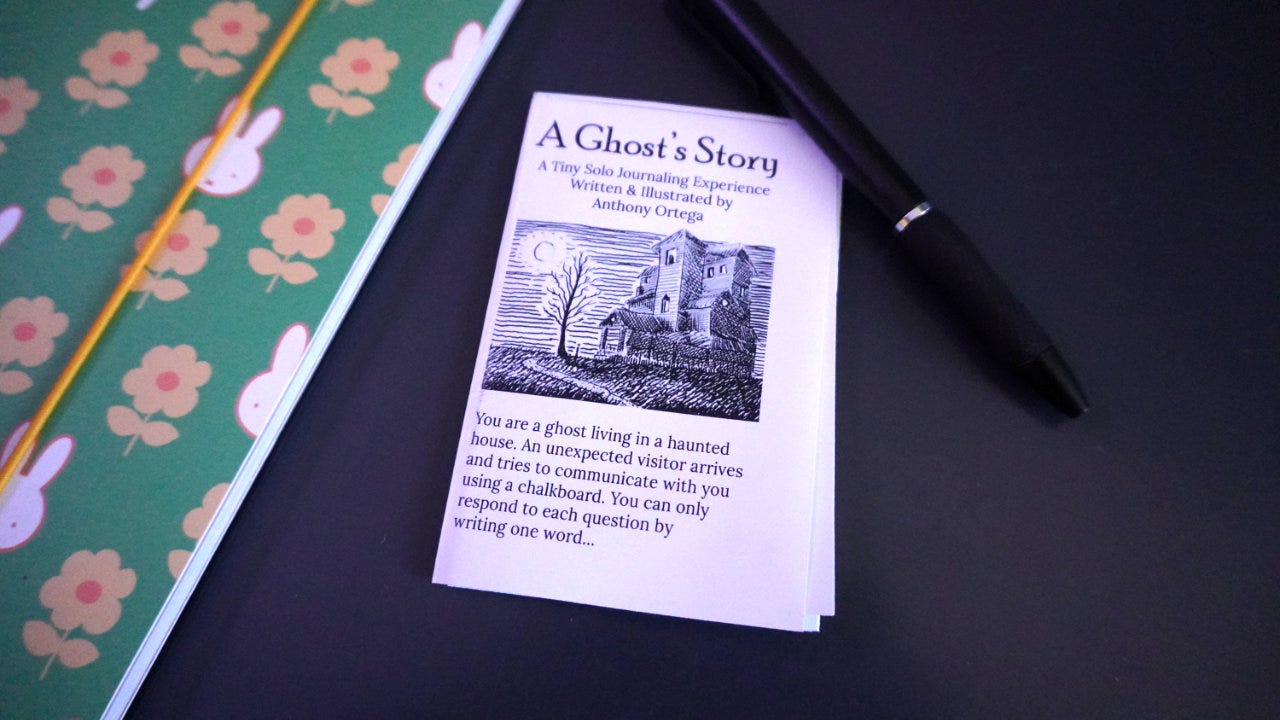
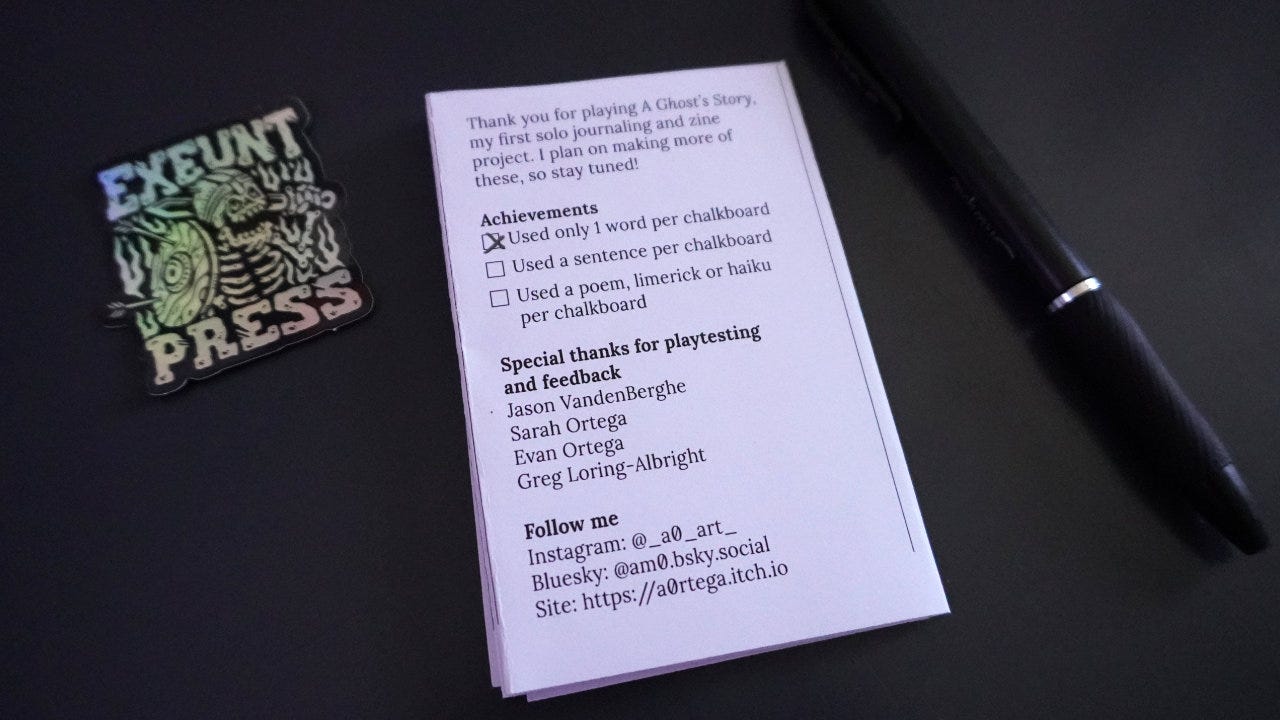
The game easily fits on a single sheet of paper and is intended to be cut and folded into a miniature zine. When complete, it’s about 70mm x 110mm in size.1 The instructions for how to play fit on the front page:
“You are a ghost living in a haunted house. An unexpected visitor arrives and tries to communicate with you using a chalkboard. You can only respond to each question by writing one word…”
And with that, the game begins.
There are no dice, no cards, no resolution mechanisms. In fact, it arguably does not even have a core game loop — making it a rare example of a linear game.2 It is one of the most minimalist games I’ve seen, and yet somehow it manages to create a compelling narrative.
Let’s look at how it does that.
Just one word per page
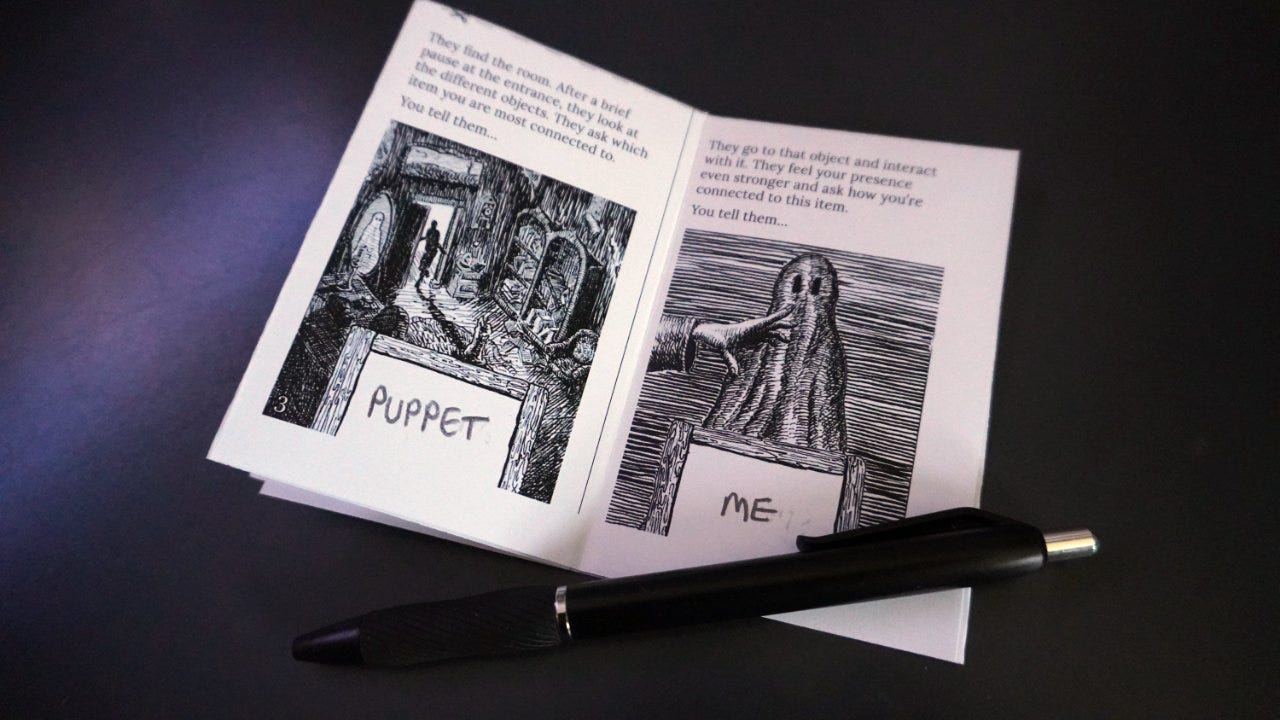
The game is structured so that each page has a short description of a scene or event — just one or two sentences long. I don’t think it is too much of a spoiler to share the first prompt:
“This visitor enters your house and asks if you know who they are.”
After each scene, the game prompts you with “You tell them…” and provides a place to write your word on a chalkboard.
Even this first prompt is surprisingly open-ended. You could write your former role or something very descriptive as your message to the living. For example, I chose to write “OWNER” as I had decided I was the former owner of the house. You could also write your name or anything else.
There are six prompts in total, allowing you to write just six words during the game. Where some journaling games aim to provide scaffolding for the player to write paragraphs and detailed descriptions, A Ghost’s Story does the opposite. It constrains the player as tightly as possible, allowing them to write just a single word per page.
It’s also notable that the prompts didn’t feel random or out of place. I felt they created a story arc that made sense, providing a limited sense of closure at the end.
Art and illustrations as thematic elements
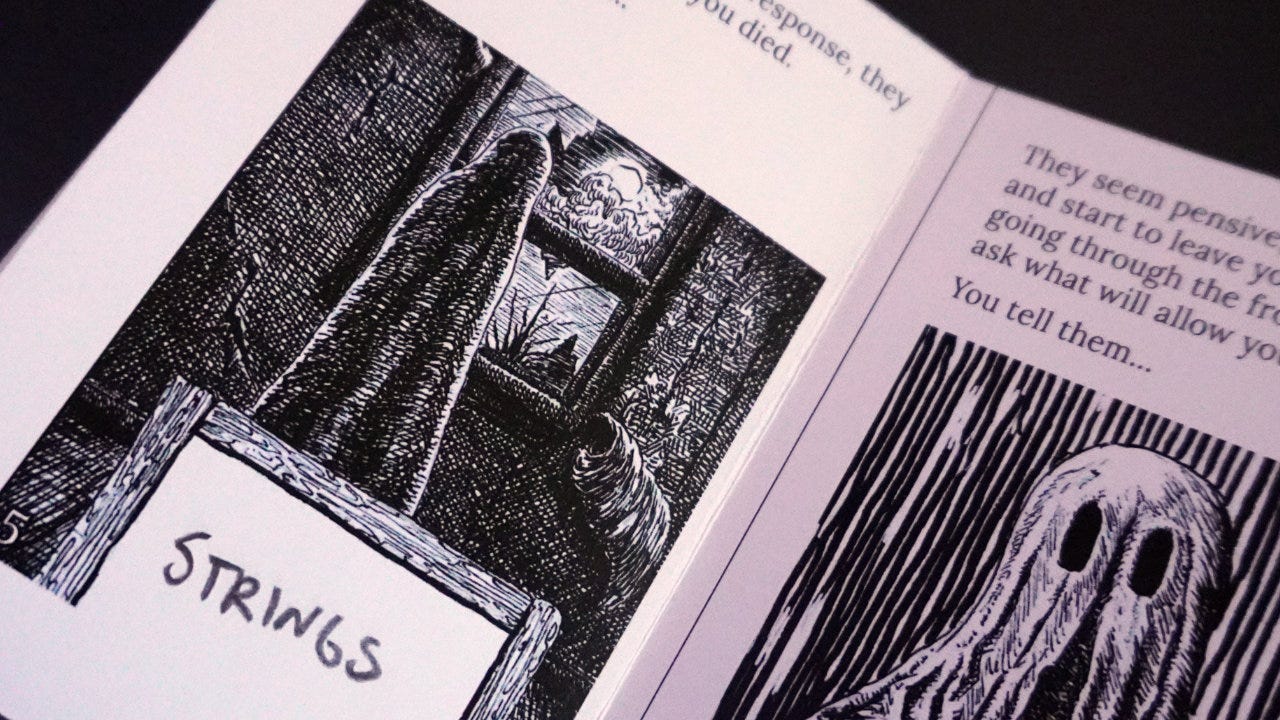
While the constrained writing of the game is notable and creates an interesting experience, the art has to be mentioned as well. I don’t believe the game would be nearly as good without Anthony’s illustrations on each page.3
The stark, black and white sketches provide just enough detail to spark imagination and allow the player to enter the world of the game. They reminded me, just a little bit, of the Edward Gorey animation introducing each episode of Masterpiece Mystery on PBS. Not that it is necessarily the same art style, but rather that it is understated and allows the viewer’s imagination to fill in the gaps.
I’ve mentioned Sarah Shipp’s layers of theme many times here at Skeleton Code Machine, and once again I think that model applies here.
The illustrations are not what she calls Layer 1: Core Gameplay elements. Layer 1 elements are necessary to play the game and may not be divorced from the game. You certainly could remove the illustrations and still play A Ghost’s Story.
Instead the illustrations are Layer 2: Baked-in Thematic Elements, and indeed a perfect example of such a thing. Layer 2 elements can’t be avoided while playing the game and usually include illustrations, components, icons, and other graphic design elements. In A Ghost’s Story, Anthony’s illustrations are front and center on each page — easily filling up 75% or more of each page.
Could the illustrations be removed? I suppose. The game would be, however, greatly diminished. They are what makes this minimalist game work.
Make your own one-page RPG
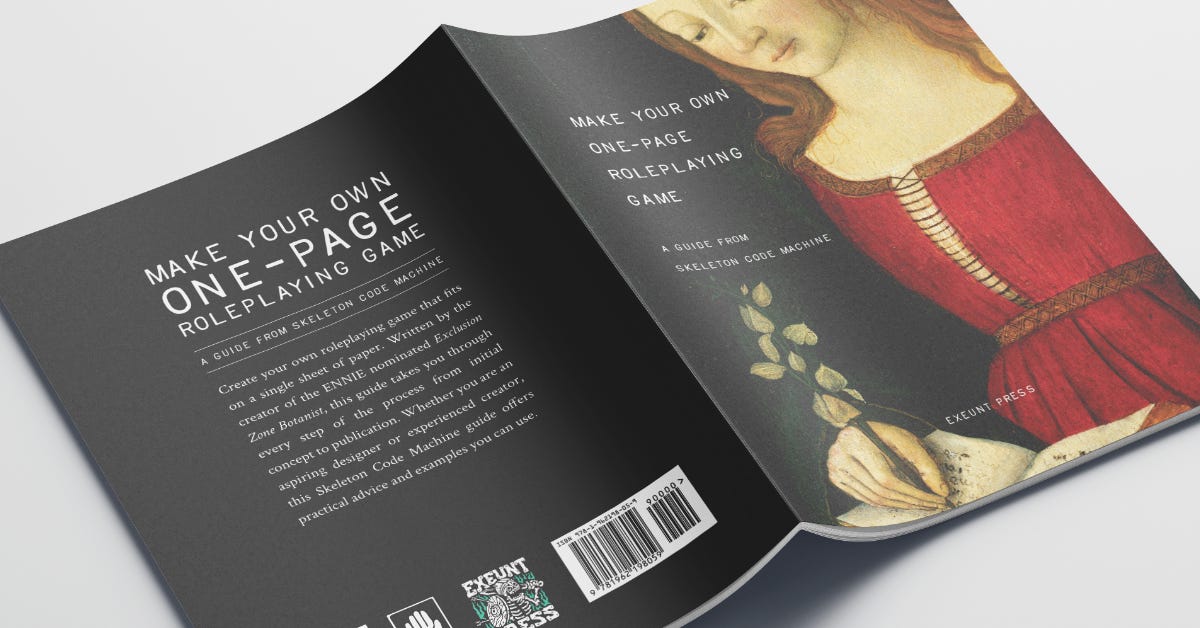
Like so many others who have told me they used Make Your Own One-Page RPG to create their own first games, I’m so thrilled that Anthony gave the guide a read. He used ideas from the guide to make something unique and entirely his own.
My goal from the start was to make something hands-on and practical. I wanted the reader to be an active participant — doing things, making things! I described it to visitors at PeopleCon over the weekend as being able to take you from a blank sheet of paper to a finished game.
So, thank you to everyone who has purchased a copy of the guide. And a special thank you to those who have shared the games they’ve made!
Make weird games!
Conclusion
Some things to think about:
A narrative experience with few words: It’s easy to think you need a long backstory or introduction to create an immersive world for the player. Certainly, for a long-running campaign game, it might be necessary. Smaller games of just a few words can, however, also create a worthwhile experience for players. In fact, it might make it easier for new players to dip their toe into the world of journaling games.
Art matters: Layer 2 thematic elements are the ones you can’t avoid while playing the game. For a TTRPG, that might include the cover illustration and key art inside. Those art pieces are critical to creating the experience for the player.4
Make weird games: Grab a copy of Make Your Own One-Page RPG and try your hand at making a weird little game. You’ll be shocked at how satisfying of an experience it can be to finish and publish your first game.
What do you think? Are there other minimalist games that succeed in creating a compelling narrative experience? I’d love to hear more examples of constrained writing in games.
— E.P. 💀
P.S. Subscribe to Tumulus and get four quarterly, print-only issues packed with game design inspiration at 33% off list price. 🩻
Skeleton Code Machine is a production of Exeunt Press. All previous posts are in the Archive on the web. Subscribe to TUMULUS to get more design inspiration. If you want to see what else is happening at Exeunt Press, check out the Exeunt Omnes newsletter.
Skeleton Code Machine and TUMULUS are written, augmented, purged, and published by Exeunt Press. No part of this publication may be reproduced in any form without permission. TUMULUS and Skeleton Code Machine are Copyright 2026 Exeunt Press.
For comments or questions: games@exeunt.press
That’s about 2.5” x 4.25” inches.
When I wrote about core game loops, I wondered whether or not all games need a core game loop: “The answer, of course, depends on how you define a core game loop. I’d argue that the vast majority of games rely on a sequence of repeated actions. The ability to define the core game loop depends on what level of abstraction you use.” Since writing that, I’ve discovered a few examples of games that do not really have a loop. They are special cases that are similar to through-composed music, and for some reason I find them fascinating.
If you want to see more of his art, he’s been posting daily MÖRKTOBER creations on Bluesky and the MÖRK BORG Discord server.
It’s great if you can make your own art and illustrations, but sometimes that can be hard. I’d encourage you to consider public domain art for your games. It’s free and can be remixed however you’d like.