
It is spooky season! I went pumpkin picking the other day. People are making weird things for Mörktober. And last week we looked at a six-word ghost story game.
Let’s continue the trend this week with a look at an interesting analog Tamagotchi-style game about keeping a pet alive and content — where the pet just happens to be a brain in a jar.
But first we need a quick peek at Tamagotchis.
The birth of the egg watch

The Tamagotchi was invented by Akihiro Yokoi and Aki Maita and first released in 1996. The name, according to Bandai, is a combination of the Japanese words for egg and watch: tamago + uotchi = Tamagotchi. In practice, it’s a little electronic device that beeps and demands attention — a virtual pet that must be fed, played with, and cared for in real time.
The Tamagotchi virtual pets are aliens, beginning life as an egg. They have Hungry, Happy, and Training meters that must be maintained. You can feed the Tamagotchi, scold it, give it praise, and play games with it. It will eventually need to be potty trained, experience illnesses, and go through a full life cycle.1
Yokoi and Maita were awarded an Ig Nobel Prize for Economics the following year:
“Akihiro Yokoi of Wiz Company in Chiba, Japan and Aki Maita of Bandai Company in Tokyo, the father and mother of Tamagotchi, for diverting millions of person-hours of work into the husbandry of virtual pets.”
Ig Nobel Prize notwithstanding, 40 million first-gen Tamagotchi units were sold between November 1996 and March 1999. Another 58 million Tamagotchi were sold by March 2025.2
People love taking care of virtual pets!
Brain in a Jar does that sans electronic device. It works like an analog Tamagotchi.
An analog virtual pet game
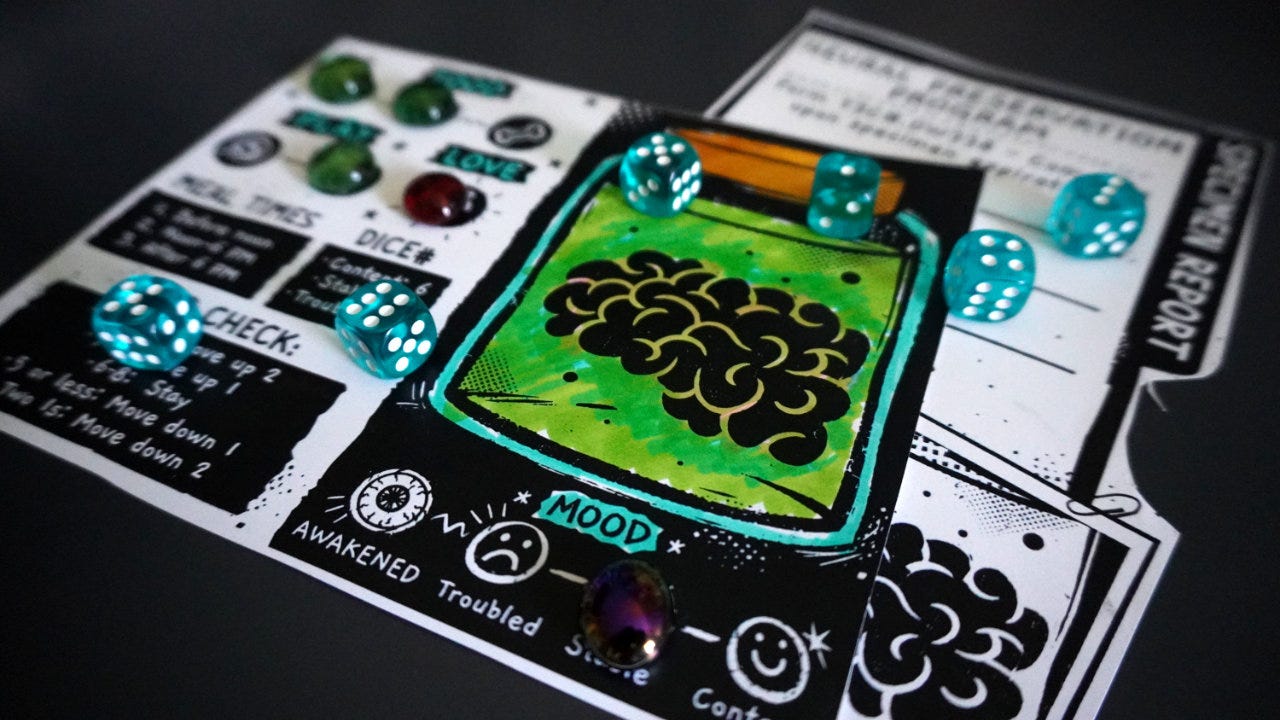
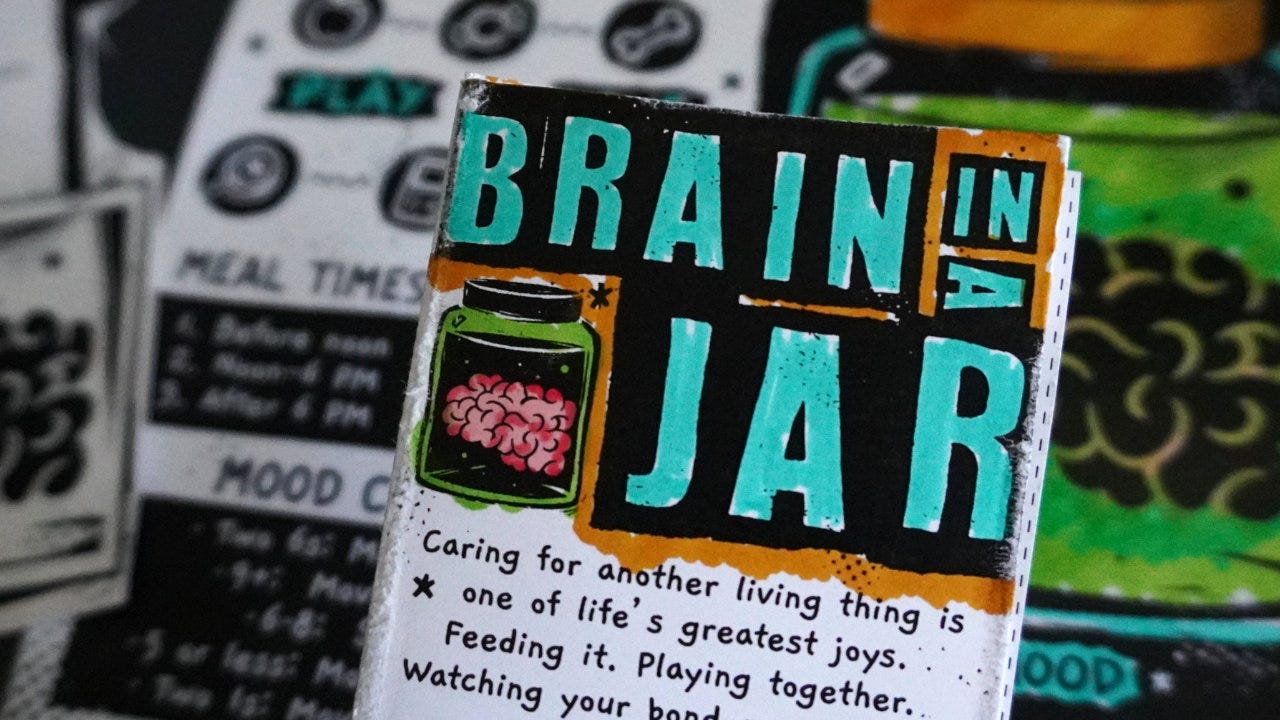
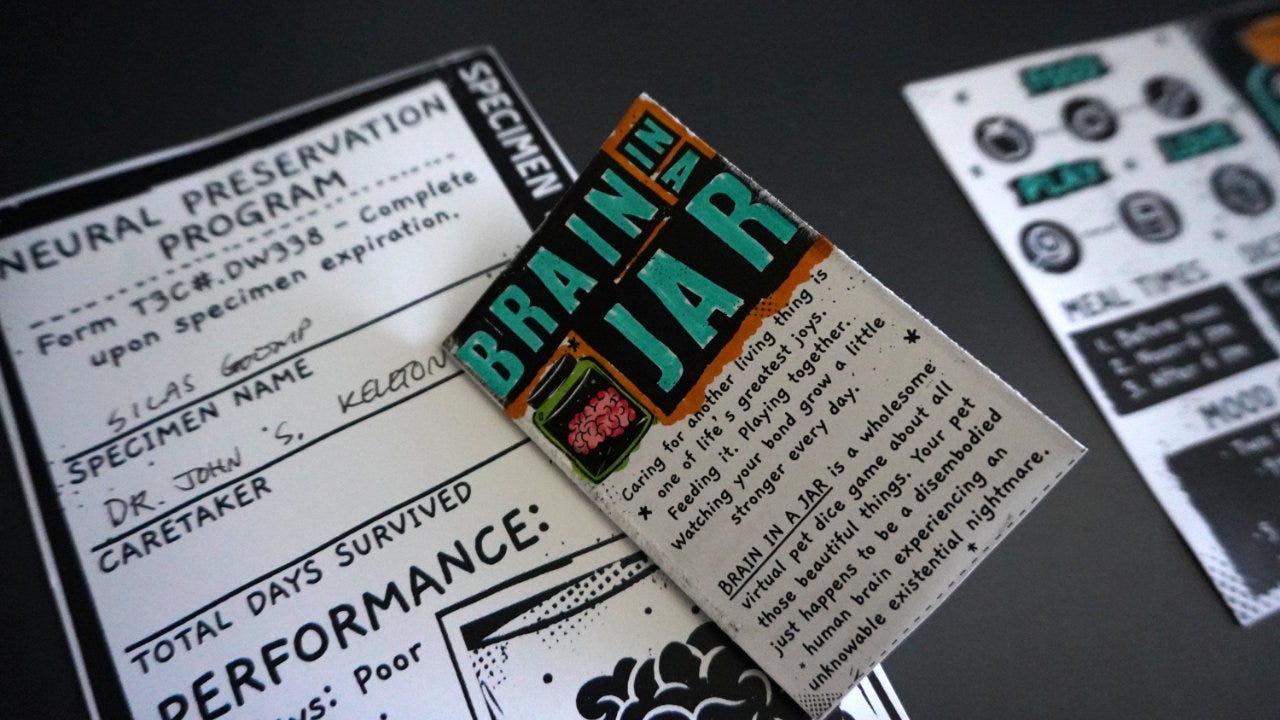
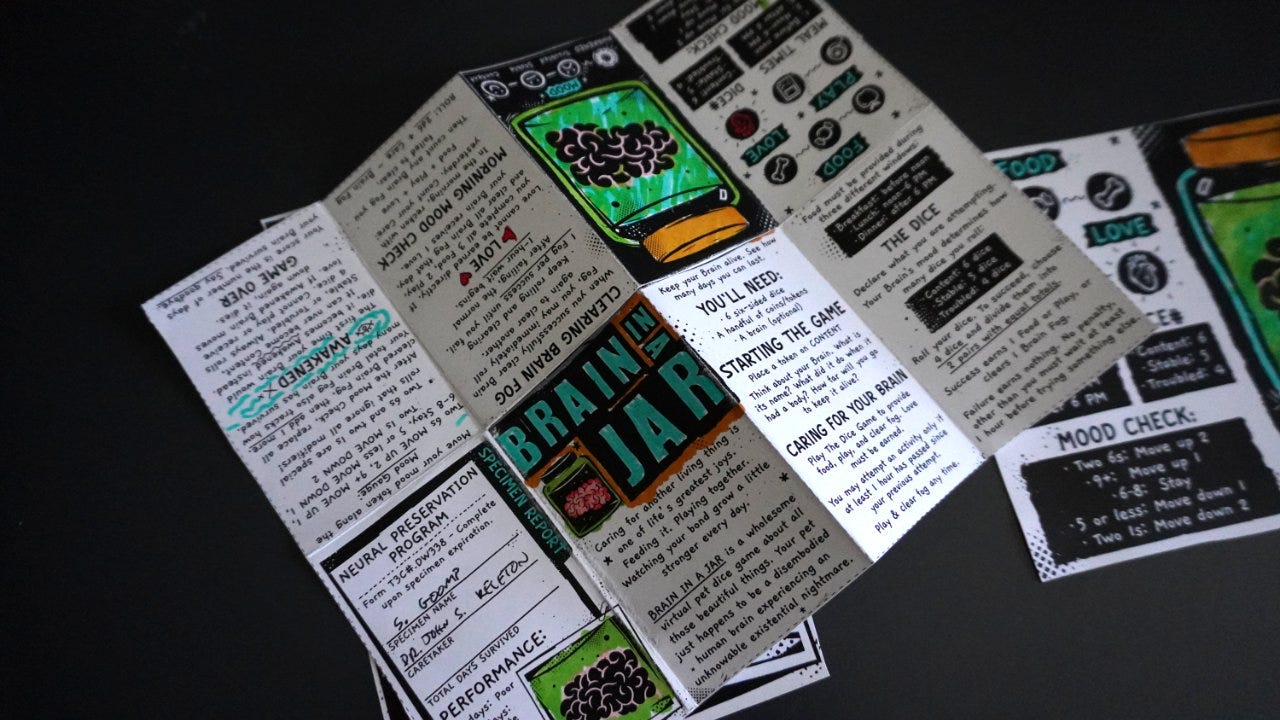
Brain in a Jar is a print-and-play analog “virtual pet” game from TechDweeb:
“Caring for another living thing is one of life’s greatest joys. Feeding it. Playing together. Watching your bond grow a little stronger every day. BRAIN IN A JAR is a wholesome virtual pet dice game about all those beautiful things. Your pet just happens to be a disembodied human brain experiencing an unknowable existential nightmare.”
Like A Ghost’s Story, it can be printed on a standard letter-sized page and then cut and folded into a little zine. With just eight tiny pages, it’s a compact game but also one that contains some interesting mechanisms.
It uses six six-sided dice (6d6) and a handful of tokens. Your little pet brain begins the game content, but keeping it satisfied will require some effort. Each day, you’ll need to roll the dice to provide food at the proper meal times. You’ll need to play with your brain in a jar. And you’ll need to periodically clear the ever-increasing brain fog that develops.
The game loop is very much like playing with a Tamagotchi. There are even real-world time restrictions for play. For example, food for breakfast, lunch, and dinner must be provided during specific windows of time. Breakfast must be served before noon and dinner after 6 PM.
Roll and split evenly
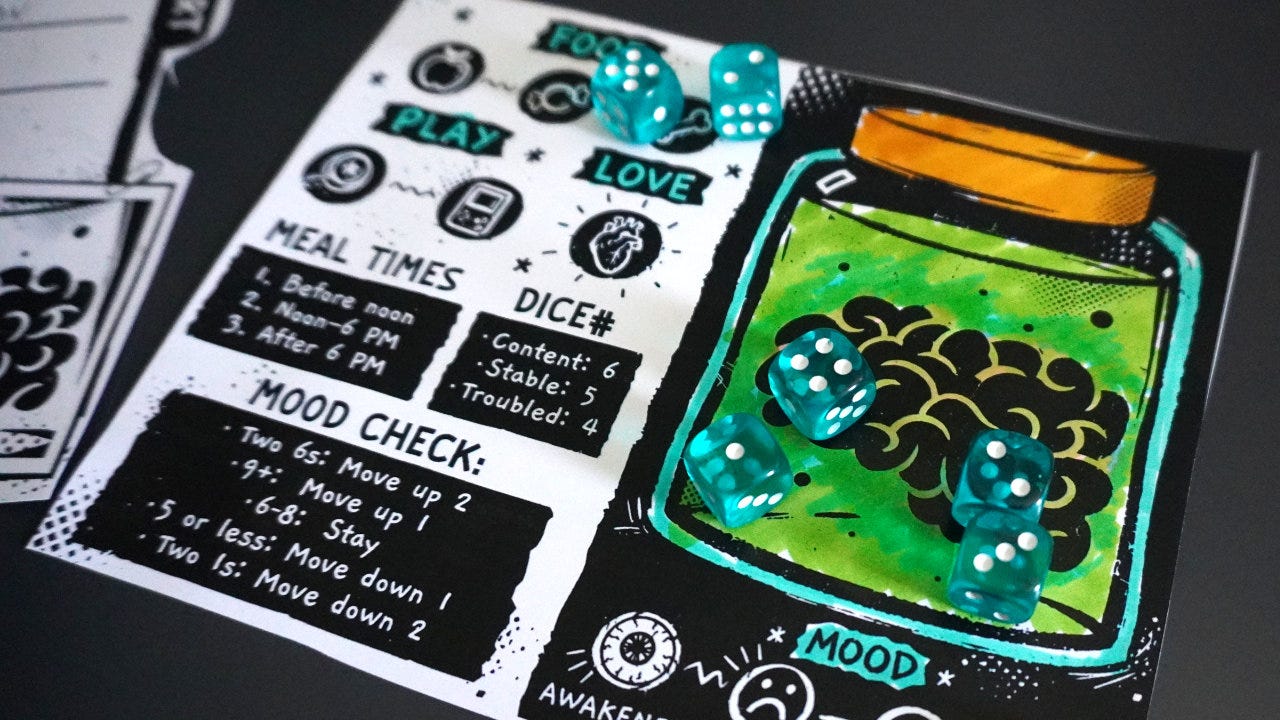
The core resolution mechanism of the game is rolling a pool of dice. At the start of the game and when your brain in a jar is content, you roll 6d6. Instead of trying to roll over or under a target number, you need to split the rolled dice into two equal groups. Choose any four of the dice rolled and divide them into two equal pairs (i.e. the sums of the pairs are equal).
For example: I roll 6d6 and get 5, 5, 4, 4, 3, 1. That’s easy because I can make two pairs of [5,4] and [5,4] and succeed (i.e. both pairs add up to 9). Alternatively, if I roll 4d6 and get 1, 3, 2, 2, I could make two pairs of [1,3] and [2,2] and succeed (i.e. both pairs add up to 4).
It gets a little trickier with fewer dice. As your brain’s mood deteriorates, your dice pool size shrinks. A stable mood grants 5d6. A troubled mood only grants 4d6. Regardless of how many dice are rolled, I need to choose four of them to form the equal pairs.
If I roll 4d6 and get 4, 2, 1, 1, it’s a failure even though I could divide them into two groups of [2,1,1] and [4]. Only pairs are allowed. No single dice. No groups of three.
Failure means nothing happens. No direct penalty is applied, but the attempt at gaining food or play is unsuccessful. More importantly, you can’t make another attempt for at least 1 hour of actual time. You’ll need to wait and try again later.
The exception to this is clearing brain fog — tokens that build up one-per-day and that, if not cleared, will impact your brain’s mood. On a successful dice roll (using the same mechanism as above), you can immediately try again to remove another brain fog token. This continues until you have a failure.
Mood check
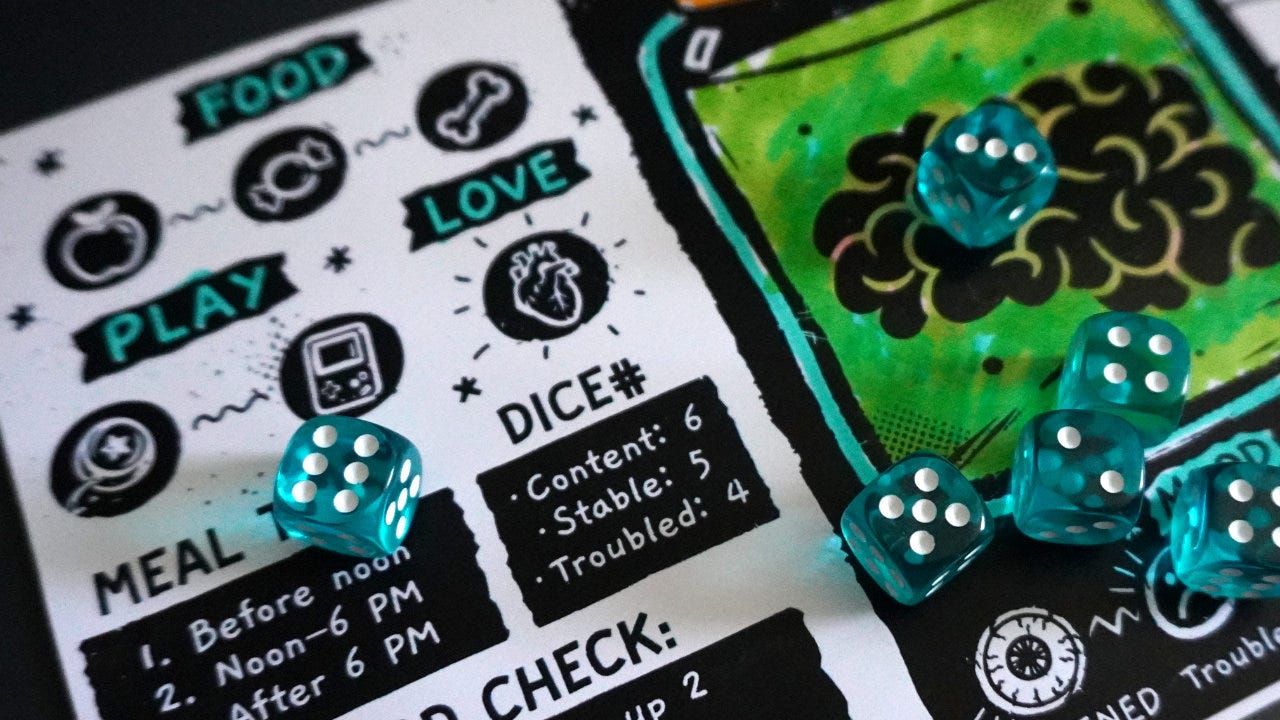
During the day, you make attempts to accumulate food and play tokens. Then each morning you need to perform a mood check. Roll 2d6 and add one for each food, play, and love token on your player mat. Subtract from that the number of brain fog tokens clouding your poor little brain. The result will cause the mood tracker to move up toward Content or down toward Troubled.
There’s a bit more to the game with a chance for your brain to become Awakened, but I’ll leave that for you to explore if you decide to give it a try.3
Probabilistically equivalent mechanism
I’ve previously mentioned probabilistically equivalent mechanisms and how you can have two different methods to achieve the same result. Rolling 1d6 with success on 1-3 is the same as flipping a coin with success on heads. Both have a 50% chance of success.
I’m not entirely sure of the chance of success for the Brain in a Jar dice mechanism (i.e. roll Xd6, choose 4d6, split into pairs), but I think it is something like 95% for Content (6d6) and 25% for Troubled (4d6).4
We could almost certainly come up with probabilistically equivalent mechanisms that would match these results. For example, we could say that you roll 1d4 for Troubled and success is when you get a 4. That’s roughly the same 25% chance of success as rolling 4d6 and making equal pairs.5
But would it feel the same? Probably not.
A quick roll and comparison to a target number would, to me, feel a little unsatisfying. It’s quicker, but that’s the problem.
If I want the game to feel like I’m caring for a Tamagotchi virtual pet, it needs to have a little more interaction. There’s no screen, dancing pet, buttons, bleeps, or bloops when playing analog games. That little bit of time to shuffle and sort the dice into two pairs takes their place. It makes it feel like I’m actually doing something to care for my brain in a jar.
That’s the part I found most interesting about Brain in a Jar. The dice mechanism is cool, but it’s also a great example of why the physicality of games and mechanisms matters.
You can’t design based on math and probability alone.6
Conclusion
Some things to think about:
Analog versions of digital games: I really like the core concept of Brain in a Jar: Can we make a tabletop version of a digital pet? This is certainly not the first time this has been tried.7 But that doesn’t matter. Starting with a favorite digital game is the perfect jumping-off point for a new design. This is a major topic in Tumulus Issue 8 and why the theme is “Insert coin to continue.”
Don’t just default to target numbers: Don’t get me wrong. I love systems that have you rolling dice versus a target number as much as anyone else. And yet, I think it’s worthwhile to consider how that mechanism fits the theme of a game. It may very well be the right answer, but there might be a different one that would be even better.
Probabilistically equivalent mechanisms: Any time I see a core resolution mechanism using dice, I think about how we could make a simpler probabilistically equivalent mechanism that would have the same chance of success. It is important to remember, however, that having the same success rate doesn’t mean it has the same feel in the game.
What do you think? Have you seen the roll and split dice mechanism before? Would this have a good use in board games or TTRPGs?
— E.P. 💀
P.S. Subscribe to Tumulus and get four quarterly, print-only issues packed with game design inspiration at 33% off list price. Limited back issues available. 🩻
Skeleton Code Machine is a production of Exeunt Press. All previous posts are in the Archive on the web. Subscribe to TUMULUS to get more design inspiration. If you want to see what else is happening at Exeunt Press, check out the Exeunt Omnes newsletter.
Skeleton Code Machine and TUMULUS are written, augmented, purged, and published by Exeunt Press. No part of this publication may be reproduced in any form without permission. TUMULUS and Skeleton Code Machine are Copyright 2026 Exeunt Press.
For comments or questions: games@exeunt.press
Tamagotchi have been around since 1996 and have gone through many different versions and feature changes. I’m not a Tamagotchi expert, so these descriptions may not apply to all versions. I tried a Tamagotchi once and found it absolutely infuriating. I appreciate that people enjoy them, but the little beeping egg was not for me.
I’m using the Bandai-Namco Fact Book 2025 as my source for this.
You can also check out the BRAIN IN A JAR video by TechDweeb. It explains everything, including the background behind the game.
Probability math is always a struggle for me, which is why I usually end up writing a Python simulation to try to guess at it instead. If you have a better, more rigorous answer for this question, please feel free to share it in the comments.
This assumes the 25% chance is correct. I think it is, but even if it is incorrect, my point still stands. The actual number doesn’t matter. Whatever it may be, we can choose some other polyhedral die or set of dice and make an equivalent roll over or roll under target number system. If 25% is correct, it just makes the example easier.
Well, technically you can. I’d argue you probably shouldn’t. ;)
Personally, I'm not very interested in this subject. I need more depth that a pet rock for game material. Call me mainstream or traditional, but trains, space, and dragons are far more intriguing. The mechanic is valid, just the subject misses.