
TTRPG Bookmark Jam
Unknown Dungeon, best known for the annual One-Page RPG Jam, is running a two-week TTRPG Bookmark Jam.
Participants can create a TTRPG or TTRPG-related bookmark — full rules, solo games, random tables, procedures, player aids, or anything else related to the roleplaying game genre.1 It’s pretty broad.
There are specific rules and an FAQ for clarification, but in short:
Submissions must fit onto a single, standard-sized bookmark.
No extra sheets, parts, or components are allowed.
The submissions may require players to bring dice, pencils, paper.
It’s an extremely tight design space as most bookmarks are 2x6 in., 2x3.5 in., or 2x8 in.2 But “restrictions breed creativity” and constrained writing is a proven way to force yourself into new ideas.3 So, as a huge fan of making one-page RPGs, I decided to give the bookmark format a try.
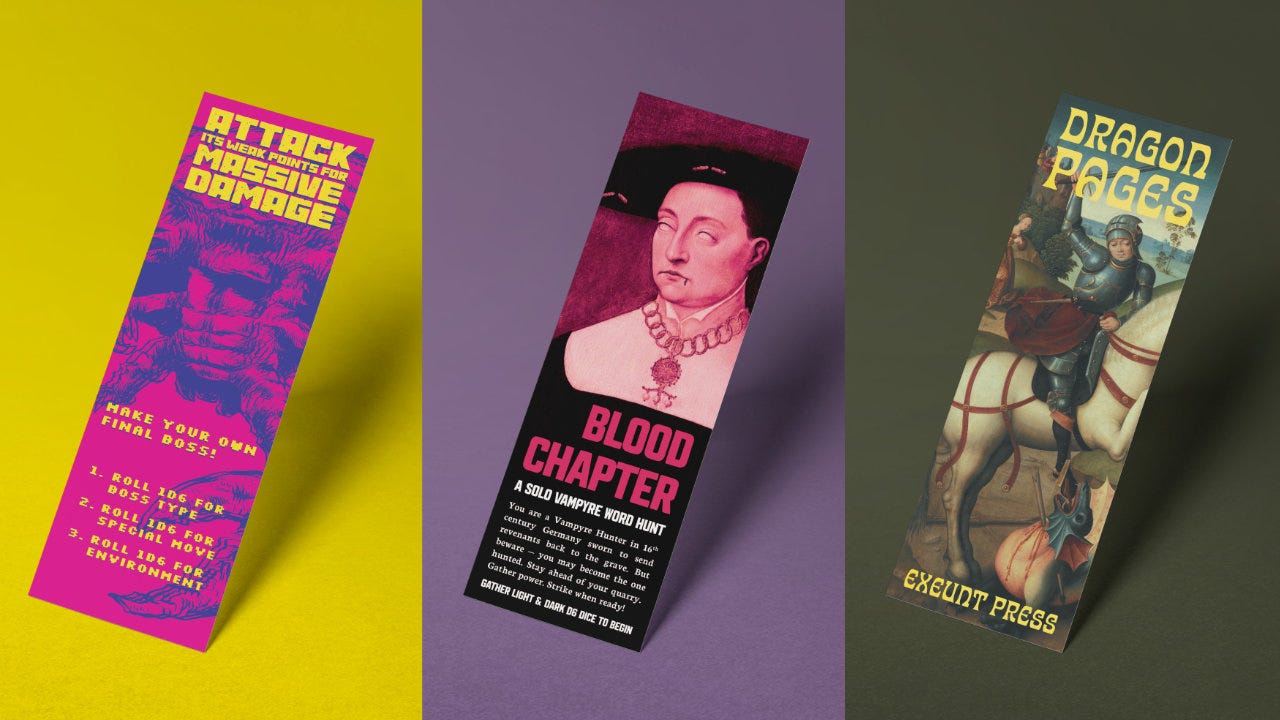
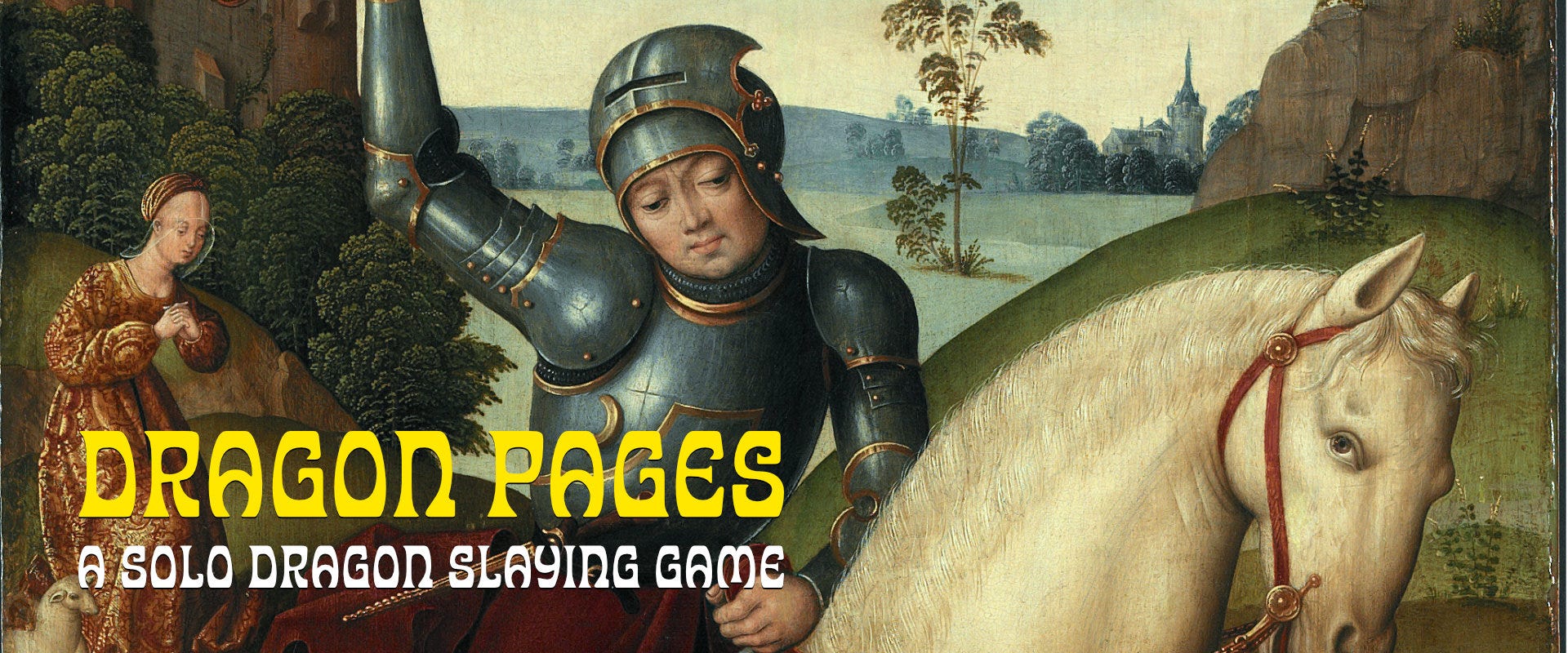
Please grab free community copies of Blood Chapter, Dragon Pages, and Massive Damage to check out. I’d love to hear what you think!
What follows are some of the things I learned. Hopefully these will help and encourage you to make your own!
Types of TTRPG bookmarks
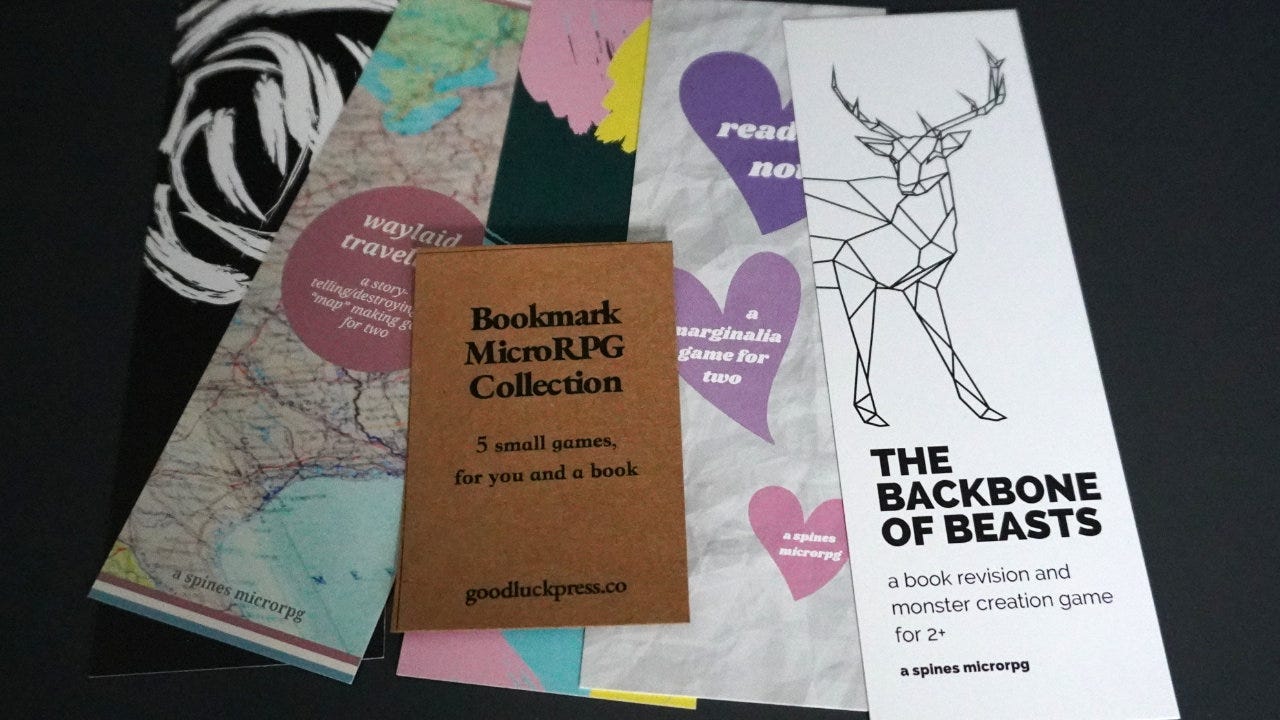
I recently asked for examples of the best TTRPG bookmarks and spent some time hunting through the submissions from previous game jams. The variety in type, scope, and style was extraordinary. There’s no way I’d be able to list everything here, so instead my goal is to give some broad ideas to get you started.
Here’s my non-exhaustive list of different types of TTRPG bookmarks, presented in no particular order:
Word/sentence story building: Players are asked to use a book (or books) to select random words, sentences, or phrases. They then use an overarching framework (e.g. spirits in a haunted library) to collaboratively create a story. This might include circling, underlining, or otherwise marking words to create something within the text. For example, The Backbone of Beasts has players “block out, circle, [and/or] highlight” words across 1-2 pages to create strange animals.4
Solo journaling: These games have you assume a role and then provide a mechanical framework to generate prompts to create a narrative story. For example, in Spell Book you are a magician recording spells hidden within the pages of the book you are reading. Using a timer while reading, you periodically stop and “discover” a spell hidden on the page based on the page number sum and first letter of the first word (e.g. 1-3: Offensive, 4-6: Protective, 7-9: Transformative, and A/B/C: Fire). Headcannon also has you create a solo story, but uses holes punched in the bookmark instead of page numbers.
TTRPG with rules: Lari Assmuth’s What’s So Cool About Kobolds is a good example, packing an entire multiplayer TTRPG (GM + players) into the two sides of a bookmark. This includes character generation, how to do stuff (d20), and a GM guide. This can also be a less structured story game like Etched in Stone.
Dungeon crawl with/without rules: A solo dungeon crawl similar to Dark Fort can fit onto a bookmark, as shown by The Cheese Caves. It has a combat mechanism, character generation, and even includes a six-room map. Sometimes the bookmark is a dungeon that can be used with Knave or other existing systems, with Wily Witch’s Townhouse as an example.
Random tables: Instead of a full, playable game, the bookmark can simply be a random table to use with other games. It doesn’t need to be tied to a book and is a stand-alone supplement. Examples include I Loot the Peasant with d100 minor fantasy items and Massive Damage which generates a final boss monster. I’d also include oracle tables like Portents & Curses of the Price of Gorse in this group.
Competitive game: It’s possible to fit a full “board game” style game on a bookmark, including rules and victory conditions. Christmas Tree Cat-astrophe by Big Puffin Games is a game for two cats about racing up the tree to be the first to knock off the star. The front of the bookmark acts as a board with numbered spaces and the back contains the rules. Players take turns rolling dice and moving up the tree in a Can’t Stop (Sackson, 1980) style game.
Meta games: These probably overlap with the word/sentence story building games above, but are worth calling out. In Peter Eijk’s In the Margins, players mark up an existing, filled journal (perhaps from another journaling game). Accusations of truth or lying are made and then the player writes in the margins, corrects mistakes, and adds footnotes.
I’m not sure where I’d position Blood Chapter and Dragon Pages on this list. They use words from the book but act like solo journaling games.5 Massive Damage is firmly in the random table category.
It’s worth noting that bookmark games are very close to postcard games. I’ve opted not to include postcards in the scope of this article, saving them for another time. There’s a lot to talk about with that format ranging from the postcard games by Paul Czege to the wargames of the Postcards from the Front Jam.
Avert! accountability bookmark
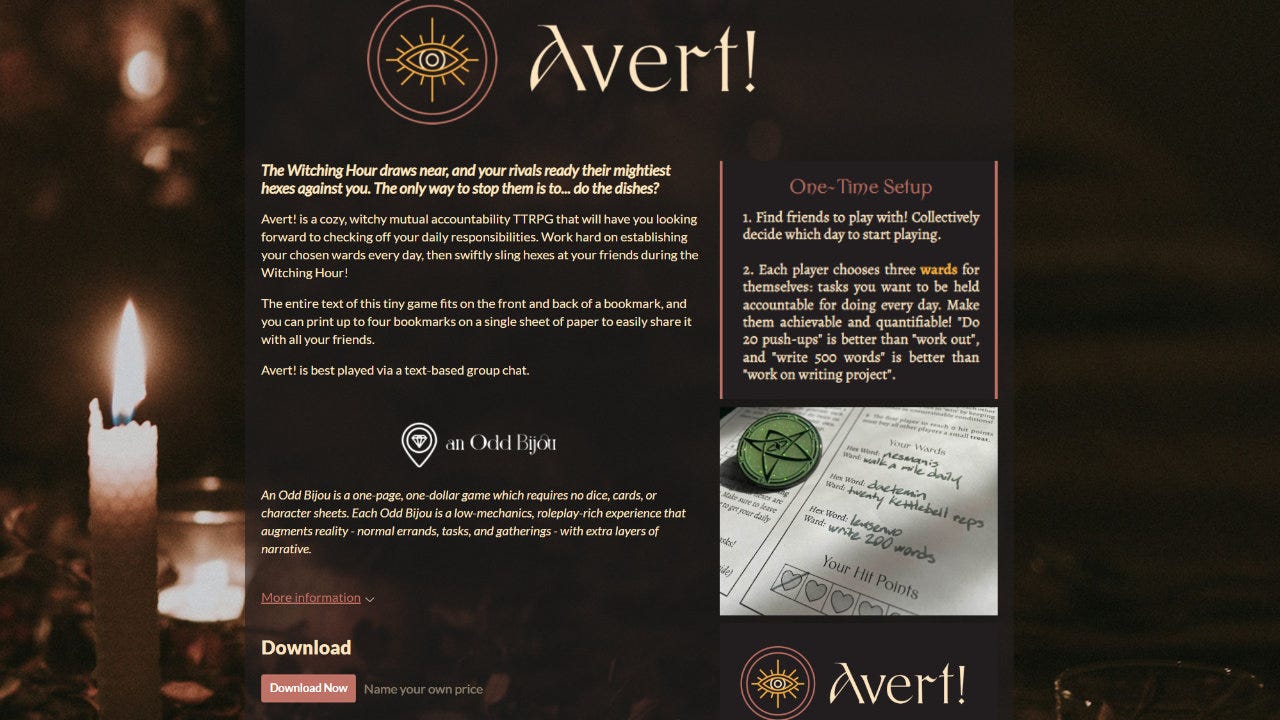
Showing just how much game can fit into a bookmark, Avert! by S. Kaiya J. is a bookmark game about “mutual accountability and hexing your friends.”
Each player has a copy of the bookmark which contains instructions for creating a hex word (e.g. 2d6 → “kormanis”). Everyone chooses three wards (i.e. tasks) that they want to be sure to accomplish every day: go for a walk, write 500 words, or read a chapter. Then, at a predetermined witching hour each day, players can send their hex word to another player attempting to catch them with their task not done. Get caught and you are downed and lose a hit point.
It’s an interesting mix of tabletop game and real life in a format that could easily fit into a small bag or pocket.
Book-related mechanisms
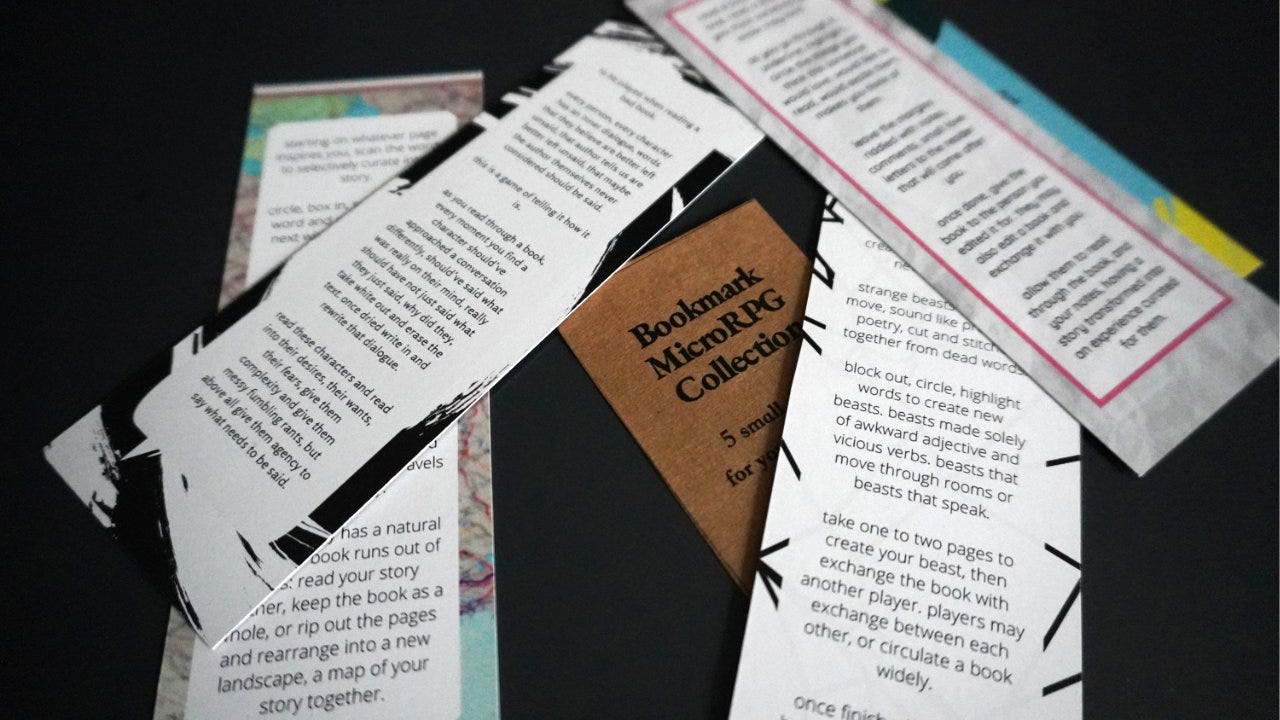
The most fun part of the jam for me was thinking about tabletop game mechanisms that could both easily fit on a bookmark and use an actual book. Again, the following list is not exhaustive, but hopefully sparks some ideas for you:
Count capital letters in the first line to generate a number.
Count paragraphs on a page.
Use the first full word on a page, ignoring articles and prepositions.
Find a paragraph that mentions a body part.
Use the copyright year as a number.
Find the longest or shortest word in a line.
Toss the bookmark in the air and call heads or tails as it lands.
Use the first letter of the first word on a page or in a line.6
Hunt for a list of specific target words.
Hunt for a general class of target words (e.g. types of weapons).
Of all the mechanism I came across, however, the digital root is my favorite.7 To calculate a digital root, you simply take a random page number of any length and iteratively sum the digits:
Select page number: 245
Add the digits: 2 + 4 + 5 = 11
Add the digits: 1 + 1 = 2
The digital root of 245 is 2.
In base 10, this has the helpful property of always resulting in a number from 1 to 9. This is true regardless of the size or magnitude of the number. The digital root of 2048 is 2+0+4+8 = 14 → 1+4 = 5.
Both Blood Chapter and Dragon Pages use this for combat by comparing the digital root to a die roll.8 The page number is selected based on the location of various target words or the position of the bookmark in the book.
Make weird games
Even if you’ve never made a game before, I encourage you to try your hand at making a bookmark game. Just like making a one-page RPG, it’s a small design space that makes it easier for new creators. Don’t worry about how it looks (although public domain art can help with that) or if it’s polished.9
Make stuff not because it is perfect and slickly made.
Make stuff because it’s fun, and engaging, and because you can.
The TTRPG Bookmark Jam runs until December 14th 2025 at 6:59 PM.
Conclusion
Some things to think about:
Small format is fun: Just like making your own one-page RPG, working within the restrictions of a 2x6” bookmark or a small postcard can be a rewarding experience. It might seem like it would be a tougher challenge to work in such a small space, but I’ve found it to be easier. And you are more likely to actually finish the project!
Books can be used as components: Cards, dice, and other components are all just ways to store information and books are no exception. Beyond the obvious words and page numbers, consider the weight, size, shape, and orientation of the book.
Make a bookmark: Do it. Roll some dice on the Theme-O-Matic and pick some mechanisms. Add some public domain art and you’ll have a game in no time. There are few things as satisfying as creating something new and sharing it with others. Trust me.
What do you think? Have you made or played a bookmark TTRPG before? Which ones did you find the most interesting? Tell us about the one you are making!
— E.P. 💀
P.S. Subscribe to Tumulus and get four quarterly, print-only issues packed with game design inspiration at 33% off list price. Limited back issues available. 🩻
Skeleton Code Machine is a production of Exeunt Press. All previous posts are in the Archive on the web. Subscribe to TUMULUS to get more design inspiration. If you want to see what else is happening at Exeunt Press, check out the Exeunt Omnes newsletter.
Skeleton Code Machine and TUMULUS are written, augmented, purged, and published by Exeunt Press. No part of this publication may be reproduced in any form without permission. TUMULUS and Skeleton Code Machine are Copyright 2025 Exeunt Press.
For comments or questions: games@exeunt.press
There was also a Bookmark Game Jam hosted by Diwata ng Manila in 2020 that had 71 entries and a Bookmark Microgame Jam hosted by Sparuh in 2023 with 37 submissions. Both are good sources for research and inspiration.
If you’ve ever placed an order at the Exeunt Press Shop and received a bookmark in your package, those are typically 2” x 6” on 130 lb. satin cover stock.
Constrained writing is when there are (often arbitrary) rules placed on the writing such as not allowing certain letters (e.g. Gadsby) or requiring a specific length (e.g. only six words). My favorite might be Pilish writing where the lengths of consecutive words or sentences match the digits of the number pi.
The thought of writing in a book, blocking out words, and otherwise marking it gives me heart palpitations. A long time ago, I bought a copy of Keri Smith’s Wreck this Journal and utterly failed at using it.
They are both low/no mechanical agency games. I’ve discussed how a lack of player agency can still create an engaging player experience previously.
I would guess letter frequency would come into play here. And only semi-related, the California job case is really interesting.
There are many other interesting properties of digital roots that I’m not able to cover.
Note that if you are using a d6 vs. digital root target number in a “higher is better” system, you will always fail if the root is 7, 8, or 9. This works if you want an intentionally hard (i.e. high failure) system. Alternatively, you could turn it into a “lower is better” system where you have to roll under the target number, flipping it to automatic success for digital roots of 7 or higher.
See my discussion of making things that are crude, amateur, and small in the context of making one-page RPGs.
"Make stuff not because it is perfect and slickly made.
Make stuff because it’s fun, and engaging, and because you can."
TRUTH
I'd never heard of a bookmark game before, but after reading your post last week then downloading Dragon Pages and Blood Chapter, I thought I'd give it a go!
I've now written two, with a third on its way, and then I'll see about trying to format them for the jam. Never formatted before, so 'crude' and 'amateur' are something I aspire to!
Dragon Pages and Blood Chapter are inspirational btw!