
If you missed them, check out Part 1 and Part 2 of my Making Better Maps series that was recently posted. They will change how you think about game maps.
This week we are looking at a little Knizia example game that I can’t get out of my head ever since I read about it.
Cards and dice with Dr. Knizia
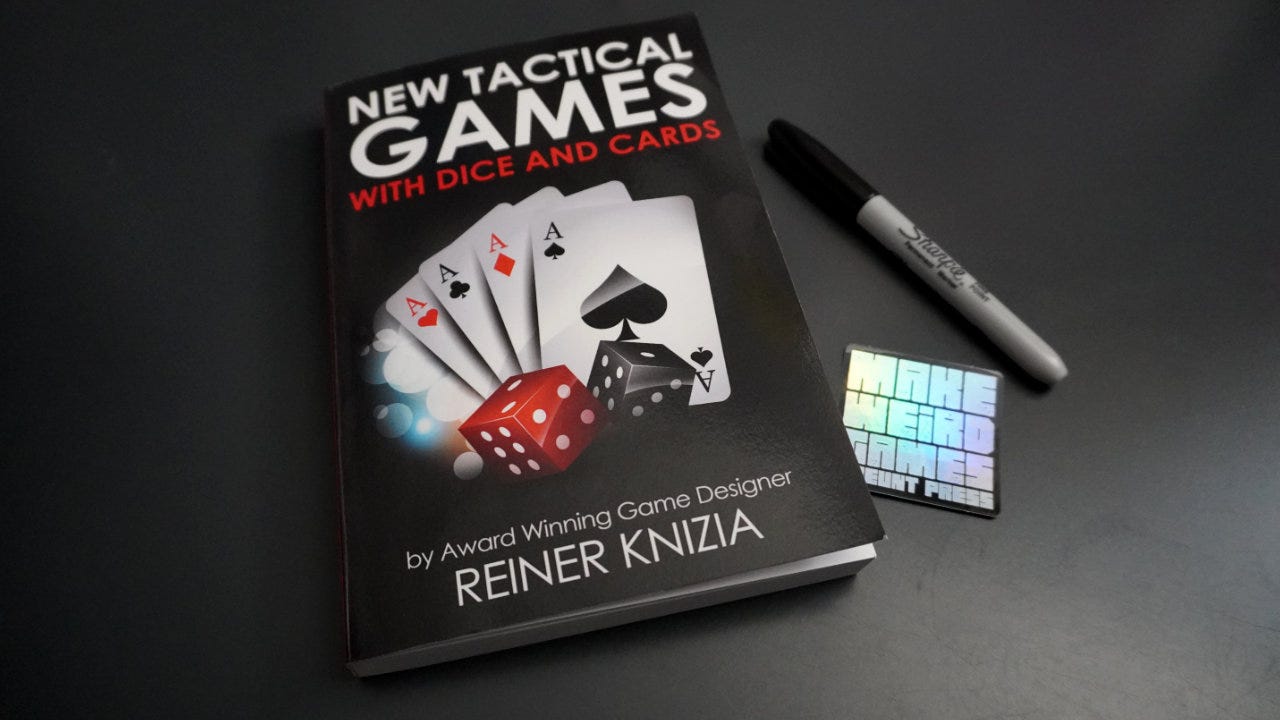
I’ve written before about Reiner Knizia and why you need to know who he is before. He’s best known for his over 700 published board game designs, most of which feature simple rules, hard choices, and not much theme. He is lesser known, perhaps, for his game design books — one of which I recently picked up.
New Tactical Games with Dice and Cards (Knizia, 1990) is a book of playable game rules, all of which use basic coins, dice, and playing cards. It is so playable that the book even has its own entry on BGG as a board game.
Each game has rules, some variants, suggestions, and sometimes a guide to strategy. It’s wonderful for inspiration and to see how the “Doctor of Board Games” thinks about game design. Importantly, most are so mechanically simple that they could be adapted and dropped into a TTRPG fairly easily.
It’s the first game in the book that has really captured my imagination: Goal.
A soccer game with cards
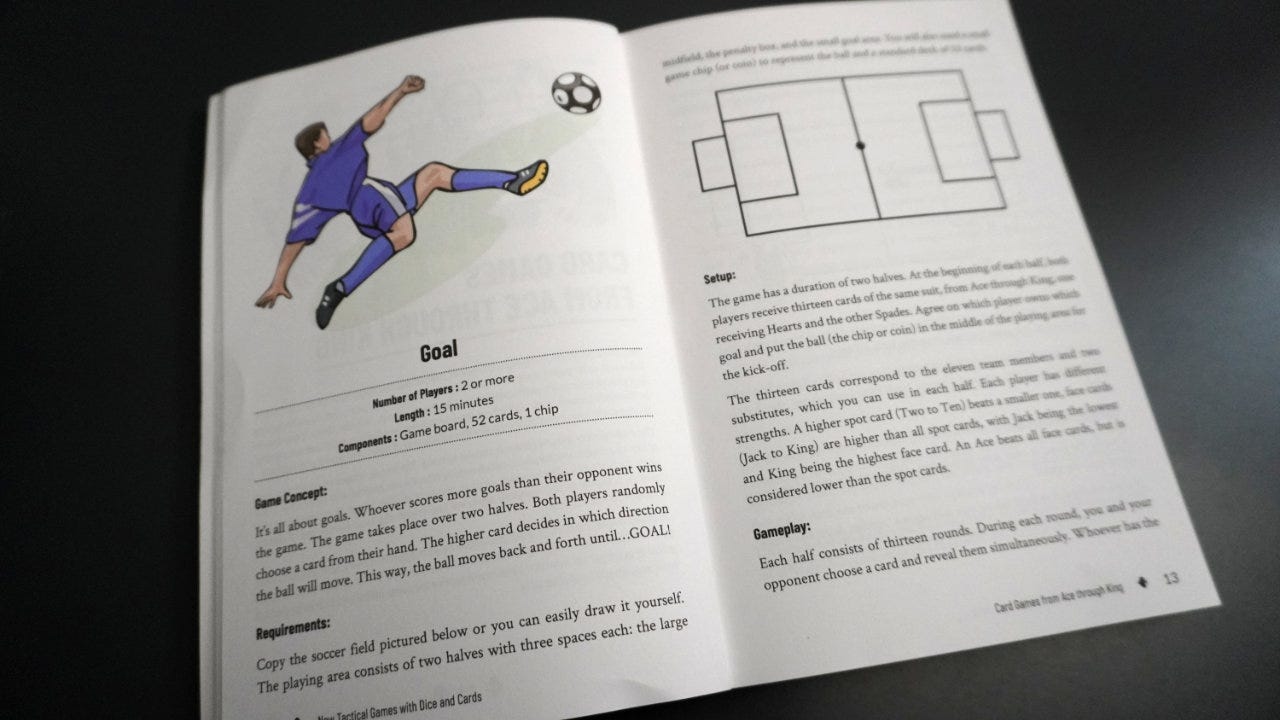
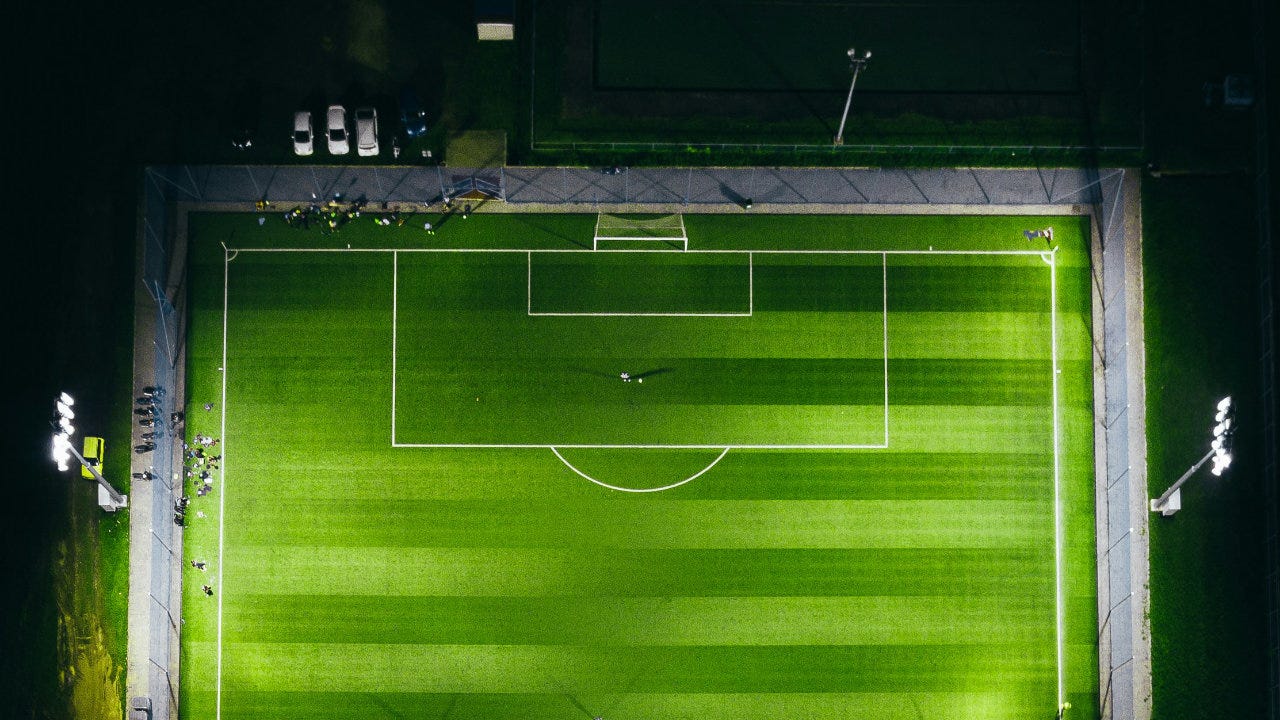
Goal (p. 12) is a quick card game for 2 or more players, meant to be played in about 15 minutes. It requires a simple game board, a standard poker deck, and 1 chip or token.
The game simulates a soccer game, taking place over two halves. The player with the most goals at the end wins. Here’s how each half works:
Each player receives 13 cards of the same suit Ace through King.
The ball (token) is placed at the center of the board.
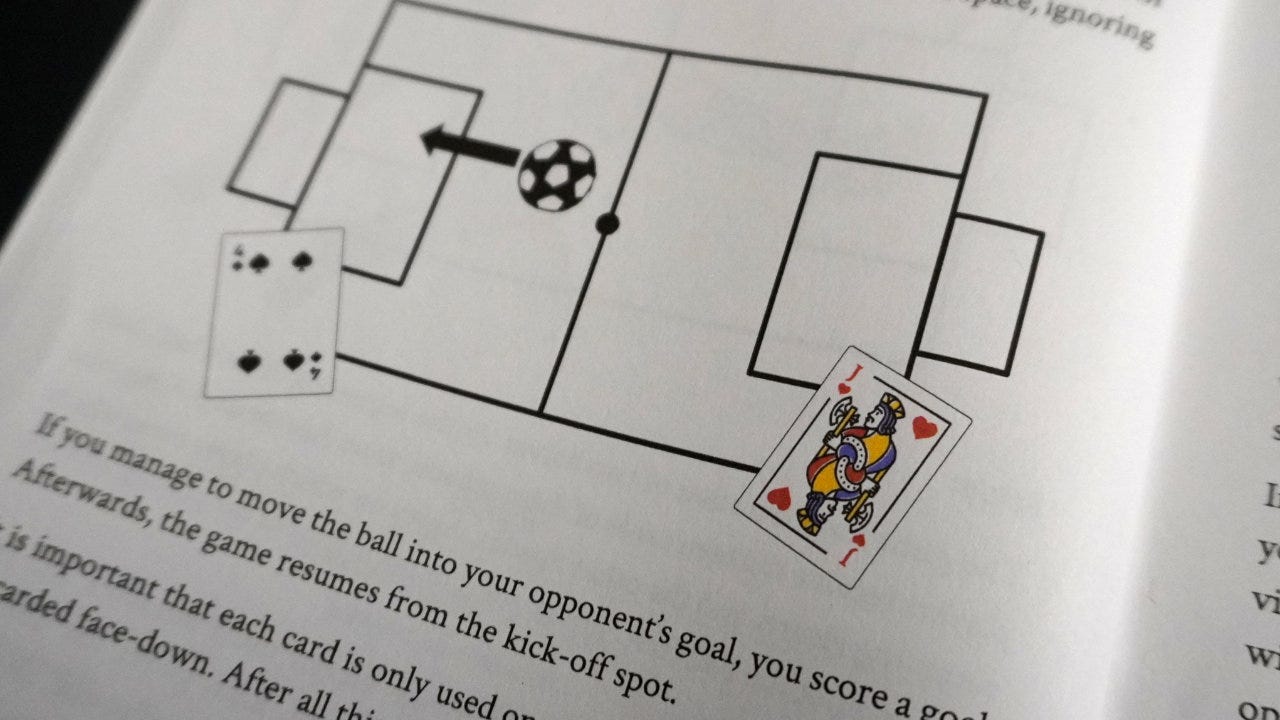
Each player then simultaneously reveals one of their cards from their hand. The higher card wins and moves the ball one space toward the opponent’s goal. Nothing happens on a tie.
The revealed cards are discarded face-down and may not be used again that half.
If the ball makes it to a goal, a point is scored.
Hands are reset at the end of the “half” when all cards have been played.
If the power of each card were simply the rank, it wouldn’t be that interesting of a game. The twist is that there’s a little more to which card beats another.
Aces and spot cards
Instead of a simple “aces low” ranking where power increases with rank from ace up to king, Knizia uses the following:
Higher spot cards (2 through 10) beat lower ones, as expected
Face cards (jack through king) beat all spot cards
Higher face cards beat lower ones based on rank (jack, queen, king)
Aces beat all face cards but lose to all spot cards
The first three points above are pretty standard in simple card games like War. The fourth point about the ace is what makes the game interesting. Knizia explains this in the game tactics (p. 15):
“The Ace has exceptional position compared to the other cards. As long as you have your Ace, your opponent will be plagued with uncertainty — especially in critical situations in front of the goal: you could use the Ace against his face cards. If he tries to beat your Ace with a spot card, you could surprise him with an even higher spot or a face card.”
If you have your ace in your hand, your opponent is never quite sure what to do. They could, of course, play spot cards to handle your ace, but they need to be certain you are actually playing an ace. On the other hand, you only have one ace. Play it too early, and you’ll be at the mercy of your opponent.
It’s a game of card counting, trying to beat each of your opponent’s cards with the least amount of “overkill.” As Knizia notes, “To beat a 4 with a King is a costly victory, as your opponent will save important resources for later.”
Sometimes it makes sense to intentionally lose a round just to force your opponent to waste a high-value card on a relatively low value one of your own.
Adapting for other kinds of games
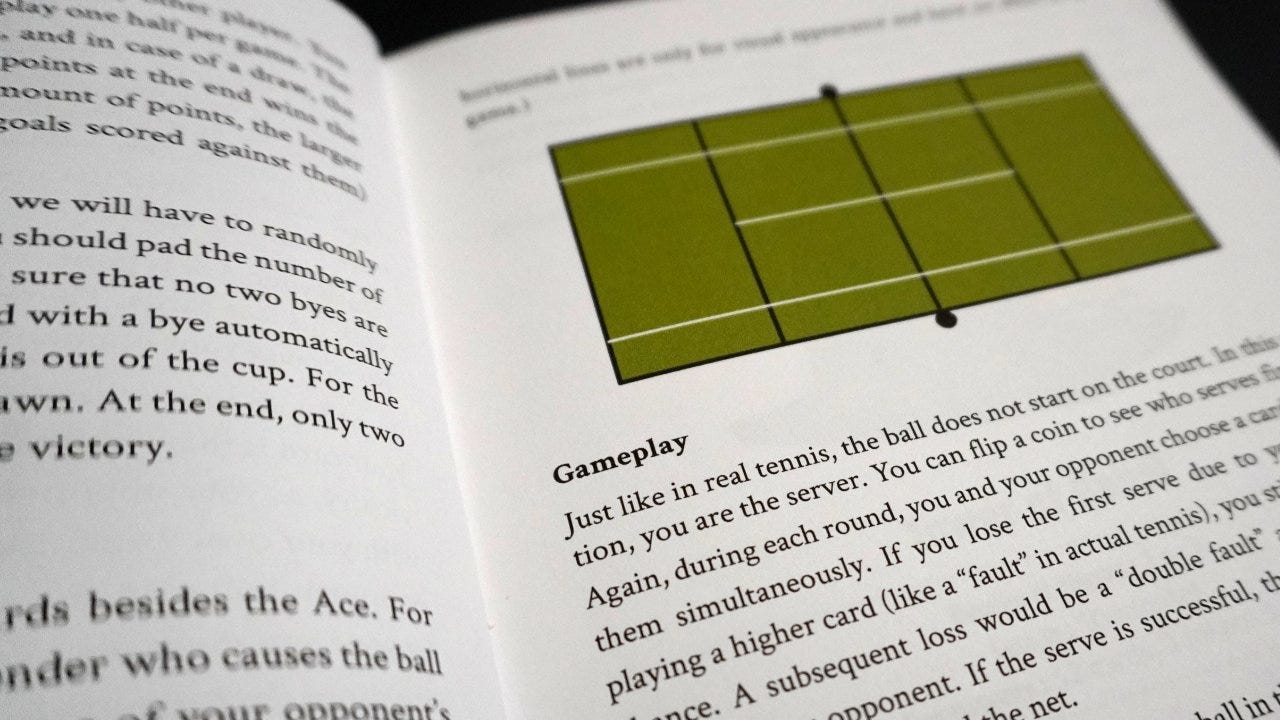
Knizia’s suggestions for additional rules and variants are all sports themed: card abilities based on player positions and turning the game into a tennis match. They are interesting, but I keep wondering how this could be turned into a different style of game. More than just swapping out the (very light) theme, how could we turn this core mechanism into something?
A few thoughts come to mind:
A larger map: The soccer board has a center point (start) and two field spots on each side. There’s a goal on each side as well for a total of 6 spaces.1 What if we had a lot more spaces? Could we play this on a hexcrawl map or pointcrawl map?
Terrain-based effects: The suggested special powers include nullifying movement that round or moving the ball two spaces instead of one. I do like the idea of certain abilities only being triggered if the card is used when the token is in a specific location on the board. Combined with the above, we could have cards that are more powerful based on terrain (water, land, etc.) or specific locations (wizard tower).
Slower pace: If the simultaneous card reveal were just part of a larger game, the pace could be slowed way down. It might happen only once per larger round, acting as a tempo control for the game.
Acquire cards: In the base rules, each player receives their full set of 13 cards at the start of the game. What if you only received some of those cards and had to choose to earn additional cards in some other manner? Deciding when and which cards to gain becomes an interesting decision, especially if one could acquire more than one of a rank. This would probably only work with the “slower pace” variant above.
Solo mode: While I’m not sure it would work, the opponent cards could certainly be drawn off the top of their deck at random. This would allow the game to be played solo, but greatly reduces the strategic decisions. It becomes almost purely a card-counting game. It might result in garbage time if not handled carefully.
That’s five mechanical changes that I think would take this small soccer game and turn it into part of something larger. They mostly ignore re-theming, which would be just as important. Are the cards spells for dueling wizards? Are they apps used by a hacker breaking into a corpo server?
As I’m most familiar with MÖRK BORG, I could see a use for this as the Calendar of Nechrubel is advanced in the game. There could be a chance to play a card vs. the GM each time a new Misery is triggered that results in some larger impact on the game world.2 Being able to earn cards through adventures during a campaign would feel significant, knowing you’ll need them later. Alternatively, the players could gain all their cards at the start and watch them dwindle as each is used.
Either way, it could be a fun method players can use to postpone the inevitable in-game apocalypse.
Simple games for big inspiration
While I think the best way to gain game design inspiration is to just play as many different games as you can, there is something special about very simple games. They allow me to focus on just a tiny aspect of mechanisms and wonder how it could be used.
In this case, Goal is basically two players flipping up cards at the same time and the higher one wins. The change to aces shows, however, how tiny twists in rank can have large strategic impacts. The tight board space makes me wonder how it would work with a large board. It’s fun to take each little aspect of this game and think about how to invert it (e.g. earn cards instead of starting with them).
As an exercise this week, pick a simple card game or dice game. Think about how you could use an isolated mechanism from it in a novel way, or how to invert some part of it to make it more interesting.
Conclusion
Some things to think about:
Reiner Knizia never fails to inspire: I often say that while Knizia games aren’t always my favorites of all time, I always enjoy trying a new one. I always feel inspired, learn something new, or otherwise just increase my appreciation for his designs.
Simple games as a base: At least here in the United States, you can’t copyright game mechanisms. Finding a simple or traditional game and using it as a base for a new design is a good way to get started. I’ve found that by the end, the original inspiration is often no longer recognizable.
Inverting concepts to generate new ideas: As with the ideas for adapting Goal into a larger game above, think about how you can invert mechanisms. If something uses a tiny, symmetric board, think about how it would be different with a large, asymmetric one. If a game uses a lot of cards, what would it look like if it had half as many cards?
What do you think? Could you think of a way to integrate the Goal game (or some variant of it) into a TTRPG? Have you seen something like this in a game you’ve played?
— E.P. 💀
P.S. Be a weird little mushroom. You know you want to. 🍄🍄🍄
Skeleton Code Machine is a production of Exeunt Press. All previous posts are in the Archive on the web. Subscribe to TUMULUS to get more design inspiration. If you want to see what else is happening at Exeunt Press, check out the Exeunt Omnes newsletter.
Skeleton Code Machine and TUMULUS are written, augmented, purged, and published by Exeunt Press. No part of this publication may be reproduced in any form without permission. TUMULUS and Skeleton Code Machine are Copyright 2026 Exeunt Press.
For comments or questions: games@exeunt.press
The center point is only used on the initial kick-off and not once the game has started. You could consider that to be a 7th spot. I’m ignoring that in this case and just saying there are 6 spaces that are used during gameplay.
Some day I’m going to finish my series of MÖRK BORG adventures that are all linked to the Miseries in the game. Three are already done, although I’d like to rework them. If I do, there’s a good chance you’ll see a card-based system like this in it.
Great article. Got some more inspiration for if I ever want to expand the TOTAL FOOTBALL one-page rpg I made for the jam recently 😁
Great little mechanism! I could see a version of this being used as an entire TTRPG combat system. PCs have a small number of cards granted by their weapons/gear (maybe a 2, 4, and 9). Enemies come with a fixed set of cards. A small enemy (skeleton) might just have a 7 and a 3. Each round, each combatant can play a card against one target (the one they are attacking). In a 1-on-1, the higher card wins. In a 2-on-1, the higher card wins from the matched attacks, but the "unguarded" attacker gets a free hit. You have to use all your cards before you get any back, so that skeleton can make one hard hit and then a weak hit. Higher strength enemies get a stronger hand and can play more cards per round. Players learn what cards are held by which enemies, theming in learning how an enemy fights. I dunno...might be something there.