
First, I must apologize. I sent out last week’s We Are Mushrooms announcement with a broken link to the shop. The link has been fixed, so I encourage you to try it again!
This is Part 1 of a multi-part series on making better maps by thinking about them as graphs and data, based on a talk I gave at Harrisburg University in March 2026.1
The goal of this first part of the talk was to give everyone an improved vocabulary for discussing maps during the rest of the hands-on session.
Draw a map of your neighborhood
This week’s article is going to be hands on. Go grab a pencil and paper. I’ll wait here until you get back.
Done? Ready? OK.
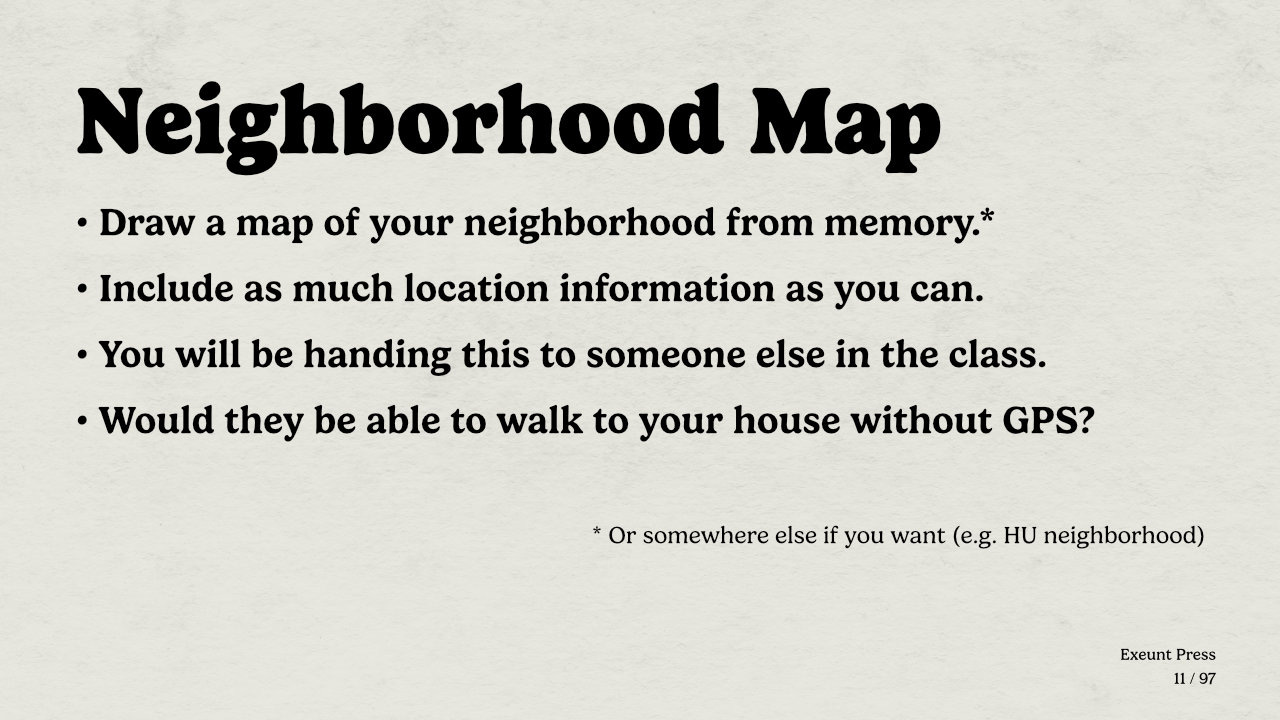
Draw a map of your neighborhood on the paper from memory.2 Don’t use your phone, online maps, or outside reference material. Just do it completely from memory.
Include as much detail and location information as you can. I’m not going to give you any other instructions or specific requirements than that. Just pretend that you are going to hand this map to someone else. Think about whether they would be able to walk to your house without using GPS?
Got your map done? If so, we shall continue!
Cognitive vs. physical maps
If you did the exercise above, you just made a map!
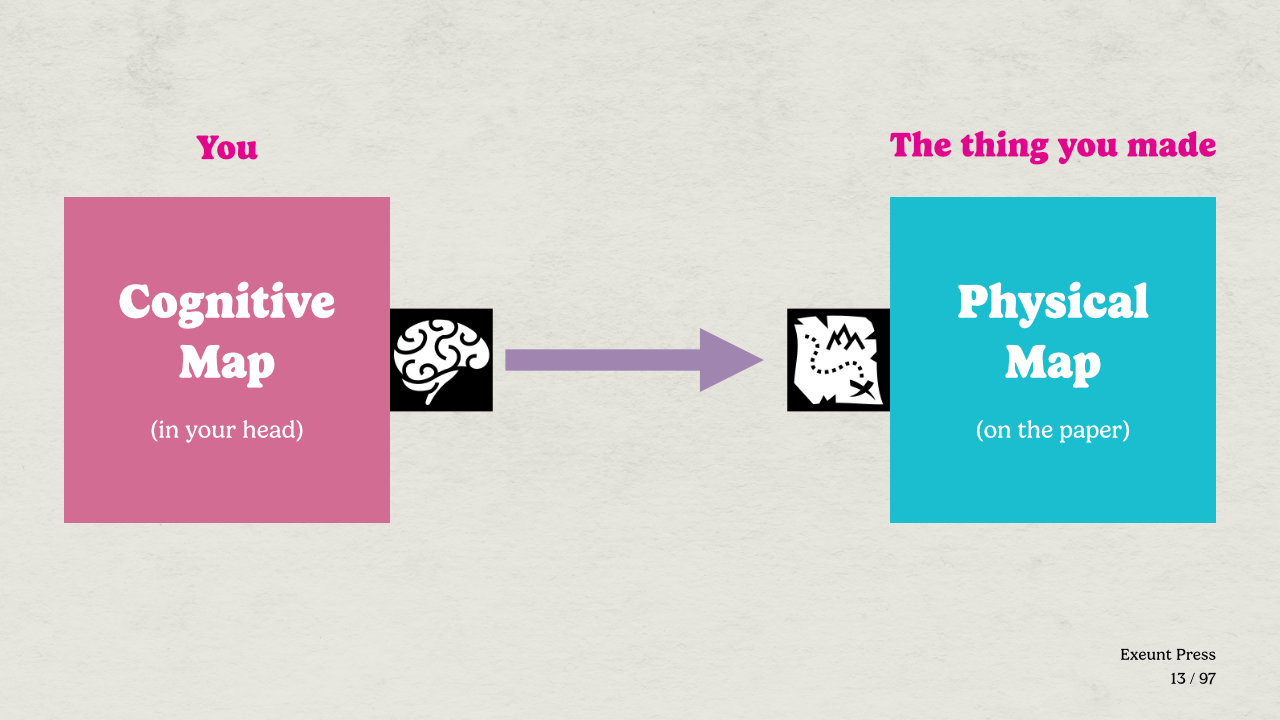
The map already existed, however, inside your head. That’s how you were able to draw it on a piece of paper without looking up other information first. What you used was the cognitive map in your head. By drawing it on paper, you converted that cognitive map into a physical map.3
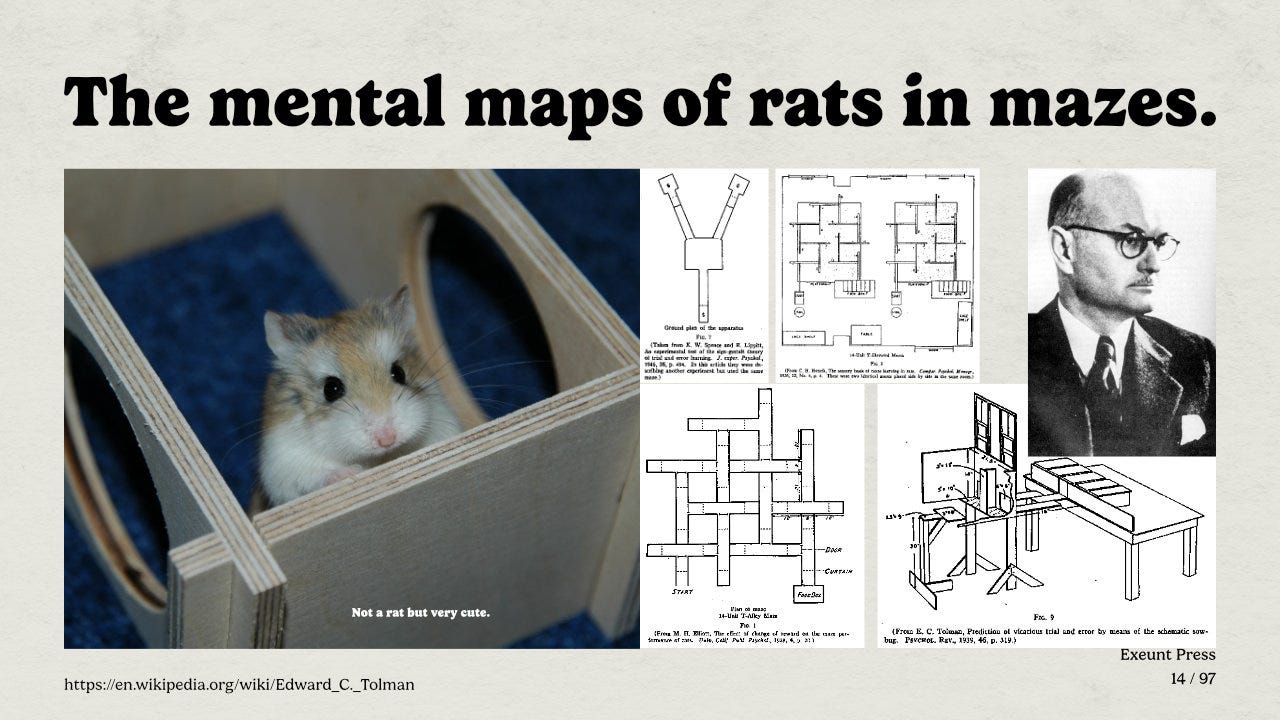
Edward Tolman introduced the concept of cognitive maps in the 1940s based on his work with rats in mazes. His rats were able to learn the layout of the maze and could choose the correct path even when placed in different parts of the maze. The rats were able to determine the path to the food, not just perform simple “always turn right” behavior.
This allows us to talk about two kinds of maps: cognitive maps vs. physical maps. It doesn’t, however, really tell us what a map is.
But what even is a map?
So it turns out we all have these invisible maps in our heads, and rats do too. With a pencil or pen, we can export these maps from our heads to create physical objects. We can then use those objects to communicate map data to others. Pretty cool.
But what even is a map?
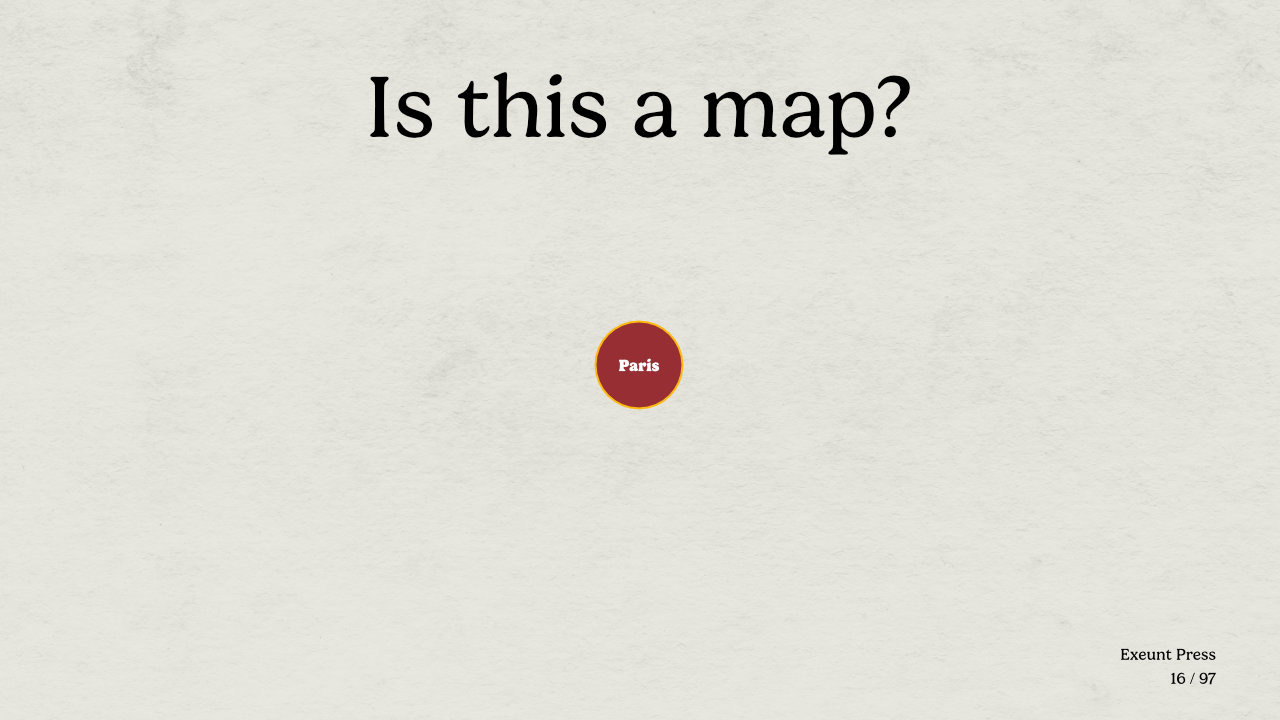
Let’s say I draw a circle on a sheet of paper and label it Paris. Is that a map? I would think most people would say, no, it is not a map. It’s just a circle and a city name on a piece of paper.
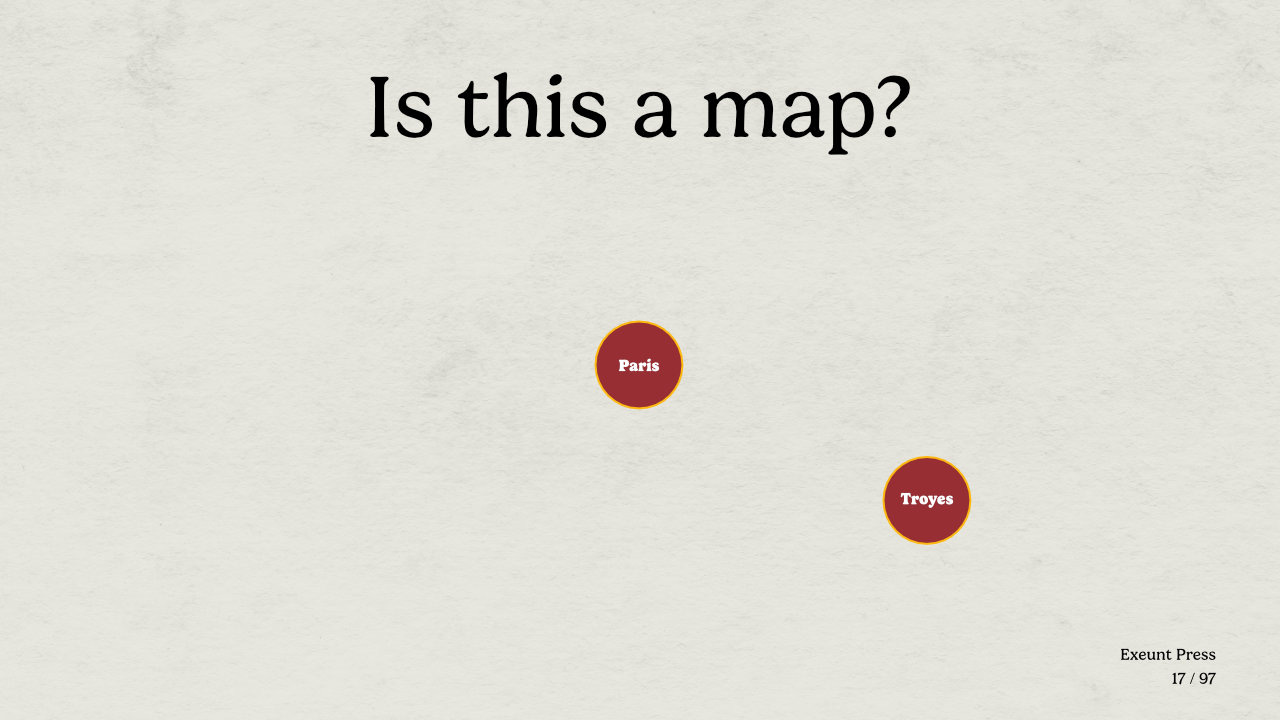
Perhaps a map is about relationships. If I add a second city to the map now the two points are expressed in relation to one another. They aren’t touching. At least on this paper, they are shown sort of diagonally separated. Is that a map?
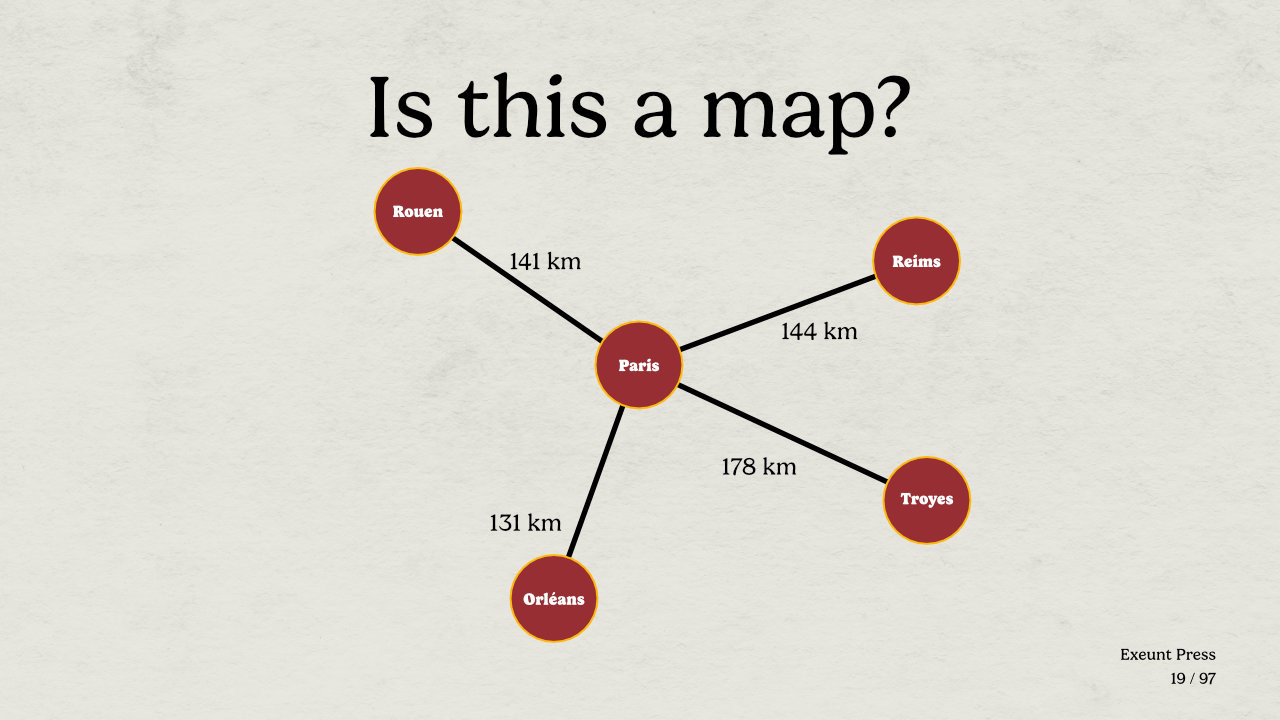
Taking this a step further, we can add multiple cities to the paper: Paris, Rouen, Reims, Troyes, and Orléans. We can also connect them by lines and indicate the approximate distance between the actual cities in kilometers. Certainly this is starting to feel more like a map.
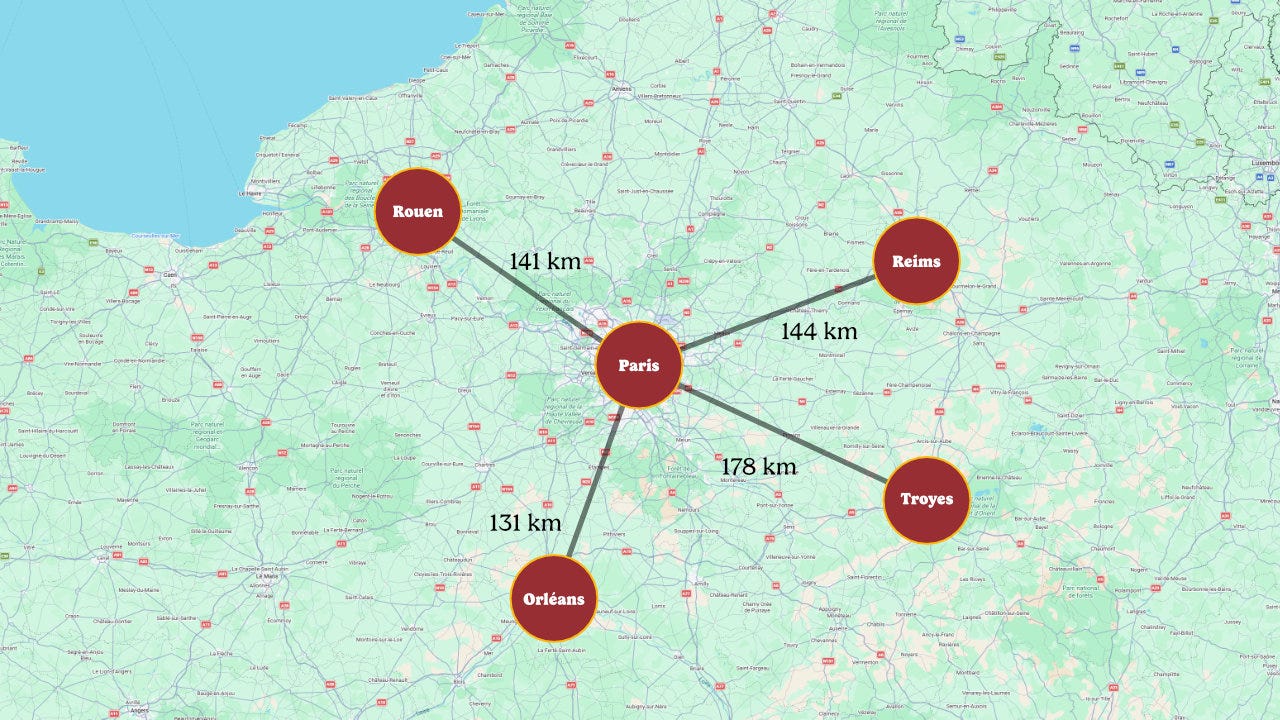
Finally, if we overlay this on a detailed view of France with other cities, bodies of water, roads, terrain, and more, we now have something that almost everyone would agree is a map!
This illustrates how there’s a bit of a blurry line between “map” and “not a map”. It also shows that the relationships between the items on the map are important.
A better vocabulary for maps
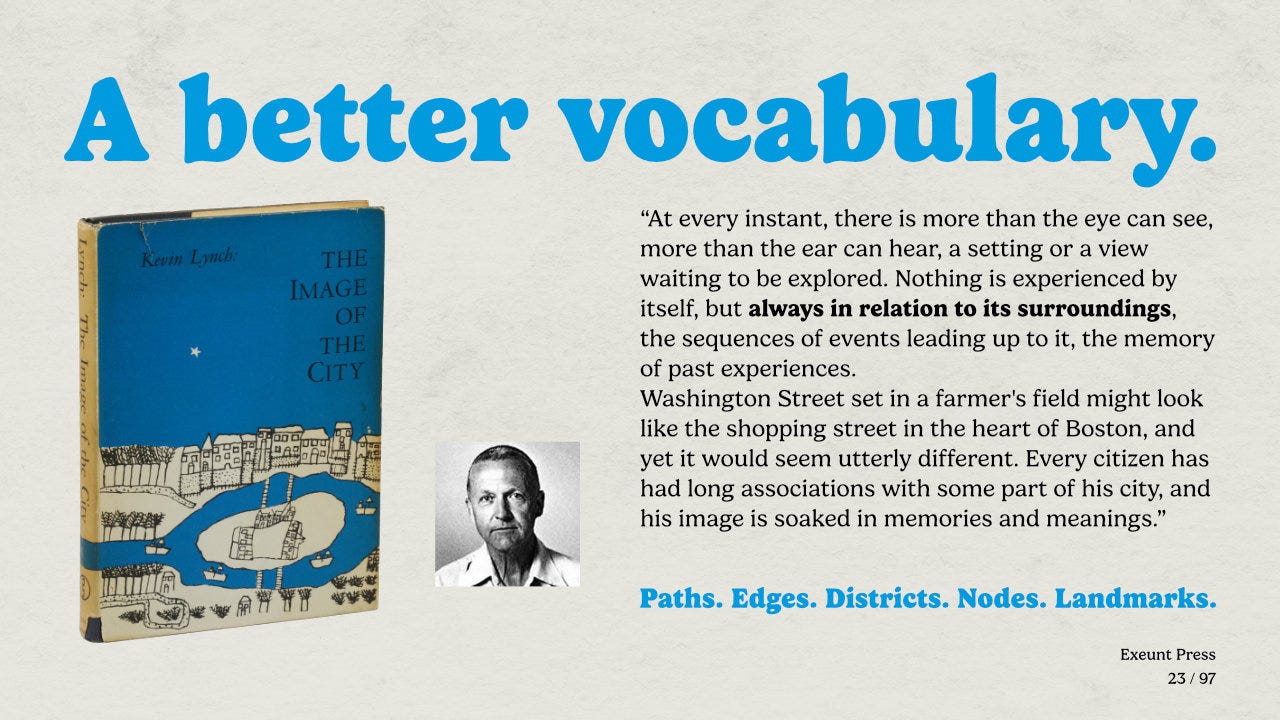
Although not a strict definition, it would appear that a key element of a map is showing the relationships of places. It is not sufficient to simply have a dot that says Paris. It is the addition of relative distances, directions, sizes, and shapes that makes something feel more like a map.
This idea of relationships is core to Kevin Lynch’s study on how people create mental maps of cities.4 In The Image of the City (1960) he says:
“At every instant, there is more than the eye can see, more than the ear can hear, a setting or a view waiting to be explored. Nothing is experienced by itself, but always in relation to its surroundings, the sequences of events leading up to it, the memory of past experiences. Washington Street set in a farmer’s field might look like the shopping street in the heart of Boston, and yet it would seem utterly different. Every citizen has had long associations with some part of his city, and his image is soaked in memories and meanings.”
He then goes on to delineate five specific qualities or features that people use to create these relational maps of their surroundings. Let’s look at each one in order because they have broad applications in game design.
1. Paths
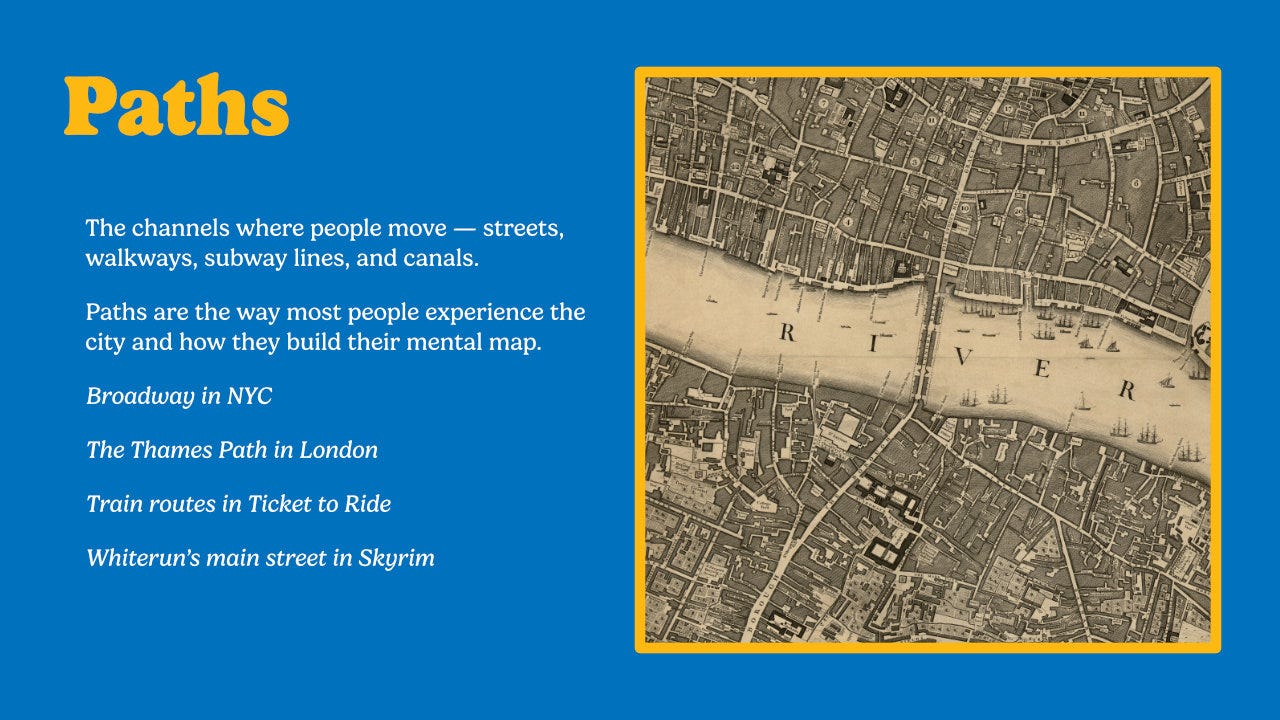
Paths are the channels where people move. They are the streets, walkways, subway lines, and canals. They are the way most people experience the city and how they build their cognitive maps. Examples: Broadway in NYC, The Thames Path in London, train routes in Ticket to Ride, and Whiterun’s main street in Skyrim.
2. Edges
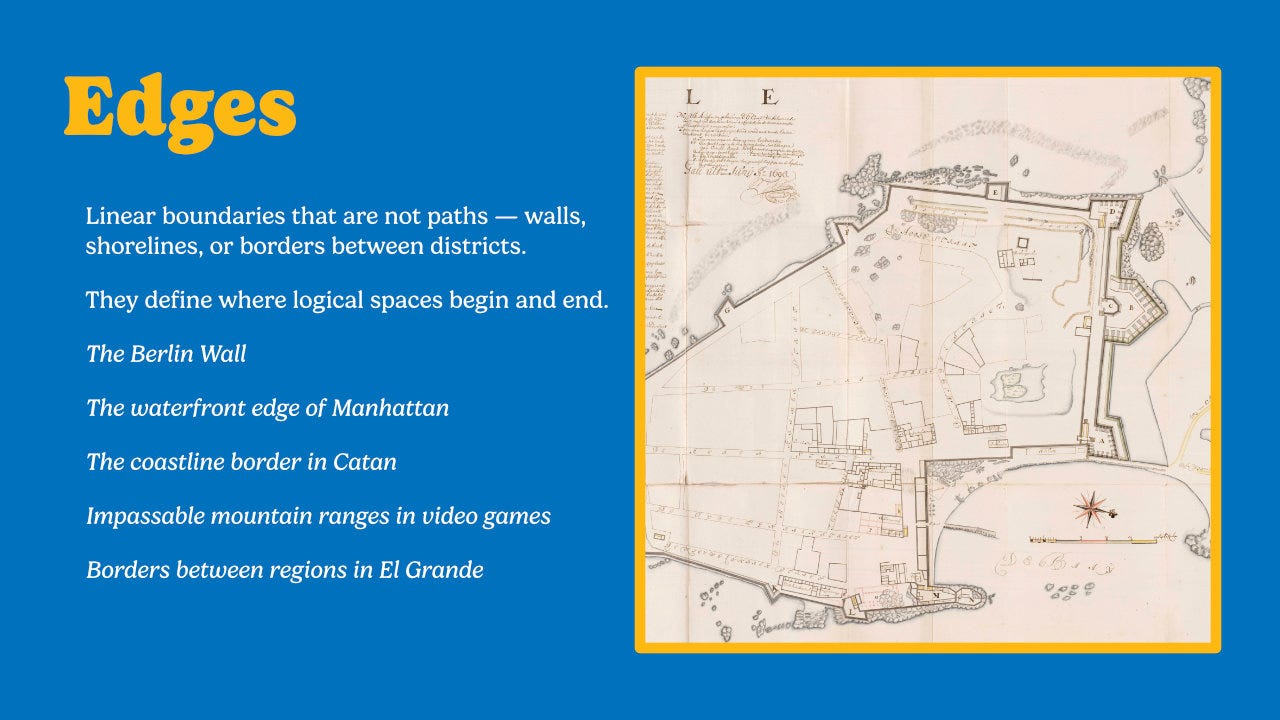
Edges are the linear boundaries that are not paths. They are walls, shorelines, or borders that exist between districts. They often define where logical spaces begin and end. Examples: The Berlin Wall, the waterfront edge of Manhattan, the coastline border in Catan, impassable mountain ranges in video games, borders between regions in El Grande.
3. Districts
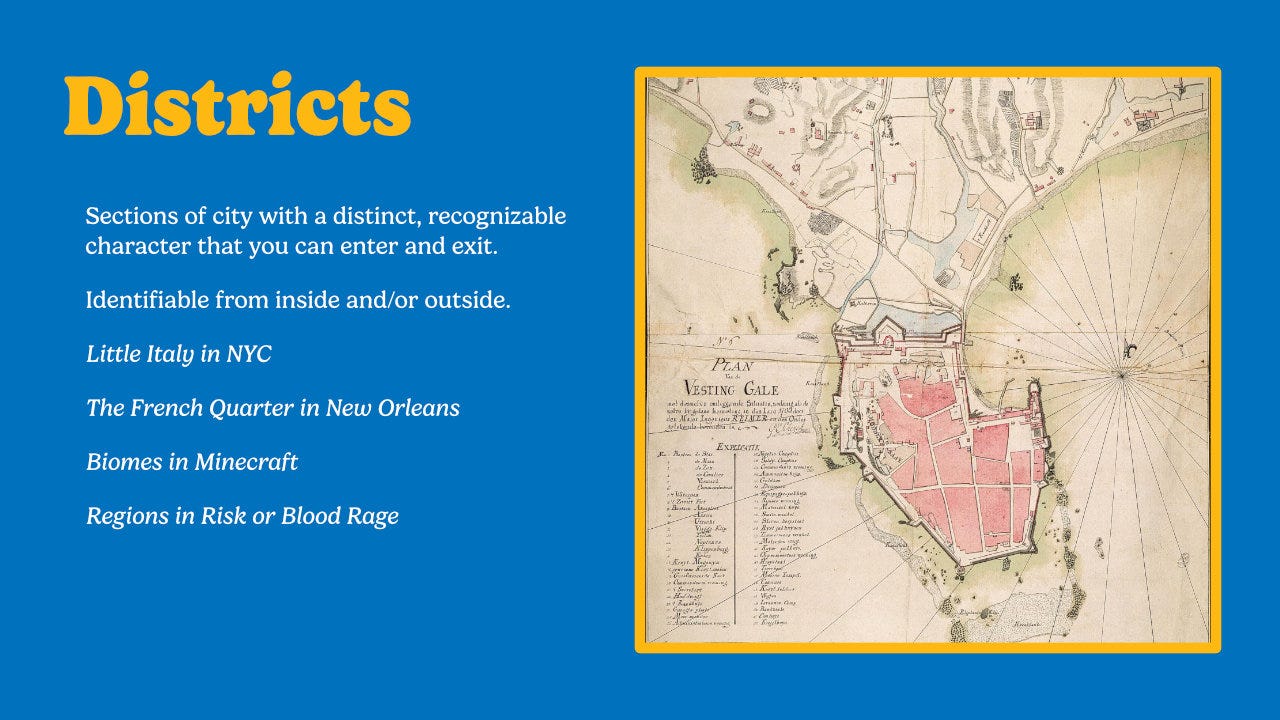
Districts are sections of the city with distinct, recognizable character. You can enter, pass through, and exit these sections. They are identifiable from the inside and/or the outside. Unlike edges which are almost always physical barriers, districts often have indistinct borders with no clear, physical dividing lines. Examples: Little Italy in NYC, The French Quarter in New Orleans, biomes in Minecraft, regions in Risk or Blood Rage.
4. Nodes
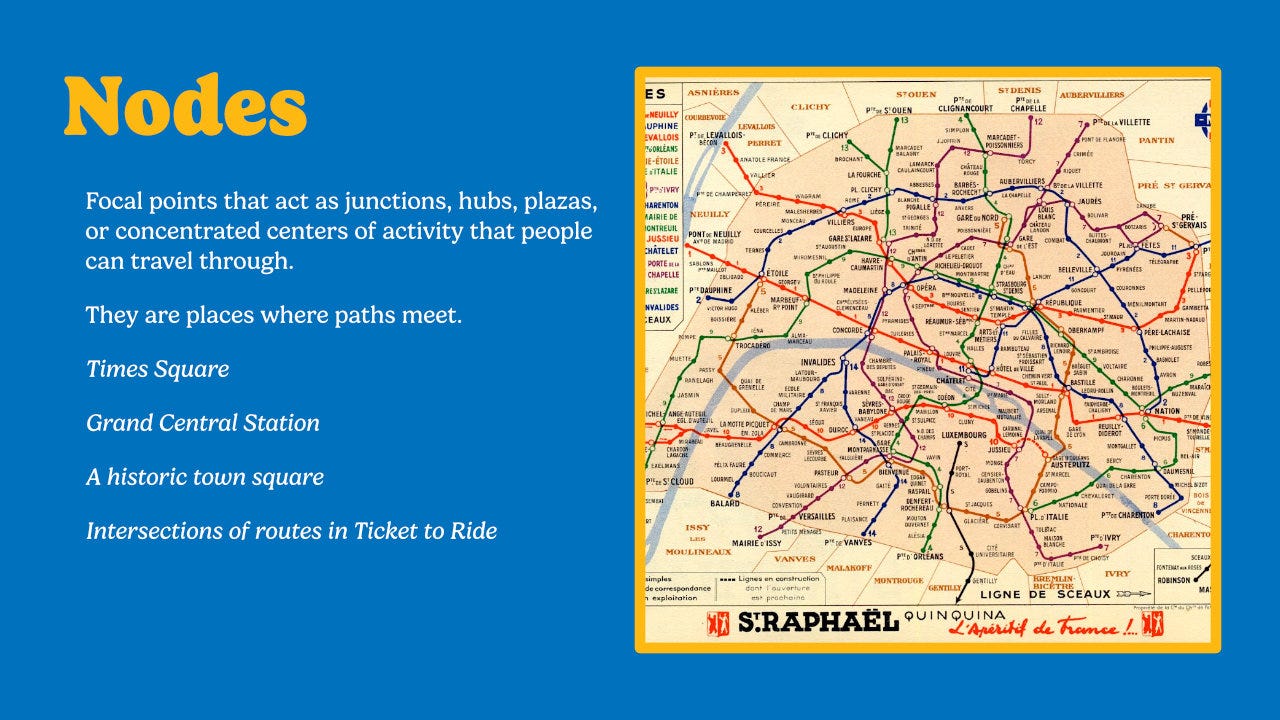
Nodes are focal points that act as junctions, hubs, plazas. They are concentrated centers of activity that people can travel through. They can be easily identified because they are often the intersections where paths meet. Examples: Times Square, Grand Central Station, a historic town square, intersections of routes in Ticket to Ride.
5. Landmarks
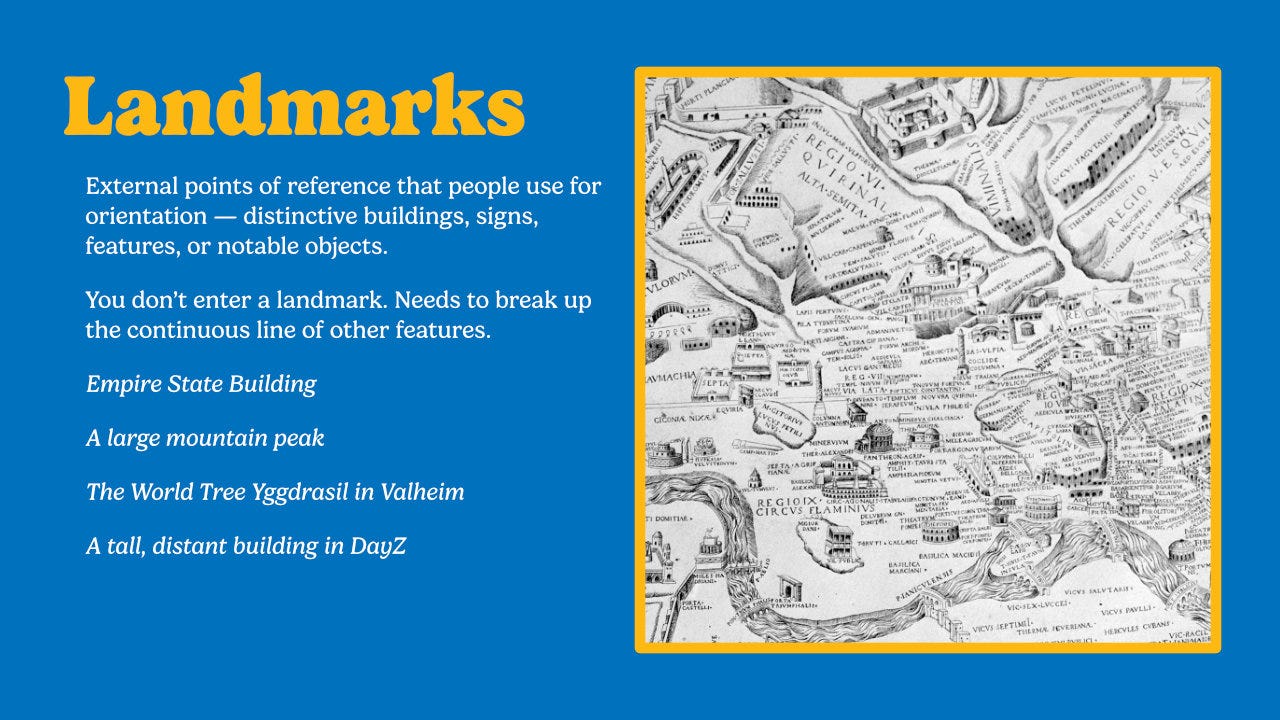
Landmarks are external points of reference that people use to orient themselves while in a city. They are distinctive builds, signs, features, or other notable objects. You don’t enter a landmark like you would a district. Instead the key feature of a landmark is that it breaks up the continuous line of other features. Lynch notes this in The Image of the City (p. 101):
“The essential characteristic of a viable landmark, on the other hand, is its singularity, its contrast with its context or background. It may be a tower silhouetted over low roofs, flowers against a stone wall, a bright surface in a drab street, a church among stores, a projection in a continuous facade.”
Examples: Empire State Building, a large mountain peak, the World Tree Yggdrasil in Valheim, a tall building in the distance in DayZ.
Looking at our maps again
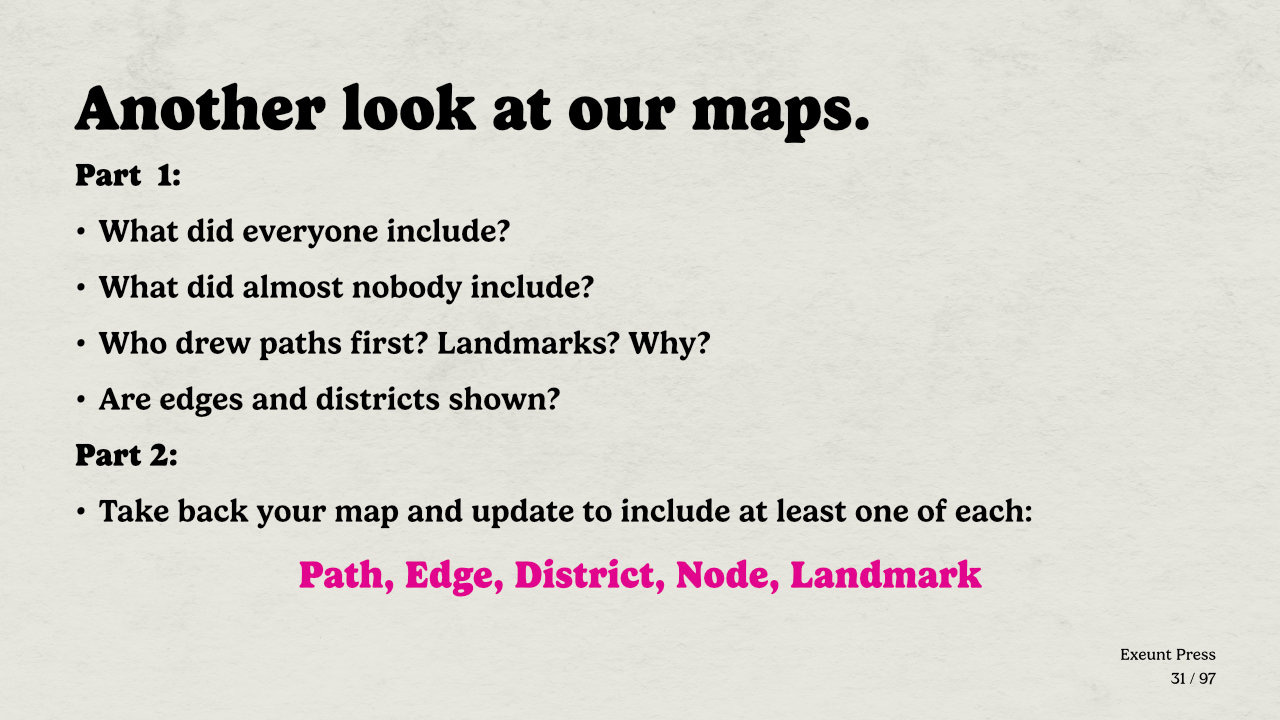
Take another look at the map you made when we started. Which of Lynch’s five features did you include? Did you skip any of them? Did you draw the paths or landmarks first? Are the edges and districts shown?
Update your map, but this time while thinking carefully about the five types of features: Paths, Edges, Districts, Nodes, and Landmarks. Add at least one of each type.
Think about how adding each of these elements improves the map. Consider how adding them allows someone to create a better cognitive map of your neighborhood.
Building blocks for the designer
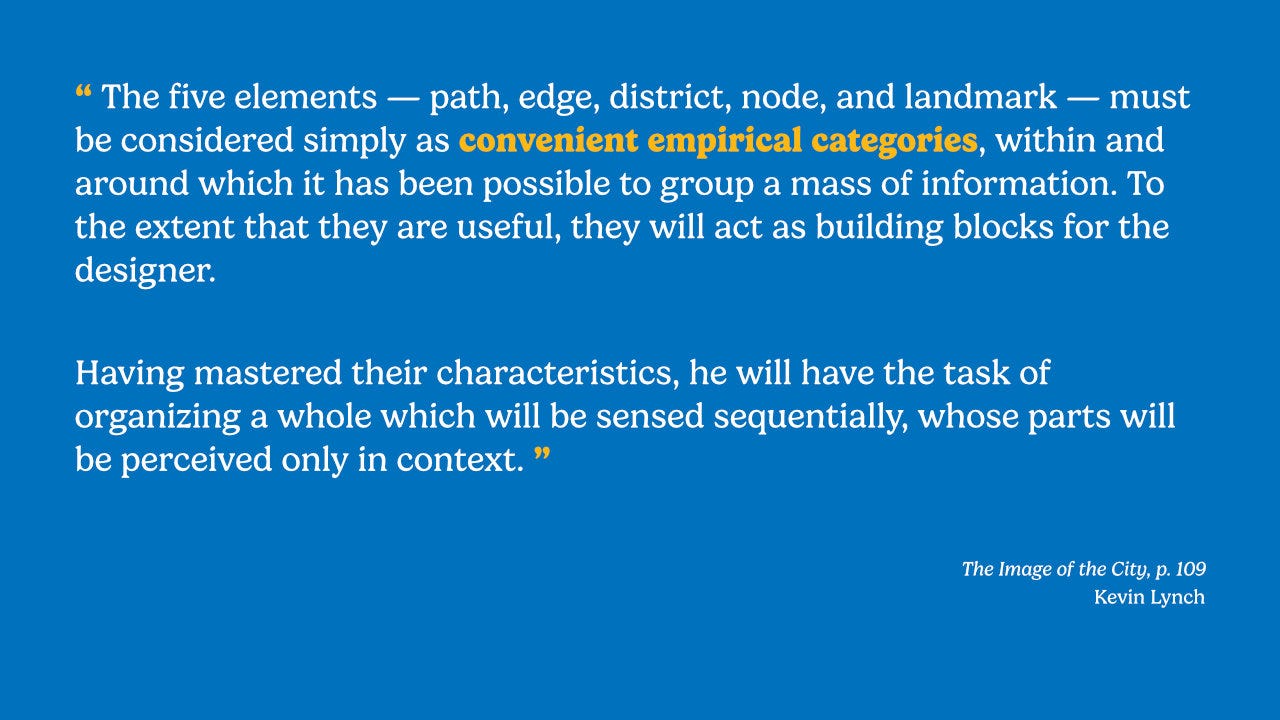
Of course, you may have added some elements to your map that don’t neatly fit into one of these five categories. Like most models, this one isn’t perfect, but that doesn’t mean it’s not useful.5 Lynch notes this in The Image of the City (p. 109):
“The five elements — path, edge, district, node, and landmark — must be considered simply as convenient empirical categories, within and around which it has been possible to group a mass of information. To the extent that they are useful, they will act as building blocks for the designer. Having mastered their characteristics, he will have the task of organizing a whole which will be sensed sequentially, whose parts will be perceived only in context.”
Much like how learning the different kinds of fun can help us move away from simply saying, “This game is fun.” and get us closer to explaining why a game is fun, Lynch’s city features give a better vocabulary for talking about maps.
Like he says above, the paths, edges, districts, nodes, and landmarks become the building blocks we can use to create better maps. In this case, better being defined as more conducive to players creating mental maps.
Maps as data
Maps are a way to represent spatial relationships, and Lynch’s elements give designers a useful vocabulary when discussing those relationships.
Once we realize that we have cognitive maps in our head, that they are all made of a set of core building blocks, and that we can export these maps to paper to communicate them, maps become a lot less mysterious. We can now think of maps as data whether they are in our heads, scribbled on a sheet of paper, or printed in a TTRPG adventure.
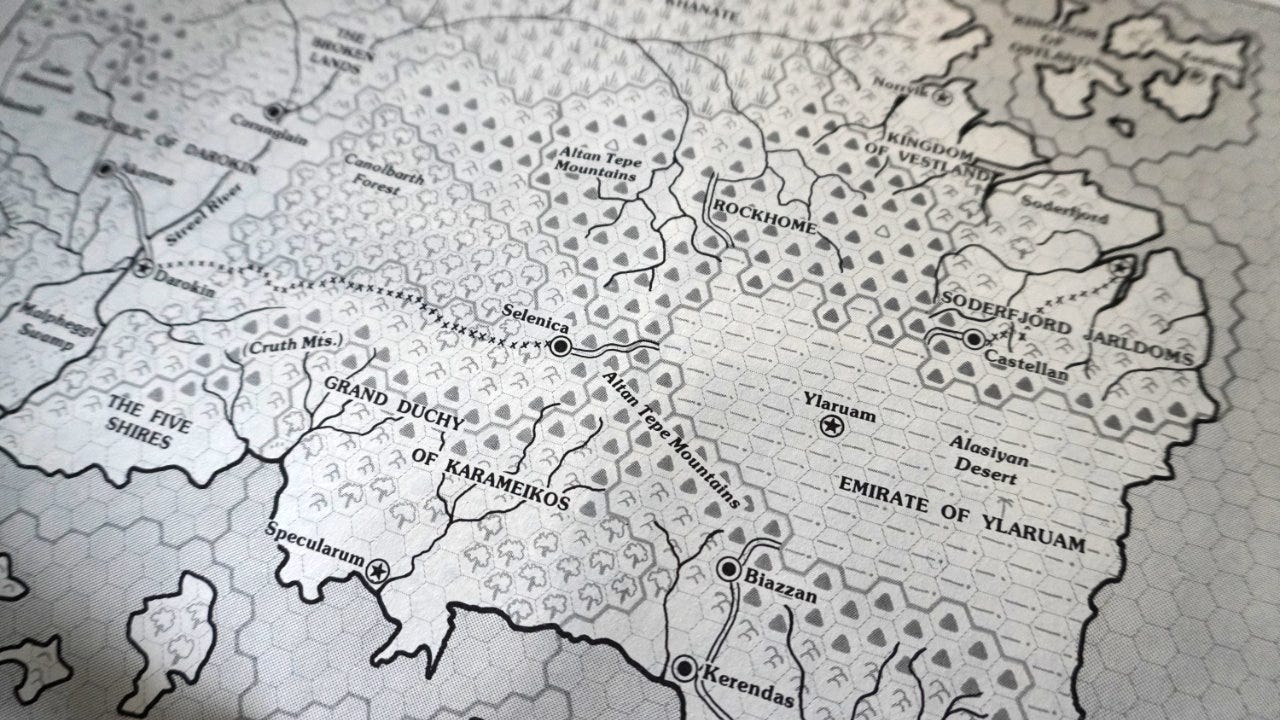
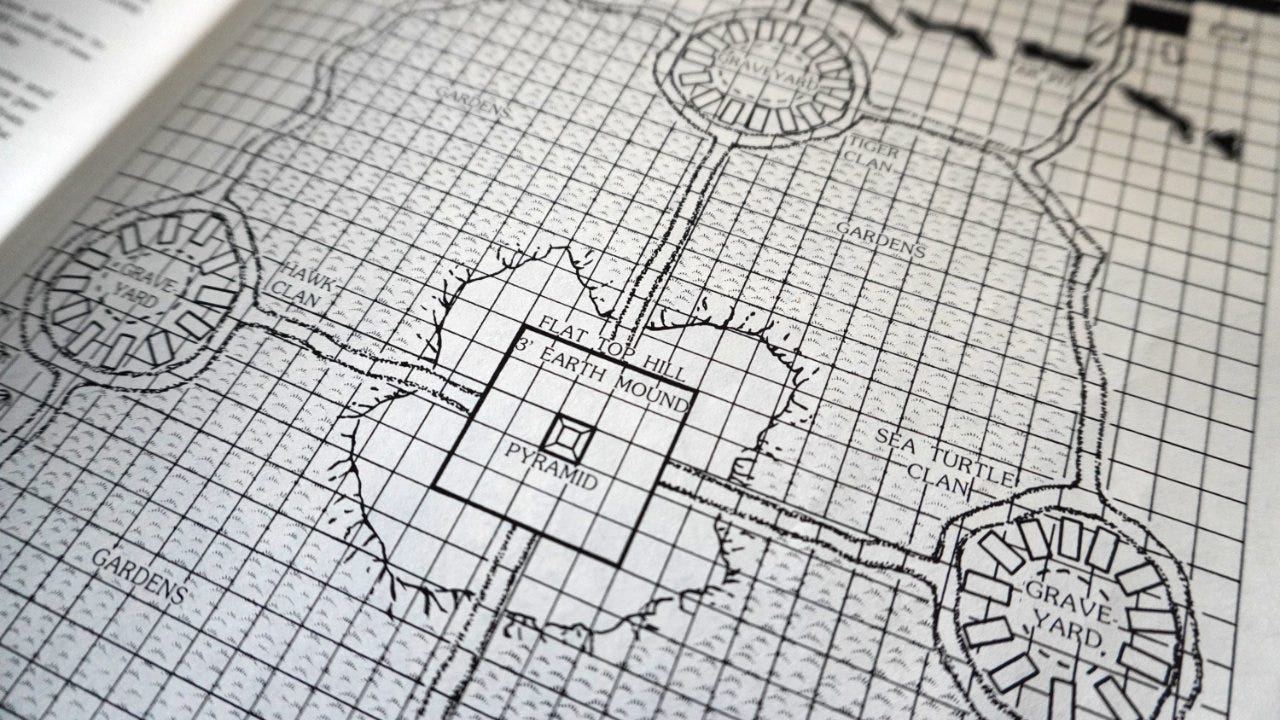
Consider the classic Dungeons & Dragons map above.6 Can you identify examples of each of the five elements?
It is important that players of both TTRPGs and board games can create cognitive maps of the game world. As we improve our maps with loops, multiple levels, and distinct areas, they need to be able to have a mental map rather than constantly referencing a physical map.
In the next part
I want to thank Nicolas Oueijan for his GDC talk called Stop Getting Lost: Make Cognitive Maps, Not Levels. Watching the video of his talk introduced me to Kevin Lynch’s work, gave me the neighborhood map exercise, and permanently changed how I think about games. I strongly encourage you to check it out.
In the next part, we will begin to think about maps as graphs — a topic we’ve already mentioned in Everything is Pointcrawl. Watch for it next week!
Conclusion
Some things to think about:
Vocabulary changes how you think: Smarter people than me have discussed this as a philosophical principle, but I do agree that having the words for things allows you to think about them in new ways.7 By learning the kinds of fun, we can have meaningful discussions about the enjoyment derived from games. By learning the elements of maps, we can develop a deeper understanding of map design.
Building blocks of maps: Although not a perfect model, Lynch’s five elements of path, edge, district, node, and landmark are incredibly useful. They allow us to analyze existing maps, breaking them into their component pieces. They also allow us to take those blocks and construct something new.
Maps as data: One might think of a map as “a piece of paper with a picture of an area on it.” They’d be sort of right, of course. Thinking about maps as data structures that exist in our heads and can be exported to paper is, perhaps, a more useful way of thinking about them. Combined with thinking about them as graphs (as we’ll see in the next part), it can become a powerful design tool.
What do you think? How’d you do on creating a map of your neighborhood? Did you include all of Lynch’s five elements? Which ones did you miss on your first attempt? Let me know in the comments below.
— E.P. 💀
P.S. Want more in-depth and playable Skeleton Code Machine content? Subscribe to Tumulus and get four quarterly, print-only issues packed with game design inspiration at 33% off list price. Limited back issues available. 🩻
Skeleton Code Machine is a production of Exeunt Press. All previous posts are in the Archive on the web. Subscribe to TUMULUS to get more design inspiration. If you want to see what else is happening at Exeunt Press, check out the Exeunt Omnes newsletter.
Skeleton Code Machine and TUMULUS are written, augmented, purged, and published by Exeunt Press. No part of this publication may be reproduced in any form without permission. TUMULUS and Skeleton Code Machine are Copyright 2026 Exeunt Press.
For comments or questions: games@exeunt.press
I wrote about it (at least in passing) as part of a very busy week at Exeunt Omnes.
If you don’t want to draw the neighborhood of where you live, feel free to choose a different location that you are very familiar with. You can use your workplace or a relative’s house.
I use physical map here as the opposite of cognitive map, but that is perhaps not entirely accurate. A video game map isn’t a cognitive map but it is also not a physical (i.e. drawn on paper) map. Calling it something like “external map” might be better.
Those who are well versed in this subject would call me out for using the terms “cognitive map” and “mental map” interchangeably. They are not (strictly) the same thing, but I’m going to use them as the same thing for this article. Feel free to scold me in the comments.
Learn well the words of George Box: “All models are wrong, but some are useful.”
Can you identify which adventure module this map is from? Hint: The copyright year is 1981.
This, of course, reminds me of how David Foster Wallace opened his 2005 commencement speech at Kenyon College: “There are these two young fish swimming along and they happen to meet an older fish swimming the other way, who nods at them and says ‘Morning, boys. How’s the water?’ And the two young fish swim on for a bit, and then eventually one of them looks over at the other and goes ‘What the hell is water?’”
im probably coming at this from a different angle, but here's perhaps a too-long ramble anyway.
for me, when i see a map, i scan for: fun (aesthetics), transferability, usability. this requires context(s).
cezar capacle recently talking about map or pointcrawl generation in his new mausworn hack. that is fun and usable, but only with the premise that all maps are cognitive - exiting as partially accurate ideas in each denizen's head. it works for a good exploratory game, because there can always be things you missed, and the map is always able to be updated, but never truly finished.
a map that we humans use - requires stability. and if a game requires that level of stability, i dont know if its that fun. modern ttrpgs tend towards a kind of static, tactical shooter sim idea of living = winning, losing = dying, so for me, that aesthetic is not really that interesting.
i think it tends to boil down to the kind of person you are and the kind of task you want or need to do. i use maps as reference, as ideas, as art... except when i need to find my way to some place i need to go. then i want my maps to be accurate.
I know a gis background when I see one