
Last week we looked at how Circus Flohcati keeps the card market feeling fresh with a push-your-luck mechanism. It’s interesting because it doesn’t directly rely on the usual dynamic market solutions like incentives or purges (discards).
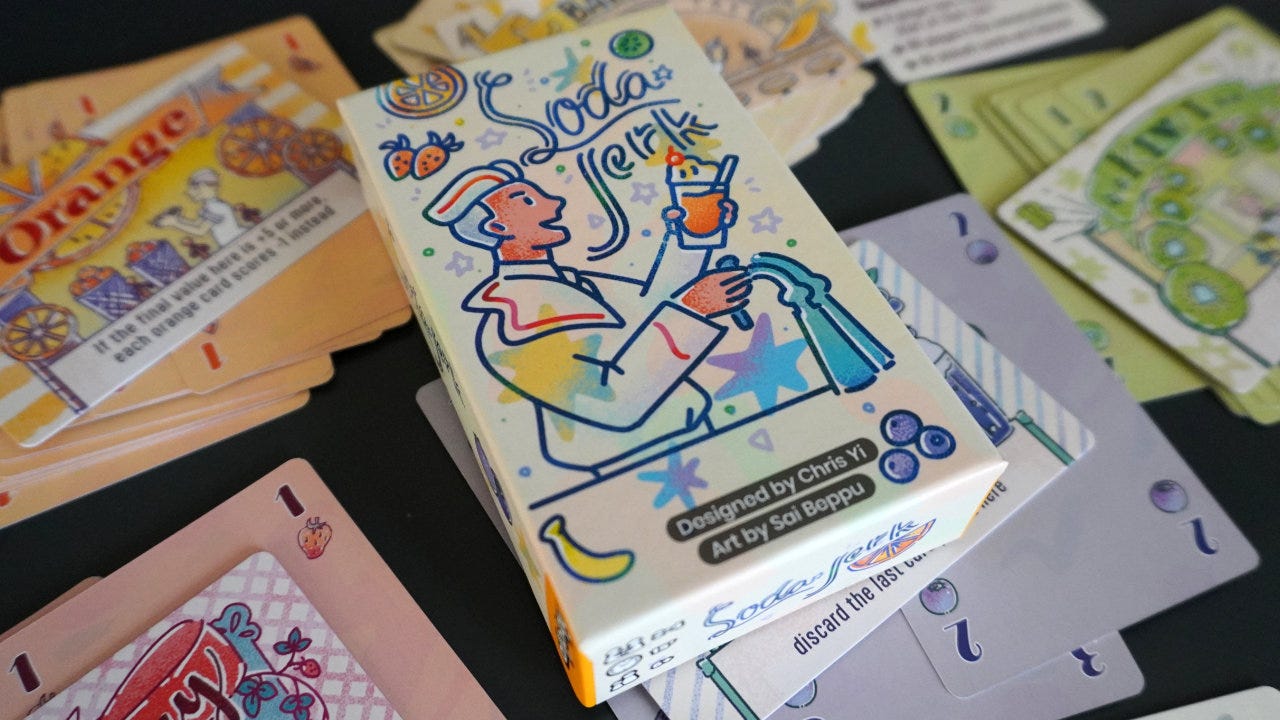
This week we are looking at another card-based game: Soda Jerk, designed by Chris Yi who you may have seen on The Dice Tower.
But first…
📋✏️ Last chance for the reader survey!
There’s still time to take the annual reader survey before it closes on December 31, 2025. It’s a chance to say what you want more (or less) of and to share your favorite games of the year. In just a few minutes, you can help guide the future of Skeleton Code Machine. I really appreciate hearing from you. Do it for Murphdog.
Being a jerk in Soda Jerk
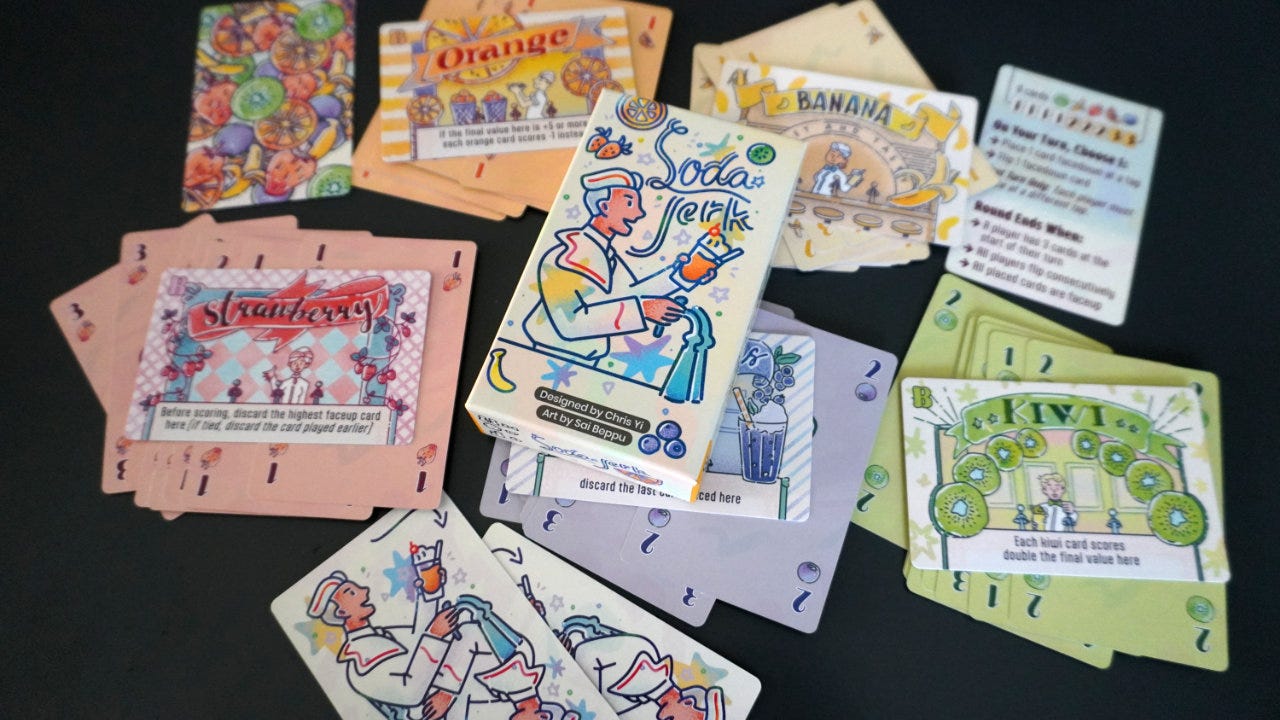
The premise of Soda Jerk (Yi, 2025) is simple: “Mix matching flavors to make the cards in your hand worth more — or sour the batch for everyone else!”
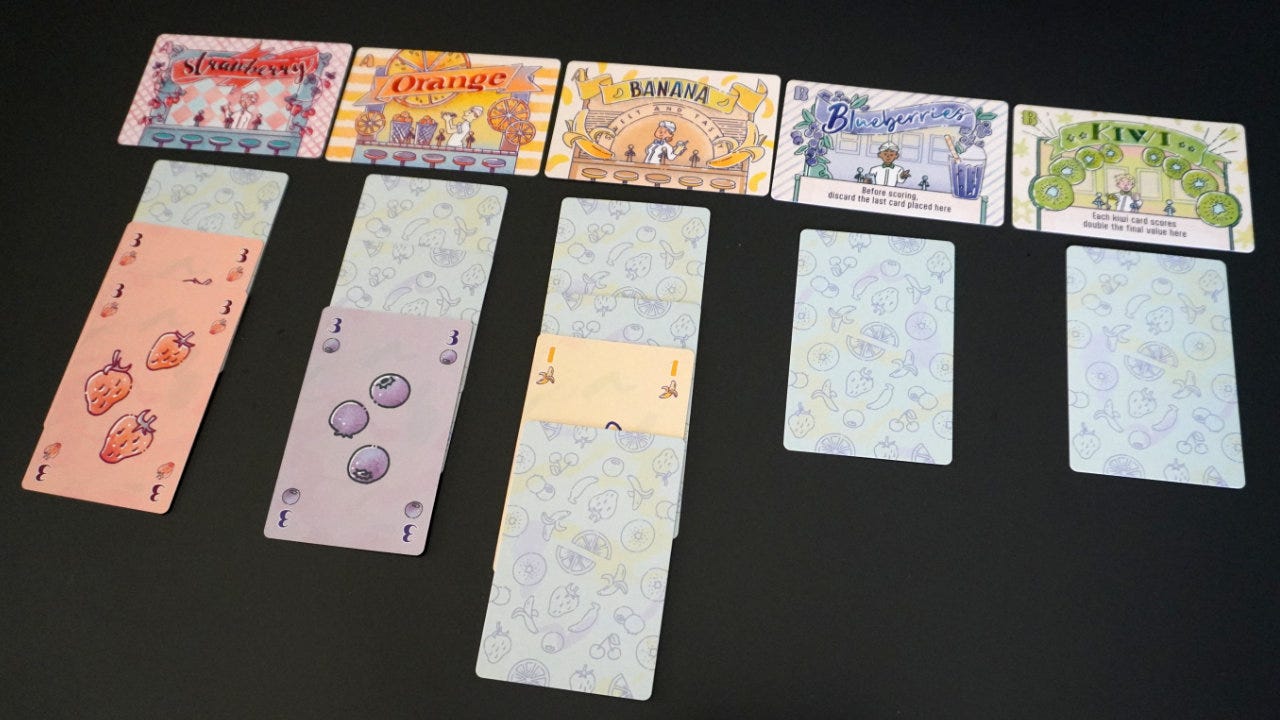
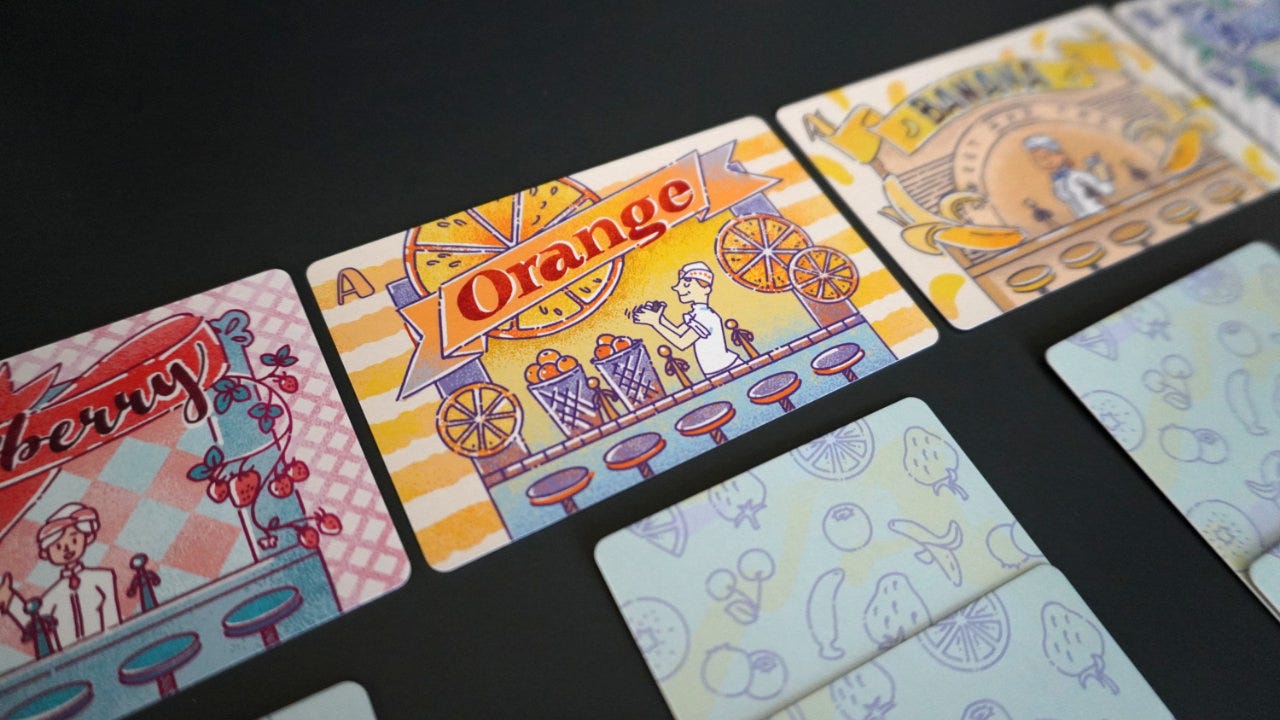
There are five soda flavors represented by cards (beautifully illustrated by Sai Beppu) arranged in a row on the table: Strawberry, Blueberry, Banana, Kiwi, and Orange.1 These are the five “soda taps” that will act as individual scoring piles in the game.
The cards, each with a flavor-suit and rank, are dealt to players with the number based on player count (10-13 cards each). Then players take turns where they can do one of two actions:
Place a flavor card: The player places one card from their hand face down below any flavor (tap) of their choice. For example, they could put a Blueberry 2 card below the matching Blueberry flavor or any of the other non-matching flavors. We’ll see why this matters in a moment.
Flip a flavor card: Instead of placing a card, the player can flip a card from face down to face up. This reveals the card for the rest of the game.
When either (a) a player has three cards left in their hand, or (b) all players flip a card consecutively, the round ends.
Scoring is based on the final value of each flavor, but here is where it gets interesting:
Matching flavor cards (e.g. a Kiwi card below the Kiwi flavor) add their value to the flavor’s end-of-round total value.
Non-matching flavor cards (e.g. a Kiwi card below the Orange flavor) subtract their value from the flavor’s end-of-round value.
Each player then reveals the cards remaining in their hand and scores points equal to the final value of each flavor tap times the number of cards matching that flavor. For example, if Orange is worth 4 and a player has 3 Orange cards, they would score 12 points.
But with the ability to add non-matching cards that subtract value, it is entirely possible to tank a flavor’s value (i.e. “sour the batch”) and make it worth negative victory points.2
Soda Jerk is a mixture of bluffing, hidden information, and trying to manipulate the value of each of the flavors.
Stock manipulation and speculation
Pete of the Decision Space podcast recently posted a Top 10 Games of 2025 thread which included the following mention of Soda Jerk (#8):
“I keep putting this micro stock speculation-y game on the table and it just keeps delivering. Perfect small box game with brutal player interaction and juicy hidden information. Maybe the best game in Allplay’s tiny line. This almost replaces Startups for me due to easy onboarding.”
What stood out to me was describing it as a stock speculation game, something I hadn’t considered during the times I played it. Looking at reviews, it is quite often described as a simple stock manipulation game. The BGG entry even lists commodity speculation as one of the core mechanisms:
A subcategory of Investment in which players buy and sell commodities of various types and quantities as they change value throughout the game.
Commodity Speculation includes both Investment games in which players have some indirect control over asset values, but have a hard time hurting others without hurting themselves; and Collusion games, in which players have huge direct control in manipulating asset values, forcing players to help others and manage shifting alliances.
And that’s exactly what Soda Jerk is! Players are trying to manipulate the value of each soda flavor — not by buying and selling like a normal stock game, but by playing cards into each of the flavor tap columns.
Each addition of a matching card makes the “stock” (i.e. value) of that flavor go up, while non-matching cards make the value drop. The twist is that with largely hidden information, the true value of each flavor is mostly unknown at any point in the game. The only way to reveal some of the information is to spend your entire turn to flip a card face up.
The cards you hold in your hand until the end of the round are your speculation on which stocks you think will be worth the most. You need to dump the ones that will have negative value before it is too late.
Other commodity speculation games include Clans of Caledonia (Al-JouJou, 2017), Modern Art (Knizia, 1992), Tinners’ Trail (Wallace, 2021), Stockpile (Sobol & Orden, 2015), and Vegetable Stock (Zong-Ger, 2019).3
Soda Jerk and The King is Dead
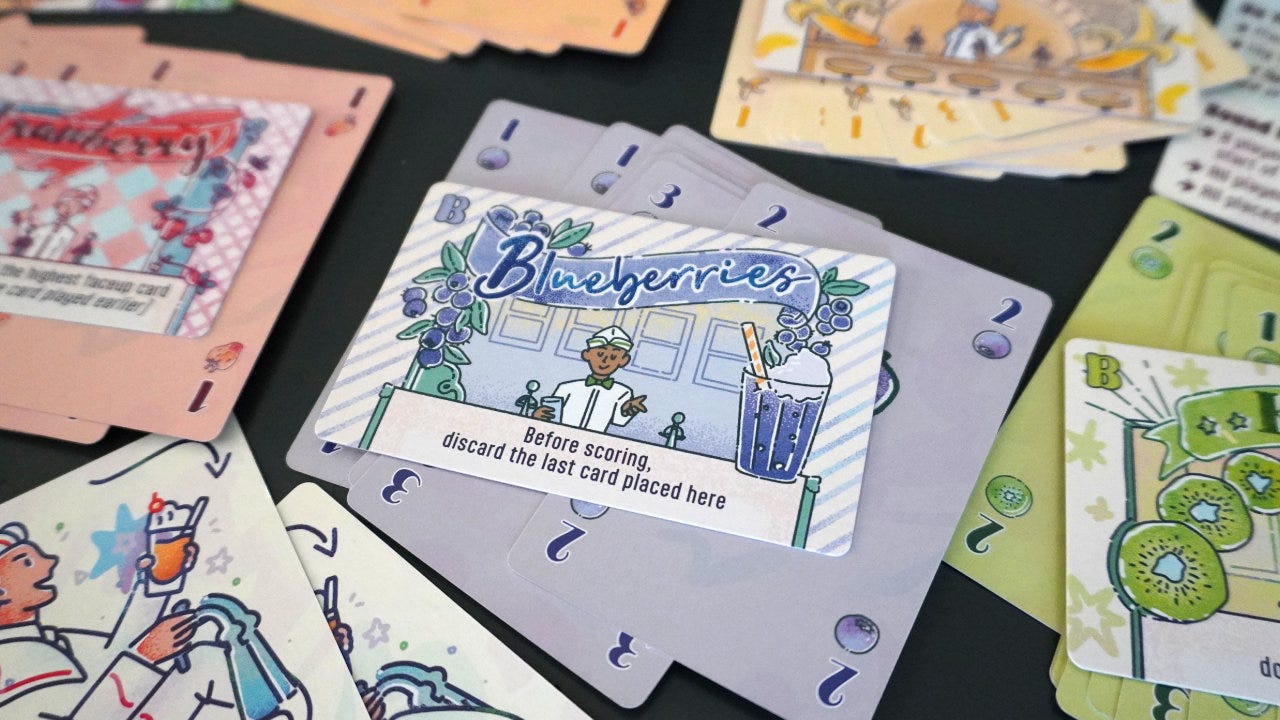
The other notable part of Soda Jerk is how it uses an influence vs. control mechanism not unlike how The King is Dead: Second Edition (Sylvester, 2020) to determine the victory points paid out at the end of the round.
In The King is Dead, players manipulate three factions represented by cubes on a map of Britain: Scottish, Welsh, and English. No player ever controls or plays as one of the factions. Instead, every action manipulates the game state: adding faction cubes, removing cubes, or shifting them between the various territories.
At the end of The King is Dead, you want to have the most cubes of the most powerful in your court (i.e. play area). This is infuriatingly difficult, however, because pulling a faction’s cube to your court weakens its position on the board.
In a similar way, adding cards to a flavor in Soda Jerk increases the value of that flavor, but at the same time decreases the number of flavor cards of that suit in your hand. You need the cards in your hand to act as multipliers for scoring, but you have to play them onto the flavor taps to have the flavors worth points. Every move both strengthens and weakens your position.
Two other notable games that use this “influence vs. control” style play are Pax Renaissance: 2nd Edition (Eklund & Eklund, 2021) and Pax Pamir: Second Edition (Wehrle, 2019).4 Both are much, much heavier games with historical themes, but they too have factions not controlled by any one player. Instead players want to be aligned with the most powerful faction at the end of the game.
Conclusion
Some things to think about:
Stock manipulation: You might think commodity manipulation mechanisms only work in games where you are buying and selling cotton, stone, whiskey, sheep, and butter. But the idea of player-controlled, changing value is a really interesting one that can be applied in non-obvious ways with unexpected themes.
Mechanisms span heavy and light games: It can be an interesting exercise to break games down into their component mechanisms. You start to see that while some games are big and complex (e.g. Pax Renaissance) and some are small and light (Soda Jerk), they can share many of the same mechanisms. This is a skill you can develop over time that will help you both analyze and design tabletop games.
Both strengthen and weaken: Forcing players to make painful choices can be a valid design goal, depending on the kind of fun you want the players to have. Having a way to make each action both strengthen a player’s position but also weaken it in a different way is a great way to accomplish this. Of the topics in this article, I think this concept has the most potential and application in TTRPGs.
What do you think? Have you played any games with non-obvious stock or commodity manipulation mechanisms? What about influence vs. control games? Let me know in the comments!
— E.P. 💀
P.S. Want more in-depth and playable Skeleton Code Machine content? Subscribe to Tumulus and get four quarterly, print-only issues packed with game design inspiration at 33% off list price. Limited back issues available. 🩻
Skeleton Code Machine is a production of Exeunt Press. All previous posts are in the Archive on the web. Subscribe to TUMULUS to get more design inspiration. If you want to see what else is happening at Exeunt Press, check out the Exeunt Omnes newsletter.
Skeleton Code Machine and TUMULUS are written, augmented, purged, and published by Exeunt Press. No part of this publication may be reproduced in any form without permission. TUMULUS and Skeleton Code Machine are Copyright 2025 Exeunt Press.
For comments or questions: games@exeunt.press
Banana soda? Kiwi soda? Yes, I know they exist, but they sound dreadful. Hard pass. Although to be fair, I’m not much of a soda drinker in the first place.
This is not a full explanation of the rules. There are also Switcheroo cards that are added to the game when playing the 2-player variant. These cards invert the value of the flavor at the scoring phase, potentially changing a +5 VP to a -5 VP.
Two notes here. First, Tinners’ Trail actually was released in 2008 as the first edition. I’ve only played the second edition, so I’ve noted that one here. I’m not clear on the difference between the two. Second, making this list made me realize how much I adore commodity speculation as a mechanism in board games. It’s my favorite part of the games listed, especially in Clans of Caledonia. I should seek more of these games out.
I’ve found that the Pax games are some of the hardest for new players to conceptually wrap their heads around. We take for granted that each player will have a “color” and play as a faction in a board game — a concept deeply embedded in American-style games. Playing a game where you may or may not want one side to win at a given time (and this changes throughout the game) is really eye-opening. They are both available on BGA and I suggest you check them out if possible.
I refuse to to vote on the soda flavors because all of them sound gross LoL
Great article though.
such a fun and fascinating article, as always :D having actions be simultaneously beneficial and detrimental can definitely be great! i'd argue that that's kinda part of the design philosophy behind Powered by the Apocalypse games; more often than not, actions taken result in a "mixed success", getting to do what you wanted, but at a cost/only kinda :) part of why i like those games so much ^^ gives so much fruitful fuel for wonderful roleplaying!
and thank you for the reminder with the survey!