
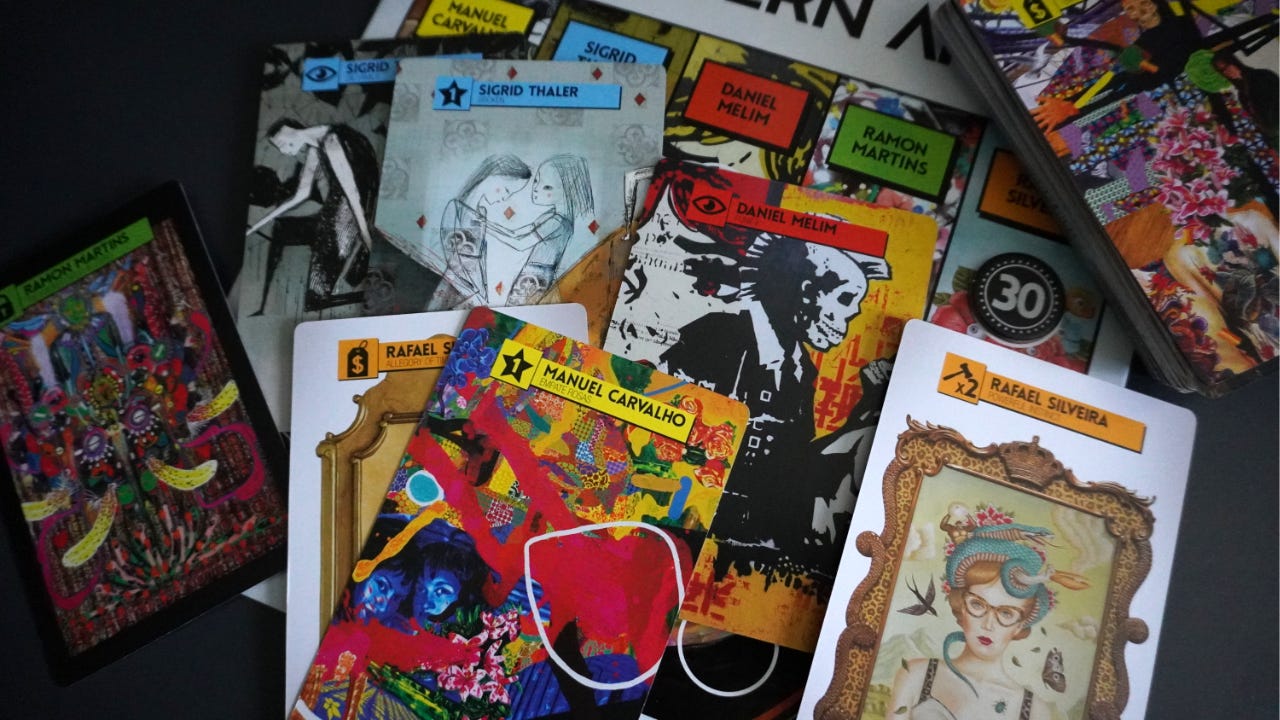
I’ve mentioned Modern Art (Knizia, 1992) many times here at Skeleton Code Machine, but I’ve never actually covered it in detail. It’s a fascinating and deceptively simple game that is based on auctions. Let’s explore the five types of auctions from Modern Art.
Even if you aren’t making an auction game, it’s important to understand the various types as a designer. Sometimes they show up in unexpected places!
Tumulus subscribers: Tumulus Issue 8 “Insert coin to continue.” shipped this week. Check your email (and spam folder) for a shipping notification and tracking information. Thank you so much for being a subscriber and supporting Skeleton Code Machine!
Modern Art
In classic Knizia style, Modern Art isn’t particularly mechanically complex, but it presents players with extremely tough decisions. In the game, players “take on the role of a museum that is trying to buy and sell paintings at the best price.”
Over the course of four rounds, paintings go up for auction and are purchased by players. The paintings are then sold based on the current value of that artist’s works. Ideally, you purchase low and sell high. It is, however, entirely possible to purchase a painting and end up losing money on the sale.
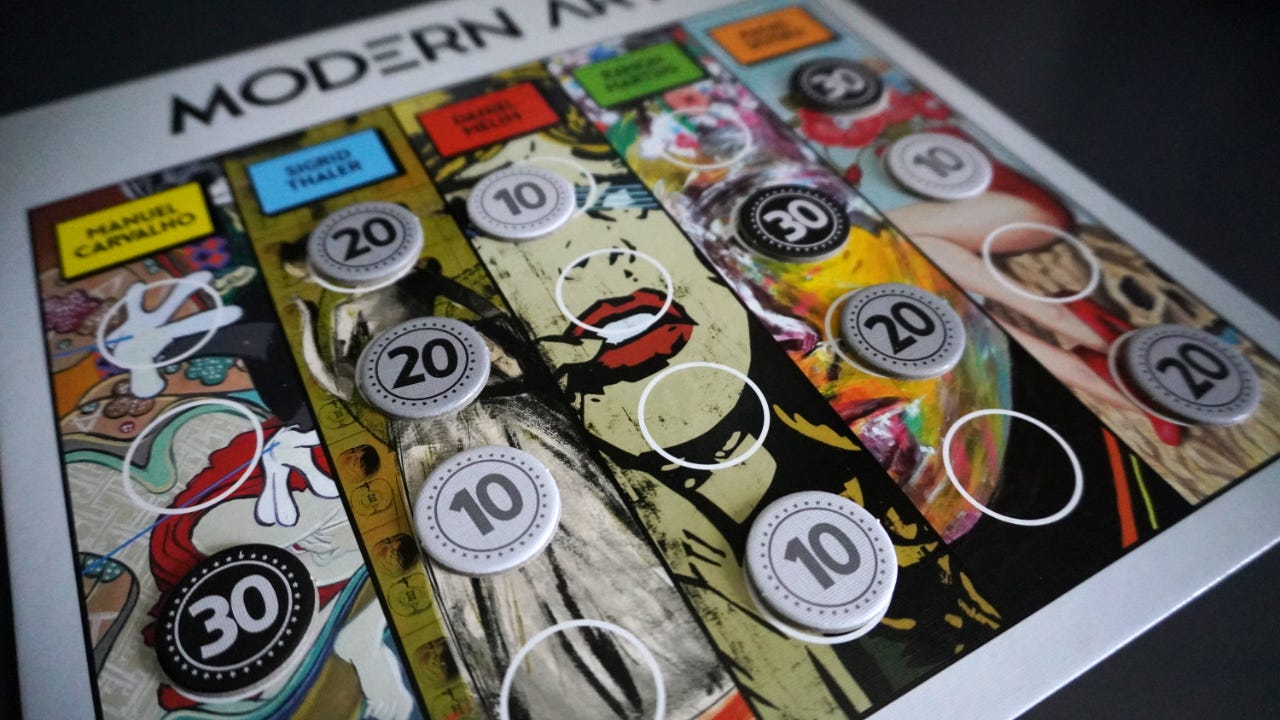
The value of the paintings (based on the artist) changes each round. The more an artist’s work is purchased, the more valuable it becomes. The top three selling artists are worth 30, 20, and 10 respectively. The bottom selling of the four will be worth nothing that round.
There’s some fun market stuff going on in the game, but for now, let’s look carefully at the types of auction mechanisms used.
The five types of auctions
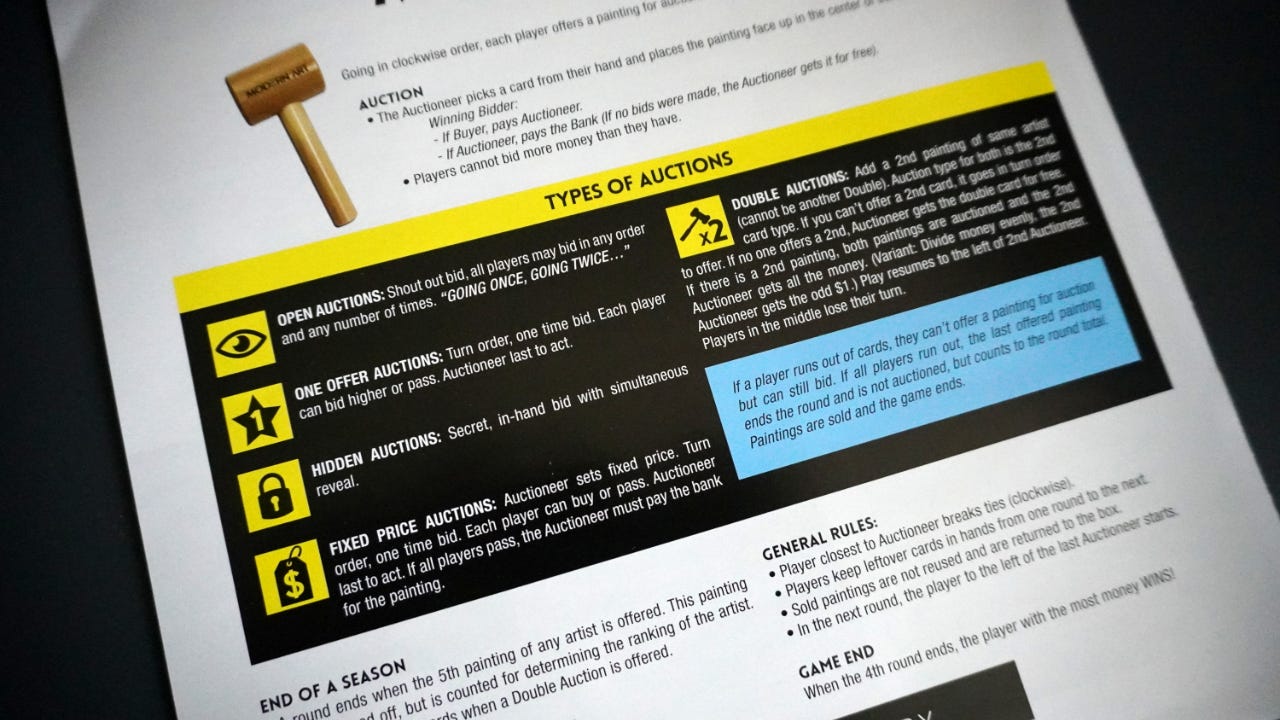
Modern Art includes five types of auctions. The type of auction (e.g. open, hidden, etc.) is determined by a symbol on the painting card played that round.
The game has a few general rules for auction to avoid weird edge cases:
All bids must be in units of $1.1
You can’t bid less than or equal to another player.
You can’t bid money you don’t have.
If no player bids, the auctioneer gets the painting for free.
The last rule in particular is critical. This ensures that there’s always incentive to bid, otherwise the player who happens to be the auctioneer that round gets a free painting.
With those general rules in place, here are the auction mechanisms.
Type 1: Open Auction
All players (including the auctioneer) can bid in any order. This is the kind of auction you often see in movies and on television, with people shouting out increasingly higher bids in a chaotic manner.2 The auctioneer keeps track of the bids and does the “Going once! Going twice! Sold to the lady in the green hat!” thing.
Type 2: One Offer Auction
Bids are presented in order, one player at a time, moving clockwise around the table. Everyone gets a single chance to place an offer or pass. All new bids must be higher than previous bids. The auctioneer always gets the final bid and a chance to win the painting.
Type 3: Hidden Auction
All players (including the auctioneer) make a single, secret bid.3 This is usually done by placing money tokens in closed hands and then all revealing at the same time. It is possible to pass by not putting any tokens into your hand. Highest bid wins. In the case of a tie, the person sitting closest (clockwise) to the auctioneer wins.
Type 4: Fixed Price Auction
The auctioneer chooses and announces a fixed price for the painting. Then, moving clockwise, each player can choose to either (A) purchase the painting at that price or (B) pass. If a player purchases the painting, the auction ends. If no players choose to purchase, the auctioneer must purchase it at the original fixed price.4
Type 5: Double Auction
I’m not sure this one really counts as another type of auction mechanism, but the Modern Art rulebook lists it as a separate type. In the double auction, the auctioneer can choose to put a second painting up for sale with the first. They both use the auction mechanism of the second painting.5 The winner of the auction claims both paintings.
Auctions in non-auction games
While Modern Art is an explicitly economic game (i.e. you are thematically buying and selling paintings), auctions show up in many types of games. It’s a good exercise to learn the various auction types and try to spot them when playing games.
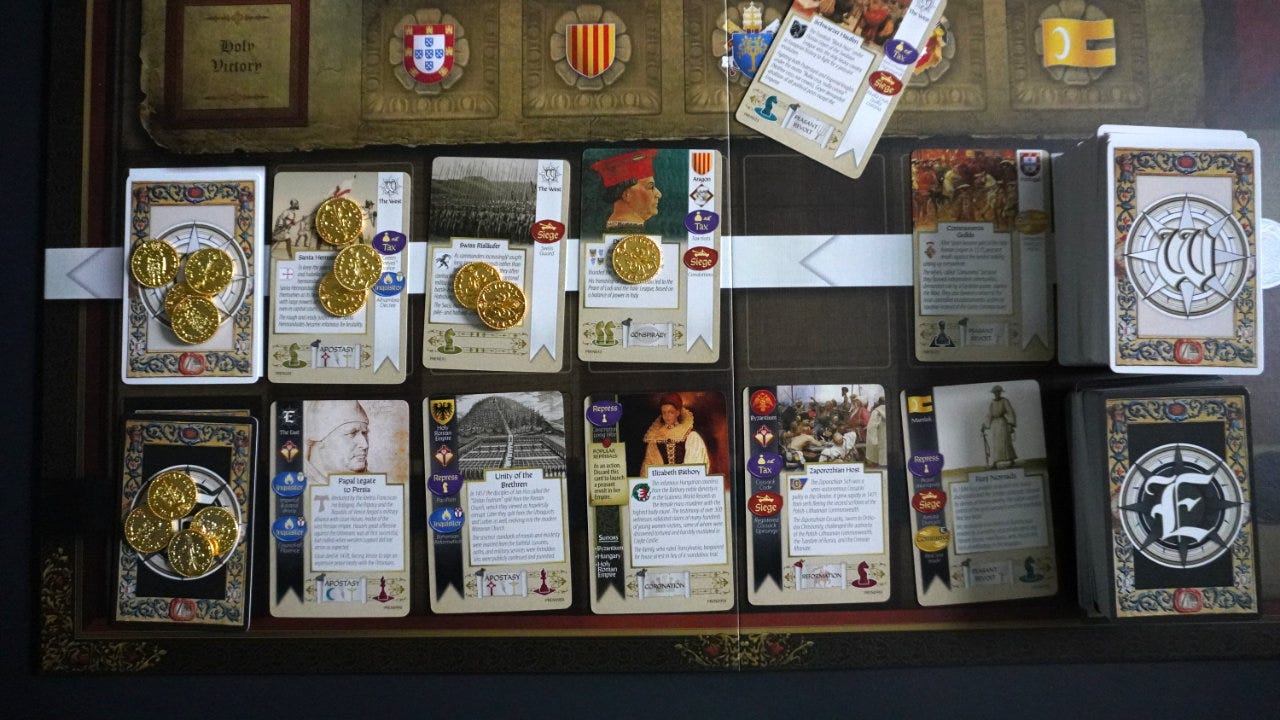
I’ve written about Dutch auctions at length previously, as they are used in games like Pax Renaissance: Second Edition (Eklund & Eklund, 2021), Pax Pamir: Second Edition (Wehrle, 2019), and Canvas (Chin & Nerger, 2021). In all three examples, cards accumulate coins on them, effectively lowering their cost to purchase. In a twist on the standard Dutch auction model, prices can be discounted so far that they go negative (i.e. you gain money by making the purchase).
In Rising Sun (Lang, 2019), a hidden auction mechanism is used to resolve zero-luck combat. Everyone places their bids for the various actions behind a screen and reveals at the same time. It’s fast, easy to resolve, and involves a fair bit of bluffing. Another interesting twist is that the winning player must give all the coins they spent to the losing players.
In all of these games, you might not immediately think “we are conducting an auction” but, mechanically, that’s exactly what is happening.6
Conclusion
Some things to think about:
Auctions are everywhere: Try to spot auctions and bidding in the games you play over the next few weeks or months. I think you’ll be surprised at how often they show up. Especially when you realize that many (all?) area control games are really just bidding games in disguise.
Many types of auctions: There are about 33 types of auctions listed at Wikipedia and many described at BGG. The five from Modern Art are a good place to start, but there are many interesting variations. Just keep the mental demand in mind when considering the more complex types.
Dr. Knizia rarely misses: While they may not be my all-time favorite games, I will never turn down the chance to try a new Knizia game. His designs are always fascinating, filled with tough choices, and leave me feeling inspired. If you haven’t played many Reiner Knizia games, I highly recommend you do.
What do you think? Do you enjoy auction and bidding mechanisms in games? What are some of your favorite examples?
— E.P. 💀
P.S. Tumulus Issue 8 “Insert coin to continue.” is all about dead malls, abandoned arcades, and the influence of video games on tabletop game design — roguelike and soulslike included. Subscribe to Tumulus to get yours!
Skeleton Code Machine is a production of Exeunt Press. All previous posts are in the Archive on the web. Subscribe to TUMULUS to get more design inspiration. If you want to see what else is happening at Exeunt Press, check out the Exeunt Omnes newsletter.
Skeleton Code Machine and TUMULUS are written, augmented, purged, and published by Exeunt Press. No part of this publication may be reproduced in any form without permission. TUMULUS and Skeleton Code Machine are Copyright 2026 Exeunt Press.
For comments or questions: games@exeunt.press
In the game, each $1 represents $1000 thematically. What this rule means is that all bids must be in units of whole money tokens. Seems obvious to me? I’m not sure who would try to bid fractional dollars during the game when there are no tokens for that.
Auction theory can actually be quite complex and mathy. That said, I’m fairly certain most of these types of auction would be considered forward auctions where there is one supplier/seller and multiple buyers.
More formally, this would be called a first-price sealed-bid auction.
All of these auction types are interesting, but this one is particularly tricky for the auctioneer. If they price the painting too low, it will be a gift to the first player who gets a chance to buy it. If they price it too high, no one will purchase and they will be stuck paying too much for the painting.
The second painting is not allowed to have a double auction symbol.
I had trouble finding familiar examples from TTRPGs. Based on what I read, it sounds like the James Bond 007 RPG and Amber Diceless might use bidding mechanisms in some way?