
It’s a busy week!
I’m preparing for Unpub in Baltimore where I’ll be doing the following:
Publisher Diaries Panel (Thursday 3/12 @ 4:00 PM): Tony Tran has invited small publishers to a Q&A about what made their games successful and how others can learn from their mistakes. I’ll be on the panel with Xoe Allred and Heather O’Neill.
TTRPG Speed Dating (Thursday 3/12 @ 6:00 PM): Check out TTRPGs from 10 different designers in quick 15-minute sessions. I’ll be running the first public playtests of Exclusion Zone Botanist: Epsilon — character creation and exploring a location or two.
Ratsail playtests (Friday 3/13 @ 5:00 PM): Running playtests of Ratsail (“Turtchester”).1 Sail ships and spend influence to compete for control of the Rat Isles in this area majority and open drafting game for 2-4 players.
Also, Tumulus Issue 06 “Hammer a nail in the coffin.” is shipping to subscribers this week! Watch your email for a shipment notification and check your spam folder if you don’t see one in the next few days.
But for now, let’s talk about tabletop game mechanisms.
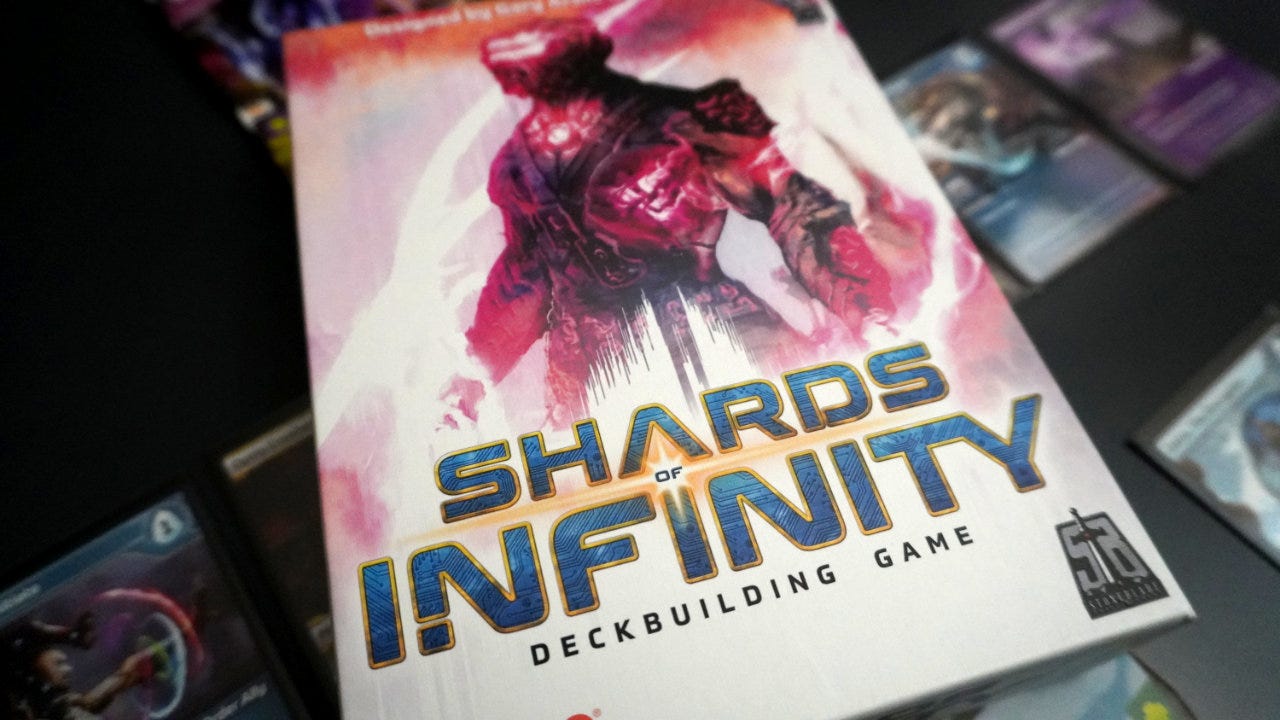
Considering deck-building is one of my favorite board game mechanisms, I’ve surprisingly never directly covered it in a Skeleton Code Machine article.2 That changes today! We will be exploring how Shards of Infinity (a deck-builder) uses red-bordered mercenary cards to add more options during play.
What is a deck-building game?
Donald X. Vaccarino released Dominion in 2008 and forever changed board game design.3 The game introduced (or made popular) many of the elements that we now associate with deck-building games — games in which players use individual decks that they create during the course of the game.4
Specifically, three elements stand out:
The game has a currency (e.g. coins) that players accumulate and then spend to acquire new cards into their deck.
There is a common or shared market that contains cards that players can choose from when spending their currency.
Players draw X cards from their personal deck each turn, play each card, and then discard them all. Their discard pile is reshuffled to create a new deck when necessary.
Since its release, there have been many games that have iterated on the idea of Dominion or outright copied it. Donald has cited both A Few Acres of Snow (Wallace, 2011) and Eminent Domain (Jaffee, 2011) as examples of completely new games inspired by Dominion.5
Games like the very clearly titled Ascension: Deckbuilding Game (Gary, et al., 2010) introduced a dynamic market (i.e. the available cards change over time) to replace the static market style of Dominion. Ascension is also an example of adding multiple currencies (Runes and Power) to the game versus the single currency (Coins) of Dominion.
The deck-building genre has matured and the mechanism is now present in games like Dune: Imperium (Dennen, 2020), Spirit Island (Reuss, 2017), Tyrants of the Underdark (Lee, et al., 2021), Undaunted: Normandy (Thompson & Benjamin, 2019), and Clank!: A Deck-Building Adventure (Dennen, 2016).
Shards of Infinity (Gary & Arant, 2018) continued to iterate on the deck-building genre in some interesting ways.
Shards of Infinity
The Shards of Infinity description gives you the theme of the game:
One-hundred years ago, The Infinity Engine was shattered and its reality-bending shards have destroyed most of the world. Now, it falls upon you to gather your forces, defeat your adversaries, and rebuild the Infinity Engine! Will you survive?
It’s a head-to-head game that I feel is best at two players. It does a few things that depart from most Dominion-derived deck-builders:
It has a six-card dynamic market like Ascension.
Players don’t compete for victory points. Instead players attack each other to reduce their opponent’s health from 50 HP down to 0.
It has two currencies (Gems and Power), but they are used in different ways. Gems are used to purchase cards from the market and Power is used to attack other players to reduce their health.
The game uses Mastery as a way to gradually increase the power of players over time, with cards gaining new effects at higher Mastery levels.6
For a small box game, there is a lot going on.7 This article is not a full rules explanation, but it is worth mentioning a few of the card types.
Allies and champions
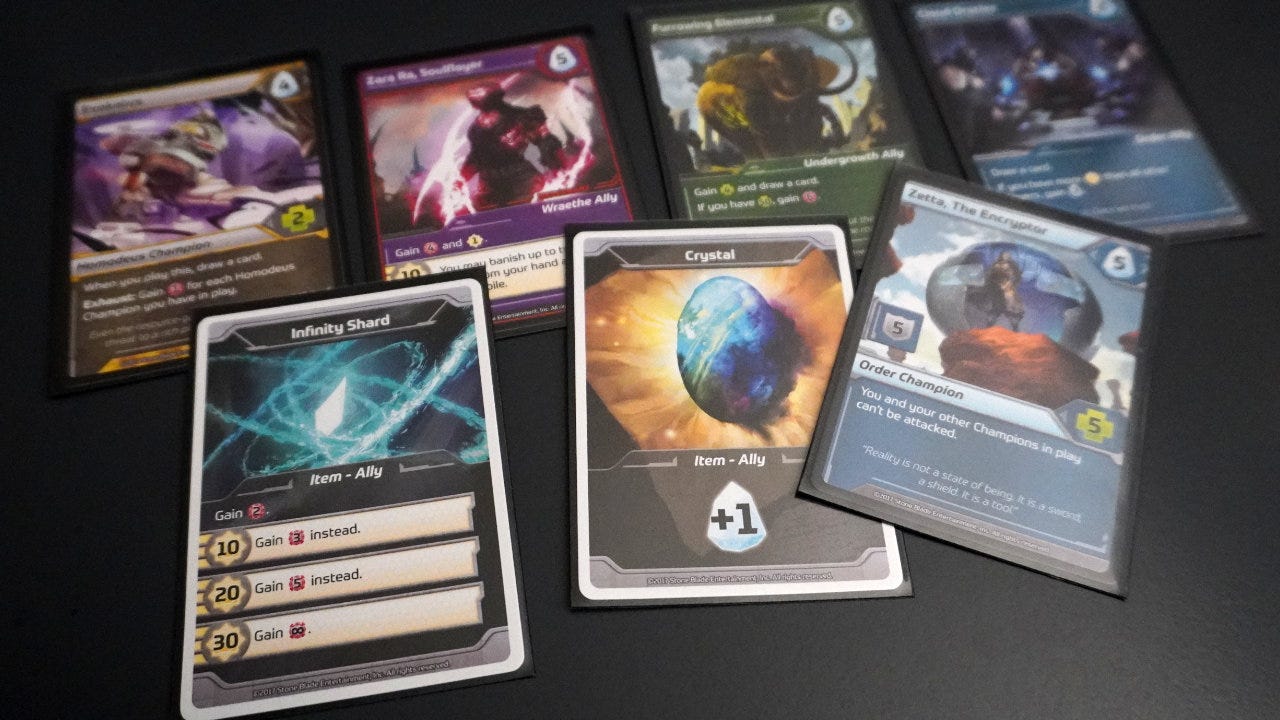
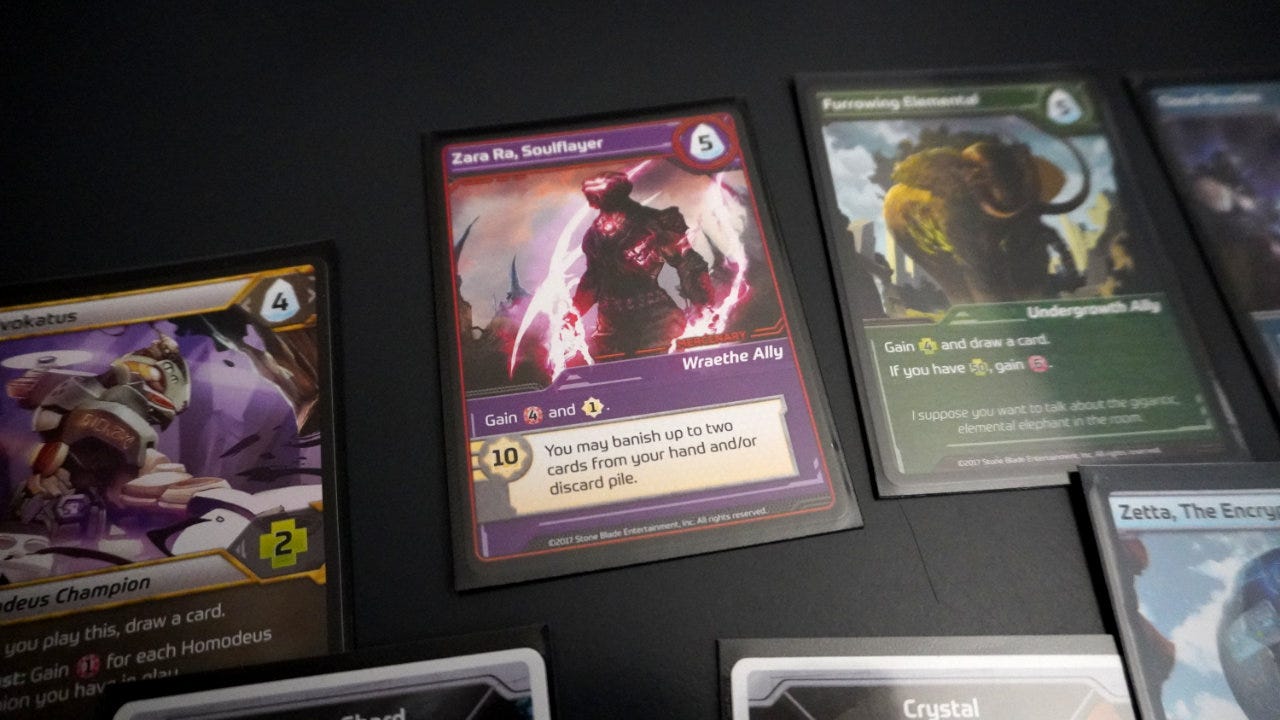
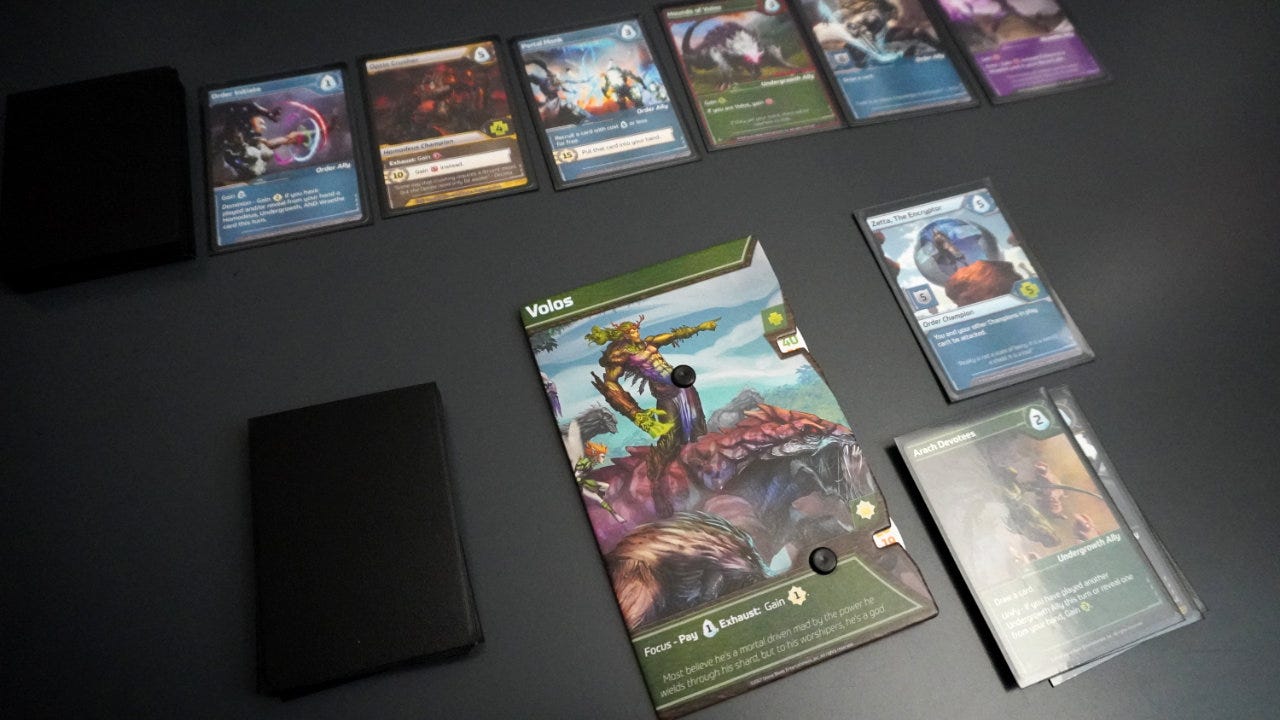
Ally cards are the most common type of card. They have a name, cost (in Gems), faction, and effect when played. For example, the Shardwood Guardian is a member of the Undergrowth faction and causes the player to gain 2 Power and draw a card. Zara Ra, Soulflayer has the player gain 4 Power and 1 Mastery, but at a Mastery level of 10 it also allows two cards to be trashed out of the player’s deck.
Champion cards are similar with a cost and effects, but unlike ally cards, they remain in play. They are placed on the table to create tableau of Champions all of which can be used turn after turn.
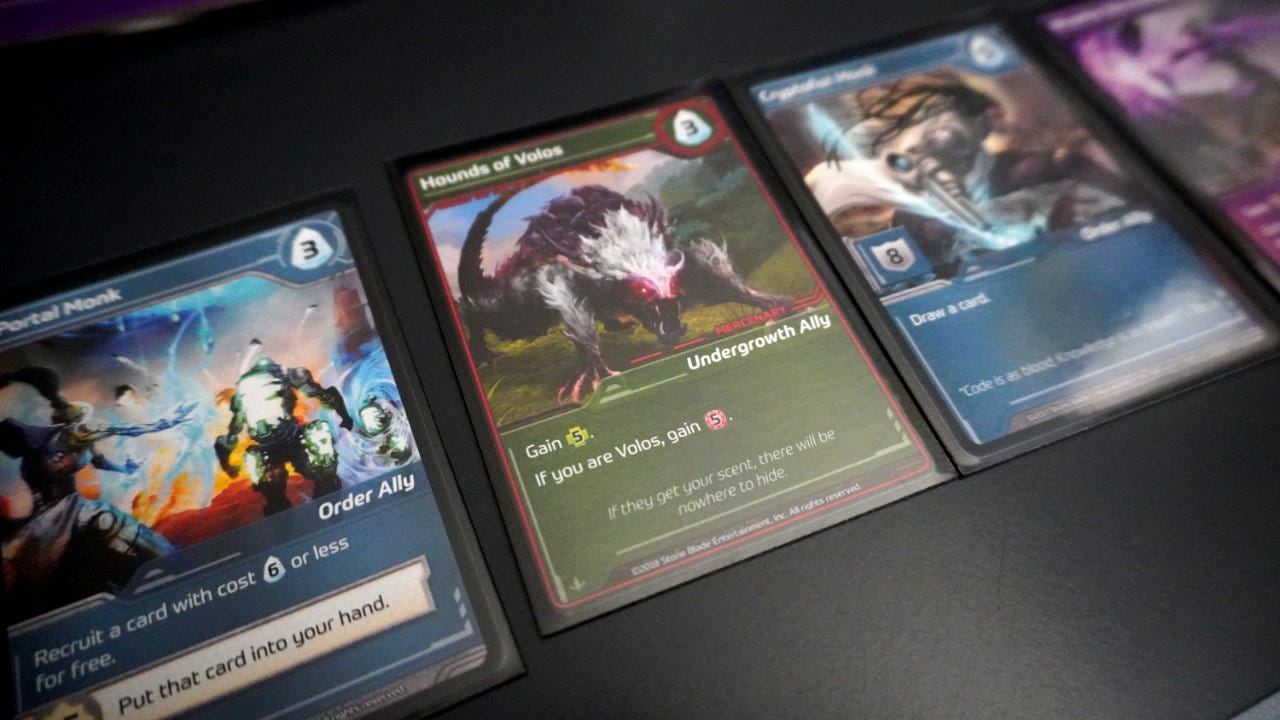
In both cases (Ally and Champion), the cards are purchased from the market and placed into the player’s discard pile. They will eventually get shuffled into their deck, and then drawn. When played and/or destroyed, they go back into the discard pile to start the cycle again. The cards become a permanent part of the player’s deck for the rest of the game.
The twist that I find most interesting is the use of Mercenary Ally cards.
Mercenary ally cards
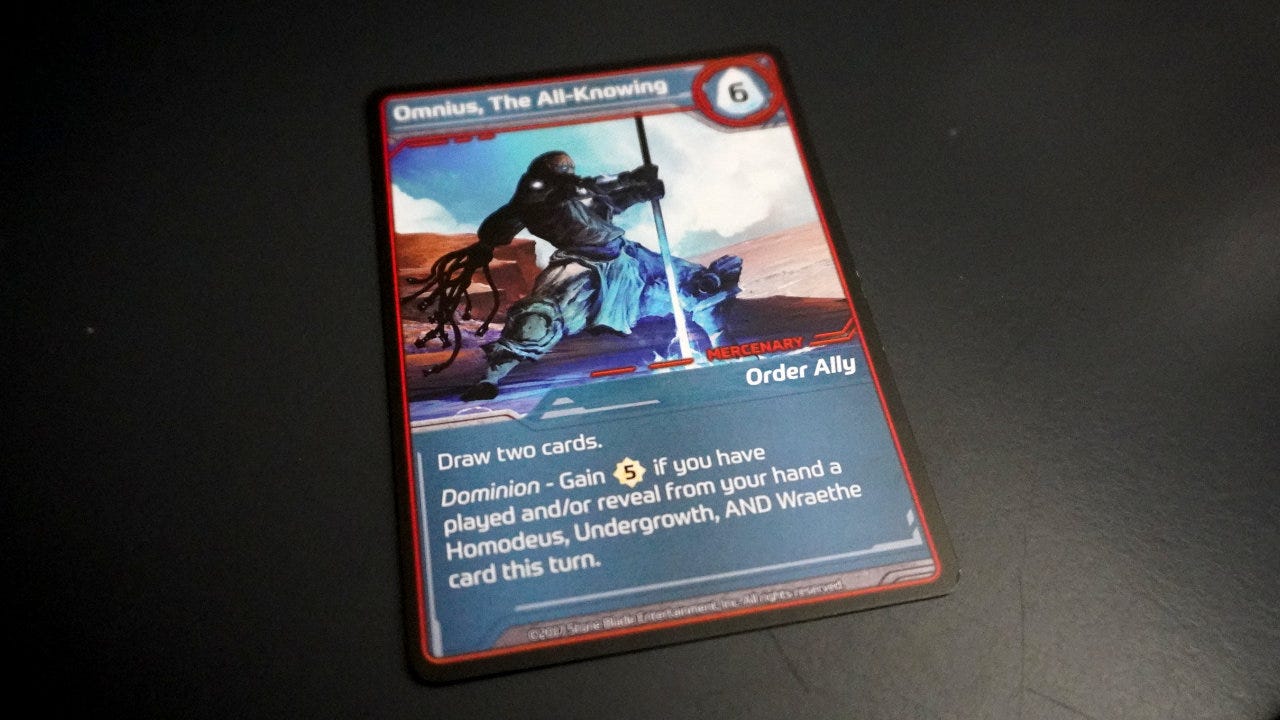
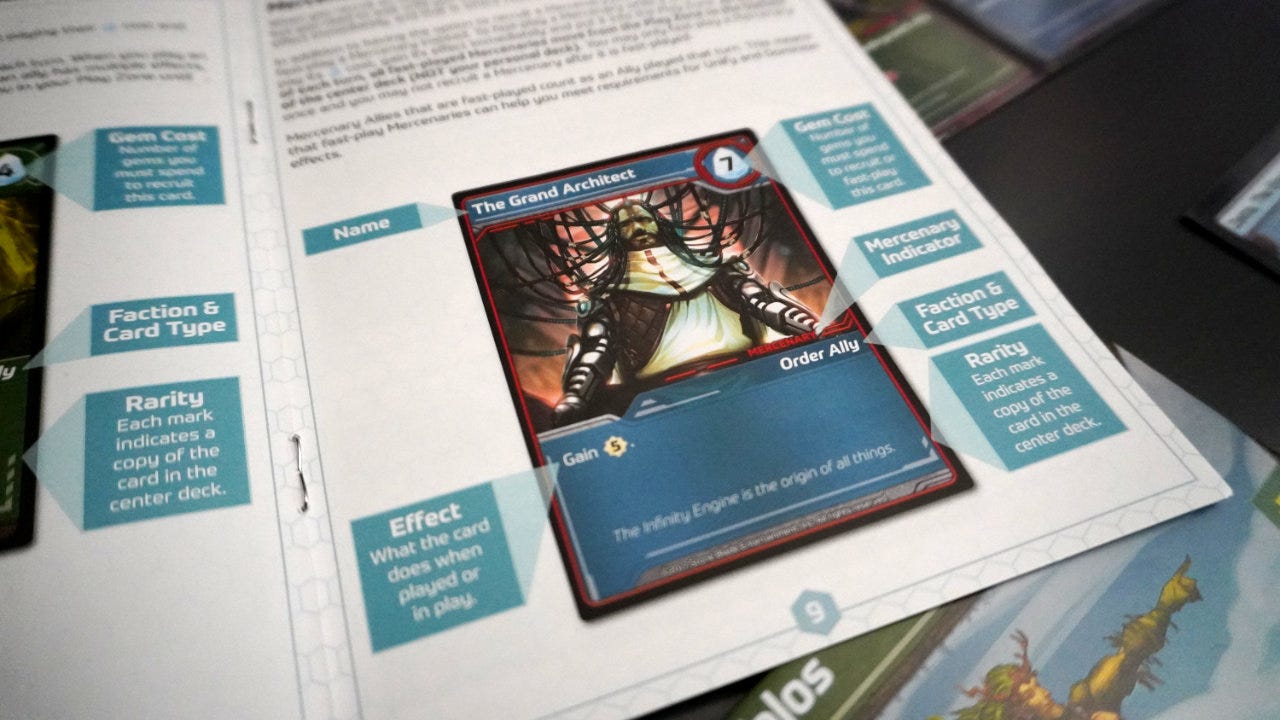
Ally cards with a red border are identified as Mercenary Ally cards. While these can be used in the same way as any other Ally card (as noted above), they also have a special ability called fast-play:
In addition to having the option to recruit a Mercenary just like other allies, you may fast-play a Mercenary instead. To fast-play a Mercenary while it is in the [market], pay its [Gem] cost, gain its effect immediately, and put it into the Play Zone. At the end of each turn, all fast-played Mercenaries move from the Play Zone to the bottom of the [market deck] (NOT your personal deck).
This means you can pay for a card in the market, play its effects, and not put it in your deck. This is really useful for a couple reasons:
Fast-play doesn’t clog your deck: Cards aren’t worth victory points at the end of the game. So there’s no reason to accumulate a large deck in Shards of Infinity. In fact, the opposite is true: a winning strategy is to prune the deck down to just a few key cards. The smaller the deck, the faster the powerful cards will cycle through the deck to hand to discard and back.
Get the effect before it’s too late: Normally a purchased (i.e. recruited) ally card needs to go to your discard pile first. It will take time to deplete your deck, reshuffle the discard, and then hope to draw that new card. Toward the end of the game, there might not be time to even see it get played. By fast-playing, you get the effect right now when you need it.
Of course, there are downsides to fast-playing a card. You spend the full amount but only get to use it once. It doesn’t become part of your deck to be used again. By fast-playing too often and too early in the game, you have no chance to build an engine to supply more Gems and Power later on.
Tough decisions
I’m constantly looking for player agency and tough decisions in games. I’ve found that most games that I enjoy and keep coming back to, they always seem to excel in both of these areas.
Adding the ability to fast-play cards in Shards of Infinity makes the decision space and choices even tougher than a normal deck-builder. Without it, the choice is to purchase one of the six cards in the market and put it into your deck or not. With it, now you need to choose to purchase or not, but also to either (a) fast-play for a benefit now but lose the card, or (b) put it in your deck, but it will take time to see it played.
I’ve played enough to know the answers to those questions depends on your deck, the progression of the game, your opponent’s deck, and many other factors.
Tough choices are fun!
Conclusion
Some things to think about:
It’s OK to be inspired by a game: There’s nothing wrong with taking a game you love and trying to make something inspired by it. That said, consider how different it is to ensure it’s not just a copy. There are so many ways a game can be changed, enhanced, and modified to make it feel special and unique.
Deck-building is awesome: It’s one of my favorite mechanisms. No matter what the game is, if it has deck-building then I’m interested in trying it. Check out some of the modern examples listed above and see how the genre has changed and continues to mature over time.
Identify tough choices: Look at your design and try to clearly identify each time a player has a choice to make. Then list out how many different options they have while noting any Hobson’s choices. For each one, is it possible to make the decision space smaller and the choice harder?
— E.P. 💀
P.S. Want more in-depth and playable Skeleton Code Machine content? Subscribe to Tumulus and get four quarterly, print-only issues packed with game design inspiration at 33% off list price. Limited back issues available. 🩻
Skeleton Code Machine is a production of Exeunt Press. All previous posts are in the Archive on the web. Subscribe to TUMULUS to get more design inspiration. If you want to see what else is happening at Exeunt Press, check out the Exeunt Omnes newsletter.
Skeleton Code Machine and TUMULUS are written, augmented, purged, and published by Exeunt Press. No part of this publication may be reproduced in any form without permission. TUMULUS and Skeleton Code Machine are Copyright 2025 Exeunt Press.
For comments or questions: games@exeunt.press
Ratsail?! Isn’t that a former Exeunt Press TTRPG project? Why yes, yes it was. Now it’s an area control board game. Strange times!
I have sort of mentioned deck-building in games before, but it was never the focus of the article. For example, in Negative Optimization on Moon Base Callisto, the focus was on how Undaunted 2200: Callisto’s unit attrition mechanism is an example of what Sarah Shipp calls negative optimization. Which is a good reminder that if you haven’t yet read Thematic Integration in Board Game Design, you really should.
This is a bold statement, but I stand by it. Few games of the modern era have had such an impact and found so many imitators. While StarCraft: The Board Game may have been the first deck-building game, having been released about a year before Dominion, I’m not sure it has had the same impact.
BGG considers deck-building to be part of the general Deck, Bag, and Pool Building mechanism: “Players play cards out of individual decks, seeking to acquire new cards and to play through their decks iteratively, improving them over time through card acquisition or card elimination.”
Donald X. did a Reddit AMA in 2016 where he addressed some of the more blatant copies of Dominion: “I have not lost sleep over Dominion clones. I have no respect for someone who has Silver cost $4 and pretends like they’ve made a new game. Obviously you can be inspired by Dominion and yet make an actual new game; I always cite A Few Acres of Snow and Eminent Domain (neither of which I’ve played). But a lot of people decided to start with all of Dominion, as if none of my design decisions could have gone another way. And well, no respect there. But no loss of sleep either.”
The best part of Mastery is the Infinity Shard card that every player begins the game with. It provides 2 Power by default but goes up as Mastery goes up. At 10 Mastery it provides 3 Power and at 20 Mastery it provides 5 Power. But at 30 Mastery it provides INFINITE POWER!!! This acts as a timer on the game as anyone with 30 Mastery can one-shot another player if they pull their Infinity Shard card.
I don’t mean this is a “heavy” or complex game. In practice, it is very easy to teach and play. There are, however, a quite a few rules beyond a normal Dominion-style deck-building game. The core rulebook is less than 16 small pages.
reminds me of Heroes in Star Realms. great article, will look out for Shards 👍
What do you think of Star Realms? I was going to pick up shards of Infinity, but someone said the two are too similar.