
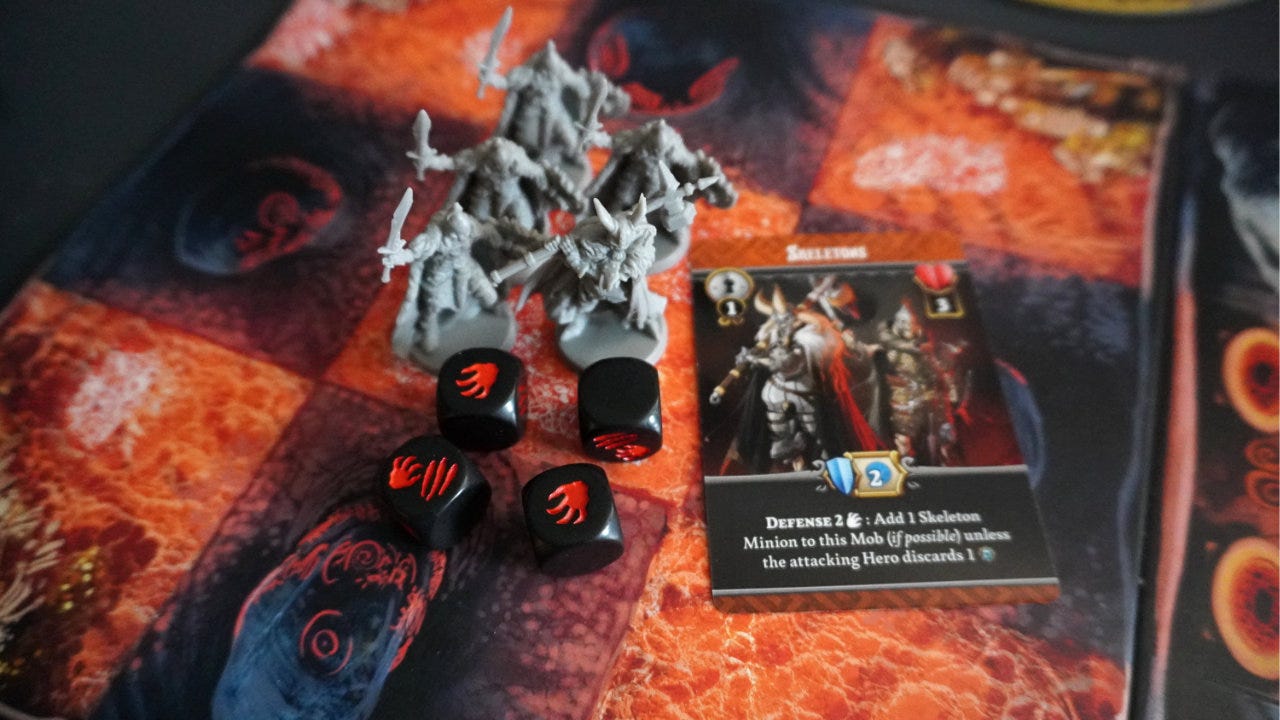
Last week we looked at how Slay uses 2d6 dice combat but adds an Effort Die to create tough choices. This week we are looking at a different kind of combat: how to fight groups of enemies without it being fiddly.
Massive Darkness 2: Hellscape
I’ve mentioned Massive Darkness 2: Hellscape (Olteanu & Portugal, 2022) a few times before in passing.1 It’s a dark fantasy board game where players explore a dungeon, fight monsters, collect loot, and level up. Thematically, it’s the classic heroes battling demonic forces to save the world — not particularly unique.
Mechanically, however, I find it to be a fascinating game.
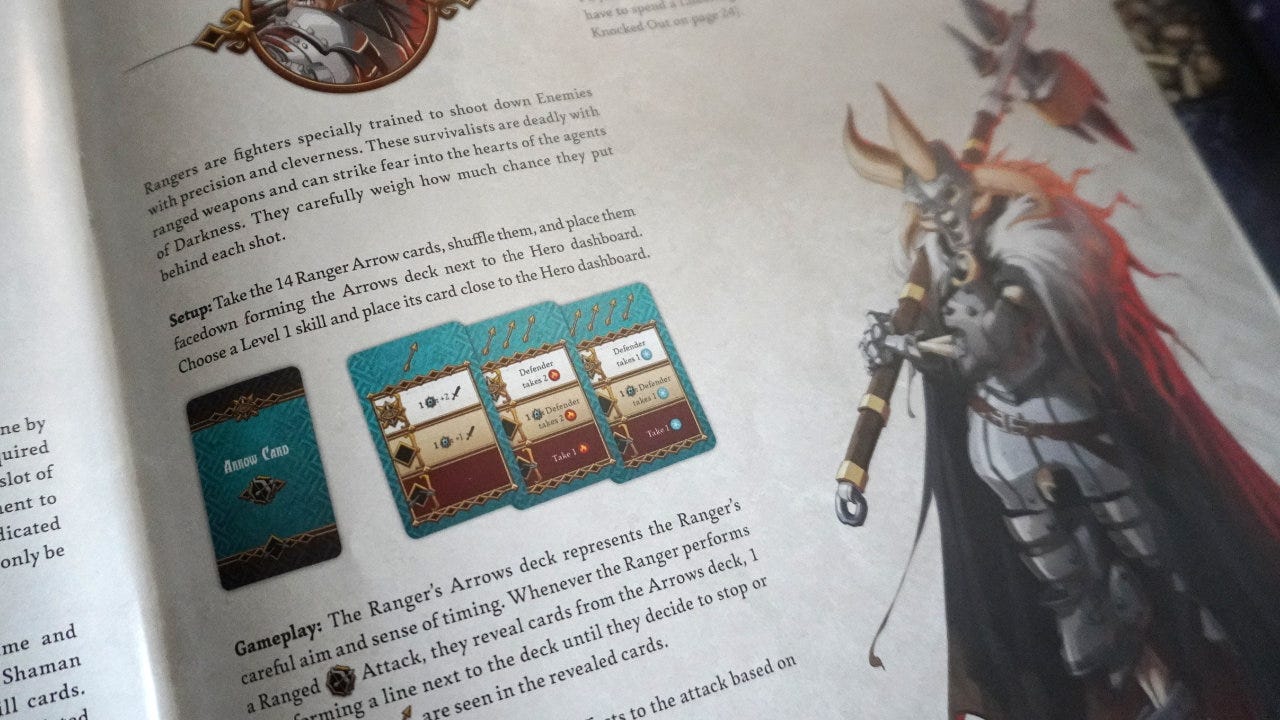
The most striking part of the design is the asymmetric character designs. The wizard uses a rotating disc similar to a rondel to power spells. The paladin can buff other players using tokens placed on the map. The rogue uses a bag-building and the ranger uses a push-your-luck card system. Each player feels and plays very differently.
While that asymmetry is the most often discussed aspect of Massive Darkness 2, a less frequently mentioned part is just as interesting. The game handles groups of enemies (mobs) in a particularly elegant way.
Exploring how Massive Darkness 2 handles mobs can provide inspiration on how to streamline combat in other board game and TTRPG designs.
Leaders and mobs
First, we need to look at how enemies work.
There are three types of enemies in Massive Darkness 2: bosses, roaming monsters, and mobs. There’s usually a single boss for each quest and some number of roaming monsters. They each operate as single creatures with their own names and abilities: Lyidan the Incubus Lord, Ytheria the Undead Queen, or The Ghoul.
Mobs are different. They work as a group.
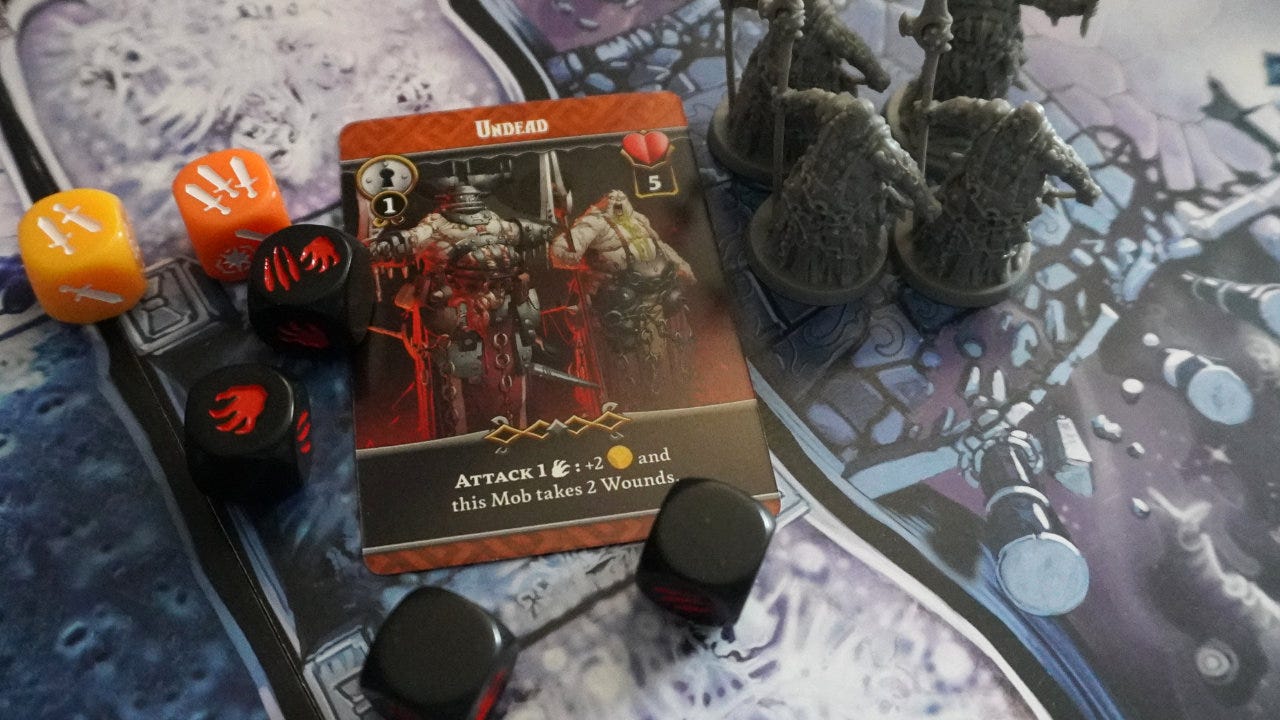
When a mob spawns, it contains a leader and one or more minions. The number of minions in the mob depends on the number of players. For example, you might spawn a mob of Fire Elementals with three minions and a leader. Other mobs include Dark Pixies, Satyrs, Fallen Angels, and Gargoyles.
Each mob has a health value, special ability, and reward to be gained when defeated.
In many games, you would start the battle with a mob and fight each one. If you have four Fallen Angels to battle, you’d deal damage to each one. Each minion would have its own hit points to track. You might focus on the leader first or the minions, and the battle would continue until they are all dead.
Massive Darkness handles this in a different way. The mob attacks and defends as a group.
Attacking and defending as a group
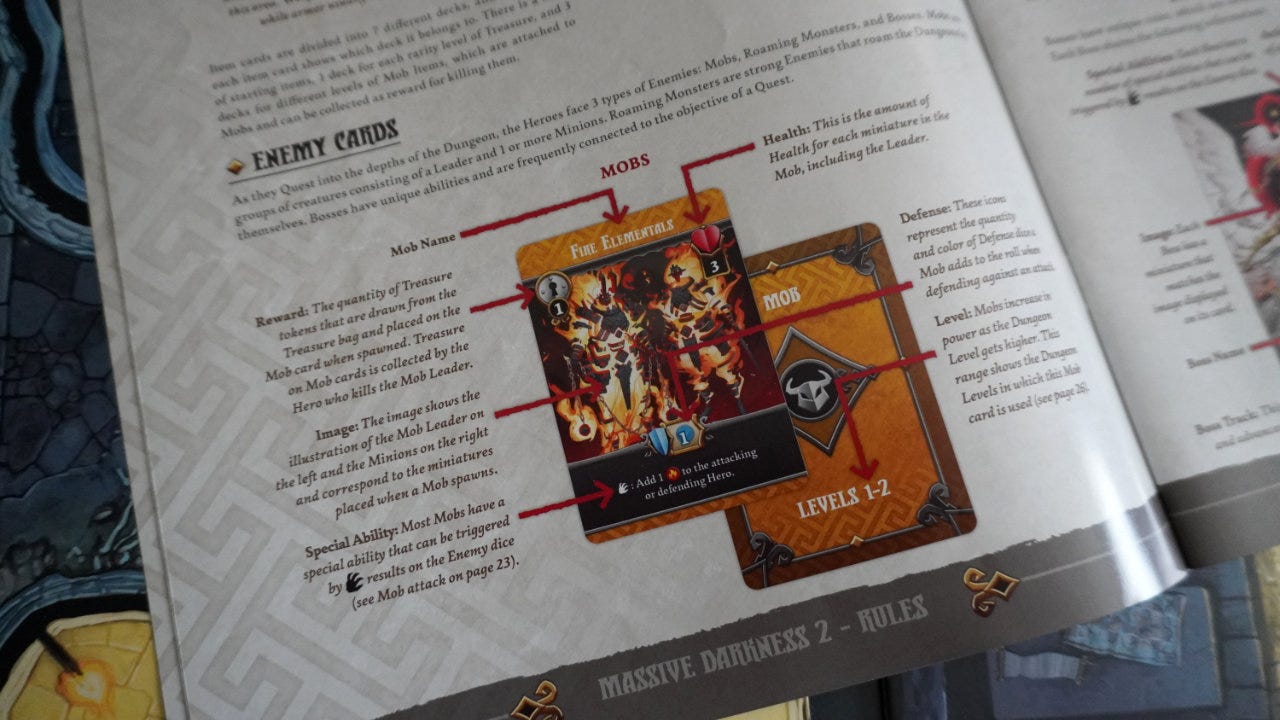
When attacking a mob, you treat all creatures in the mob as a single group even though they each have their own health points (HP).2 Let’s say you have three players and a mob of Dark Pixies spawns:
Leader (6 HP)
Minion 1 (6 HP)
Minion 2 (6 HP)
Minion 3 (6 HP)
Four Dark Pixie miniatures are placed on the board, each with 6 HP.
When a player attacks, they assemble their dice pool. An enemy die is added for each minion in the mob.3 They roll their dice and calculate the number of wounds dealt to the mob. Wounds are always applied to the minions first. The leader can only be wounded after all minions have been defeated.
The player rolls, uses a special ability, and deals 13 wounds.4 That’s enough to kill two of the minions (6+6=12) and apply the one remaining wound to the final minion. Two of the three minion minis are removed. The leader is untouched.
When the mob attacks, it attacks as a single group. It uses the most effective attack available (ranged or melee) and targets the closest hero. Their dice include their weapon dice plus one enemy die per active minion in the mob.
Just like the attack, it’s a quick roll and done. Wounds are applied to the targeted hero.
Keeping it simple
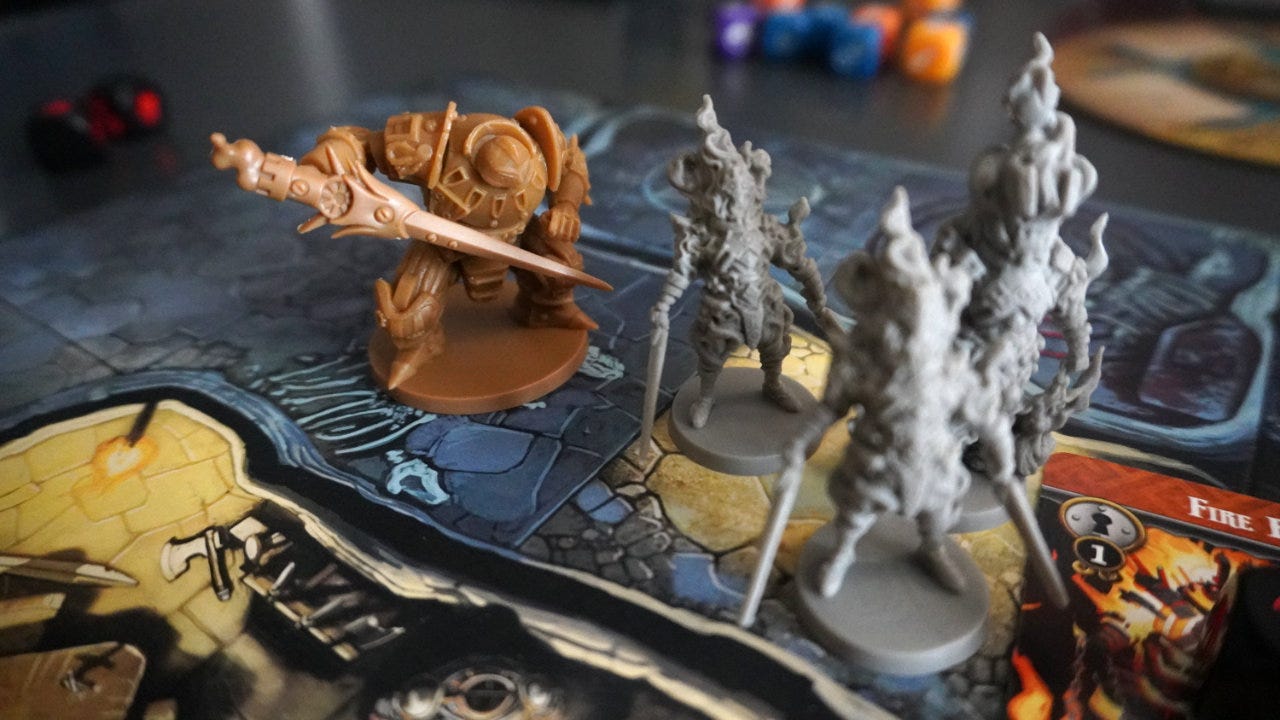
Being a big fan of simple, solo dungeon crawls like Dark Fort, I think about how to streamline combat systems all the time. While there are times that I want highly detailed crunchy combat, for solo games I often want to keep it minimal.
When you are fighting a single monster in a solo game, it’s simple. You do damage and apply it. It does damage back. It’s not hard to track the damage or HP for a single foe, but it also can get boring fighting one monster at a time. As if they all neatly lined up, patiently waiting for the defeat of their fellow monsters before launching their attack.5
Fighting a mob in a solo game can, however, feel fiddly. You battle a swarm of 2d6 giant rats and have to track the HP for 2-12 rats until they are all dead.6 It’s not bad, but I don’t love it.
Using a Massive Darkness 2 style system speeds up combat and keeps it simple. Rather than tracking individual health for each minion, you just track the total number of minions. That can be done with tokens just as easily as with plastic minis.
The attacks are fast because you don’t need to track who you are attacking. Just apply the damage and keep going. The enemy’s counterattack is just as easy. One shot and done.
While I’m confident this idea of mob combat has been used in other TTRPGs and board games, I can’t immediately think of any.7 It seems like a system that could be adapted for use in other games.
Simplicity at a cost
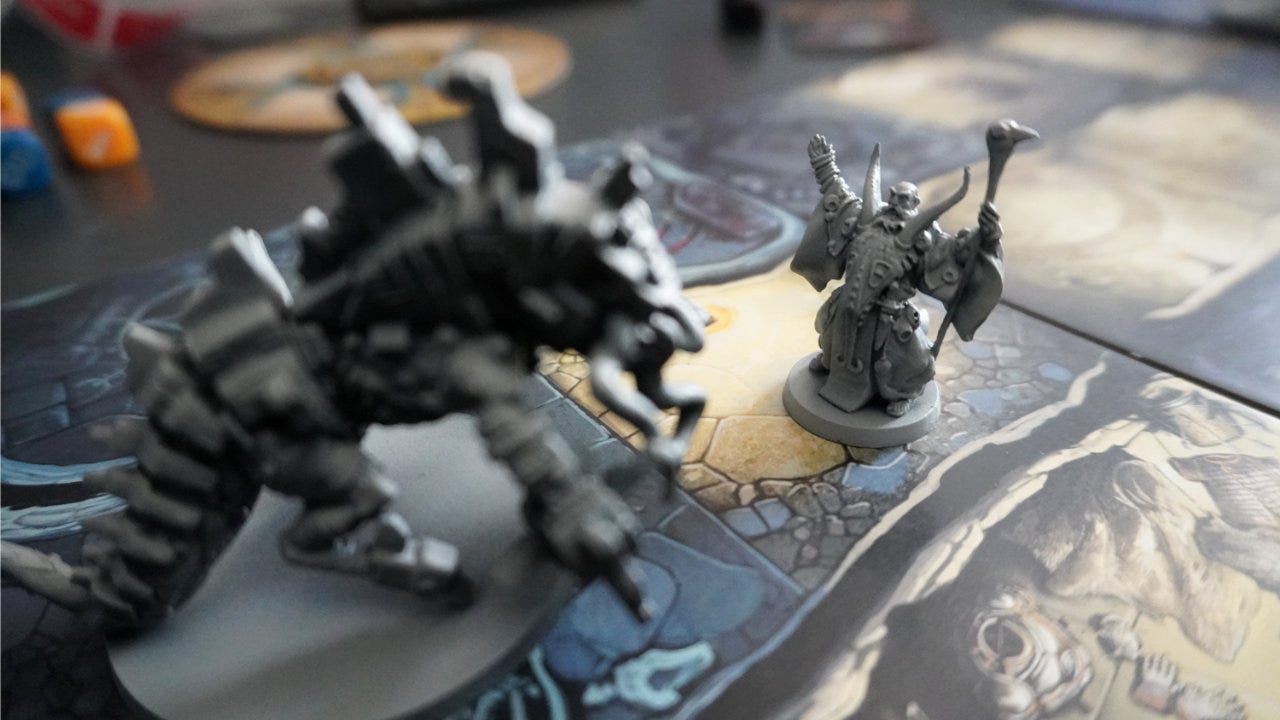
This mob system is, of course, not without its downsides. You lose a few things when lumping all the enemies together into a single mob:
Lack of individual positioning: In Massive Darkness 2, the mob enemies all occupy a single space on the board. If you want tactical combat that happens on a grid or hex map, this won’t work.
Lack of target selection: There is something fun about coordinating attacks against a single foe. In a more complex system, you might be able to wound a single enemy enough to reduce their effectiveness and then target another.
Lack of narrative detail: Although there is technically a leader for each mob, they effectively act like any other minion. In a different system, there could be a benefit to ignoring the minions and going after the leader first. This could make narrative sense and cause the minions to retreat once their leader is gone.
Is the simplification worth it?
That depends on what your goals are for the game, the kinds of fun you want to have, and the promises you make to your players.
Conclusion
Some things to think about:
Games contain multitudes: I’ve found that tabletop games often become known for one specific part of their design. In the case of Massive Darkness 2, that’s the asymmetric player characters. And yet there are other, less talked about, aspects that are just as interesting.
Simplifying mob combat: It can be tricky to manage multiple enemies when they each have their own health, attack, defense, and abilities. This is particularly true in games where downtime can be an issue. Streamlining the combat does lose some narrative and thematic complexity, but it might be worth it.
TTRPG inspiration from board games: There are so many excellent dungeon crawling board games available and many of them could serve as inspiration for TTRPGs. The streamlined mob combat in Massive Darkness 2 is a solid example.
What do you think? Does the benefit of streamlining the mob combat outweigh anything lost due to the simplification?
— E.P. 💀
P.S. 🎁🩻 Looking for the perfect holiday gift? Send a Tumulus gift subscription! They’ll get four quarterly, print-only issues and no pesky automatic resub. It automatically cancels at the end, making it no hassle at all.
Skeleton Code Machine is a production of Exeunt Press. All previous posts are in the Archive on the web. Subscribe to TUMULUS to get more design inspiration. If you want to see what else is happening at Exeunt Press, check out the Exeunt Omnes newsletter.
Skeleton Code Machine and TUMULUS are written, augmented, purged, and published by Exeunt Press. No part of this publication may be reproduced in any form without permission. TUMULUS and Skeleton Code Machine are Copyright 2026 Exeunt Press.
For comments or questions: games@exeunt.press
I mentioned Massive Darkness 2 in my original Top 10 Board Games post, giving it an 8.5/10 and ranking it #9 on the list. Having written that post over three years ago, it seems out of date now. My tastes have changed. The game also gets a mention in the Typology of Death post due to the use of Lifebringer tokens.
The mob cards have a single health value shown on them. For Dark Pixies, that value is 6. This means that each and every minion in the mob, including the leader, as 6 health.
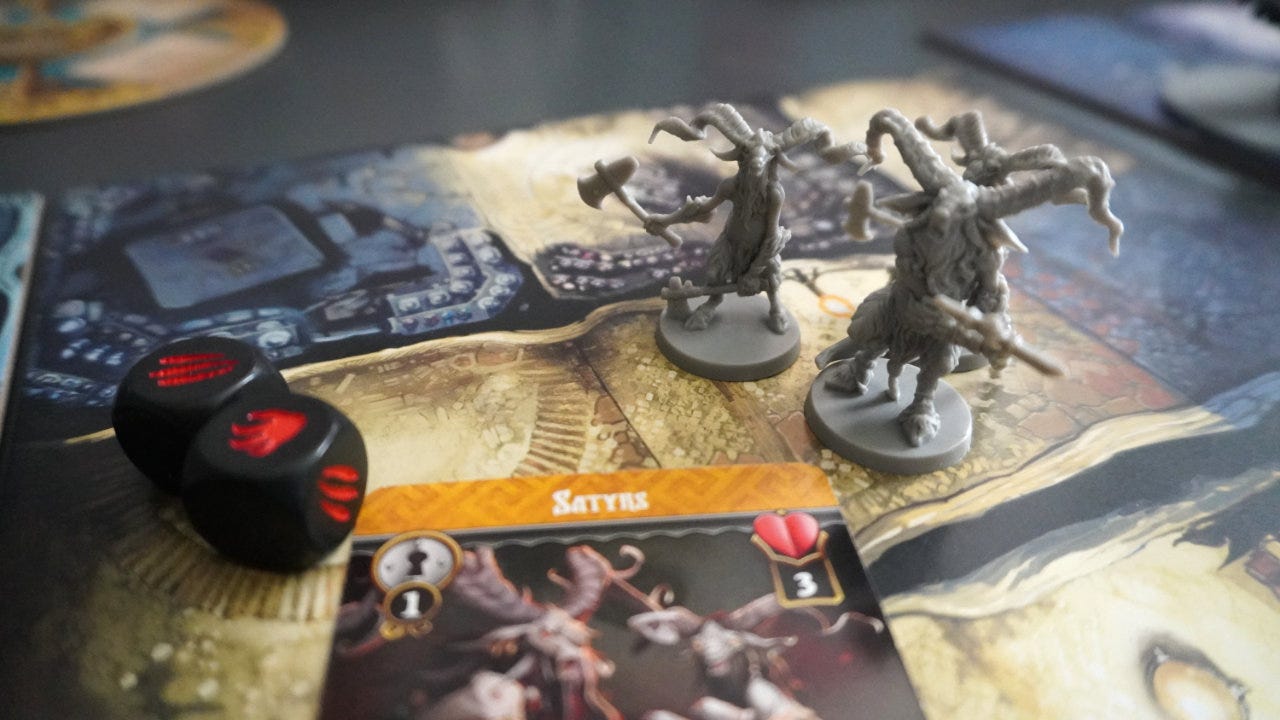
The six-sided black enemy dice have a chance to inflict wounds on the hero or trigger the enemy’s special ability. They also have two blank sides.
That would be a pretty big hit in Massive Darkness 2. I’m not sure how likely that would be, but it doesn’t really matter for this example. Just work with me here and assume they dealt 13 wounds to the pixies.
I believe this is called mook chivalry in the movie trope world.
Alternatively, if you live in Multnomah County, Oregon, it is recommended that instead of fighting the rats, you stay calm and grab the dish soap. This will make it easier to flush them back down the toilet from whence they came. 🐀🚽
If you can think of any, please let me know in the comments! I’m sure I’m missing some obvious examples.
Mork Dod, a chainsaw weilding, demon slaughtering Borg hack has HORDES. The horde HP equal to individuals in the horde (so basically 1HP each). There are stronger unique ones, but they are like 3 HP. Makes it easy to keep track of.
Then to HIT, the difficult rating is 13 minus the # of minions. So a horde with 13+ = autohit. 5 minions= DR8.
Then the horde attacks. Defensive DR is 12+ (1DR for every 5 minions). So 20 minions = DR16. 5 minions= DR13.
Horde's damage is easy too. Make D12 dmg, you roll what every dice is closest to the number of minions. 5 minions = D6, 20 minions = D12 (that is probably the weakest element of this system. It should be D20, which is what I use anyway). for like 16 minions, I would roll a D12 +d4.
I like this system that I usually incorporate it in all my games I run since it's the simplest and fastest while also being terrifying when I throw over 2 dozen screaming undead sprinting at them in the complete darkness.
If we're really going to go back to the beginning and look for where this stepped into the RPG sphere, it takes us all the way back to day one, where original Dungeons and Dragons split off from Chainmail and was intended to be used in concert with Chainmail.
Even at the individual dungeon scale, early D&D clumped vermin like swarms of rats into unified swarm stat blocks, and they acted like a single creature.
As someone else pointed out, Tunnels and Trolls in '75 very much does this, and it is the primary mechanism by which combat is resolved. When a party goes up against multiple targets, the GM adds all their monster ratings together into a combined die pool and modifier total, and then as the party takes their actions and gets their results, the lowered MR reduces the group's dice on subsequent rounds.
This is sort of the ultimate form of swarm resolution. It's also really fast and quite good. If you've never played Tunnels and Trolls, you should look into it.
Then we go to 87 for Star Wars from WEG, where stormtroopers, not surprisingly, get a Combined Action, which lets a group of them act with a single roll.
This actually comes up a lot in RPGs, and to one degree or another, most of the RPGs I've played in the last several decades have mechanics which cover it.