
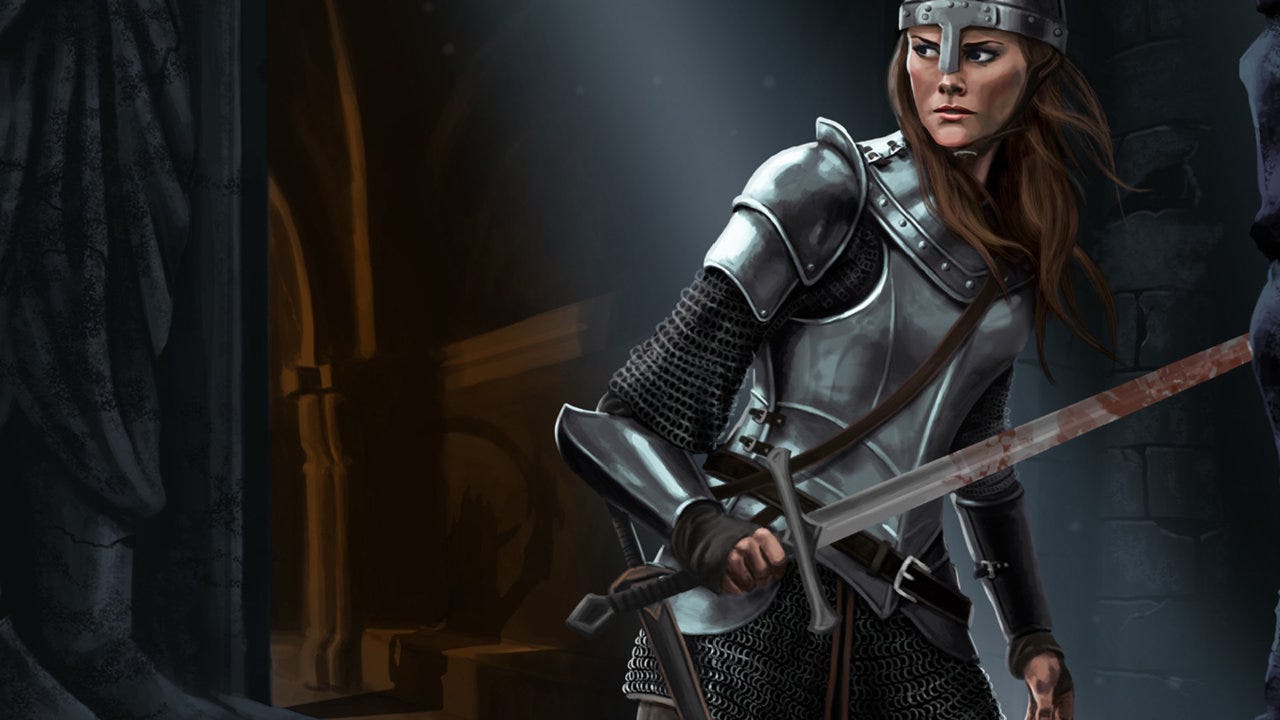
Making a solo dungeon crawl good is tough enough, but making the combat interesting is perhaps the toughest challenge. With just one player, rolling the dice over and over can get tedious quickly — especially for misses. While there’s nothing wrong with the classic opposed roll slugfest until one side dies, I’m always excited to see something new.
This week we are looking at a solo dungeon crawl called 2D6 Dungeon. Specifically, the way it uses a D66 roll during combat and the ability to change the dice.1
A solo dungeon crawler game
2D6 Dungeon is a “roll-and-write, print & play, solo player, dungeon crawler game” by Toby Lancaster released in 2023. The setting is a world called Coradine:
“It is a land where the people have a longstanding peace, war seemingly forgotten, and the regions and realms respect a unified sovereignty. But beneath this shroud of peace is a turbulent underworld; a dark realm that is riddled with dungeons and underground chambers where monsters hide away guarding their treasure, and organised groups of bandits and brigands form plans to raid the settlements above.”
The rulebook is upfront that the core aim of the game is to “gather treasure, experience points, and legendary status” but there are many opportunities to build an interesting narrative as well.
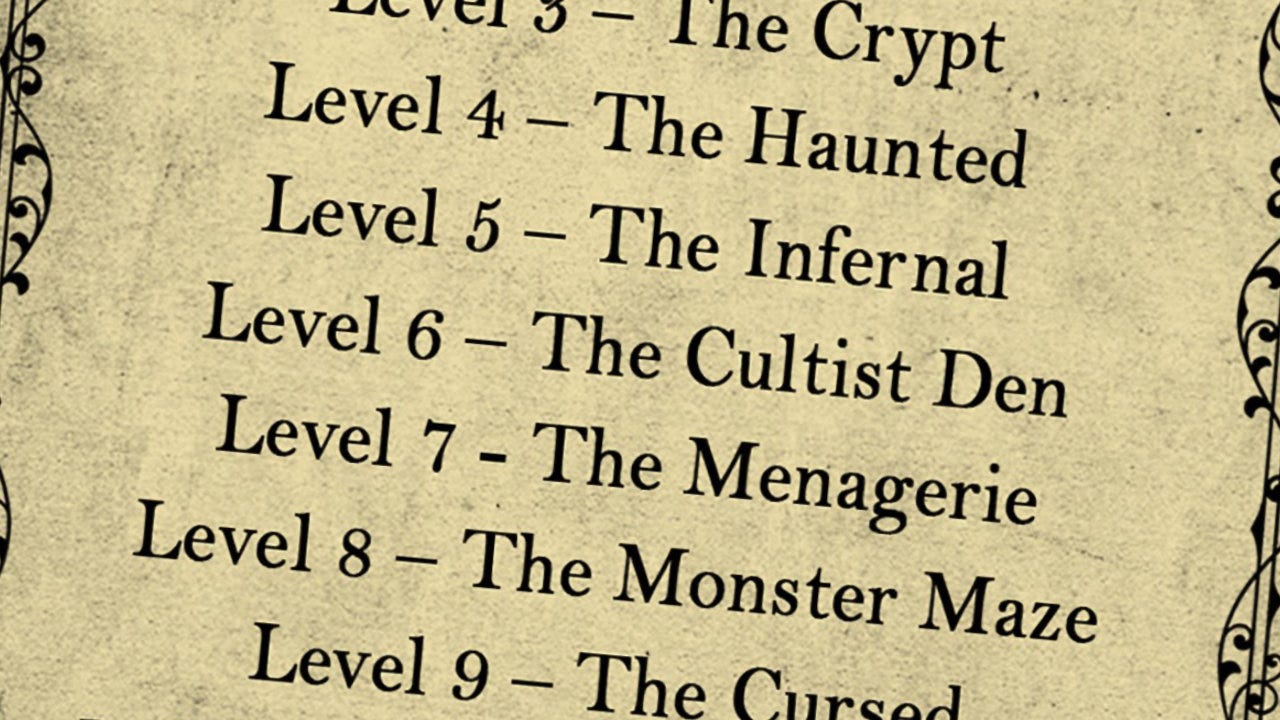
Ultimately, the goal is to complete all ten levels of the dungeon beginning with Level 1 - The Entry. Other levels include The Crypt, The Cultist Den, The Monster Maze, and eventually end at Level 10 - The Dungeon Lords.
It’s a classic dungeon crawl with weapons, potions, magic, monsters, and loot.
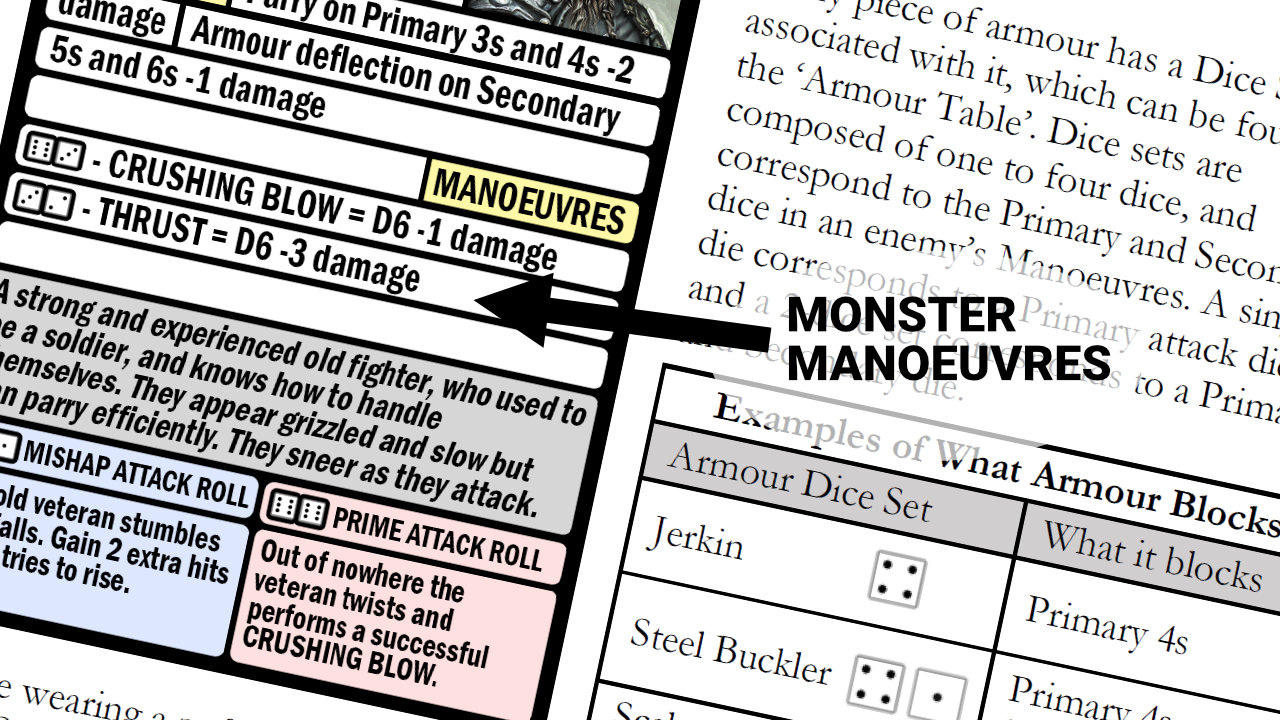
The part I found particularly interesting was the combat system, but there’s a lot there to explore. So this week I want to look at just one part of combat: manoeuvres.2
Just one weapon
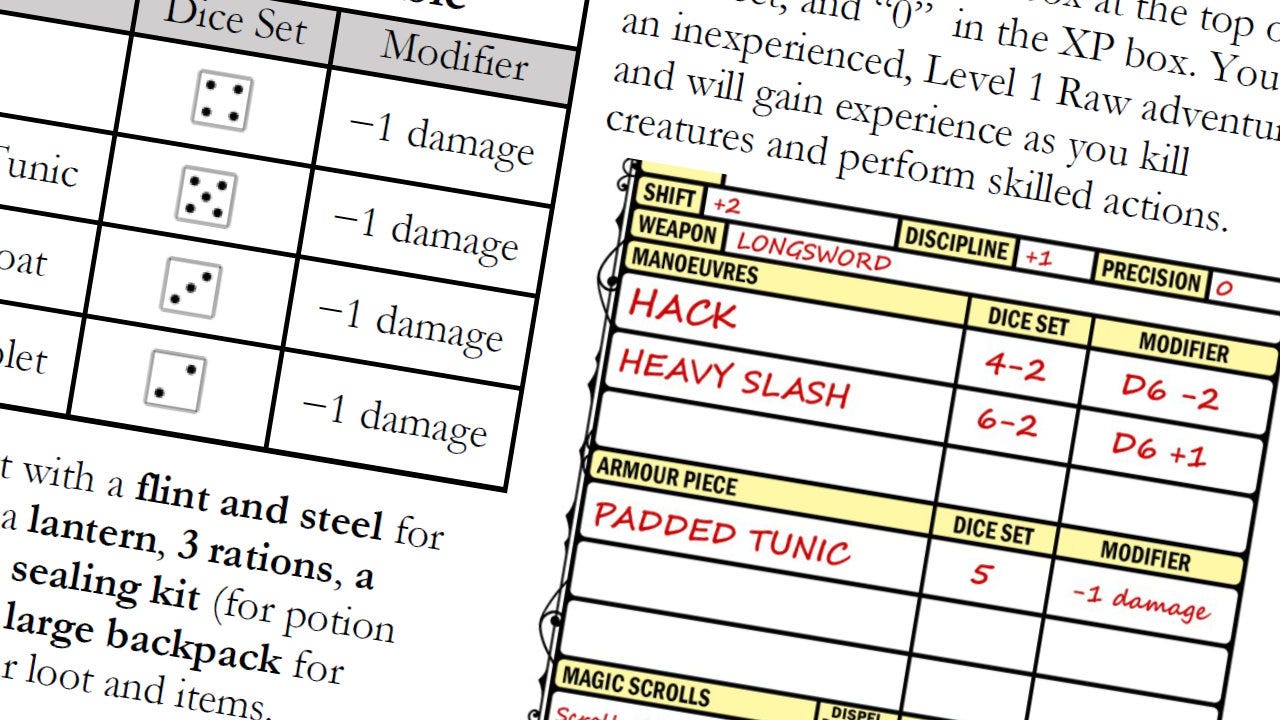
One departure from the usual dungeon crawler mechanisms is that adventurer’s will use just a single weapon during their adventure. Usually, in my experience, dungeon crawl games rely on the character finding progressively better weapons as they explore. They might start with a dagger, pick up a longsword later, and eventually find the +5 Bog Sword of the Lost Frog Wizard.3
2D6 Dungeon takes the opposite approach. During character creation, the player must choose: Longsword, Greataxe, or Heavy Mace.4 That will be their weapon for the entire game. There is a thematic explanation for this:
“You can’t just pick up any weapon in the dungeon and expect to know its intricacies, so you stick to what you know best and wield the same weapon throughout your adventure. Years of training have taught you how to use it with a decent level of skill.”5
Instead of swapping out weapons for better ones, your character will learn more manoeuvres — attacks tied to specific 2-dice combinations. There are 24 manoeuvres for each of the three weapon types, divided into three levels. Characters begin the game with just two Level 1 manoeuvres but will get the chance to improve this over time.
Using manoeuvres in combat
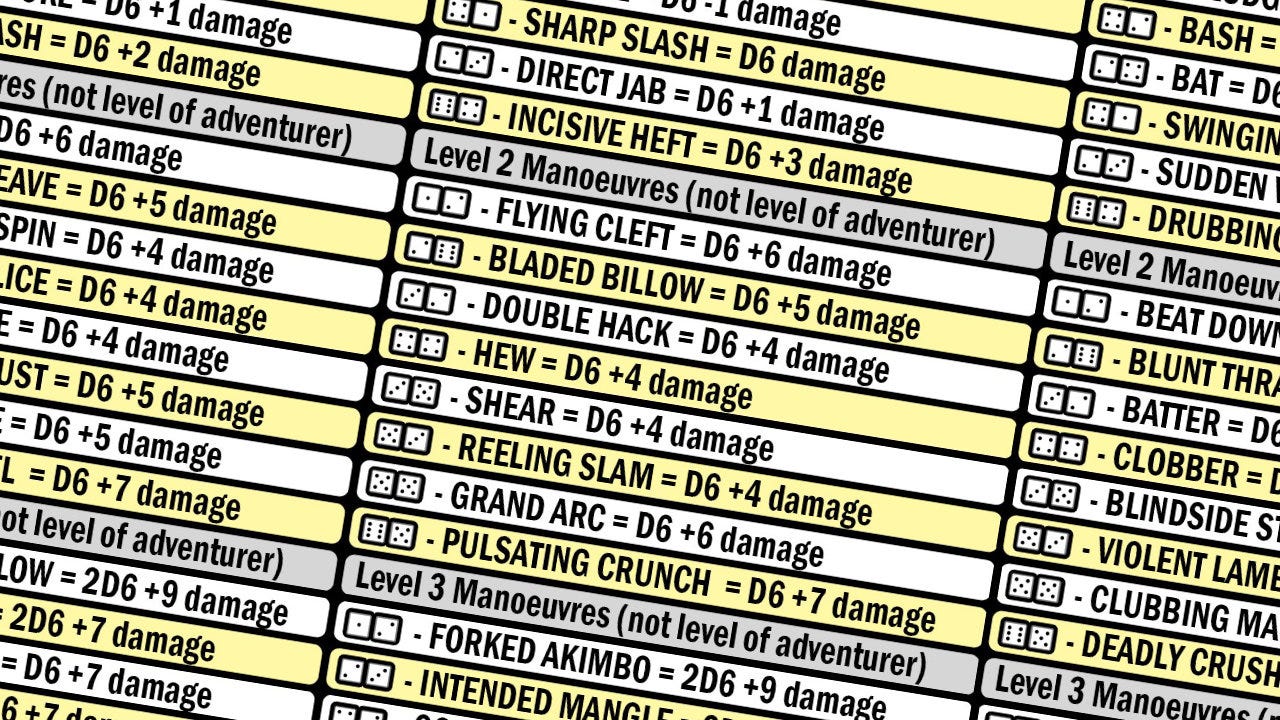
Combat in 2D6 has a lot going on. There are manoeuvres, dice shifting, interrupts, armor deflection, fatigue dice, and some special always-hit/always-miss rolls. You can’t flee combat. It continues until one side wins.
I’m not going to try to do a full combat rules explanation here, but I do want to give a very high-level overview.6 Here’s the sequence:
Player attacks: You roll D66 using differently-colored dice. If the dice match one of your manoeuvres, you hit your foe and deal damage based on the manoeuvre’s type. For example, the longsword’s Biting Stroke does D6+1 damage while the Heavy Mace’s Blistering Swing does 2D6+6 damage.
Shift if necessary: Failing to match a manoeuvre combination is a miss, but you have a chance to modify your roll using Shift Points. Each Shift Point can adjust a die up or down by 1, but this does not loop from 1 to 6 or 6 to 1.
Check for interrupts: Each monster has an Interrupt Stat listed. If either of your manoeuvre dice match the monster’s interrupt, the damage is reduced by that amount. For example, damage might be reduced if you roll a 3 or 4 on your primary (first) die.
Monster attacks: If the monster is still alive, it attacks back using a similar method. The player rolls D66 for the monster and applies its Shift Points to try to match one of the monster’s manoeuvres. On a hit (i.e. match), it deals damage to the character.
This process continues until either the monster dies or the player dies.
Although it’s probably a topic for its own article, it’s worth mentioning the Fatigue Dice here. Each round, a Fatigue Die acts as a tracker and is incremented. Once it hits 4, both the player and monster get +1 Shift Point. At 5, each side gets +2 Shift Point. At 6, both sides have +3 Shift Points. This acts as a timer on the game ensuring that hits get more and more likely to hit. Using d6 dice and 3 Shift Points, the combat is going to end quickly.7
A probability puzzle to solve
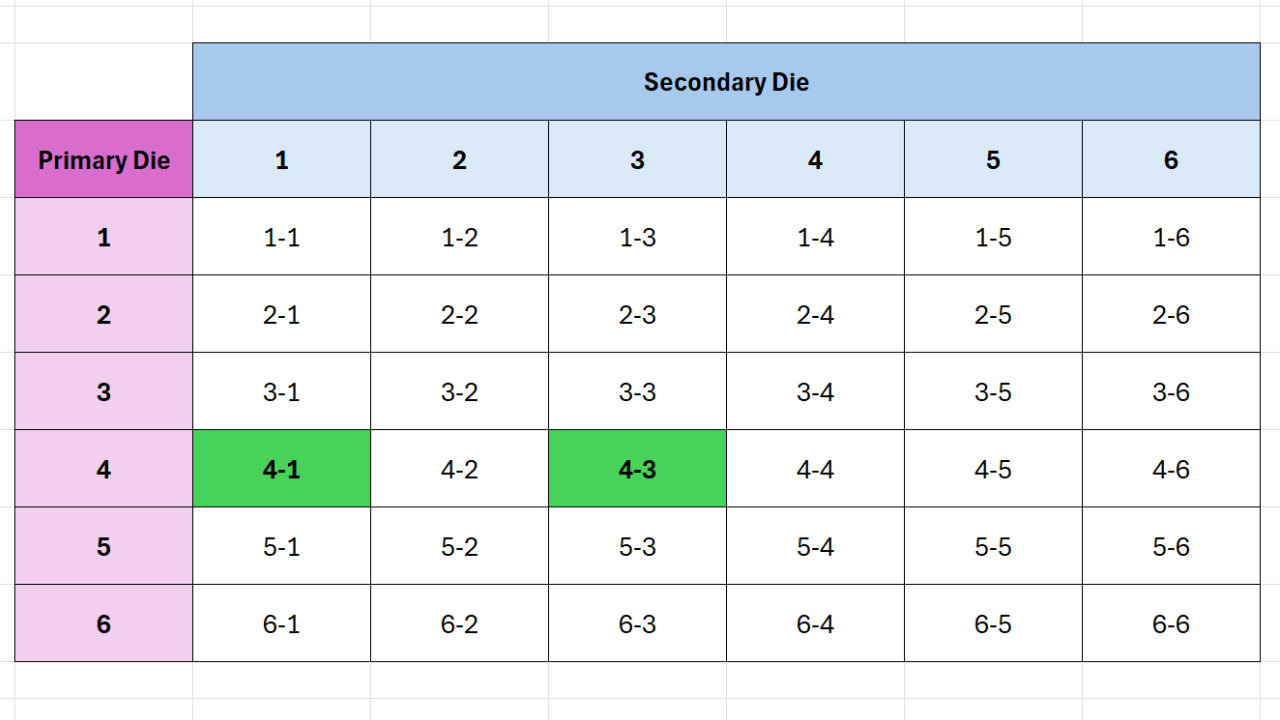
When the player rolls D66, the dice have 36 possible combinations ranging from 1-1 to 6-6, remembering that the order of the dice matters.
Let’s say you have a longsword and two manoeuvres:
[4-3] Swing = D6-1 damage
[4-1] Carving Blow = D6 damage
You will hit the monster when you roll either a 4-3 or a 4-1. That’s a 2:36 (5.6%) chance of an exact hit:
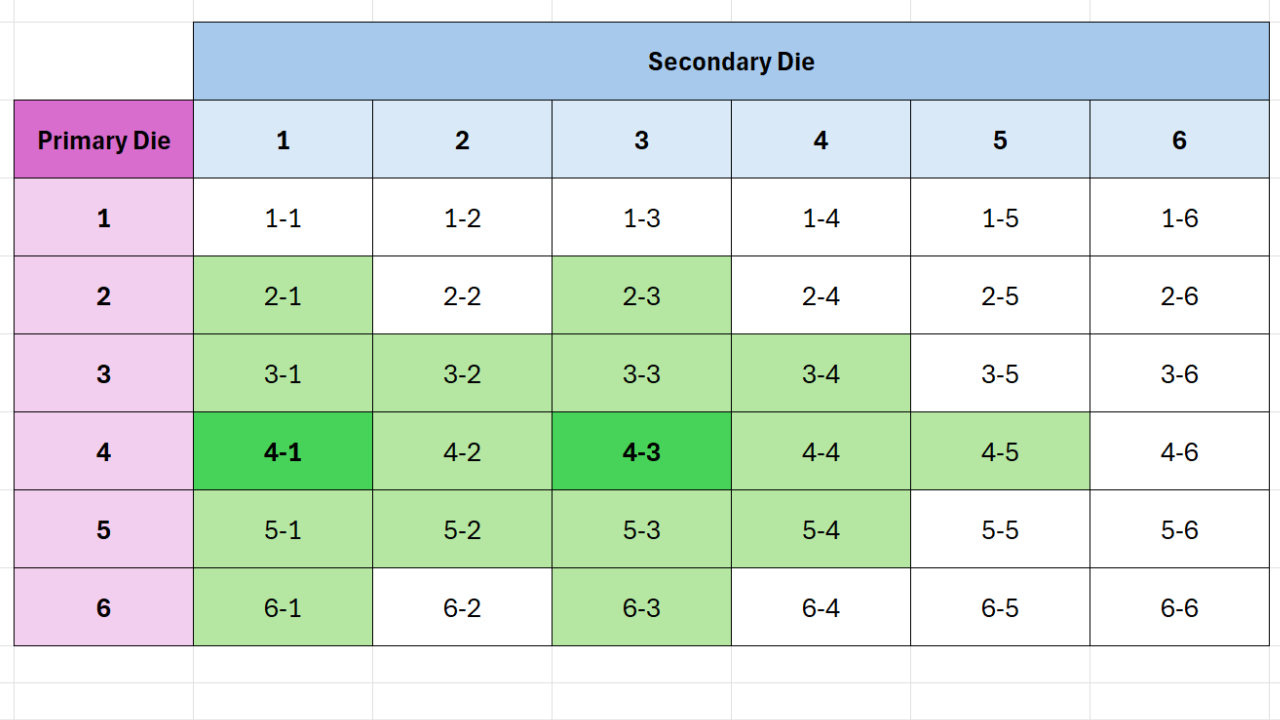
But you can use 2 Shift Points to turn a miss into a hit. That means a 2-1 or a 6-1 would also hit, as would a 4-5 or a 2-3. This significantly changes the chance of hitting your foe. You now have a 17:36 (47%) chance of a hit:
You might have noticed that choosing the correct manoeuvres has a large impact on your hit chance. Selecting two manoeuvres with a lot of overlap in values reduces the overall chance of a hit. Choosing two that cover a wider range of the D66 values improves your chance to hit. For example, let’s look at what happens if we have 4-2 Hack and 3-5 Brutal Drive as our manoeuvres:
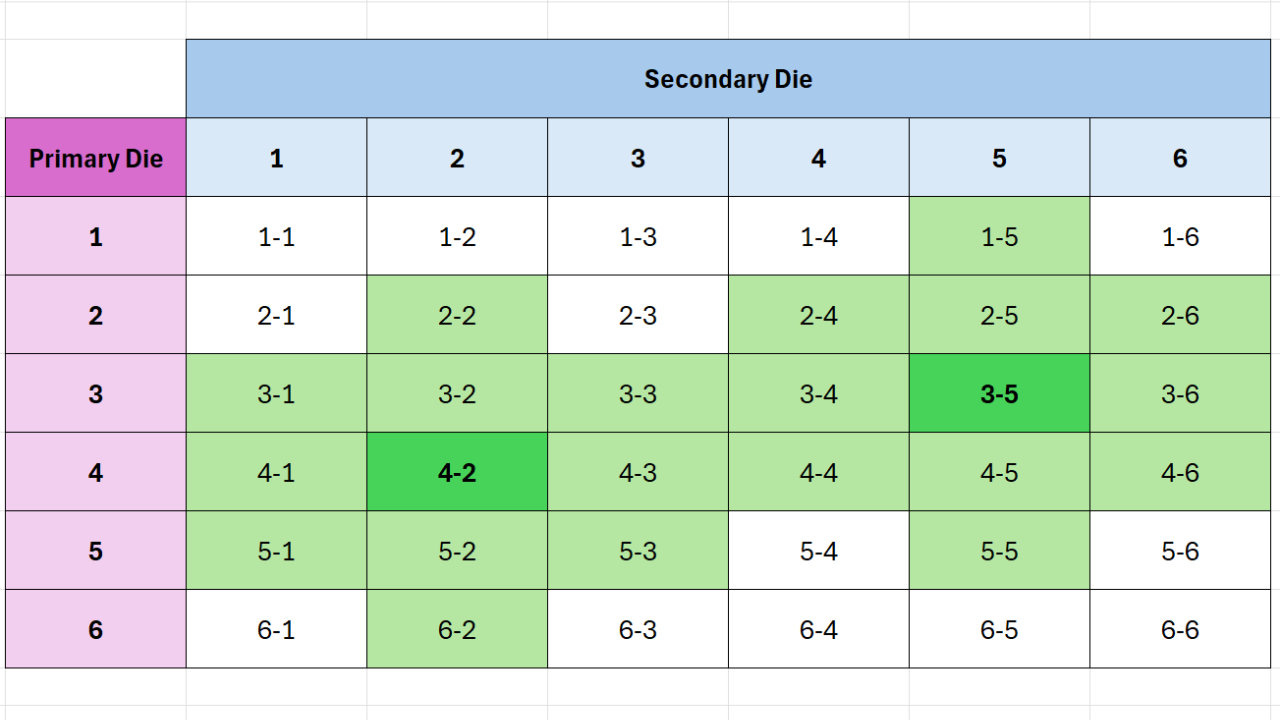
With less overlap, there is now a 22:36 (61%) chance to hit. So why not just choose those two manoeuvres from the start? Because one of them is a Level 2 manoeuvre. Yet another reason why leveling up and improving manoeuvres is important.
The combat itself might be procedural, but the choice of manoeuvres can be a tough one. The attacks with a 6 or 1 as part of the combination often deal more damage, but are harder to shift into.
Dice combinations to trigger actions
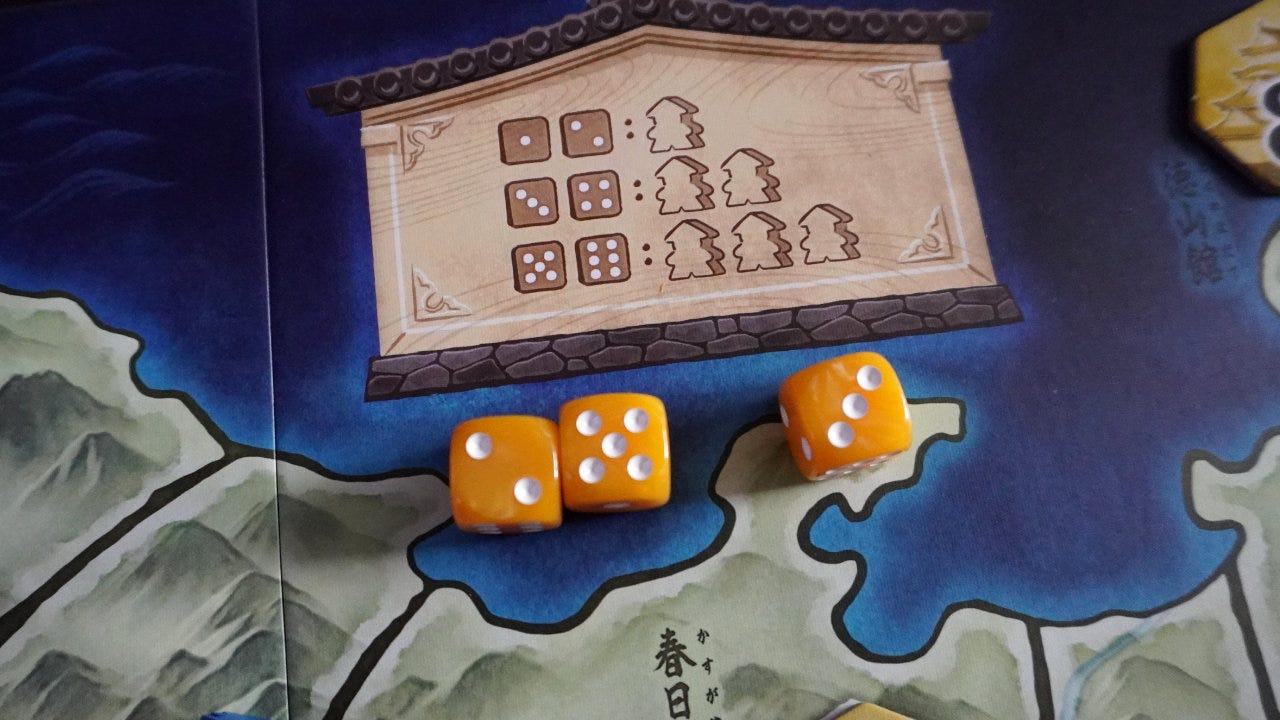
This sort of dice combination mechanism shows up in other games too. I’ve written about how Rumble Nation uses a roll roll pick two system where the two dice determine which province is reinforced. Parallels could also be drawn to the “Playing Dice with Death” system mentioned in the Giant Enemy Crab article.
My recent guest piece in the Monthly Mecha newsletter about how Celestial Bodies uses a reverse-Battleship system for combat is similar — a D66 roll to match a hit location.
Recently I tried Spooky Tower and it uses a 2d6 dice roll to determine which cards players can add to their tableau and which cards in their tableau they can activate. In that case, the dice can be used individually or added together. This results in three possible combinations for each roll. For example, rolling a 4 and a 3 could be used as 4, 3, or 7.
These “roll dice to try to match some targets” systems are really interesting to me because they are both simple (in terms of mechanical complexity) and yet quite deep. There are so many ways to slightly tweak and adjust this general mechanism to create tough choices for the player.
Conclusion
Some things to think about:
Everyone has d6 dice: Having sold at small conventions and events, I’ve learned that while not everyone has polyhedral dice, almost everyone has six-sided dice at home. Using systems like this that use just d6s potentially makes it more accessible to those who are new to the hobby.
Dungeon crawler combat: I love Dark Fort as much as the next person, but there is room for innovation in the solo dungeon crawler space that makes combat really interesting. It’s hard to do, and I think the 2D6 Dungeon system is a great example of making it feel fresh and new.
Dice combos vs. targets: If we broaden this idea to “rolling two or three dice to try to hit specific value targets” then we can see it in many games. They don’t need to rely on the Yahtzee style re-rolls either as 2D6 Dungeon’s Shift Points demonstrate.
What do you think? Have you tried 2D6 Dungeon? What do you think of this combat system? If you’ve seen similar systems elsewhere, please let me know in the comments.
— E.P. 💀
P.S. Want more in-depth and playable Skeleton Code Machine content? Subscribe to Tumulus and get four quarterly, print-only issues packed with game design inspiration at 33% off list price. Limited back issues available. 🩻
Skeleton Code Machine is a production of Exeunt Press. All previous posts are in the Archive on the web. Subscribe to TUMULUS to get more design inspiration. If you want to see what else is happening at Exeunt Press, check out the Exeunt Omnes newsletter.
Skeleton Code Machine and TUMULUS are written, augmented, purged, and published by Exeunt Press. No part of this publication may be reproduced in any form without permission. TUMULUS and Skeleton Code Machine are Copyright 2025 Exeunt Press.
For comments or questions: games@exeunt.press
A D66 roll means rolling 2 six-sided dice (2d6) and using their individual values to look up a result in a table. For example, rolling 4 and 3 would mean item 43 in a list. 2D6 Dungeon requires that two differently colored dice are used so one can always be the designated Primary (first) die and the other the Secondary (second) die. They can’t be reversed.
The most difficult part of writing this article is spelling manoeuvres correctly throughout. You earn 15 XP for each misspelling of the word that you catch.
If you include the +5 Bog Sword of the Lost Frog Wizard in an adventure or game, please let me know.
“Each weapon is also blessed by the Zeegor Priests to damage undead.”
I must admit this makes sense. How in the world are adventurer’s able to be proficient with a longsword and then suddenly able to use a different weapon just as well? Yes, I know some TTRPGs have weapons proficiency systems. In general, however, characters can swap weapons rather easily as long as they are roughly similar.
For more details on how the game works, check out the videos by The Dungeon Dive and Lone Adventurer.
I’m a huge fan of including timers in games like this. The point accumulation in Knarr is one of my favorite examples. The way the smuggler increases the point economy in Ahoy is another example. It is a rare case where games should be allowed to just drag on forever.
I really like how you showed the range of values that could shift into a hit using those 6x6 grids. I will say, however, I am most intrigued by that +5 Bog Sword of the Lost Frog Wizard. Not sure I know a system where a +5 sword makes sense, but I really want to find one now.
I loved this game, backed it during kickstarter. I even wrote a Lair expansion themed around Xmas (crawling through Santa's workshop, playing reindeer games all while trying to find and save Santa) i didn't know the numbers as you pointed out but it made sense to cover as much ground as possible. The other thing I thought was great was the armor, essentially blocking certain combos by denying a certain primary or secondary dice value...such a pain when the enemy who always seems to pop up, also is able to block or dodge your strongest attach.