
Last week we looked at the dice-based combat in 2D6 Dungeon. I’m in a dice mood so this week we are looking at another dice game. Hellboy: The Dice Game is a push-your-luck dice and card game from Mantic. While it’s a simple game, it can serve as both a lesson in push-your-luck game design and creative inspiration.
Hellboy: The Dice Game
Designed by Rob Burman and Matt Gilbert, Hellboy: The Dice Game was released as part of the Hellboy: The Board Game expansion Kickstarter.1
“In Hellboy: The Dice Game, you take on the role of a B.P.R.D. recruit exploring a mysterious location. As a new recruit your abilities and resources are limited so you’ll need your wits about you to try and survive. Push your luck to press deeper into the unknown or play it safe and live to fight another day.”
The game components consist of a deck of 40 cards, wound cubes, and custom dice that can be used as spares for Hellboy: The Board Game.
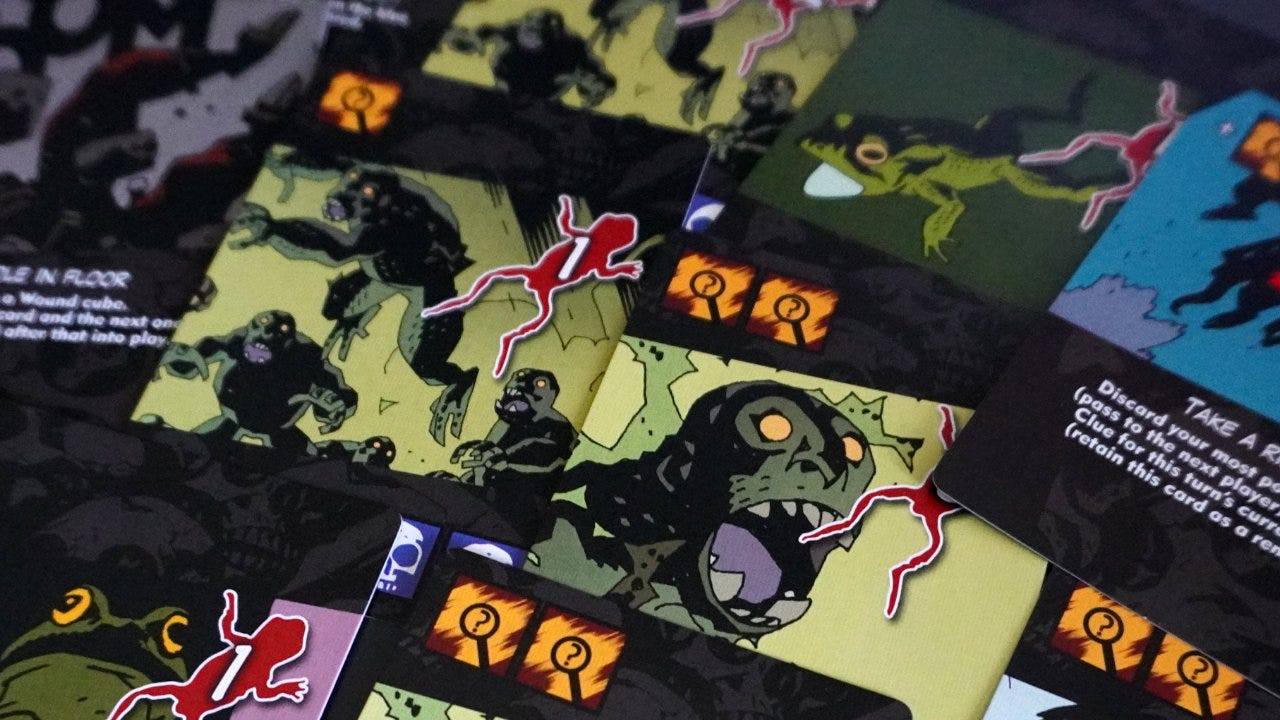
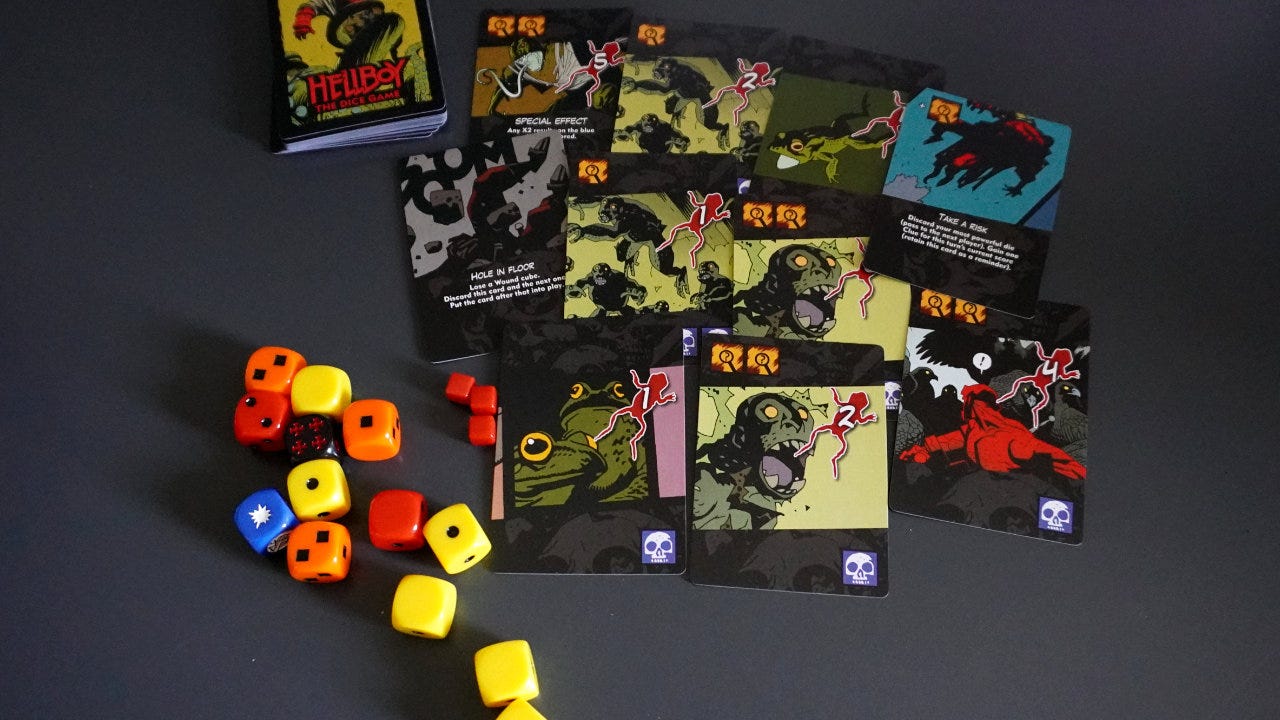
Each card has a Fight Value (1-5), a number of Clues (i.e. 0-4 victory points), Damage (0-3 wounds if not defeated), and possibly some special effects.
Pure push-your-luck
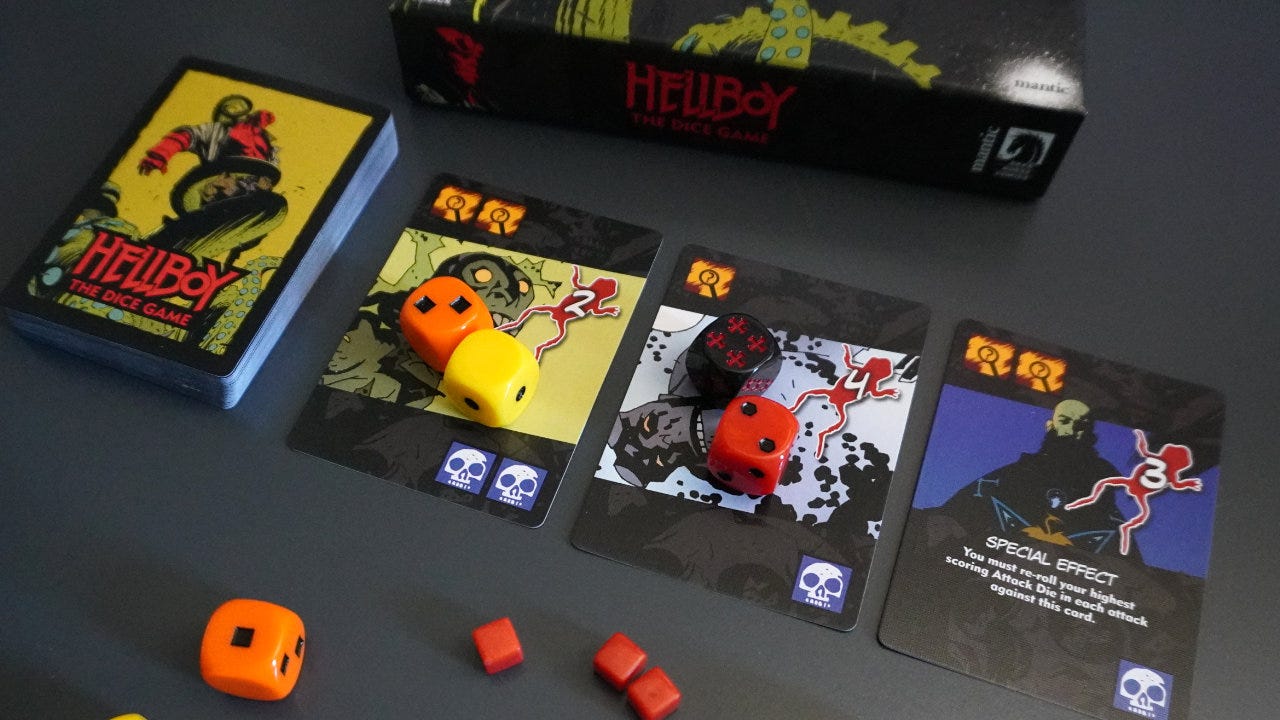
On your turn, you flip the top card of the deck and attempt to defeat it by rolling the blue, special die along with up to three of your pool of attack dice. The total hits on your rolled dice need to meet or exceed the Fight Value of the card to defeat it.
If you are successful, you claim the card but pass the used dice to the next player. You can then choose to either end your turn or reveal another card. If you stop, you permanently claim the defeated cards, earning the Clues (victory points) on them. All dice are passed to the next player and they start their turn.
If, however, you decide to continue instead, you reveal the next card and must attempt to defeat it. You’ll have less dice available this time because you can’t use the dice previously used this turn. If you defeat the card, you can again decide to stop or keep going.
If you ever gain 3+ wounds, you are “knocked out” and lose all the cards claimed this turn (i.e. you get zero Clues this turn).
The first player to gain 15+ Clues wins the game.
Attack dice design
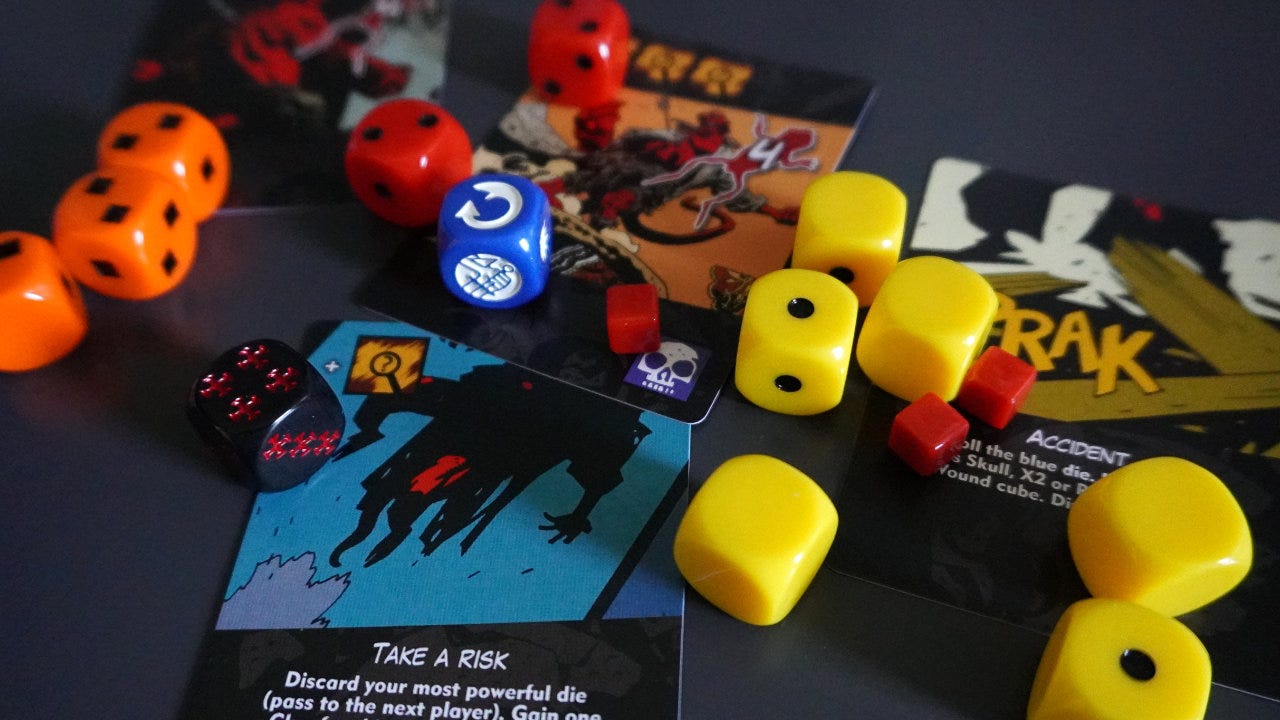
The game uses the same four varieties of dice as Hellboy: The Board Game: Yellow, Orange, Red, and Black. Each one has different faces ranging from 0-4 hits per face:
Yellow (Y): 1,1,1,0,0,0 (0.5 avg, 50% hit)
Orange (O): 2,2,1,1,0,0 (1.0 avg, 67% hit)
Red (R): 3,2,2,1,1,0 (1.5 avg, 83% hit)
Black (B): 4,3,3,2,2,1 (2.5 avg, 100% hit)
There’s also a blue die that has random effects: lose a wound, x2 hits for one die, +1 hit, +2 hits, cancel a skull/wound, and reroll one die. Ignoring that die, we can calculate some average hits for two-die combinations:
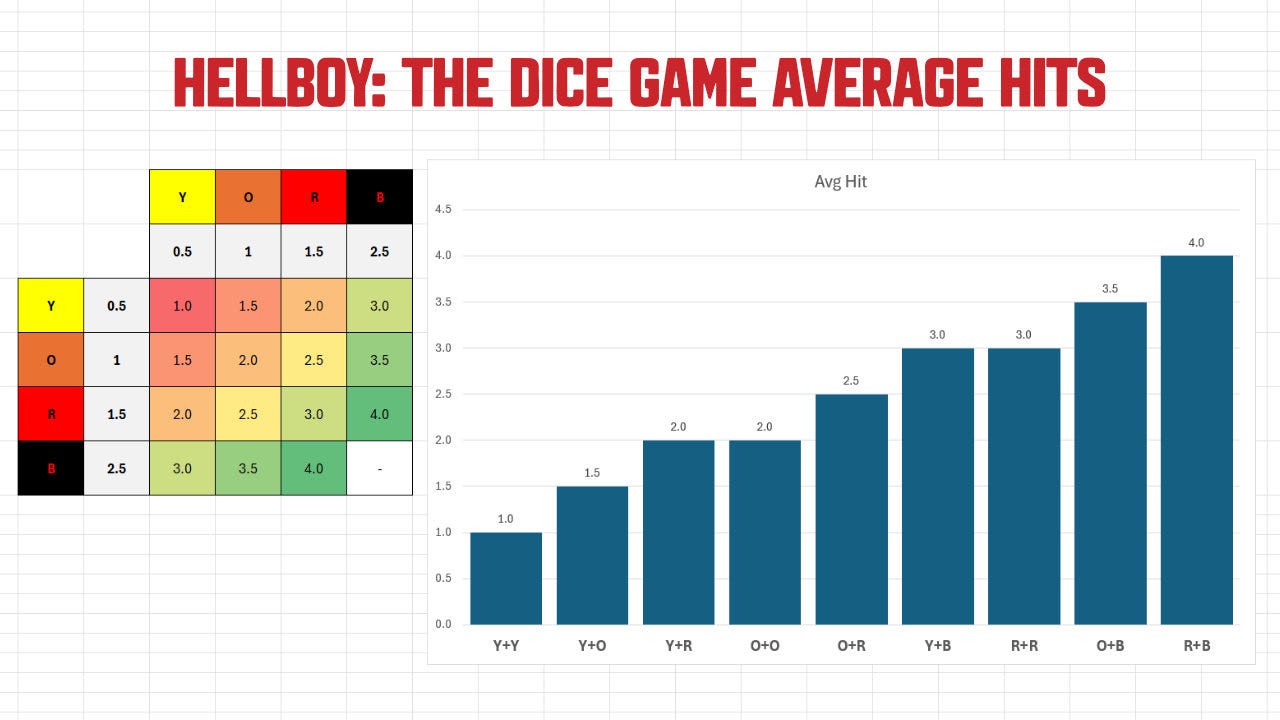
Yellow dice are pretty bad. Rolling two of them, you have about a 75% chance to get a single hit. Even with three of them, it’s only an 88% chance to get 1+ hits and the chance to hit 3+ hits is around 13% or less.2 That said, a Yellow+Black combo has the same average value of 3 hits as a Red+Red combo.
You only ever get one Black die at the start of your turn, so it’s a tough choice when to decide to use it.
Given a card with Clues and Damage on it, it’s a matter of selecting the right available dice with the right % hit and average total hits.
Dice as a resource
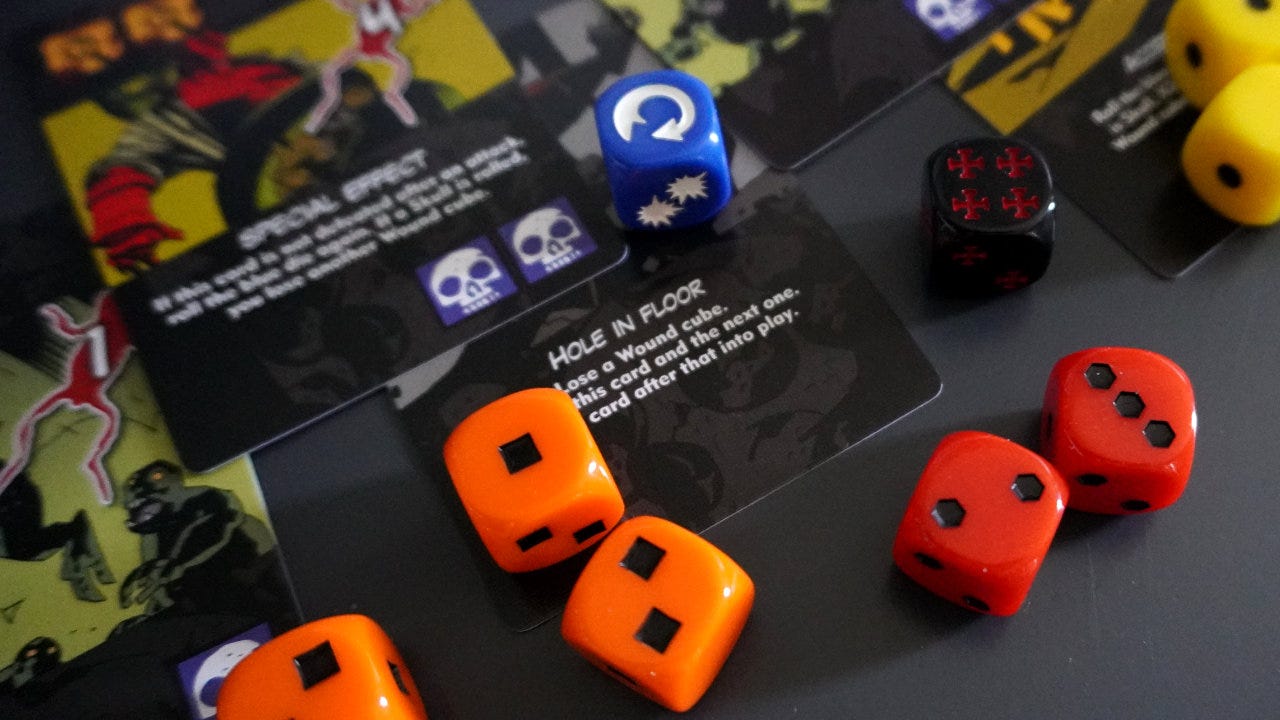
The game is not without its flaws. The event cards in particular feel overly random and impactful, causing you to potentially lose 1-2 of your 3 wound cubes just because you had a bad card draw. There are bosses like Rasputin, but they don’t feel particularly special or thematic (e.g. “re-roll your highest scoring attack die”).
What I think it does well, however, is to implement the dice as a resource to spend. You always start your turn with 12 dice. With each new, revealed card, you can use 0-3 of them along with the mandatory special blue die. That’s probably the most interesting choice of the game.
You can use your Black and Red dice right away and ensure you defeat the card, but then they are unavailable. It’s entirely possible to push your luck more with riskier dice rolls and score 5+ Clues in a round. That’s 33% of the way to a victory per turn if you can pull it off.
While I’m generally not a fan of decreasing decision spaces in games where you have fewer and fewer options as the game progresses, it feels right in this game.3
Solvable games
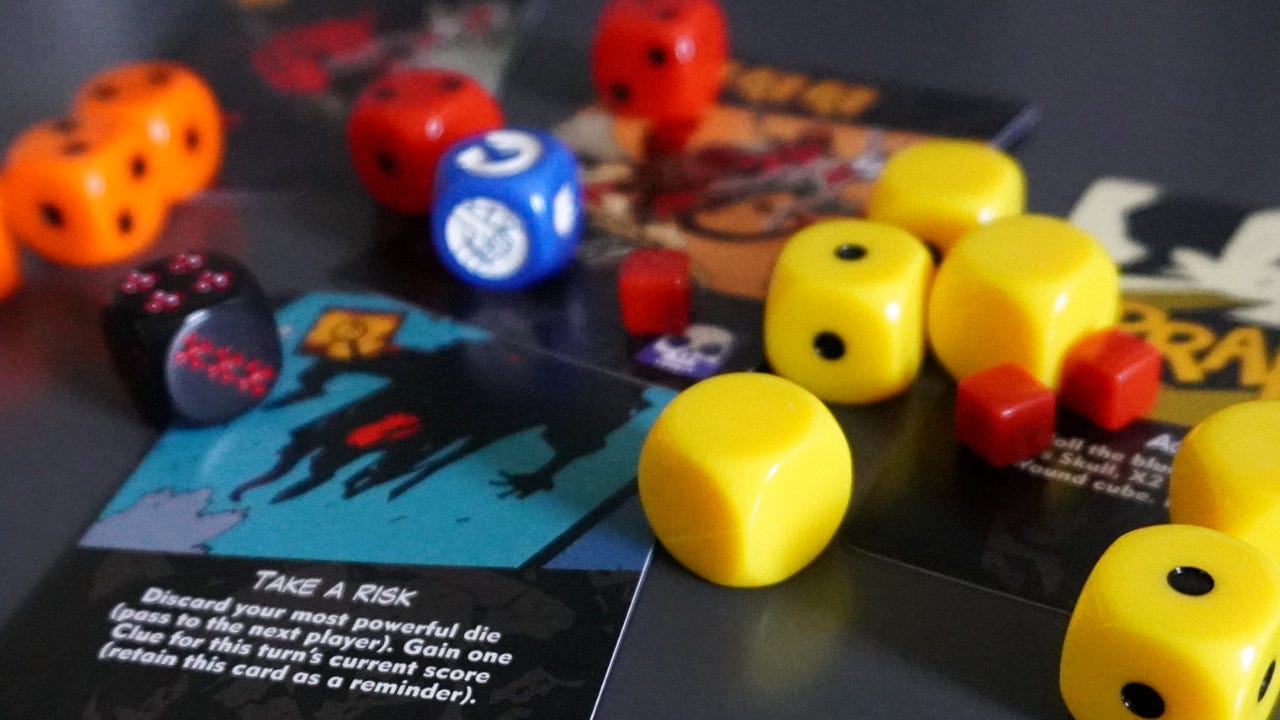
While I didn’t take the time to calculate and visualize all of the dice probabilities from 1-3 attack dice plus the blue die, I think someone could. If this were done, I’m afraid the game would become looking up the current card and available dice on a table and selecting the right set. For example, with N dice of each color left and a card with a Fight Value of X, you should choose A, B, and C dice to roll.
Would this be a case of a degenerate game state? I’m not sure, but it’s important to consider how “solvable” your game designs are. If someone were to calculate it all out or, worse yet, be able to calculate it in their head at the table, it would impact the experience.
The E.B. White quote applies: “Explaining a joke is like dissecting a frog. You understand it better but the frog dies in the process.” Solving games potentially sucks all the fun out of them. Therefore many people just avoid doing so even if it’s technically possible.
Conclusion
Some things to think about:
Dice as a resource: A key takeaway from this game is to use the dice themselves as a resource. Many TTRPGs use dice pools, but being able to choose which ones to spend is an interesting twist. I could see this used as a magic or stamina system.
Push-your-luck mechanisms: If you read SCM each week, you know I love push-your-luck mechanisms in games. They are easy to implement and (to me) almost always improve a game in a simple way. They are worth researching.
Math and “solvable” games: Some games intentionally keep their underlying statistics hidden from players. Others are more upfront with it, even including probability tables on player boards. Being solvable isn’t necessarily a design flaw, but it is something to consider when designing.
What do you think? Have you played Hellboy: The Board Game or Hellboy: The Dice Game? Do you think the game is potentially mathematically solvable? If so, does that matter?
— E.P. 💀
P.S. Want more in-depth and playable Skeleton Code Machine content? Subscribe to Tumulus and get four quarterly, print-only issues packed with game design inspiration at 33% off list price. Limited back issues available. 🩻
Skeleton Code Machine is a production of Exeunt Press. All previous posts are in the Archive on the web. Subscribe to TUMULUS to get more design inspiration. If you want to see what else is happening at Exeunt Press, check out the Exeunt Omnes newsletter.
Skeleton Code Machine and TUMULUS are written, augmented, purged, and published by Exeunt Press. No part of this publication may be reproduced in any form without permission. TUMULUS and Skeleton Code Machine are Copyright 2025 Exeunt Press.
For comments or questions: games@exeunt.press
I wrote about the use of cooperative action points in Hellboy: The Board Game a few years ago. It’s an interesting mechanism that I haven’t seen in many other co-op dungeon crawlers.
Feel free to check my math here and see if I got it wrong. Probability statistics are not my strong suit.
Probably because of the short cycle time before regaining all your dice. This is an extremely fast game, especially at 2 players. So it doesn’t seem like a big deal to blow your dice. You’ll get them all back soon enough.
I believe it would be mathematical solvable, but in doing so suck the fun out of the game.
wonderful article as always :) thank you for sharing!
i like the idea of using different kinds of dice that you can choose when to spend for a ttrpg! it would be really interesting if there was some kind of mechanism by why they would then also transfer on to an adversary when doing that...
push your luck mechanisms are definitely fun! just about to play Trophy Dark for the first time in a few minutes, which has plenty of that :3
(and the math, giving rounding, checks out ^^)