
Last week we looked at Before the Bog God by Infinite Citadel, a two-player TTRPG that uses a dice game as a framework for storytelling. And before that we explored how the A Place for All My Books board game split worker placement actions into multiple boards.
The nomination deadline for The Bloggies is January 31, 2026.
This is your last chance to submit a Skeleton Code Machine article for consideration. Please consider nominating an article like Everything is Pointcrawl, Playing the Chaplain’s Game, or How Should We Handle Garbage Time. I really appreciate your support. Thank you!
This week we are returning to board games with Rauha, but with some thoughts on how its mechanisms could be applied to TTRPGs.
Life has sprung up again on Rauha
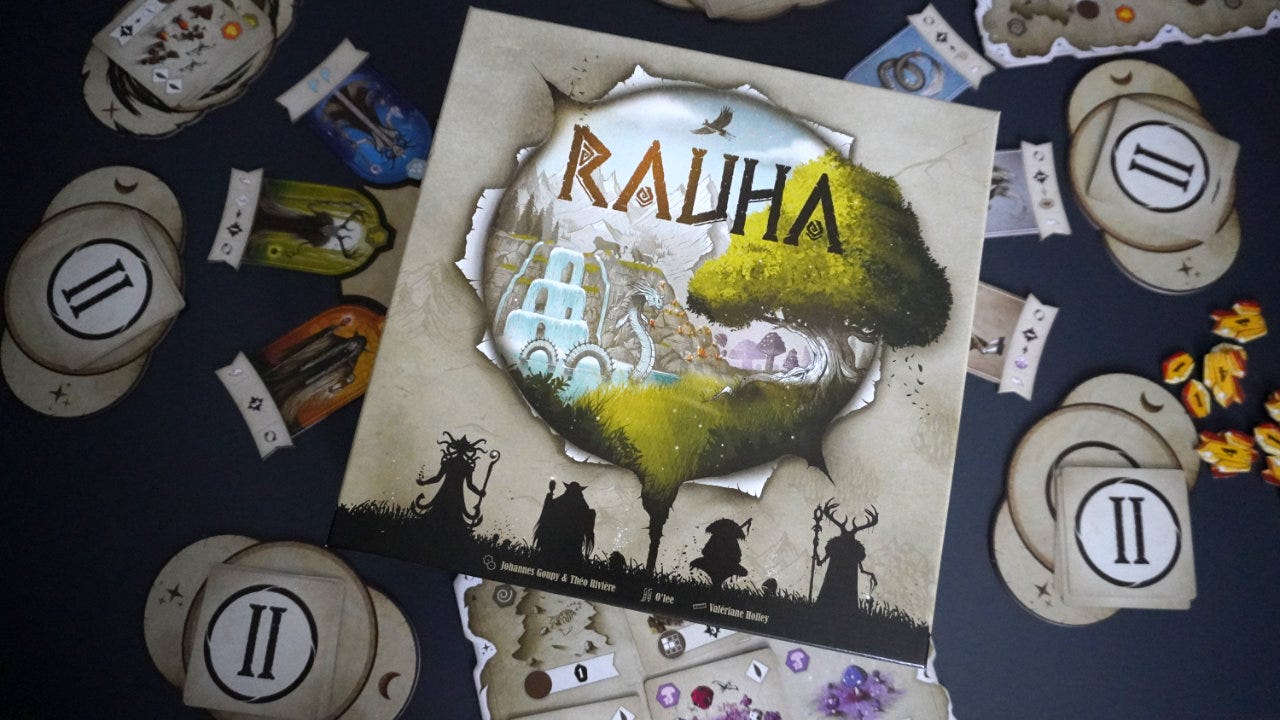
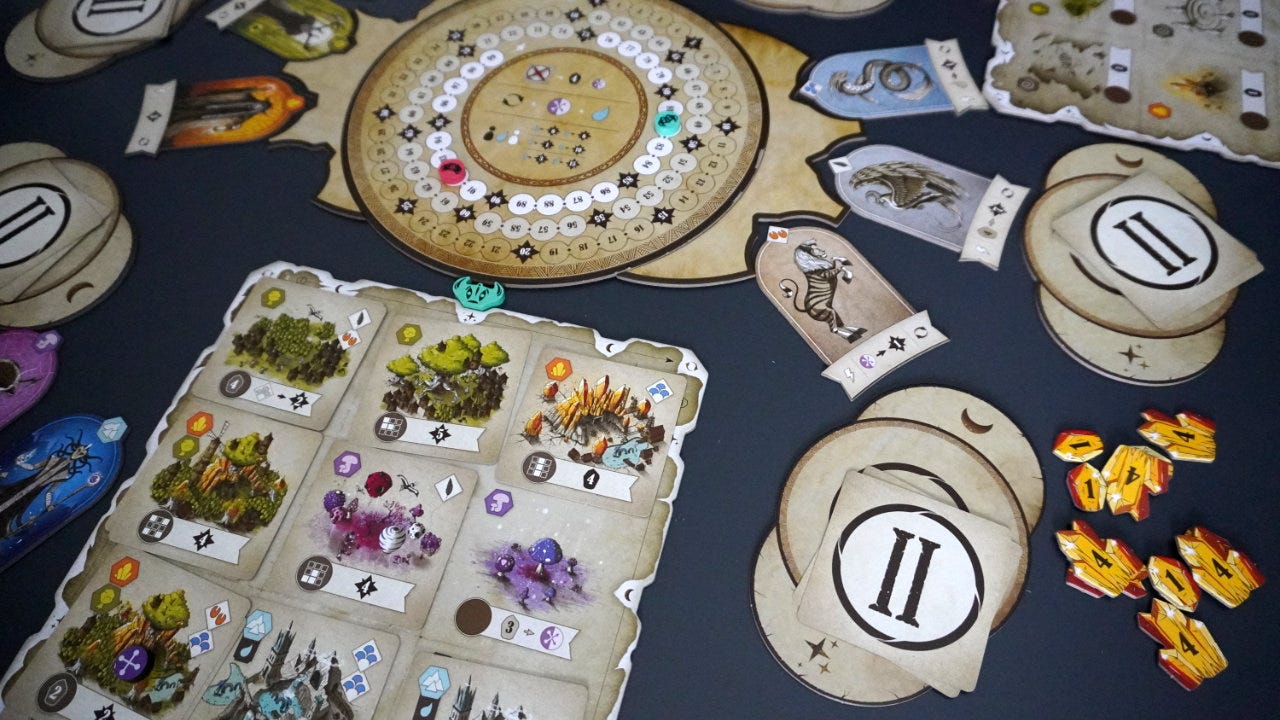
While Rauha (Goupy & Rivière, 2023) does have an ostensibly environmental theme, I’d consider it to be almost an abstract tile-laying game:
“After millennia of sterility, life has sprung again on Rauha. As a venerable Shaman, one of its five worlds has been entrusted to you. Your powers are divine and allow you to shape the environment in order to turn this world into a cradle of life energy, keeper of serenity and harmony for the centuries to come.”
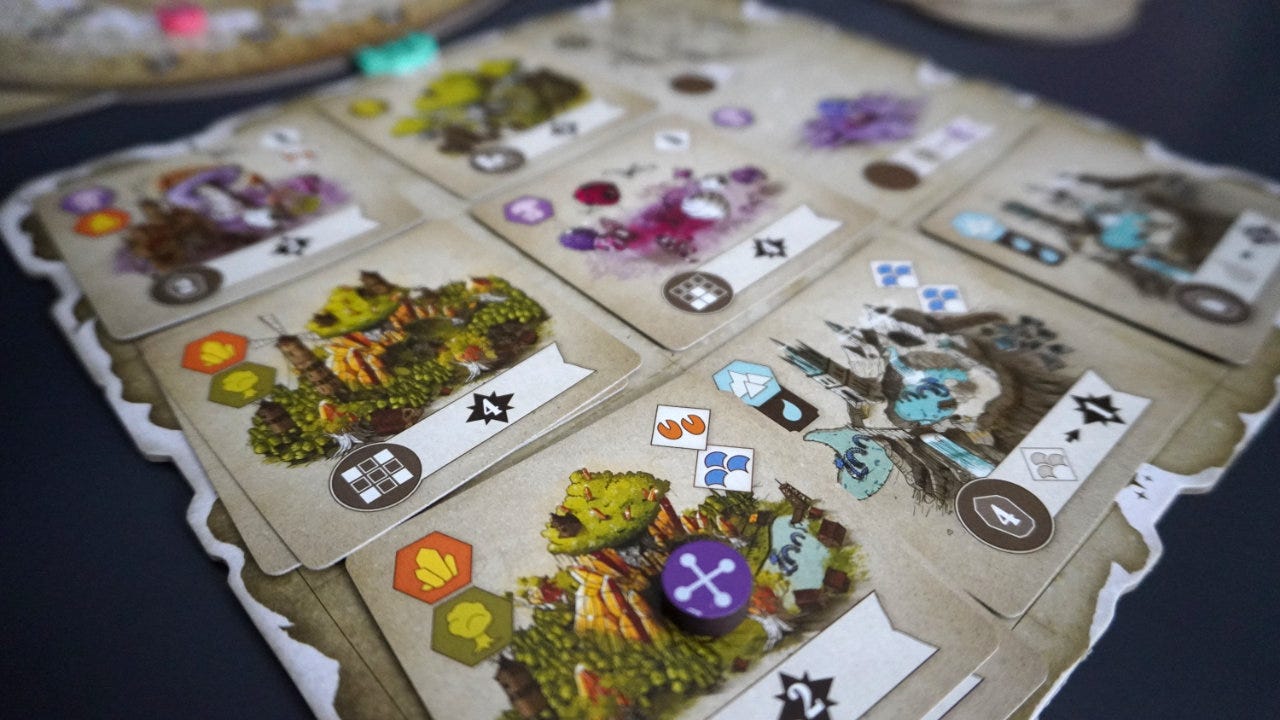
The cards (i.e. tiles) used in the game depict various biomes: forest, mountain, crystal, mushroom, and desert.1 In addition, there are other icons for animals: flying, land, and marine.
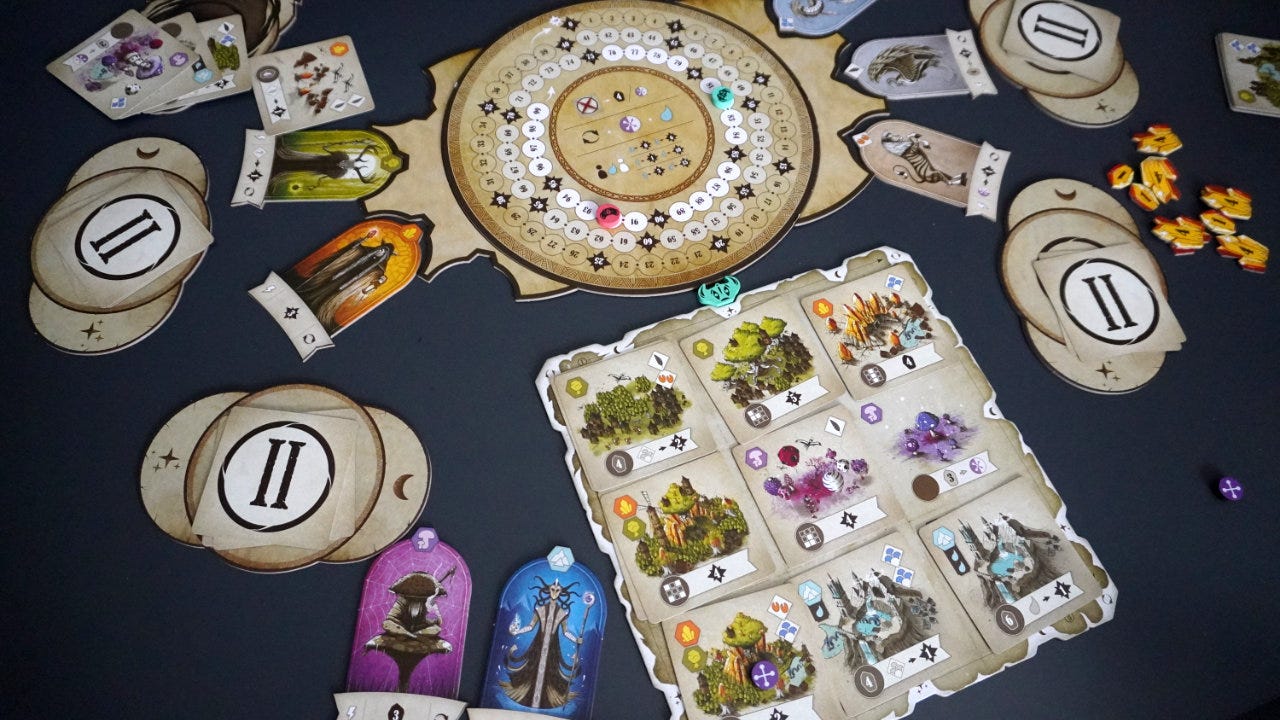
Over the course of two ages divided into four rounds with three turns each, players simultaneously draft cards and play them onto their player boards.2 Throughout the game, players collect life energy crystals (the currency of the game) and can gain divine powers.
It’s how Rauha uses the grid to trigger actions that I found so interesting. So let’s take a look at (1) how the grid is constructed and (2) how it’s used to trigger actions.
Grid-based pattern building
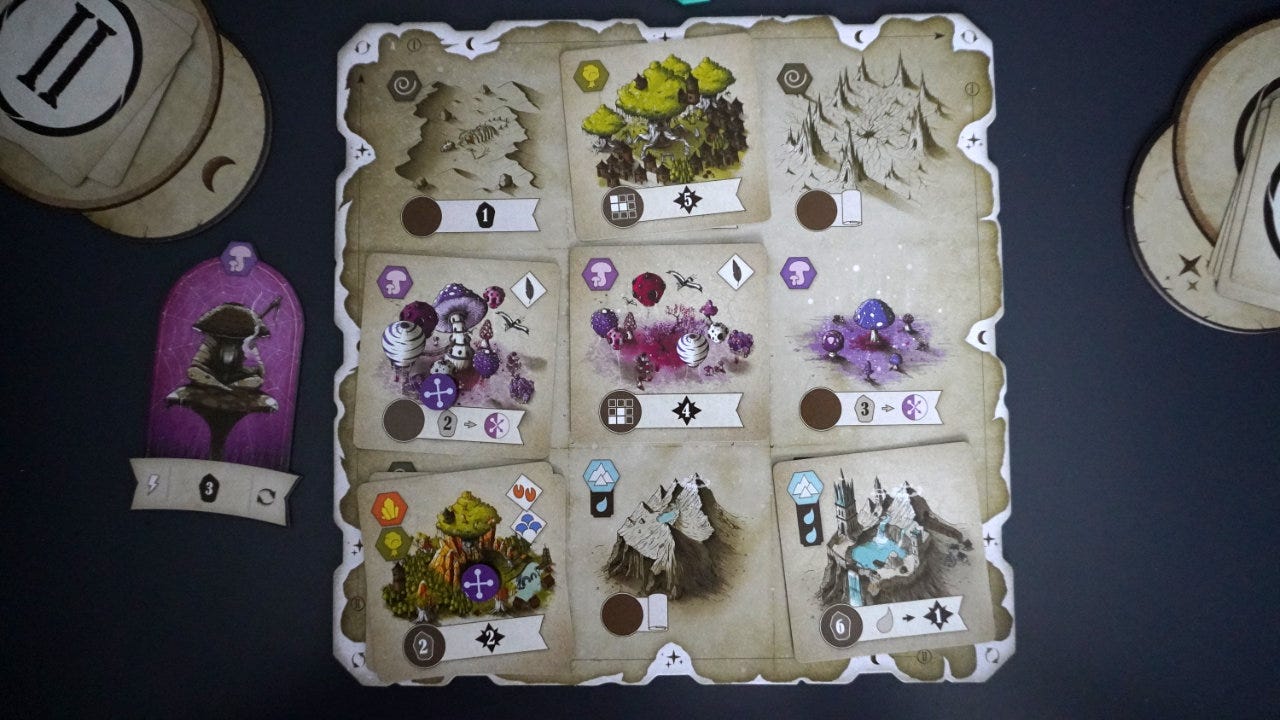
Each player has a square player board with a 3x3 grid of 9 square spaces. There are starting biomes printed on each space of the board. Some biomes have no actions on them while others have some basic ones such as spending 3 energy to gain 1 spore. Another starting biome might give 1 victory point when activated.
The game uses multiple draft piles with players alternating between the ones to their right or left. At the start of each turn, players draft a card from one of the two piles next to them — either right (stars) or left (moon).
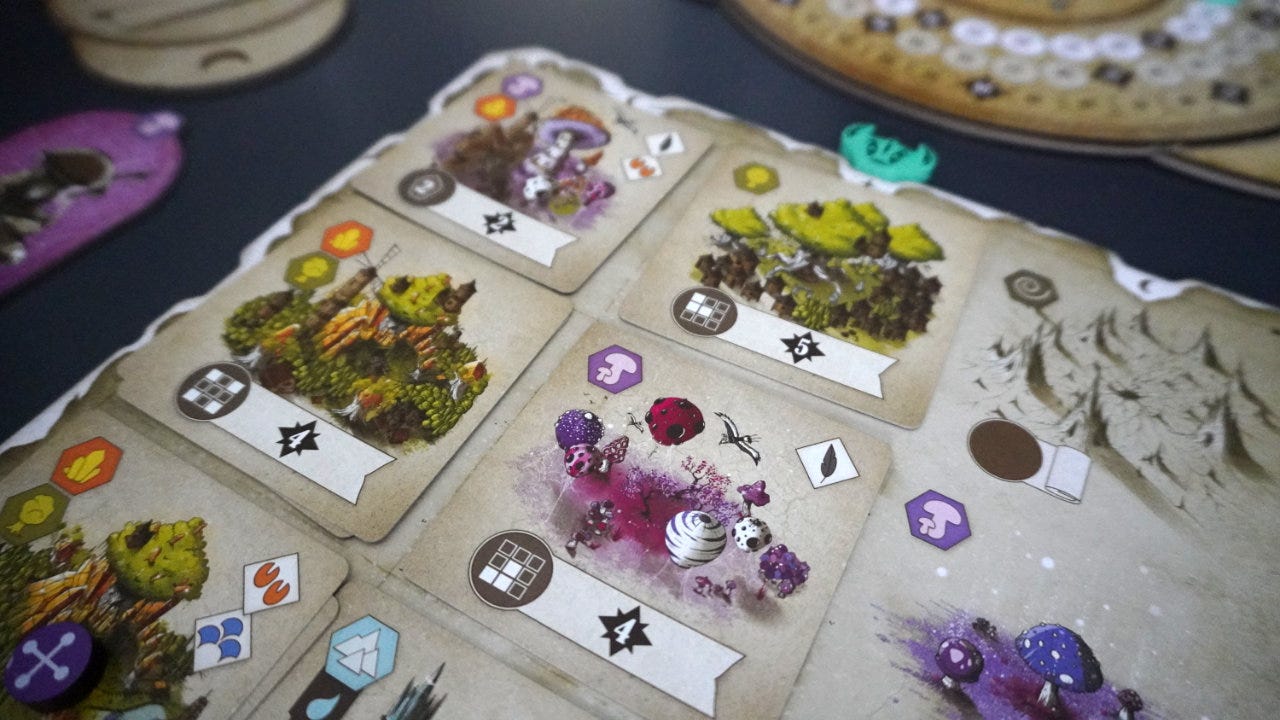
In general, players are trying to choose cards that act as upgrades to their starting biomes.3 Cards are placed anywhere on the grid, covering up any starting biomes or previously played cards. This creates some interesting pattern-building choices:
Most water icons: Cards with water icons can be worth a lot of points, but only if you have more water icons than everyone else when scoring.
Matching biome/animal icons: Completing a row or column with matching icons (like tic-tac-toe) allows you to take a Divine Entity tile with new powers.
Income generation: Most cards have a cost in crystals to play them to your board, so it’s important to have some cards that generate crystals when activated.
Victory point generation: To win the game, you need the most victory points. So it’s even more important to have biome cards that generate points when activated.
By restricting the grid to just 9 spaces in a 3x3 grid, these competing goals become tough, interesting choices.4 You’ll draft a total of 12 cards throughout the game, discard some, and play others. It’s quite possible you’ll need to cover up a card previously played to try to hit a new, better pattern on the board.
Activating rows and columns
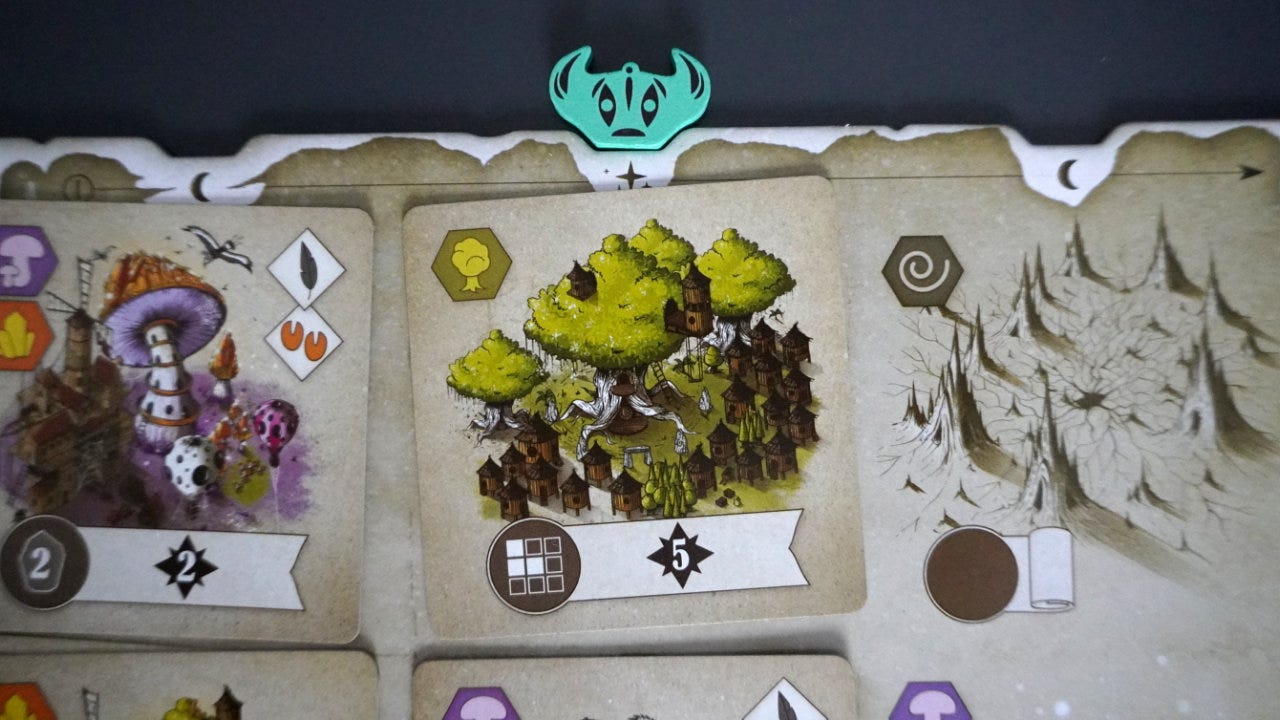
What I found most interesting was Rauha’s grid-based activation system.
After drafting a card each turn, players activate all the biome cards in either a row or a column. Each player has an Avatar token that moves around their player board after each draft to show which one will be activated.
Tokens start at the top left position indicating that all the cards in the leftmost column will activate first. Then they move clockwise around the board so that all the cards in the middle column will activate next, followed by the rightmost column.
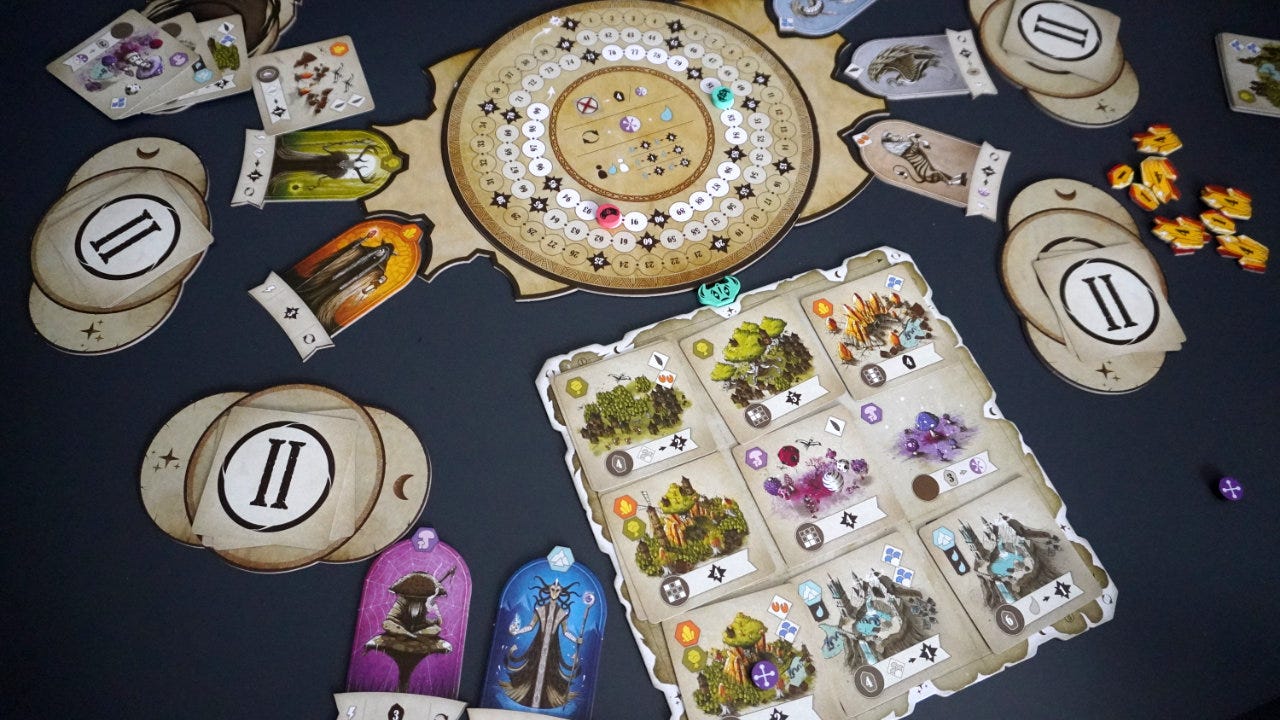
Scoring happens every three rounds when the token reaches a corner.
By the fourth round, the top row activates, followed by the middle row, and then the bottom row. Then in the second age, the marker moves across the bottom of the board, activating columns again.
The result is that each row and column will activate just twice in a game. This makes it important to place cards in a way that they will be activated multiple times and in the right order.
Grid-based activation
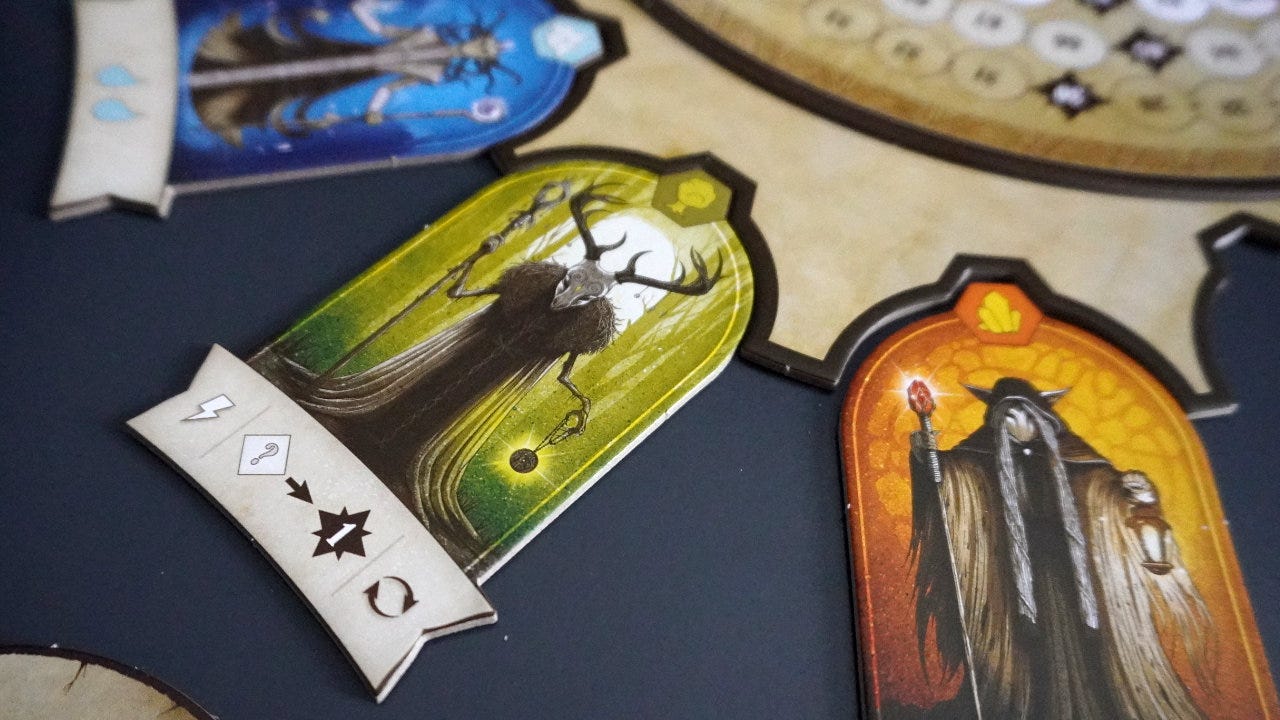
Although I haven’t played many similar games, I know that grid-based activation systems have been used before. What I found interesting was that in Rauha, the player didn’t control which rows or columns were activated. Instead, it was a fixed rotation controlled by the Avatar token’s clockwise movement around the player boards. The player agency was entirely focused on drafting cards and playing them into the grid.
I could see a similar system being used in other board games and TTRPGs:
A magic system based on moon phases where you can’t control which grid would activate but you could learn and upgrade which spells would be active.
A cyberpunk hacking system that blocks certain actions depending on security sweeps or rotating corporate defenses. Instead of activating a row or column, the rotation would block a specific row or column.
While this would make the game feel more like a puzzle, I think it could be done in a thematic way.
Conclusion
Some things to think about:
Alternative drafting methods: I would have expected the drafting in Rauha to involve passing sets of cards around the table much like Blood Rage or 7 Wonders. Instead it alternates drafts between fixed piles. While I’m not sure it changes much, it shows there is room to innovate when it comes to drafting.
Use a grid: Playing this game has me thinking about grids in games, particularly tight ones that are 3x3. With just 9 spots, even print and play games could include printable custom cards. The potential use in both fantasy and cyberpunk settings is compelling!
Puzzle elements: The tight decision space and need to plan ahead makes Rauha feel very “puzzle-ly” and potentially a “brain-burner” as board gamers would say. Whether this is a good thing or not depends on the kinds of fun you want your players to have.
What do you think? Have you tried any games with grid-based activation systems? I’m particularly interested in hearing about examples from TTRPGs.
— E.P. 💀
P.S. Want more in-depth and playable Skeleton Code Machine content? Subscribe to Tumulus and get four quarterly, print-only issues packed with game design inspiration at 33% off list price. Limited back issues available. 🩻
Skeleton Code Machine is a production of Exeunt Press. All previous posts are in the Archive on the web. Subscribe to TUMULUS to get more design inspiration. If you want to see what else is happening at Exeunt Press, check out the Exeunt Omnes newsletter.
Skeleton Code Machine and TUMULUS are written, augmented, purged, and published by Exeunt Press. No part of this publication may be reproduced in any form without permission. TUMULUS and Skeleton Code Machine are Copyright 2025 Exeunt Press.
For comments or questions: games@exeunt.press
What exactly is a crystal biome?
What the game calls turns, I’d probably call rounds. But then I’m not sure what you’d call the rounds — phases perhaps? The distinction between and use of the terms phase, round, and turn might be an interesting topic for a future SCM article. For example, in Successors: Fourth Edition, a game might consist of a single “turn” lasting 4-5 hours when using the nomenclature described in the rulebook.
As always, this isn’t a full rules explanation. For example, cards can be discarded to gain currency or place spores instead of being played to the grid.
My group found that the Age I cards aren’t as interesting or powerful as the Age II cards. Most of the tough choices occurred in the second half of the game.
It's always vexed me that, upon seeing the relative irrelevance of the grid in a game like D&D 5e, designers either move to abstract positioning entirely, or else double-down on the grid... without making the grid itself more interesting, or forcing the GM into the position of either designing or interpreting a grid in a way that's interesting to interact with.
There's lots of ways to improve on that. My game borrows from Cortex, letting you "mark" interesting environmental features with Inspiration/Advantage dice (a tree that grants a boon to ranged attacks; a wall that can be pulled down for +2d8 damage). Doing this also makes those spaces into contested resources.
Kingdom Death, which I think beautifully straddles boardgame and TTRPG, has prescribed terrain tiles that are part of each encounter and must be negotiated. Forced movement over the whole board is a BIG part of the game. (Forget "Shove 10 feet", we're talking "Suffer Knockback 20.")
The 3x3 grid could also be a great middle-ground for people who want more abstract/"zone"-based combat but are maybe overwhelmed by not having any visual reference. You could use index cards and have each card count as 30ftx60ft or something similar. Messing with scale to still follow RAW while creating a more bounded space that can then have different triggers/relationships between tiles sounds like a great place to start.
RE: Crystal biome - (because I am prone to jumping down rabbit holes) It didn't occur to me (or maybe it's just that I haven't had my coffee, there's a mountain of snow waiting to be shoveled and my brain isn't switched on just yet) that in science, biomes are categorized by climate and not ecosystem, but in many games "biome" is used to describe an ecosystem. This leads me to another question: As game designers, do we have a responsibility to use terms correctly? Or are we the agents of language change? (And is that why there's already a game for that?) What do you think?