
With 2025 behind us, I spent some time thinking about how this newsletter and the business as a whole is doing.1 If you missed them, take a moment to check out the Skeleton Code Machine Annual Review and Exeunt Press Year-End Review.
Thank you so much for your support including purchases from the Exeunt Press Shop and taking time to fill out the annual reader survey.
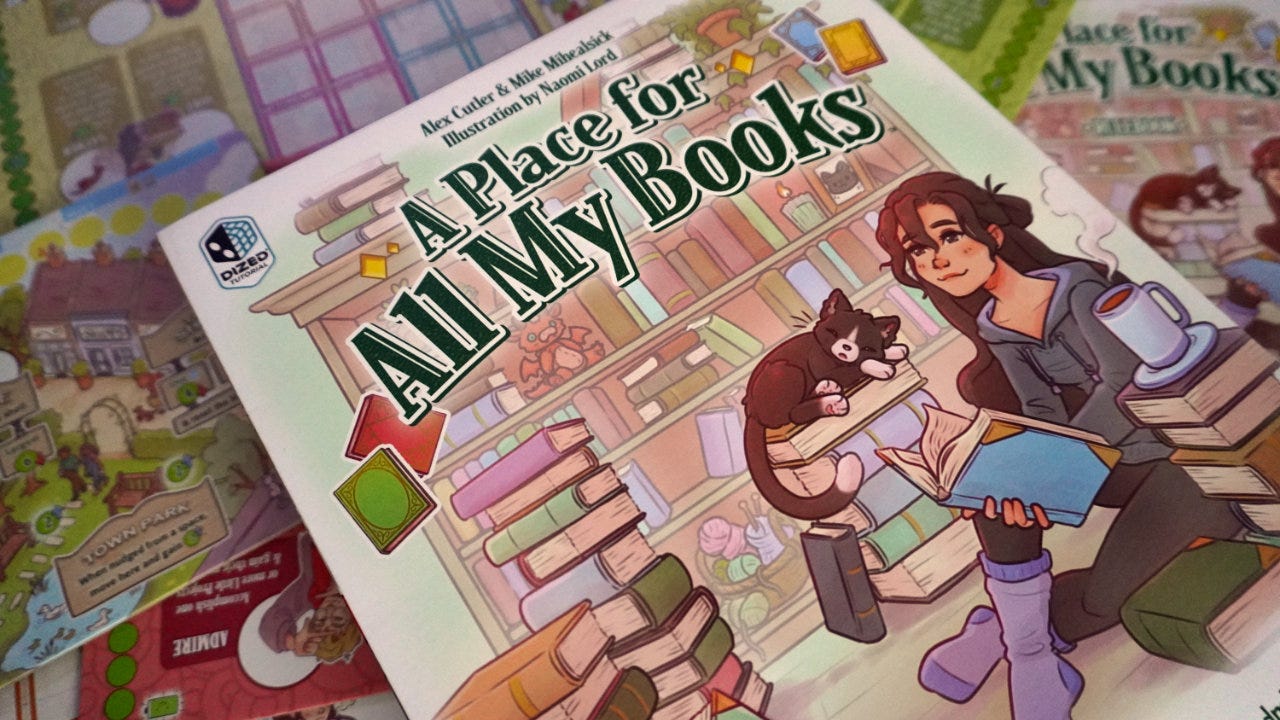
This week we are looking at an interesting twist on worker placement in A Place for All My Books.
But first…
Nominate SCM for a Bloggie award!

Each year The Bloggies celebrate the best blogs and writing in the world of tabletop roleplaying games. Submissions are open now through January 31, 2026. I’d be honored if you took a moment to send in a link to a Skeleton Code Machine post.
Two eligible articles to consider are:
Exploring hexcrawls, pointcrawls, and other crawls to see if everything is actually just a pointcrawl. How we can reduce the illusion of choice and instead have players make meaningful decisions? (December 2, 2025)
Exploring the use of coins as a divination mechanism in Mechs to Plowshares, a solo TTRPG about war, anxiety, paranoia, identity, and purpose by Anomalous Entertainment. (April 22, 2025)
Of course any article posted between December 1, 2025 and December 31, 2025 is eligible. Feel free to submit your favorite!
And now to this week’s topic…
A Place for All My Books
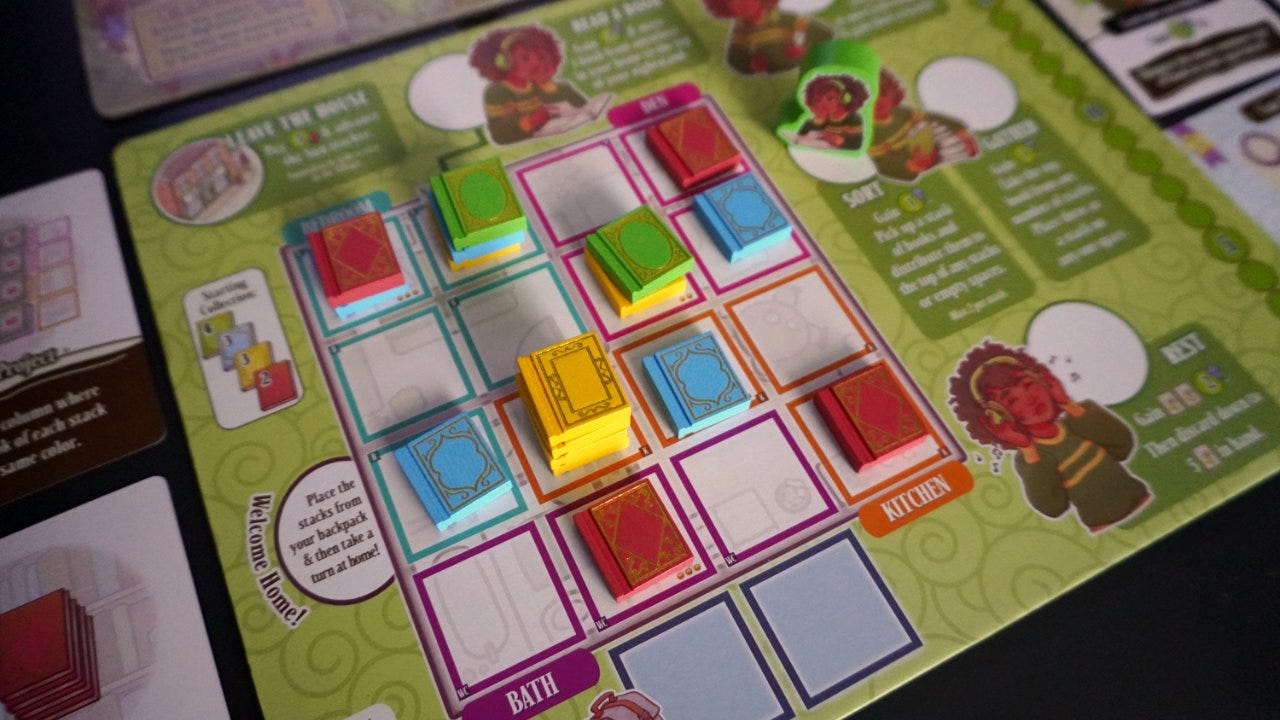
Released in 2025, A Place for All My Books is “a puzzley book gathering, sorting, and organizing game” designed by Alex Cutler and Michael Mihealsick. In the game, players move stacks of colored books around their apartment, complete personal projects, and recharge/spend their social battery to acquire more books.
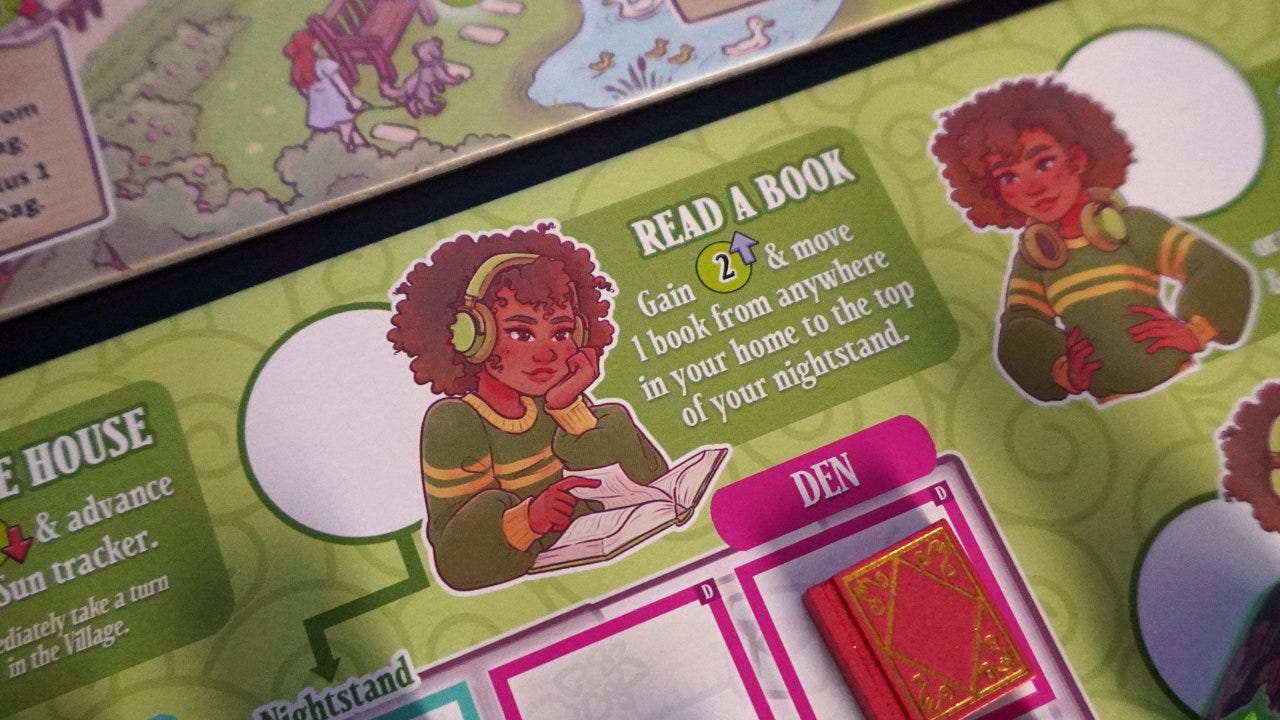
It is a worker placement game. Players take turns moving a piece representing a worker (in this case your reader persona) to various locations on either their personal apartment board or the shared village board. Each location is associated with an action that is triggered by placing your worker there.
For example, each player’s personal apartment board includes:
Gather: Take the top book from stacks and combine them.
Sort: Distribute a single stack to multiple spaces.
Admire: Complete project.
Rest: Gain new projects to complete and increase social battery.
Read a book: Increase social battery and move a single book.
These actions allow you to move the little wooden book pieces around your apartment, stacking them in your bedroom, den, kitchen, and bathroom.2 Gather and sort enough and you can complete objective cards (i.e. “little projects”) such as “Have 3+ tall stacks that have no Blue books.” or “Have a full column where the top book of each stack is the same color.”
The player’s personal apartment board actions can only be used by the owner, and are never blocked by the opposing player.3 This is not the case with the shared village board actions.
Leaving the house to acquire more books
The interesting part of A Place for My Books is the use of a single currency (i.e. social battery) to control the flow of workers to and from personal and shared player boards.
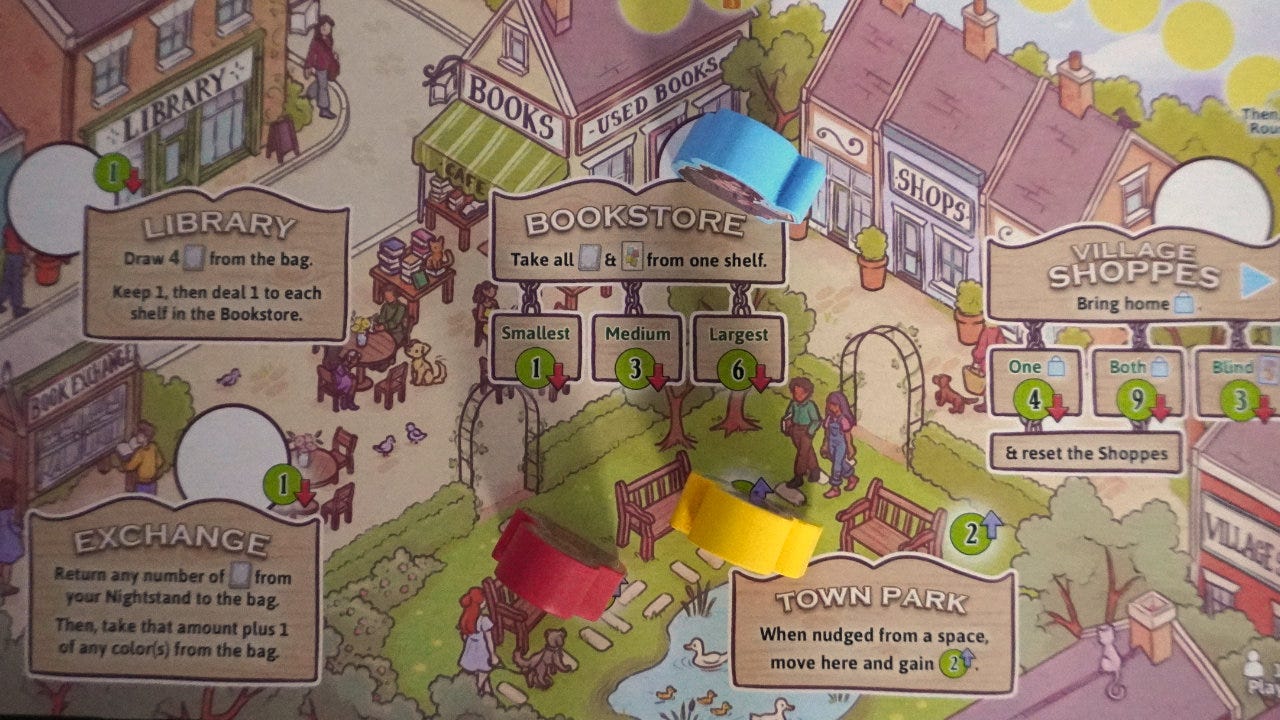
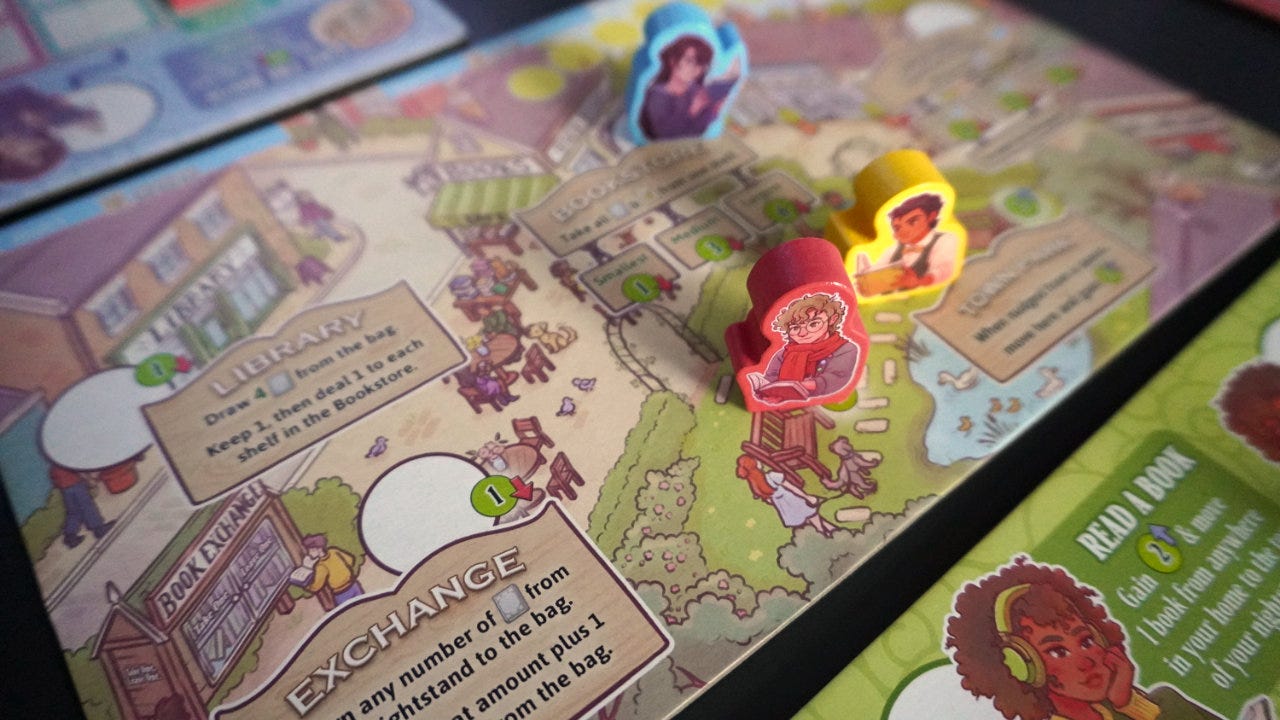
There is a special action on each personal apartment board called Leave the House that costs 5 social battery and moves your worker to the shared village board. Once there, you can immediately take one of the village actions: gain books at the library or bookstore, gain a special item at the shops, or exchange a book. All of these actions cost more social battery, usually in the range of 1 - 9 per action.
After your social battery has been drained, you can decide to return to your apartment. New books are offloaded into stacks in your apartment and play resumes on your personal apartment board.
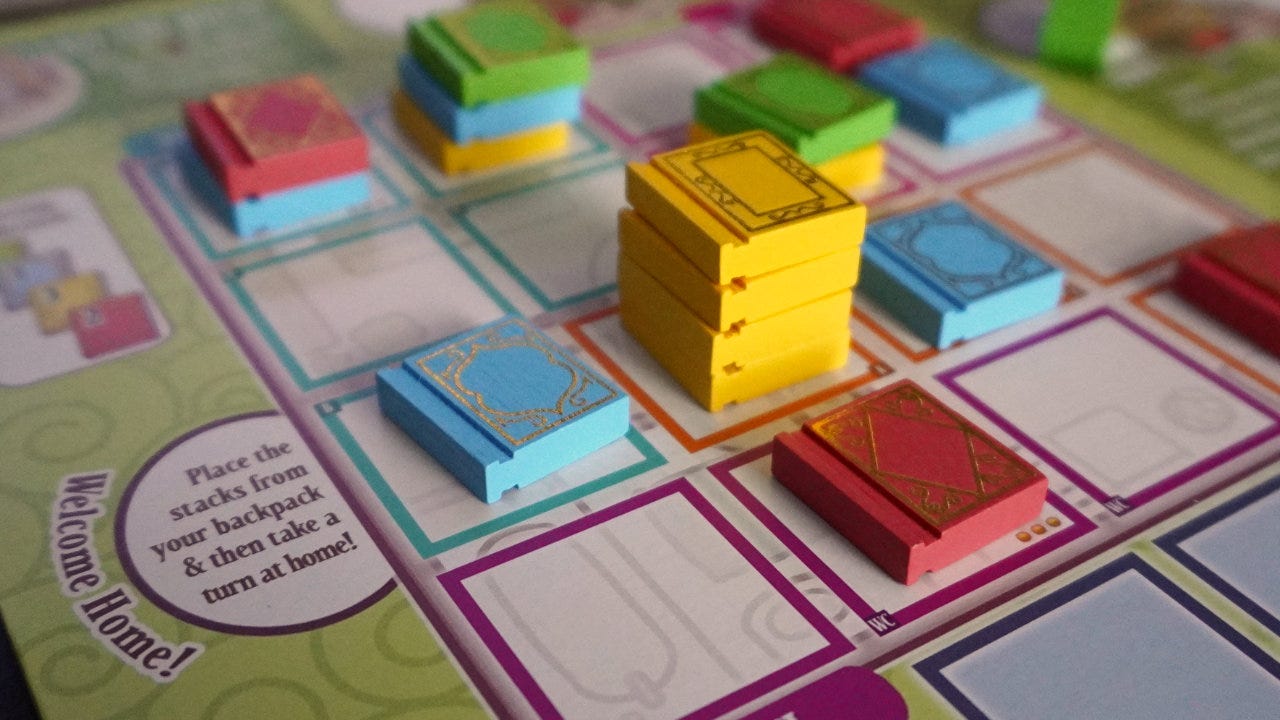
Because the village board is shared and spaces are limited (e.g. there is only one Bookstore action space), there is a little bit of player interaction. Still, there is no action blocking. Instead players can bump (i.e. “nudge”) a player’s worker to the Town Park where they gain more social battery. Actions are never fully blocked.
Moving to and from the village
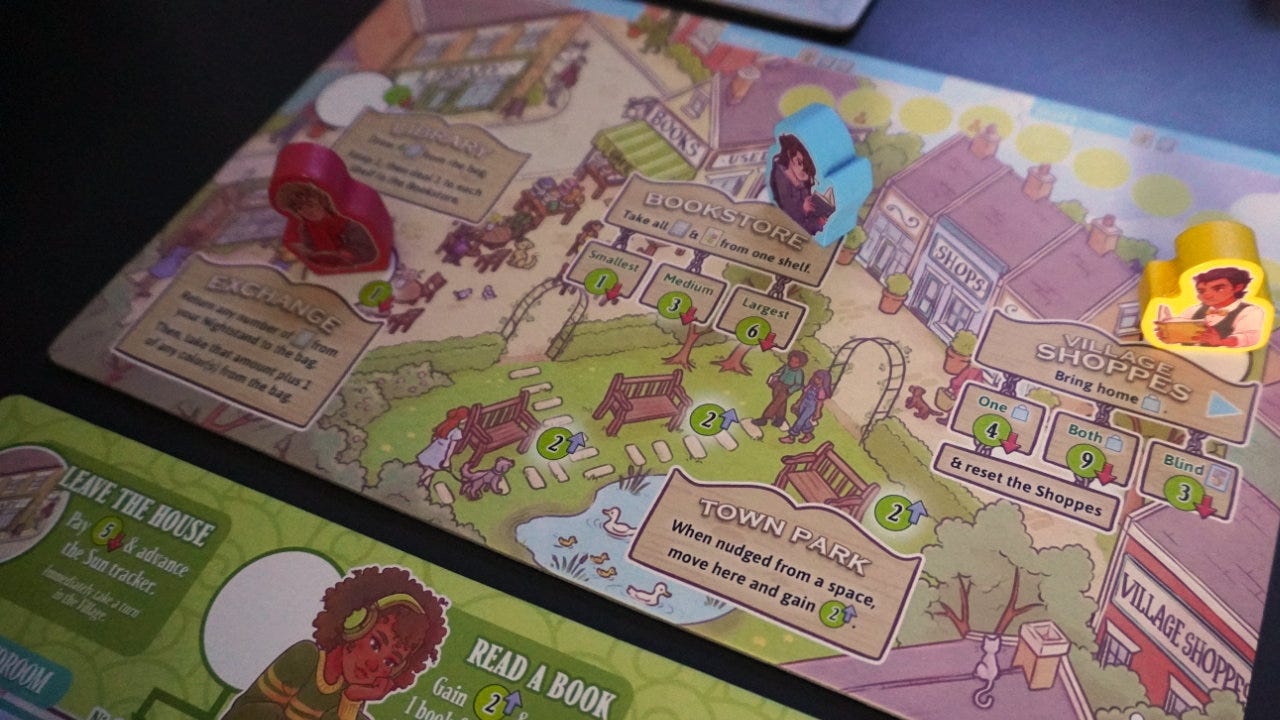
In many ways, A Place for All My Books is a pretty standard worker placement game combined with tile laying and stacking. Having both personal and shared worker placement action selection boards in a game isn’t uncommon either. What I find interesting is the flow of the game where workers move to and from the boards:
Charge up in apartment: Players need to spend time taking actions on their apartment board: gathering, sorting, reading, admiring. All of those actions increase social battery.
Go to village and spend: Once they have 5+ social battery, they can go to the village but would be left with no battery left to take actions there. So it probably makes sense to get your social battery to 11-19 before making the trip.
Return home to do it again: Then, after taking some actions and depleting the battery, it’s time to return to the apartment board game. This cycle then repeats throughout the game.
This wouldn’t be nearly as interesting if you had free access to choose apartment or village actions at any time. Nor would it be as interesting if you could easily hop back and forth between the boards. It takes effort to go to the village board, and you are there until you decide you are done.
Both mechanically and thematically, it feels meaningful to travel to and from the apartment and village.
Other applications
I couldn’t help but think of how this type of mechanism could be used in other games:
Fantasy questing: Players spend time in the town gathering supplies, resting, gaining allies, and preparing. When ready, they spend resources to travel to the quest location (e.g. dragon’s lair) and all actions there are costly. Eventually they need to return home to the town and begin the cycle again.
Cyberpunk hacking: Players spend time at a safe location (i.e. the bar or safehouse) preparing for a heist — brain stims, credits, gear. After they have enough resources, they launch the heist. Hacking and sneaking is costly, and eventually they need to bail.
In some ways, this is just theme applied to a core game loop. In the context of worker placement, however, it is a way to make a potentially abstract game feel more thematic.
Conclusion
Some things to think about:
Worker placement is popular: As a form of action drafting, worker placement is a popular, modern game mechanism: Dune Imperium (2020), A Feast for Odin (2016), Lost Ruins of Arnak (2020), Barrage (2019), and Everdell (2018).4 Even if you plan to only make TTRPGs, I think it is worthwhile to understand how worker placement work mechanically and to think about why it is so popular with players.
Cycles can be satisfying: I found the cycle of moving to and from the apartment to be one of the more satisfying parts of A Place for All My Books. I am, similarly, a fan of cycles in games as mentioned with the token pool in Sakura Arms. These cycles are slightly different than the game’s core game loop.
Making actions feel meaningful: If it were too easy to take actions in both the apartment and village, they wouldn’t feel important. It is only because the player needs to work and “build up” to leaving the apartment that it feels important. It’s worth considering actions that can only be taken after some time and effort on the part of the player.
What do you think? Have you seen a similar personal vs. shared action selection board in other worker placement games? Do you enjoy having to work toward taking a larger or more powerful action in a game?
— E.P. 💀
P.S. Want more in-depth and playable Skeleton Code Machine content? Subscribe to Tumulus and get four quarterly, print-only issues packed with game design inspiration at 33% off list price. Limited back issues available. 🩻
Skeleton Code Machine is a production of Exeunt Press. All previous posts are in the Archive on the web. Subscribe to TUMULUS to get more design inspiration. If you want to see what else is happening at Exeunt Press, check out the Exeunt Omnes newsletter.
Skeleton Code Machine and TUMULUS are written, augmented, purged, and published by Exeunt Press. No part of this publication may be reproduced in any form without permission. TUMULUS and Skeleton Code Machine are Copyright 2025 Exeunt Press.
For comments or questions: games@exeunt.press
2026 is already almost 4% over. How are your New Year’s Resolutions going?
The theme of this game seemed odd to me after thinking about it. Every book is worth a point. They don’t have titles or even genres, just colors. The game is largely recharging your battery to go to town to acquire more books to stack in your apartment. More points are awarded for having stacks and stacks of books in your bathroom and kitchen. Cozy game for book lovers or hoarding simulator? You decide.
It’s worth noting that for the apartment actions, there is no “action blocking” which is a defining feature of worker placement. Opposing players may never place their worker on your apartment board, taking spaces and blocking your actions. The only restriction is that you need to move your worker each turn, meaning you can’t take the same action twice. Without action blocking, one could argue that the apartment board in A Place for All My Books is really just action selection or action drafting and not worker placement at all. Only the worst sort of pedantic player would make this argument while playing the game. And I am that player.
Of these games, I’d recommend Everdell (Wilson, 2018) as a good introduction to worker placement mechanisms. It is a clear example of how it works and includes some light action blocking by opposing players. It’s a light game, so consider adding in the Spirecrest expansion for more experienced players.
Literally just the idea of a game about figuring out where to put my books makes me want to play it.
Also, it feels very much like maybe my real life? At least before I move houses. When we picked up and moved several states away, I had to figure out how to liquidate six bookshelves that were stacked front to back with books.
Did you like the game? It’s been on my wishlist for awhile now. No one got it for me for Xmas…lol and boo!