
Tumulus Issue 8 is shipping now! Rounding out two years of publication, this issue is all about dead malls, abandoned arcades, roguelikes, soulslikes, and more. This new issue ships right away with new 4-issue subscriptions.1 And don’t forget you might need to renew if you are already a subscriber!2 They don’t auto-renew by design!
And now on to this week’s topic: antagonistic game design.
Use & Regret, a short-answer exam
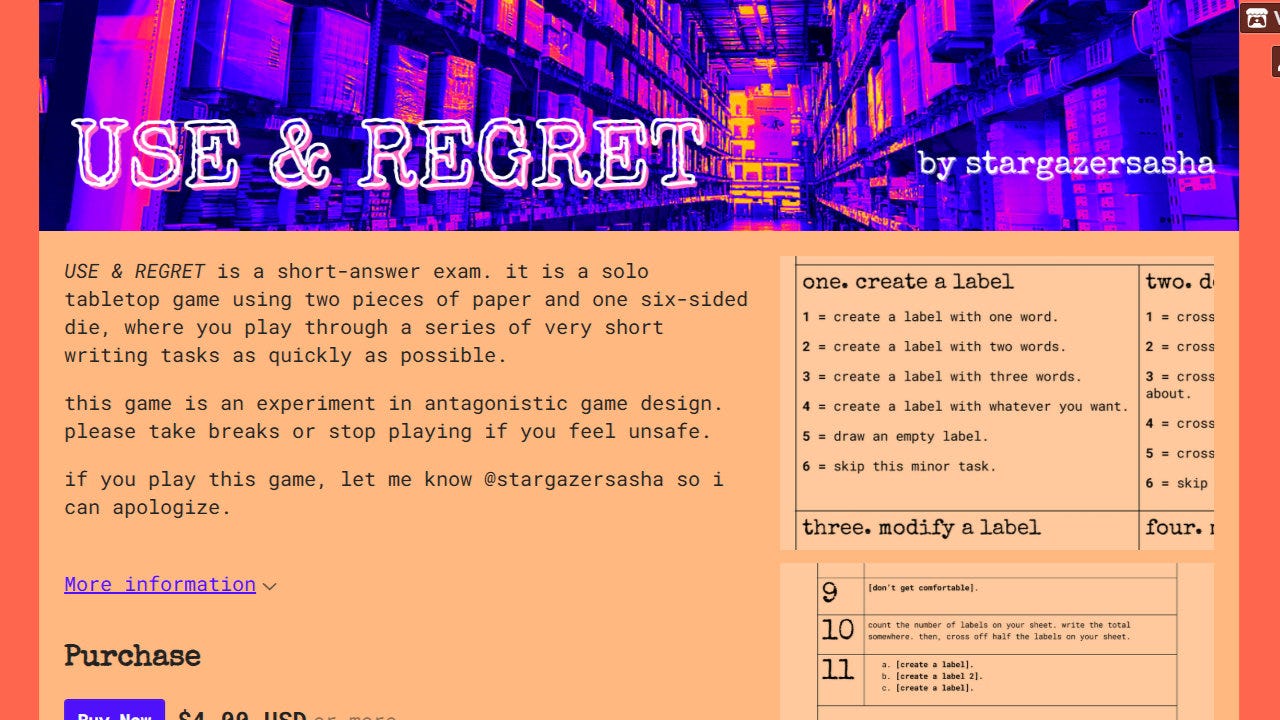
I recently discovered Use & Regret, a very strange little game by Stargazer Sasha.
It is structured as a written exam using two pieces of paper and a six-sided die. There are almost no thematic elements in the game, although one could argue that the entire game is a thematic element. It’s eleven pages of Roboto Mono with some terse instructions on how to play, followed by the exam questions.
You are instructed to set a timer for 60 minutes and then start.3
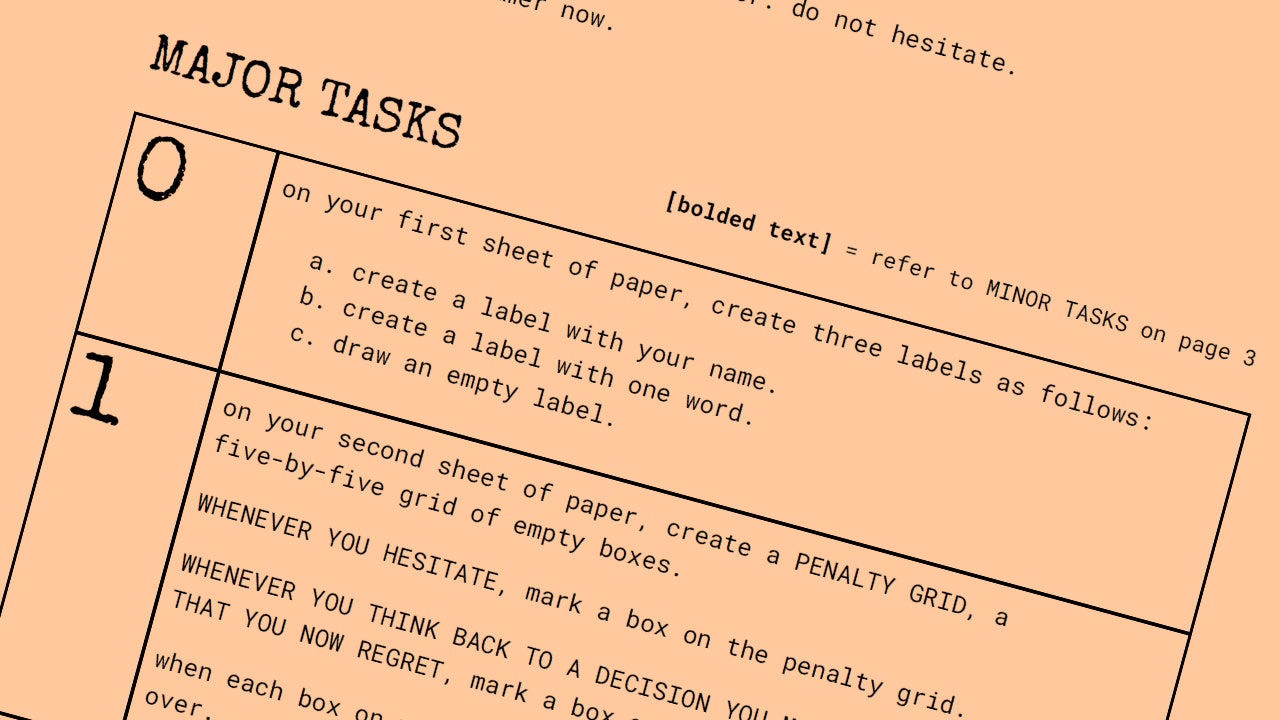
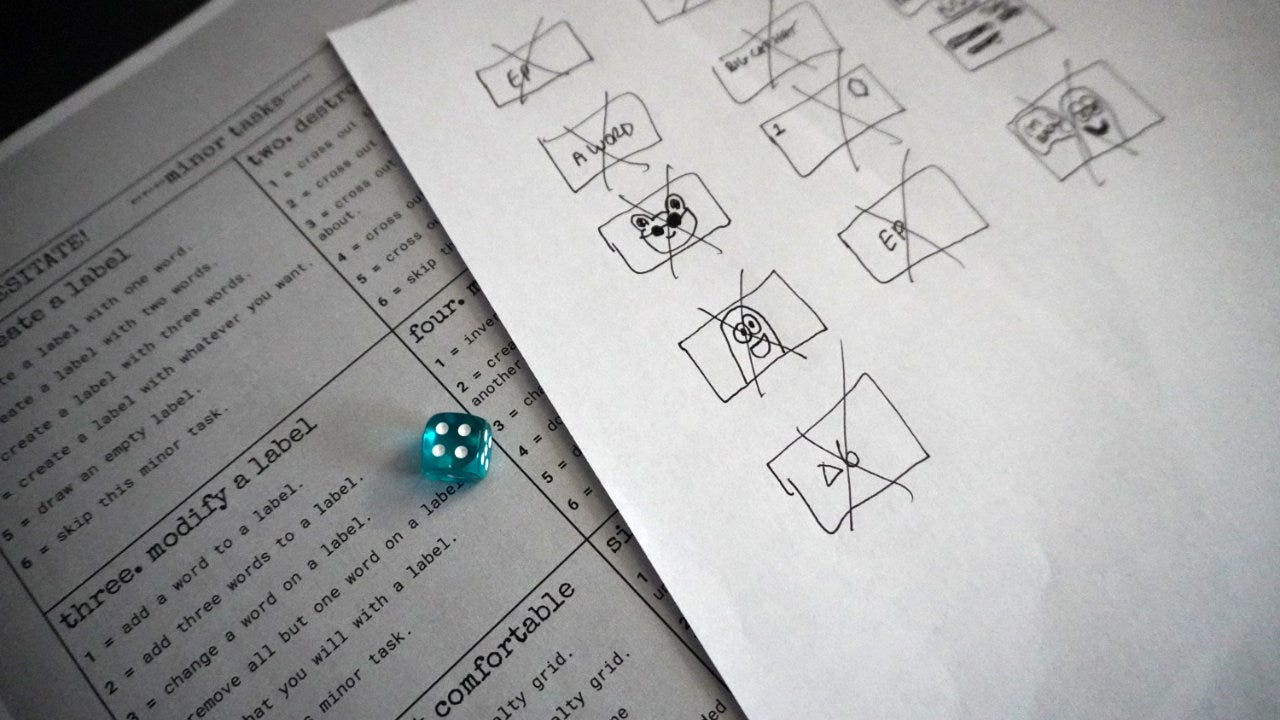
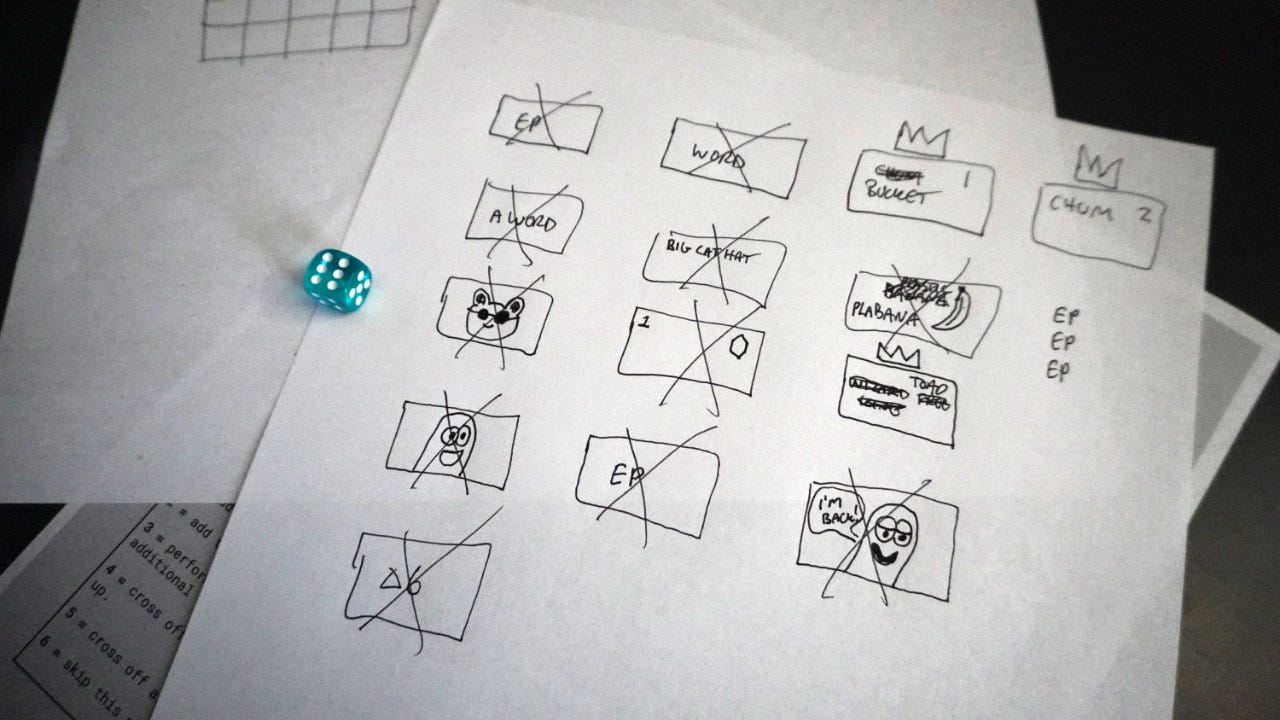
The game begins (Major Task 0) by drawing three labels. Labels are boxes (containing words, numbers or other things) and they are the core mechanism of the game. The first three labels you’ll create include a label with your name, a label with one word, and an empty label.
There are 33 sequential Major Tasks to complete in the allotted time.
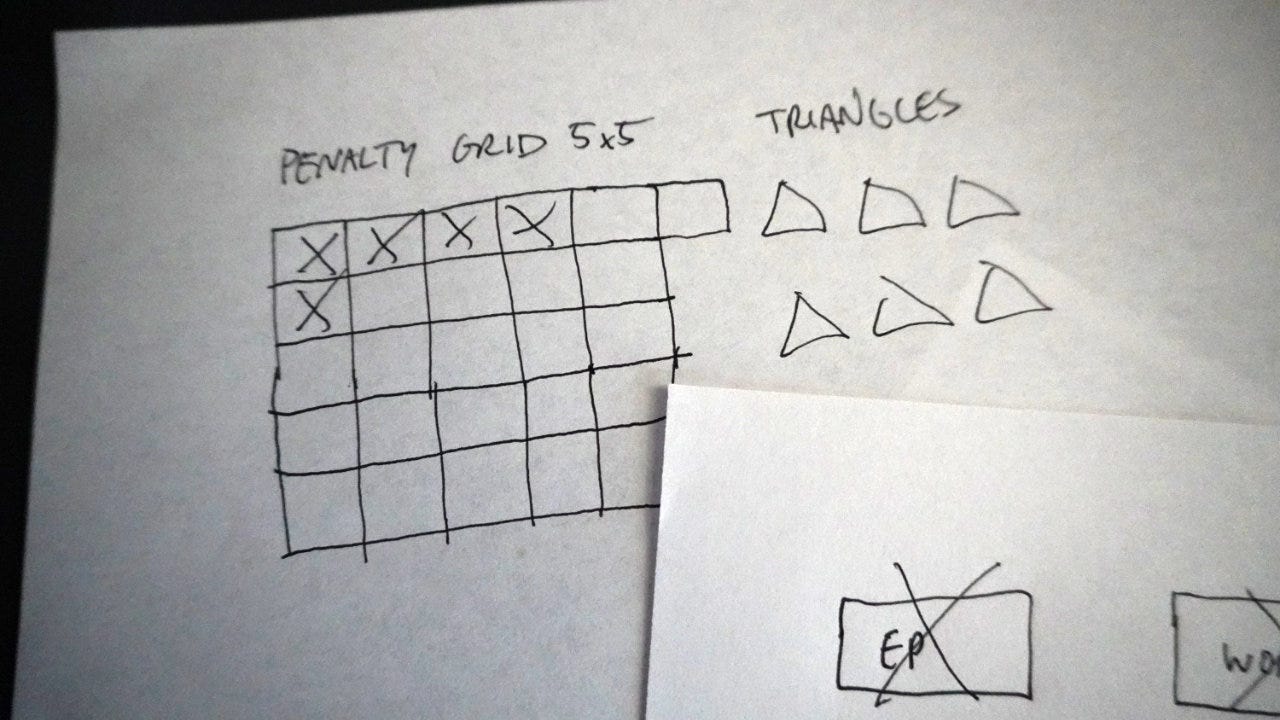
One has you create a Penalty Grid on the other sheet of paper to record each time you hesitate or think back to an earlier decision in the game. Too many penalties and you are disqualified, ending the game.
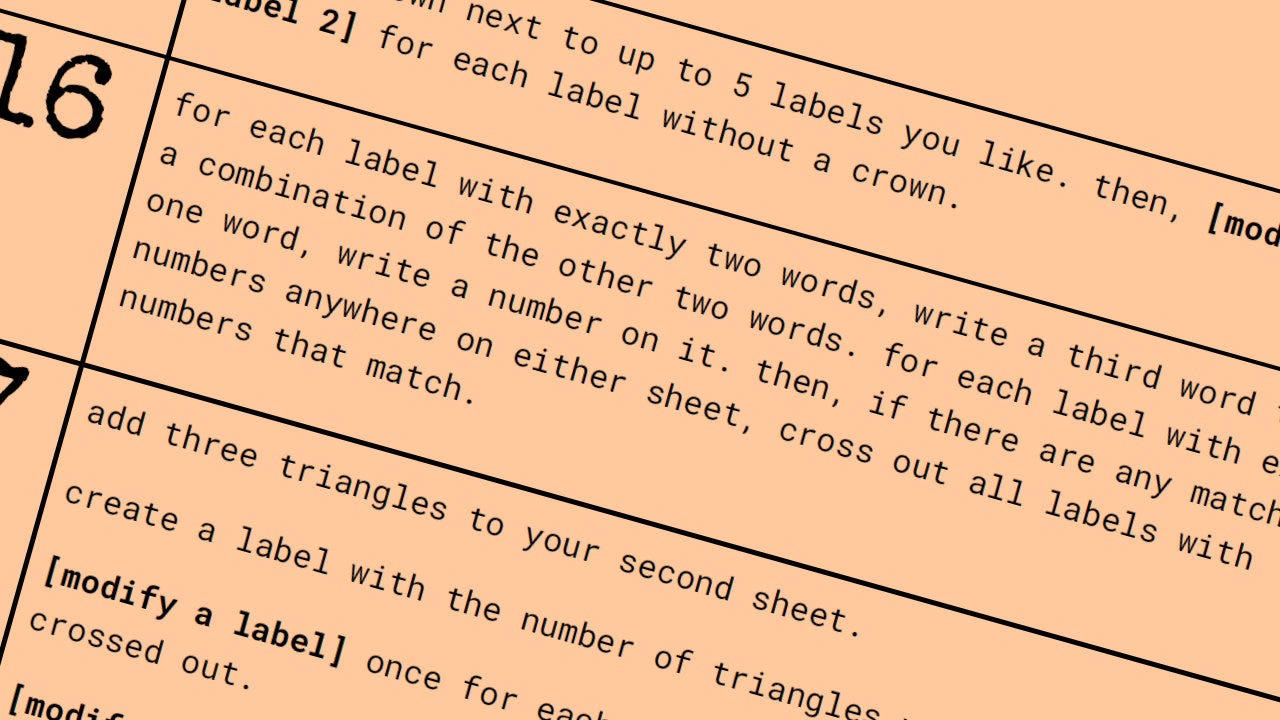
Other Major Tasks might have you roll the die for a random minor task like creating a new label, modifying an existing one, or destroying labels. A particularly nasty one has you cross out the label you love the most. Other Major Tasks change the rules of the game, adding crowns to labels or introducing a new subsystem using triangles.4
The rules and complexity begin to build up by about Major Task 12 or so. At least for me, it became increasingly hard to quickly complete each task without hesitating or thinking back to earlier choices (both of which would incur a penalty).
I don’t want to spoil the rest of the tasks or game, as I think it’s best going in with as little information as possible. I can, however, say that it was a very frustrating process and may have triggered some ancient school test anxiety that was lingering somewhere in my memory.5
And yet it was also… fun? I think?6
At the very least, it made me want to “win” even though I’m not really sure “winning” means much in this game. I was fully engaged.
Antagonistic game design
It is notable that the Use & Regret description includes this warning:
“This game is an experiment in antagonistic game design. Please take breaks or stop playing if you feel unsafe.”
What is antagonistic game design? Doesn’t sound fun, right?
Stefano Gualeni explores this concept in “Antagonistic Game Design: The Author as Player” published in Eludamos: Journal for Computer Game Culture.7 In the most simple terms, antagonistic game design seeks to create games that are meant to frustrate and provoke their players. Rather than relying on pleasure and the different kinds of fun to create player engagement, these games create engagement another way. They establish the game’s designer as an “imagined persona” who is the “off-putting and often sadistic (implied) author behind the work.”
Antagonistic games can be “adversarial to the players, derisive of their efforts, or outright cruel to them.” This is a deliberate action and choice on the part of the designer.
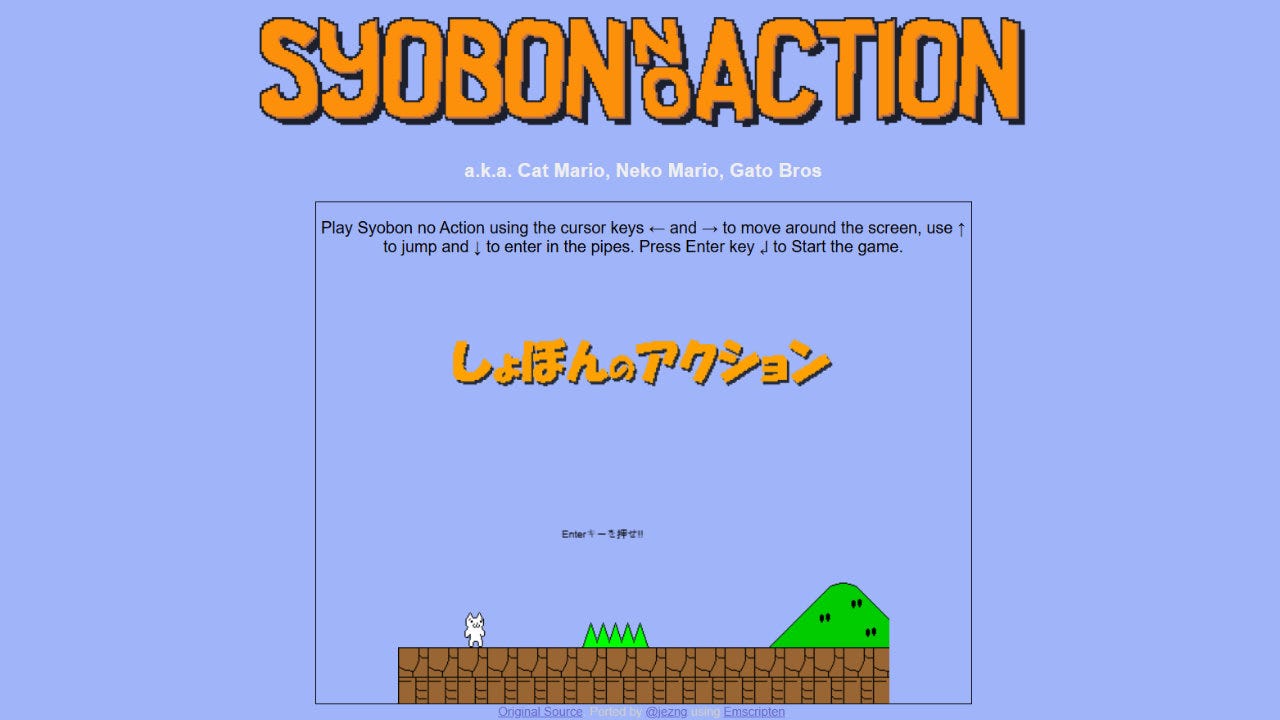
The paper uses Syobon No Action, a side-scrolling Super Mario Bros. clone, as an example of an antagonistic game:
“Soon, however, Syobon No Action subverts this initial impression, disrupting the player’s sense of familiarity through the introduction of behaviours and challenges that not only diverge sharply from those in Super Mario Bros. but also exhibit internal inconsistency. An in-game course of action that has proven effective or desirable may suddenly become ineffective in new gameplay situations, or even lead to the character’s death.”8
Syobon No Action switches what works for the player with little or no warning. Character death is, at times, unavoidable. The author of the game changes the rules as the player plays the game, making exceptions and subverting assumptions. Gualeni goes as far as to say the game is “akin to a playable prank at the expense of the player” and an “infuriating experience that relies on mockery and deception.”
Other examples in the paper include Getting Over It with Bennett Foddy (2017) and The Stanley Parable: Ultra Deluxe (2022). The example from The Stanley Parable is particularly antagonistic: You must press a button periodically to prevent a cardboard baby from falling into a fire. You must do this for four actual hours.
We’ll discuss why anyone would want to play such a game, but first we need discuss the author as the player.
The author as player
To be truly considered an antagonistic game, Gualeni argues, the author must become an implied adversary in the game. Note, however, that not all cases where the author of the game becomes a player in the game are antagonistic designs.
Gualeni breaks this “author as player” phenomena into three distinct categories:
Relinquishing the clinical gaze: The designer abandons “their disenchanted professional stance towards the game, and return to it with a playful attitude.” The author of the game engages with their game in a way that is different than playtesting. Given enough time and distance, they can play the game as a normal player would.
Officiating an RPG session: The designer takes on the role of one or more characters (e.g. NPCs) in the game. This should be familiar to anyone who has played a TTRPG where the GM is very much a player in the game.
Projecting antagonistic intentions: The game manifests “the authors’ intention to tease and frustrate the players.”
It is this third category that is perhaps the most subtle and most important for antagonistic game design.
It exists when the author becomes the adversary and causes the player to view the designer of the game as the enemy to be defeated rather than just the in-game final boss.
To me, Use & Regret is the clearest example of this. It perfectly combines the frustrations of antagonistic design with the “author as player” adversary.
Beating the game means defeating the author of the game.
Why do we play antagonistic games?
Why would anyone want to create a game that is intentionally mocking, deceptive, or cruel? Or, perhaps more curiously, why would anyone want to play such a game?
There are, of course, the usual gamer motivations that apply. Some players enjoy hard fun and want to prove their mastery of a game. Other players respond to social motivations like getting into the secret Getting Over It chat room that is only accessible after reaching the top of the mountain. Pride can factor into it as well.
Those aren’t particularly interesting answers to the question. There is something more to it than that.
And I don’t think that Gualeni is arguing that players enjoy the suffering and frustration of antagonistically designed games — at least not directly. Instead, the argument seems to be that (for a certain kind of person), the very idea that the author is being antagonistic is enough to trigger the player to want to beat the game. Gualeni calls this “sticking it to the (implied) man” in the paper.
I must admit, I found myself doing that in Use & Regret. I knew it was designed in a way to be frustrating and hard going in, so I immediately positioned myself as an adversary of the author of the game. When they said, “write a word in a label” I wrote “A WORD” in the label. Ha! Take that!
But of course, that is exactly what the author of the game would want me to do.
This is what separates antagonistic game design from simply games that are very difficult. They tap into a different kind of motivation — one that isn’t simple as the the ones we find in Bartle’s Taxonomy. It is a mixture of opposition, defiance, and perhaps a quest for validation as a player. It is what Gualeni calls “resentment-fueled determination and ingenuity.”9
I hate this game, but I’m not going to let it win.
It’s not for everyone, but antagonistic game design is a fascinating topic for inspiration and development.10
Conclusion
Some things to think about:
Elements of antagonistic game design: Based on my interpretation, three common antagonistic design elements must be considered: (1) an implied adversarial author as player, (2) deliberate frustration of the player (e.g. obstruction, deception, punishment, etc.), and (3) an opportunity for player agency to respond in opposition and defiance of the author’s antagonistic intents.
Player motivations are complex: While we can try to boil them down into a simple quadrant diagram or a more complicated matrix, no model is going to capture everything. While the paper referenced above doesn’t make me want to run out to play more antagonistic games, I love that it tugs at something new and different. It showed me a motivation that I didn’t previously have the words to describe.
Abusive game design: Somewhere beyond antagonistic game design exists abusive game design. Wilson and Sicart describe this concept in “Now It’s Personal: On Abusive Game Design” where games engage in physical abuse, unfair design, lying to the player, aesthetic abuse, and social abuse.11 That is an entirely different thing.
What do you think? Have you played (and enjoyed?!) a game built on antagonistic design? Is this a useful design pattern or more of an academic exercise?
— E.P. 💀
P.S. Subscribe to Tumulus and get four quarterly, print-only issues packed with game design inspiration at 33% off list price. Limited back issues available. 🩻
Skeleton Code Machine is a production of Exeunt Press. All previous posts are in the Archive on the web. Subscribe to TUMULUS to get more design inspiration. If you want to see what else is happening at Exeunt Press, check out the Exeunt Omnes newsletter.
Skeleton Code Machine and TUMULUS are written, augmented, purged, and published by Exeunt Press. No part of this publication may be reproduced in any form without permission. TUMULUS and Skeleton Code Machine are Copyright 2026 Exeunt Press.
For comments or questions: games@exeunt.press
Remember that if you select Tumulus Issue 09, 10, 11, 12 as your 4-issue subscription, Issue 9 will not ship until December 2026. Check out the schedule for more details.
Check your final issue for a discount code to use when renewing. ;)
I generally dislike “real-time” games with timers and refuse to play them. I made an exception in this case.
New mechanisms like crowns are introduced but not fully explained. It could be many tasks later until you find out what something does.
Everyone has recurring college nightmares for the rest of their life. Right? Right?
My favorite itch.io reviews of Use & Regret include these two: “Wow that was awful. I love it!” and “YOU may only have an hour, but playing Use & Regret feels like a full day spent at a high school staffed by ferocious surrealist bent on keeping you on your toes working from a strange, hostile-but-creative state.”
“Antagonistic Game Design: The Author as a Player” by Stefano Gualeni. Eludamos: Journal for Computer Game Culture Volume 16, issue 2 (2025), pp. 95–116.
This might describe me a little too accurately.
I’d love to design an intentionally antagonistic game, but I think it’s a particularly challenging design space. Use & Regret somehow achieves this while making it an engaging and rewarding experience. It would be hard to pull that off.
“Now It’s Personal: On Abusive Game Design” by Douglas Wilson and Miguel Sicart. Center for Computer Games Research. IT University of Copenhagen