
Happy MÖRKTOBER to one and all! Every day in October, people are making dark and weird things for MÖRK BORG, CY_BORG, and other BORG-adjacent games. I encourage you to check out the #MÖRKTOBER tag on your favorite social media platform to witness the chaos. Tenebrous can help you make things of your own!
Last week we explored antagonistic game design and games that use frustration as a core element. This week we are looking at an old game, but one that still has important applications today: bingo!
A long history of lotteries
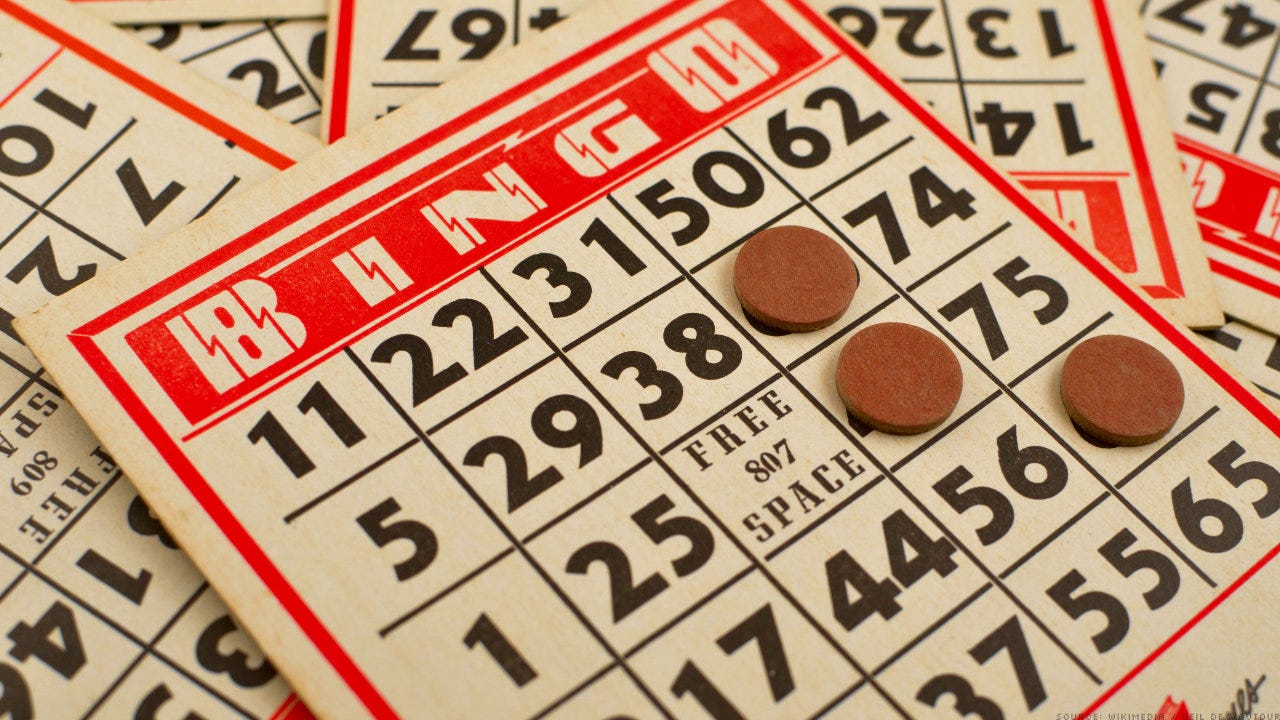
I would imagine most of you already know what bingo is and how to play it, but the history of the game is interesting enough that it deserves at least a mention.
The roots of the game go back to the Italian lotto with records of lotteries going back to at least the 15th century. Keno, another lotto-like game, goes back to a much earlier time. According to legend, the game was invented in China over 2,000 years ago during the Han Dynasty.1
In the early 1900s, a similar game was played in the United States. Hugh J. Ward is credited with inventing the game near Pittsburgh, publishing a rulebook for it. Edwin S. Lowe (of Yahtzee fame) was, however, the one who gave it the name of bingo.2
There are a few stories around how the game became known as bingo. The most popular of these tales is that Lowe saw people playing Ward’s game using dried beans to mark the spaces on their tickets and calling the game beano. A friend of Lowe’s accidentally exclaimed BINGO! instead of BEANO! upon winning, and the name stuck.3 Is this true or apocryphal? Who knows.4
Either way, the game was massively popular (particularly as a fundraiser) and electronic bingo systems were being developed by the 1970s.
Classic bingo cards and winning
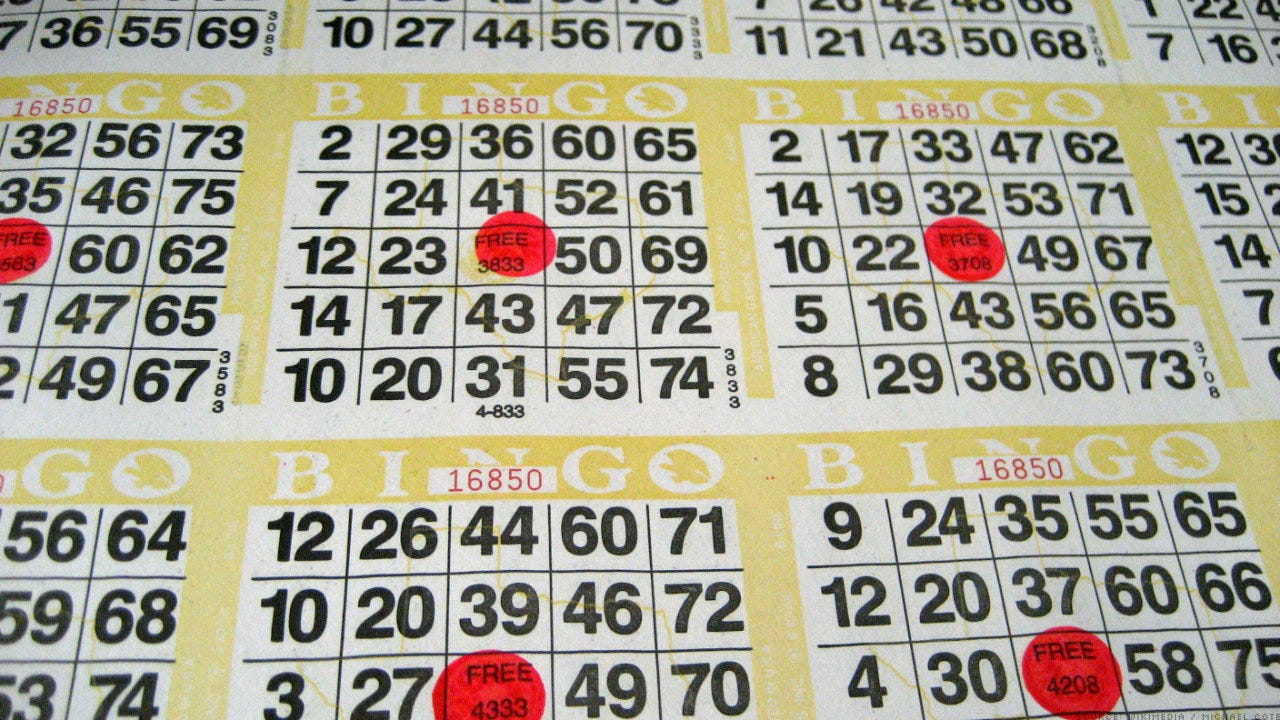
A typical bingo card has a 5x5 grid of numbers, usually with values from 1 to 75. The vertical columns are labeled B, I, N, G, O. The center space is a “free space” and considered automatically filled in or claimed.
Random numbers are called out and players stamp their cards if they have a match. Stamp a complete row, column, or diagonal and you win the game.5
Not being much of a bingo player myself, I only recently learned that the number ranges are tied to the columns. For example, the B column will have numbers 1-15 while the I column will have 16-30 and so on. The O column has the highest values from 61-75. According to “The Bingo Paradox” (Benjamin, et al., Math Horizons, 2017), this arrangement means that a horizontal line is almost twice as likely as a vertical line win.6
Bingo is simple and completely random. There is no player agency or strategic skill involved.7 While it certainly taps into some of the kinds of fun, it’s hardly in the same class as most of the games discussed here at Skeleton Code Machine.
Bingo as a game mechanism
If we broaden the definition of bingo a little, we can use it as a game mechanism within other more complex games. Removing the need for a rigidly defined bingo card, we can instead say that a bingo mechanism involves selecting items at random and players marking off (or somehow otherwise noting) those items on their individual player boards.8
Generating random things (numbers, token values, etc.) and marking them off is a core mechanism of roll-and-write games, one of the more popular genres of late. A game like Cartographers (Adan, 2019) might not look like bingo at all, but there are elements of bingo in its design.9
Using bingo cards in TTRPGs
I think bingo mechanisms are a good fit for TTRPGs.
In “I’m not the traitor. Trust me.” (2024), I talked about how I used secret background cards when running a game of Mothership. After players had created their characters, but before we began, I handed out secret background cards to each player with the following rules:
I created four secret background cards for the three players. So one card will not be used in the game.
Players could not read all the cards ahead of time.
The cards are distributed (one to each player) secretly. Neither the GM nor the players knows who received which card. Nor does anyone know which card was left out (i.e. the extra card).
Each player may choose if they want to use the card as a secret background or not. Their choice is kept secret.
The cards ranged from “You are an android.” (“You will do anything and everything to hide the fact that you are an android.”) to “You are a xeno worshiper” (“You are secretly obsessed with alien life. You are driven to come face-to-face with some form of alien life.”).
It worked great and helped drive the narrative roleplaying in the game.10
But I think it could be even better by using bingo!
Bingo identities
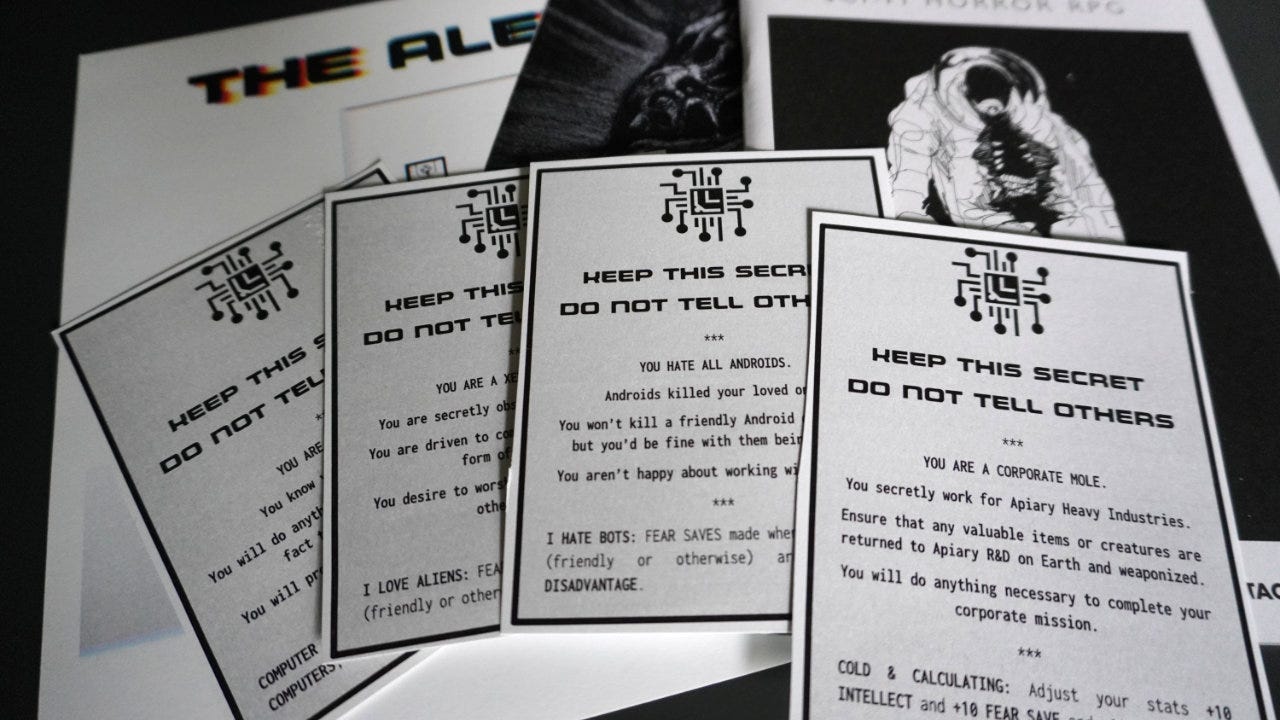
My version of secret identities simply had a role (“You hate all androids.”), a short background (“Androids killed your loved ones.”), and a trait (“You won’t kill a friendly android on purpose, but you’d be fine with them being killed.”). They also had a mechanical impact, changing a stat or modifying a specific save type.
Instead, I’d love to try making bingo cards for each secret identity. The corporate mole might be able to mark off a square if they capture/collect an alien creature that can be used for R&D purposes. The xeno worshiper might have squares for seeing an alien, creating a shrine, or coming face-to-face with an alien.
The items on the bingo card perform double duty, acting as both goals to achieve and potential prompts for how to play their character. It could be a menu of things to try (or at least think about) without mandating the use of any items at all.
Coming up with 25 of these for each role seems like a bit much. Reducing it to a 3x3 or 4x4 grid would make it more reasonable.
Then if that player achieves a row, column, or diagonal win, they could get some sort of bonus or in-game effect. This meta-goal of achieving Bingo! is what separates this method from simply using a checklist or similar list of achievements.
Similar ideas about bingo in TTRPGs
I am, of course, not the first person to have such an idea.
A Reddit user created a Dungeons & Dragons session bingo card for each of their players using a full 25-square grid. It included items like: “Someone rolls a Nature skill check”, “Someone is invisible”, and “Someone rolls minimum damage”. There are also some meta items like “All the players show up late”.
Another Reddit post discusses using bingo cards as a system to level up characters. Approaches include random words (“witches”) that can be marked off when encountered, or using character goals and motivations. The character-goals idea is much closer to my suggestion for secret bingo identities above.
Roleplaying Tips shared an RPG Bingo card that included various cliches to mark off while playing. These were mostly meta items like “The GM laughs at a roll they make.” or “Someone is rolling dice on a smartphone.”
The Bingo Style Experience Points idea at Githyanki Diaspora is one of the most developed versions, including a downloadable example PDF bingo card.11 Items are thematic and/or narrative and include things like “Thwarted a rival.” and “Recovered ancient lost treasure.”12 The particularly interesting part of this mechanism is that the GM only fills in the center 9 squares of the 5x5 (25-square) grid. The players and group then decide what to put in the remaining blank squares, adding things they’d like to see in the game. Players level up when they complete a row, column, or diagonal.
A model for TTRPG bingo cards
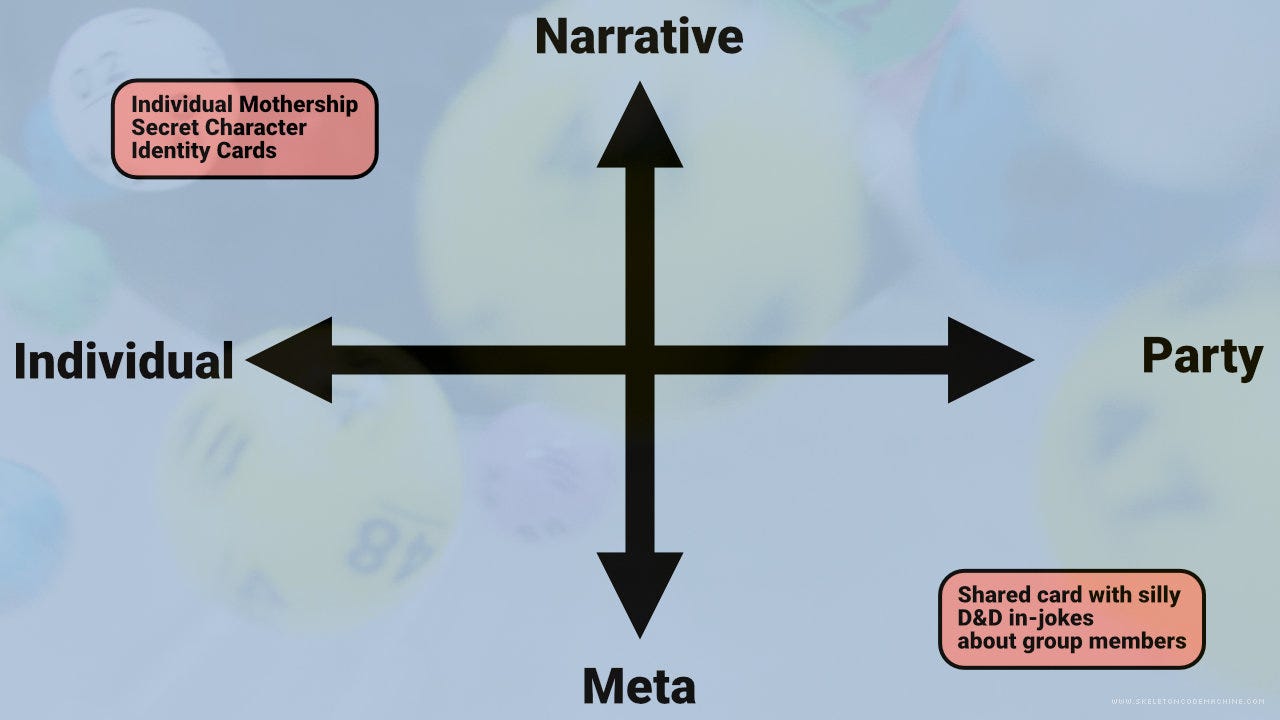
The above are just a few examples of the countless ones that exist online. I’ve found that the bingo cards usually can be grouped as follows:
Individual motivations: Each player has a bingo card tied to their specific character in the game. Items are directly tied to narrative motivations and goals for that character.
Group achievements: Rather than at an individual level, the card exists at an adventure or campaign level. Goals and motivations apply to the adventuring party as a whole and may include special locations or quest features.
Narrative elements: For both individual and group cards, the items are sometimes exclusively focused on in-game thematic items. The items are things which happen in the world of the game.
Meta elements: Many times the items are related to things that happen in the real world, rather than in the world of the game. The item could be that a player says something amusing or someone does a specific thing.
I’m a big fan of quadrant charts, and this grouping naturally lends itself to that. All TTRPG bingo cards therefore exist somewhere on two axes: Individual vs. Group and Narrative vs. Meta.
Thinking about TTRPG bingo cards this way allows us to design new ones in the style that most suits our needs. You could have individual-meta cards or group-narrative cards. More importantly, you can have cards anywhere in between.
Conclusion

Some things to think about:
More than just regular bingo: Bingo (the traditional) game is fun for many people, but might have limited utility in the world of modern game design. If we broaden the scope and definition of the bingo mechanism, however, it becomes a useful tool in our design toolbox.
Direct applications in TTRPGs: I’m not the first to think of using bingo cards in TTRPGs and that’s a great indication that there’s something here worth investigating. Whether it’s at the individual or party level in a game, the bingo card mechanism can help new players come up with ideas on how to engage with the game.13 It can also add a new and interesting way to interact with systems for even more experienced players.
Many ways to play bingo: I tried to include a few key examples of how others have thought about adding bingo mechanisms into their games. This article does not provide an exhaustive list of such ideas. Instead, I’ve tried to provide a useful model that can be used to make the system that works best for you.
What do you think? Where have you seen bingo mechanisms in use in either TTRPGs or board games? Would you welcome such a thing in your next TTRPG session?
— E.P. 💀
P.S. Don’t forget that your 4-issue Tumulus subscription does not auto-renew! Watch for your blue final issue notice and then resubscribe at the EP Shop. All new orders in October also receive a free MÖRKTOBER sticker while supplies last. 🩻
Skeleton Code Machine is a production of Exeunt Press. All previous posts are in the Archive on the web. Subscribe to TUMULUS to get more design inspiration. If you want to see what else is happening at Exeunt Press, check out the Exeunt Omnes newsletter.
Skeleton Code Machine and TUMULUS are written, augmented, purged, and published by Exeunt Press. No part of this publication may be reproduced in any form without permission. TUMULUS and Skeleton Code Machine are Copyright 2026 Exeunt Press.
For comments or questions: games@exeunt.press
The legend also states that Zhang Liang invented Keno to raise money to defend a city and that this proved to be so successful that it was used to fund the building of the Great Wall of China as well.
This is the very same Edwin S. Lowe I mentioned in the footnotes of the Rolling and Locking with Yahtzee article!
There are multiple variants of this story. Some versions say that Lowe simply overheard someone saying Bingo! when they won and it wasn’t necessarily his friend. Regardless, I’m now going to yell Beano! instead of Bingo! from here on out.
The other version is that the Bingo name comes from the sound of a bell ringing to indicate a winner of the game.
Ties can happen. In that case, play continues until some additional condition is achieved like filling in the complete card.
The proof of this paradox gets very mathy indeed and involves 12th-degree polynomials.
Waiting for hardcore bingo fanatics to correct me on this and explain how they increase their odds of winning. ;) And yes, card construction, probabilities, victory condition variants and such do make bingo a more complex game that one might initially think.
BGG’s bingo mechanic description says: “Items are selected at random, and each player needs to use the items for their own player boards.”
Again, this is using the most broad definition of bingo as a mechanism and not the strictly defined bingo game. Other random marking games, for example, do include elements of player agency and potentially strategic decisions.
Everyone was confused when one player slipped an obviously dangerous parasite sample “because it might be useful later” into their pocket, but later realized they were the corporate mole. The same when an energy pulse only impacted androids, but a self-proclaimed “human” player was knocked out.
This is actually a multi-part series. An earlier post on Bingo Style Experience Points has more of an introduction to the concept.
“Thwart” seems like such an odd word even though it’s part of my vocabulary. Just looked up some possible etymologies and apparently it comes from Old Norse meaning to tranverse or cross. Our modern sense seems to be connected to the meaning of to lie across the path of someone or to block.
It is very easy to forget just how daunting and uncomfortable TTRPGs can be for new players. Having a GM ask you “OK, so what do you do next?” might cause a brain to go completely blank. I appreciate any tools and/or systems in roleplaying games that give players hints as to what they can do next, rather than just a blank page. Is this a necessary feature in every game? Certainly not. I do, however, consider it to be an accessibility feature that is always welcome when reading through a new game.
Interesting article. I agree there is potential for bingo mechanics in a ttrpg.