
If you’ve ever run a tabletop roleplaying game, you’ve probably had to decide what is in a room or area. The adventurers kick open the door to a new dungeon room. You need to tell them what they see inside: Is there a monster waiting there patiently for someone to fight? An NPC to chat with? A trap attached to the door? Or an empty room?
This isn’t just a topic for GMs running TTRPGs. Solo RPG players often need to imagine what they find in a given room. Solo game designers often want to stock the dungeon for their players and need inspiration for map/level design.
This week I want to look at a few existing dungeon stocking systems and then propose one of my own. Not because I think mine is amazingly novel, but because I want to share what I’ve settled on after reading many different options.
Classic dungeon stocking tables
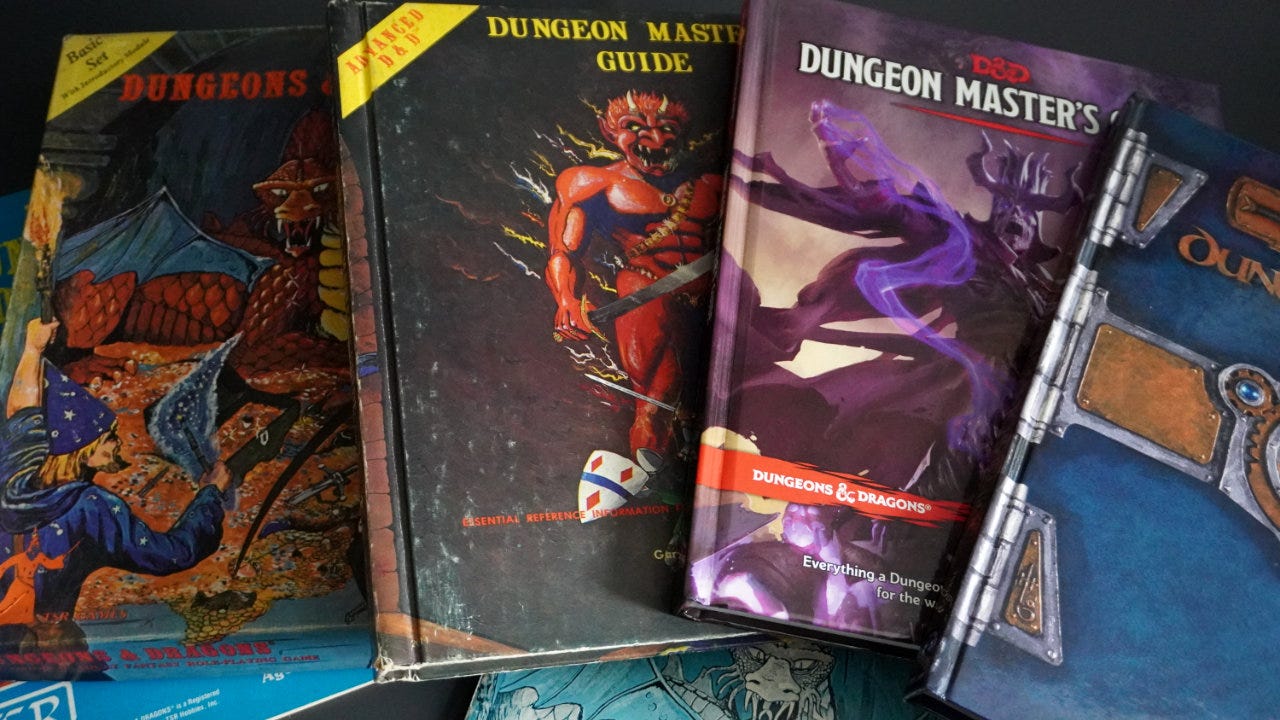
It can be useful to start at the beginning and look at how dungeons were stocked in early versions of Dungeons & Dragons. I happen to have three versions of the Dungeon Master’s Guide available to review, so let’s start with those first:
1. Advanced D&D Dungeon Masters Guide (1979)
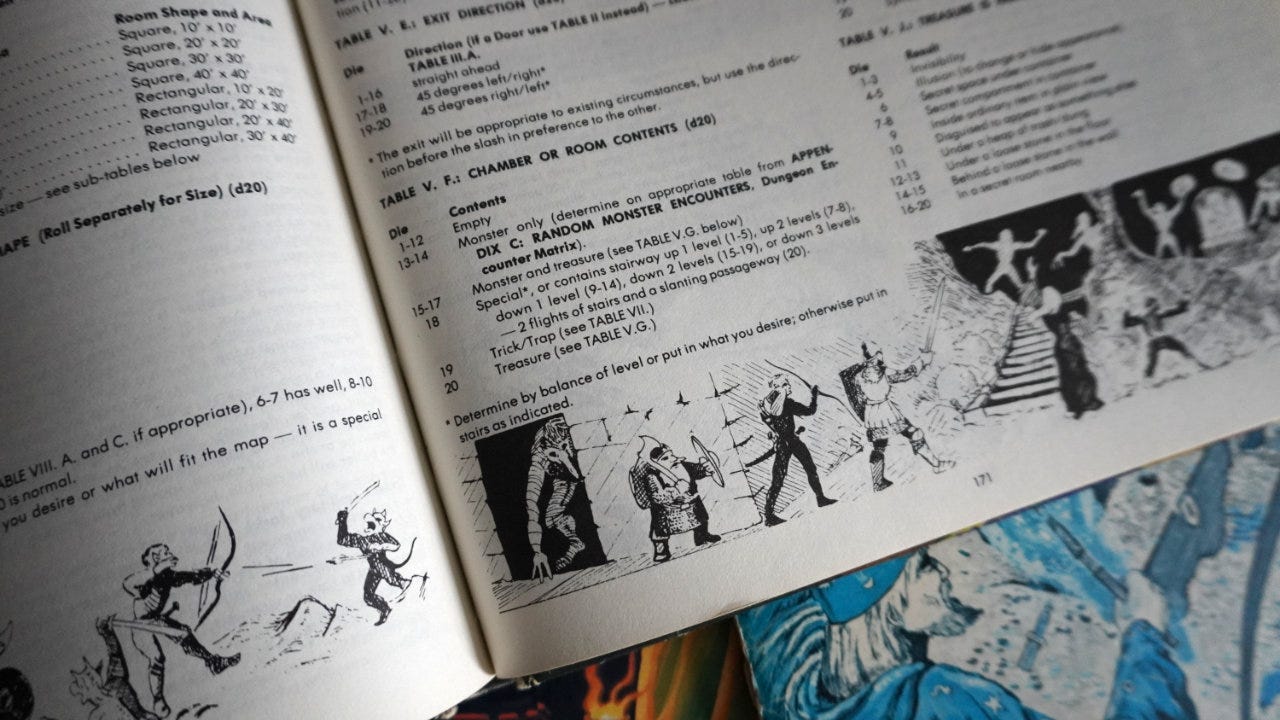
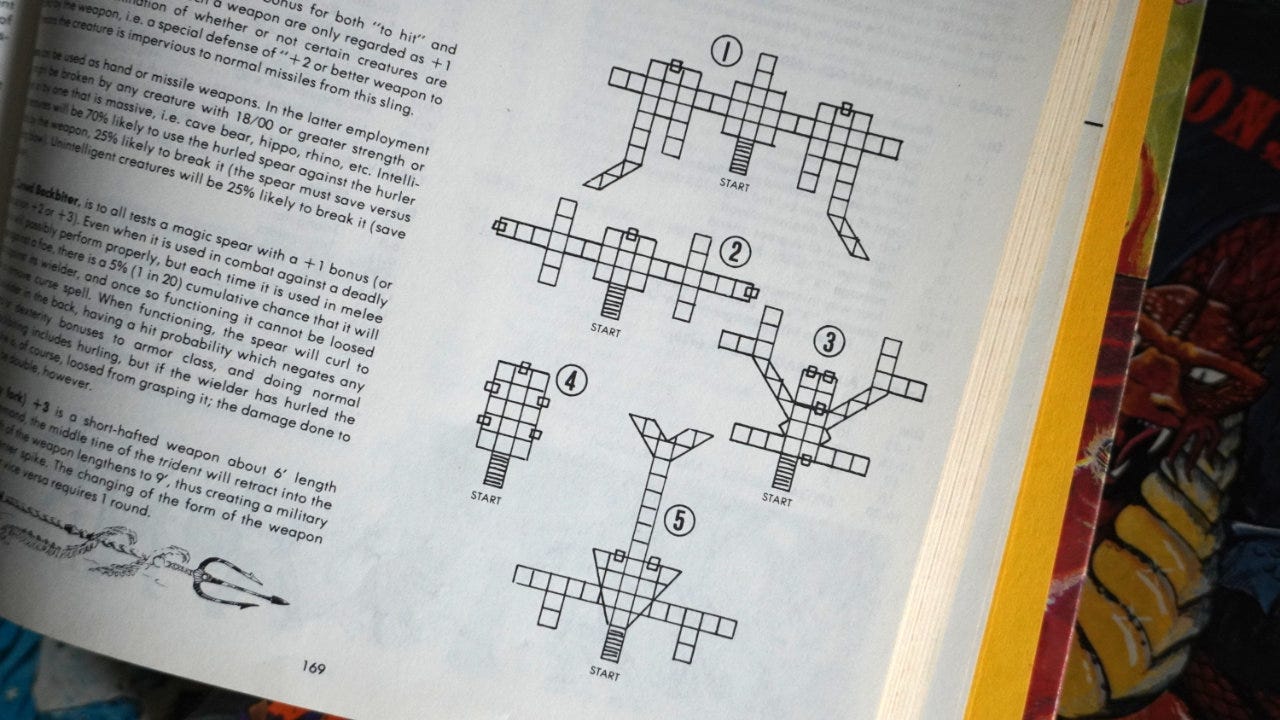
I checked my copy of the Advanced Dungeons & Dragons Dungeon Masters Guide (1979) to see how Gary Gygax et al. proposed to stock dungeons.1 Appendix A (p. 169) covers Random Dungeon Generation and includes starting map areas, periodic checks, doors, special passages, rooms shapes, and number of exits. The tables focus on making a random dungeon map and placing treasure in the rooms.
Table V. F. Chamber or Room Contents (d20) contains, however, a high-level list of what one might find in a dungeon room grouped into six categories:
Empty
Monster only
Monster and treasure
Special or stairs
Trick/trap
Treasure
There are, of course, separate tables to use for monsters, treasures, and traps.
2. D&D Dungeon Master’s Guide (2000)
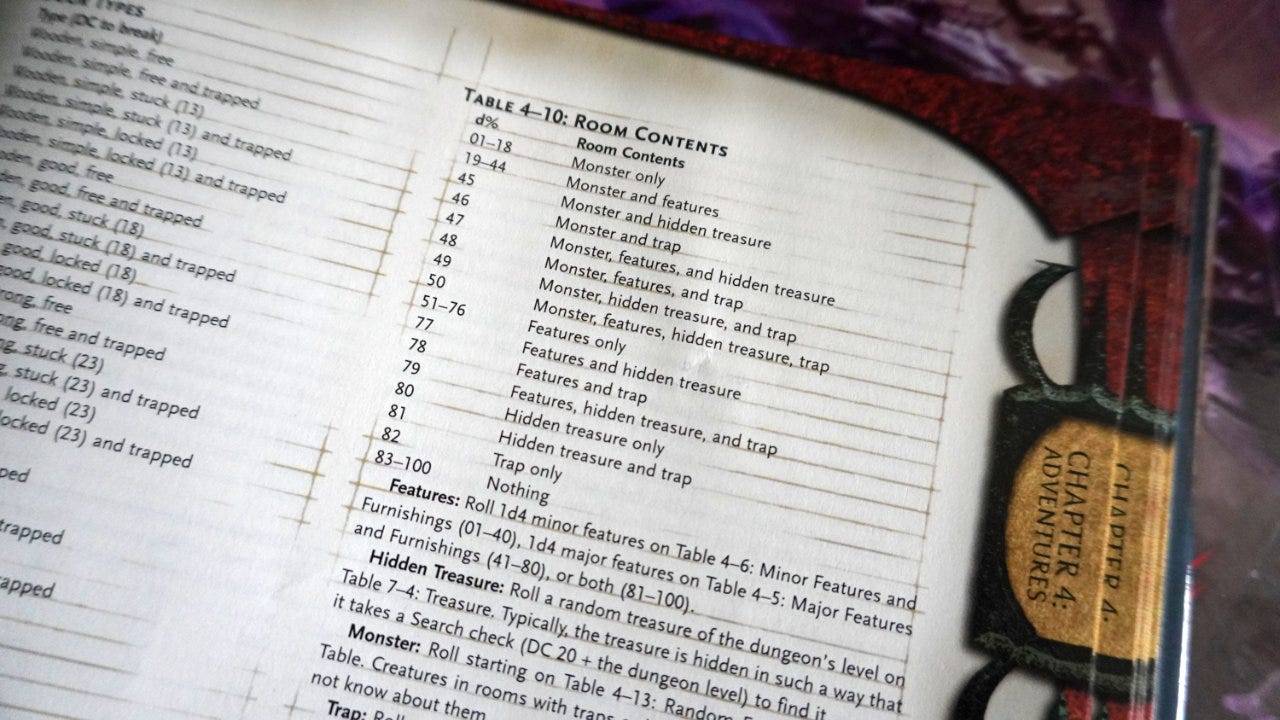
The inclusion of a section on dungeon construction continues into the 3rd edition version of the Dungeons & Dragons Dungeon Master’s Guide (2000). In Chapter 4: Adventures there is a section on Random Dungeons (p. 118). Table 4-9: Door Types contains an impressive D100 list of wooden, stone, and iron doors.2 Table 4-10: Room Contents is, however, the one I find most interesting. It’s a d100 list of things to find when opening the door to a new room: 01-50 are related to monsters, 51-79 are features including treasure and traps, 80-81 are treasure, 82 is a trap, and 83-100 are nothing. Compressing this list we see:
Monsters
Feature (items, trinkets, and other furnishings)
Hidden treasure (with or without a trap)
Trap (without monster or treasure)
Nothing (empty room)
Although rearranged, this is similar in many ways to the 1979 Chamber or Room Contents table. This general style will continue into the 5th edition as well.
3. D&D Dungeon Master’s Guide (2014)
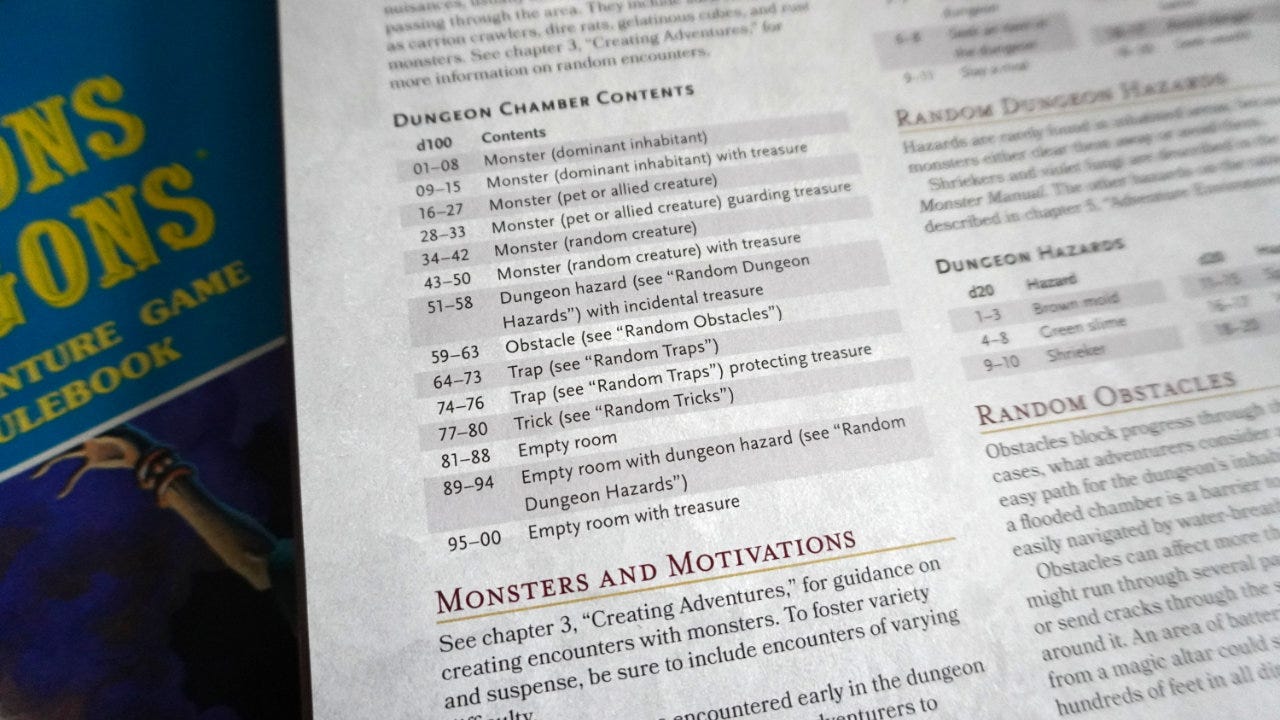
The 5th edition Dungeons & Dragons Dungeon Master’s Guide (2014) expands the appendix from the 1979 version as Appendix A: Random Dungeons (p. 290). Starting areas, passages, and doors are all there, although the door types are trimmed down to a mere d20 list.
There is a “Stocking a Dungeon” subsection in Appendix A that includes a discussion of chamber purpose based on the adventure environment. There are individual d20 tables for many types of environments such as Death Trap, Lair, Maze, Mine, and Planar Gate. The d100 Dungeon Chamber Contents table (p. 296) is the one that looks most familiar:
Monsters
Hazard
Obstacle
Trap
Trick
Empty room
It’s notable that many of these results are a mix of more than one type. Even some of the “empty room” results also contain treasure or hazards which, to me, would make them decidedly not empty.
What’s also notable is the inclusion of Hazard and Obstacle as distinct types of room contents. The book provides a short list of example hazards: molds, slimes, spiderwebs, and fungus. Obstacles are also detailed in a separate d20 table including an antilife aura, blade barriers, cave-ins, flooding, lava, fire, and poisonous gas.3
Hazards, in this context, are dangers that exist in uninhabited areas and could be cleared out. Obstacles are anything that blocks progression through the dungeon and often can’t permanently cleared. For example, a chasm or lava flow will remain in place even if the adventurers figure out a way to traverse it.
Even more stocking methods
In researching the various dungeon stocking methods and models available, I came across quite a few modern ones. Many of these are from the indie TTRPG communities, using the D&D tables as inspiration and making them their own.
I couldn’t possibly cover them all, but there are four that are important to mention:
4. Cairn 2e Dungeon Die Drop Table
The Cairn RPG Warden’s Guide is a helpful online resource not just for running that specific game but also as a general reference in game design.4 The Dungeon Seeds section contains the Dungeon Die Drop Table that uses a simple 1d6 roll and the following four categories:
Monster (dangerous creatures)
Lore (clues, mysteries, lessons)
Special (obstacles, puzzles, challenges)
Trap (dangerous and hidden devices)
By rolling the dice on the dungeon map, the location of the dice indicates where the rooms are and the result (face value) indicates what is in the room.
It is the Lore option that is particularly interesting in this system:
“Lore rooms should build on the theme of the dungeon, provide a valuable lesson, or connect the characters with an NPC or Faction. They might create a dilemma that unites the party or puts them at odds with their mission. At a minimum, these rooms act as a curiosity, adding something memorable to the experience beyond danger and puzzle-solving.”
I like that this reinforces the addition of explicitly narrative-advancing things in the dungeon. Not everything needs to be a trap to disarm or something to hit with a sword.
5. Necropraxis Hazard System v0.3
The Hazard System by NecroPraxis is one of the top results that comes up when looking for various dungeon stocking methods:
“The six-sided hazard die deploys threats, manages resources such as light, and keeps time. It is the engine that drives gameplay forward, ensuring that choices have consequences while minimizing bookkeeping.”
The list departs from the “monster, treasure, trap” model used in the earlier D&D Dungeon Master’s Guides and uses slightly more abstract language:
Setback (encounter or disaster)
Fatigue (reduce or consume resources)
Expiration (clear a condition)
Locality (advance or shift the state of something)
Percept (clues and foreshadowing)
Advantage (recovery or free turn)
This list is highly versatile in how it can be used and implemented. The Hazard System page gives examples of interpreting the results in wilderness settings, dungeon exploration, or even using it to drive combat turns. Where some dungeon stocking lists can feel constrained to classic “monsters in a dungeon” settings, this one feels broad enough to use almost anywhere. It has applications far beyond simply stocking rooms in a dungeon.
I also appreciate the ordering of the list. Higher rolls are better than lower rolls, which makes it easier for me to mentally internalize the results.
6. Liminal Horror Voidcrawl Procedure
Liminal Horror is a “rules-lite survival horror roleplaying game about normal characters and their struggles against the things that go bump in the night.” It’s a survival-horror TTRPG that usually uses a modern setting rather than medieval dungeons. While not explicitly a “dungeon stocking” table, the Voidcrawl Procedure (p. 28) included in the Liminal Horror Investigators Guide has connections to the topic.
A voidcrawl is a “turn-based system for Liminal Horror sessions that creates a procedure for exploring the dark and neglected spaces where those touched by the abyss reside. It uses an overloaded encounter die to inform what happens next and bring the focus on the narrative.”
A d20 is rolled once per turn to determine what happens next based on the following 8 categories:
Dire Omen (foreshadowing changes)
Encounter (could be a monster)
Horror (increase stress)
Setback (hazard or resource depletion)
Locality (environment change)
Clue (hint or warning)
Free (nothing or temporary effect clears)
Regroup (regain health or resources)
This system isn’t made for classic dungeon crawls, and yet I think it could be used to stock a dungeon. It’s abstracted concepts much like the Hazard System above. In fact, they share the concept of locality being a change in environment or state of something.5 The Clue and Percept items are similar too.
I like that the voidcrawl list contains an explicit Regroup type — a safe room that serves to replenish resources, gives players a tiny break, and rest. It’s exceedingly rare, only happening on a roll of 20, making it feel special. I’m not sure I’ve seen something like this in many other dungeon stocking models.
7. Murkdice Dungeon Stocking Overhaul
The final list I want to mention is the Murkdice Dungeon Stocking Overhaul. Based on both the classic D&D and the Cairn 2e procedures above, it uses a d6 roll like the Hazard System.6
NPC (monsters, factions, etc.)
Information (clues, hints, warnings)
Hazard (traps and environmental hazards)
Opportunity (treasure, supplies, safety, hidden shortcuts)
This is similar to some of the other systems mentioned above. There is a Information category that aligns with the Clue, Percept, and Lore categories used elsewhere. Hazards are specifically called out.
GMs using this system can (and should) include more than one type of item in a given room. For example, a room might have two pieces of information and a hazard.
Opportunities are given their own group which I quite like. This includes treasure, supplies, and safety. It’s similar to the Liminal Horror Regroup if taken alone or a bit riskier if combined with a hazard.
THORCS!
I’m interested in stocking dungeons for use in solo games. Reading countless discussions and blogs about the various ways to do this has been enlightening. As is to be expected, however, I am left wanting a system that takes my favorite parts from all of them.
Thus was born THORCS! — our eighth and final system of this survey.7
THORCS! is yet another dungeon stocking system.8 My goal was to make it flexible enough for use in any setting and yet specific enough that the results were useful. It has six categories:
Threat: Unavoidable, direct threats to life and limb. This includes monsters but also always-hostile NPCs. Combat encounters would go here. After defeat, threats are cleared from the room. You push through the webs into the room and are attacked by giant spiders.
Hazard: Environmental obstacles that may cause injury or other physical barriers. Hazards are explicitly non-combat encounters that can not be avoided. They remain in place and probably can’t be cleared. A mass of animated roots cover the floor, blocking the path to the next chamber.
Opportunity: A potential benefit that required a test or challenge, but is completely optional. Opportunities are about risk and reward, remaining in place until the adventurers interact with them. (I love a push your luck mechanism.) Valuable herbs are growing high up on the cave wall, requiring a dangerous climb to collect them.
Resource: Loot! These are valuables, supplies, boons, and other good stuff with low or no risk. Unlike Safe rooms (below) these are not located in areas where the adventurers can rest. Once collected, the resource is removed from the room. You find the corpse of an adventurer with backpack filled with gear.
Complication: This is the opposite of Resource rooms (above). Something bad happens, but it is non-combat and non-hazard. Complications increase terror, slow progress, consume resources, or reveal omens. These are almost always one-time events. Something moves through the underbrush and your torch flickers out.
Safe: Take a breather. Safe rooms allow adventurers to rest, recover stamina, and heal. Unlike Resource rooms, these areas are truly safe and come with zero risk. The safe rooms remain safe even after the adventurers leave. There is a hot spring here, emitting soothing vapors.
None of these categories are new, and hopefully you can see the inspiration from all of the dungeon stocking systems above.9 Splitting Hazards and Opportunities out like Murkdice is a key feature, leaning more into the risk involved in the opportunities. Liminal Horror’s Setback and Regroup are the inspiration for Complications and Safe rooms. Building this list helped me formalize what each of these terms meant to me, and how I could (should) use them in games.
Although lore, clues, and information are not explicitly addressed in THORCS!, they could be rolled into the Resource category. Information is sometimes more valuable than silver coins or a fancy dagger. Therefore, I didn’t feel the need to include it as a separate category. Also, this keeps the list to just six items, making it easy to use with d6 dice.
Rolling and ranges
I didn’t assign dice values to the items. Instead they can be adjusted as necessary to fit a given probability distribution. For example, rolling 1d6 on THORCS! gives a flat (equal) distribution. For more differentiation between the types, a 2d6 could be used with assigned ranges:
2-3: Threat
4-5: Hazard
6-9: Opportunity
10: Resource
11: Complication
12: Safe
The range above would keep Threats and Safe rooms rare because the results will cluster around 7 vs. 2 or 12. Which categories show up the most often depends on the game, setting, and desired kind of fun.
For the player or for the designer?
Why would I bother making another dungeon stocking system?
For me, this comes from working on two upcoming solo dungeon crawl games. In both games, I want to include large lists of pre-made rooms. Rather than having the player make multiple rolls to figure out what is in the room, I’d like them to be able to just roll once (maybe twice) and get a fully stocked chamber.
As I started to write out a list of 50+ rooms, I noticed they were naturally falling into a few categories: monsters, hazards, and so on. That is what led me down the path of researching dungeon stocking tables, and realizing that many people have already solved this problem.10
I wouldn’t expect THORCS! to be a player-facing tool. Instead, it is an internal development framework that I can use when stocking chambers or creating encounters for solo games. It acts as both a reminder to include all of the various types but also a source of inspiration if I get stuck.
If it’s helpful for me, I thought it might be helpful for you too!
Conclusion
We looked at 8 different dungeon stocking systems:
Advanced D&D Dungeon Masters Guide (1979)
D&D Dungeon Master’s Guide (2000)
D&D Dungeon Master’s Guide (2014)
Cairn 2e Dungeon Die Drop Table
Necropraxis Hazard System v0.3
Liminal Horror Voidcrawl Procedure11
Murkdice Dungeon Stocking Overhaul
THORCS!
Some things to think about:
Dungeon stocking systems: There are countless ways to stock dungeon rooms dating back to the very beginning of TTRPGs. There is no right or wrong way to accomplish the task. I recommend reading many different systems and picking the one that works best for you.
Specific or abstract: A dungeon stocking system can be very specific, indicating a “monster” is in a room. The system can also be abstract, simply indicating that there is a “threat” present. I used to prefer highly specific tables, but lately I’ve come to appreciate ones that are more abstract and flexible.
It’s OK to reinvent the wheel: Creating THORCS! did more than just give me a framework for generating game content. The process of putting it together helped me think about what an encounter should be, what kinds of areas should be present, and what I would want in a dungeon crawl. It’s OK to reinvent the wheel when you want to learn more about wheels and the wheel making process.12
What do you think? Do you have a favorite dungeon stocking table that you use? Would THORCS! be helpful to you when generating a dungeon?
— E.P. 💀
P.S. Want more in-depth and playable Skeleton Code Machine content? Subscribe to Tumulus and get four quarterly, print-only issues packed with game design inspiration at 33% off list price. Limited back issues available. 🩻
Skeleton Code Machine is a production of Exeunt Press. All previous posts are in the Archive on the web. Subscribe to TUMULUS to get more design inspiration. If you want to see what else is happening at Exeunt Press, check out the Exeunt Omnes newsletter.
Skeleton Code Machine and TUMULUS are written, augmented, purged, and published by Exeunt Press. No part of this publication may be reproduced in any form without permission. TUMULUS and Skeleton Code Machine are Copyright 2025 Exeunt Press.
For comments or questions: games@exeunt.press
I’m sure I’m not the first person to notice this, but why is the title Dungeon Masters Guide without an apostrophe? Shouldn’t it be Master’s or Masters’? Curious if this was done for a reason or it is just poor grammar right on the front of the book.
The door type table is largely door material, condition, status, and trap. I would think this long D100 table could be compressed into a much smaller A+B+C combinatorial table.
There is always a lava map.
I could have sworn I saw a post about overloading encounter dice on the NSR blog that touched on topics similar to this, but I can’t find it. Yochai, if you are reading this and can remember which post that was (if it exists), I’d love to provide a link. :)
I’m not sure if Liminal Horror or the Hazard System used “locality” first. I would imagine it is a common concept in these sorts of dungeon stocking tables.
It is also inspired by the d4 Caltrops Dungeon Stocking - Expanded post.
Did I spend way too much time modify the names for the categories and rearrange them until I could make a pronounceable acronym? Maybe. Don’t judge me. Also, when referring to THORCS! you should always add an exclamation point.
There’s a long history of naming things Yet Another in the open source software community: Yacc, YAML, YaST, and so on.
As well as many, many other systems that I’ve read online. There is a ton of great information on this subject out there. I highly recommend reading Prismatic Wasteland’s Encounter Checklist as a companion article to this one.
As it does in so many cases, the XKCD “Standards” comic applies here.
I know this isn’t technically a dungeon stocking system, but it provides a valuable perspective (and inspiration) when thinking about dungeon structure and room contents.
This isn’t a novel saying. I’ve heard this many times in various contexts. Still, I think it captures the sentiment well.
Dungeon crawls work as a combination of a ruleset and content. While ruleset defines ways to interact with the content, the content sets the pacing. In a way it's similar to racing tracks in racing games, or combination of platforms and chasms in a platformer game. Content is more than "a thing to do", it's the sequence that matters. In general we want to built up the tension and then release it in satisfying ways, and while some of these functions can be transferred to the ruleset (such as systemic resource drains), some rest on pacing the content. If that's true, it might make sense to formalize pacing/tension as a foundation of stocking system, and then work from there. Somewhat similar example would be Left4Dead AI director, which is basically algorithmic stocking GM procedure for a multiplayer shooter game.
On a completely different note, I'd like to share my procedure for generating NPC encounters, which is a mix between an oracle and an overloaded disposition table. Rather than just dropping a random monster in the world, it's designed to create a fruitful situation that players could immediately interact with. In a pinch, it allows to generate random encounters that don't look too generic, without preparing any encounter tables in advance. Example results would be "small trader caravan building an improvised bridge through a narrow river" and "remains of goblin hunters and dire wolf tracks leading away"
I use series of bell curve tables to answer these questions:
1. Who?
- Typical inhabitants of this area
- Rare inhabitants of this area (I usually have 1-2 typical and 3 rare inhabitants jotted down for each area)
- Typical inhabitants of a neighboring area
- Rare inhabitants of a neighboring area
- Somebody completely out of place (if not sure, a wizard!)
2. Doing what?
- Doing what you'd expect them to do in their daily life, considering their role, time, and place.
- Recently had an encounter with another NPC group (roll on the table above)
- In an encounter with another NPC group right now! (roll on the table above)
- Recently had an encounter with a local hazard, obstacle, or phenomena (weather, difficult terrain, traps, anomalies)
- In an encounter with a local hazard, obstacle, or phenomena right now!
- Doing something weird or unexpected for them (mysterious cult ritual, or goblins trying out dresses)
3. How is it going for them?
- Quite well, actually (often means advantage over the players)
- Amazingly well, it's a triumph! (often means celebrating and drunk, or hauling a big prize)
- Deadlock or tense stand off (easy for players to interfere)
- Tough luck (often battered, paranoid and aggressive, hint at upcoming dangers)
- A disaster! (might ask for help, or an easy target)
- Actually they're not here anymore, there's only traces/clues/tracks. Roll this table again to see what actually happened. Figure out where this would lead the players.
Hope you'll find it useful!
love this. also i feel like i've already commented about this on one of your posts, but maybe not. really dig this system from level up (A5E):
https://www.levelup5e.com/news/dungeon-delvers-guide-the-nodes-system