
It is no secret that I look forward to Unknown Dungeon’s One-Page RPG Jam every year. To me, the jam has always been a great example of how people can create fun, innovative games in small spaces at low/no cost. This year is no exception, with almost 200 submissions with about 12 days to go.
This week I want to look at six one-page RPGs that were submitted to the jam, explore what makes them interesting, and maybe inspire you to make your own.1 The first two are my own creations, and the other four are from others.
All of them can provide design inspiration to make your own one-page RPG! Not sure where to start? Roll 1d6 and start there!
1. The Walden Paradox
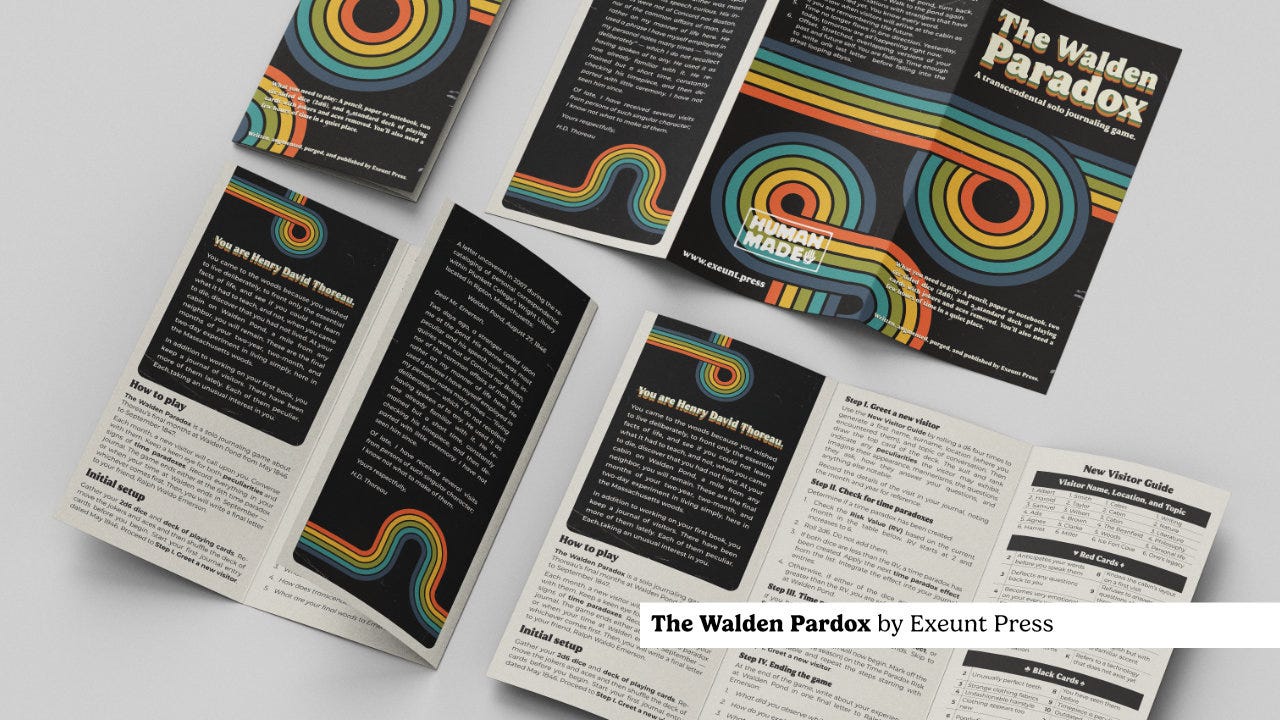
You are Henry David Thoreau. It’s 1846 and you are living simply and deliberately at the cabin you built at Walden Pond. Visitors keep showing up, however, who seem overly interested in your personal details. While you came to observe nature, you are the one being observed like an exhibit in a zoo as time itself begins to unravel.
Like Eleventh Beast and Exclusion Zone Botanist, which began as one-page games, I wanted The Walden Paradox to have a tight, clear core game loop. Each cycle you greet a new visitor, check for time paradoxes, and update your journal.
My hope is that The Walden Paradox evokes the same feeling as watching an old episode of The Twilight Zone or reading a story in Weird Tales: the slow realization of a more subtle kind of horror.
2. Wizard Fuel Duel
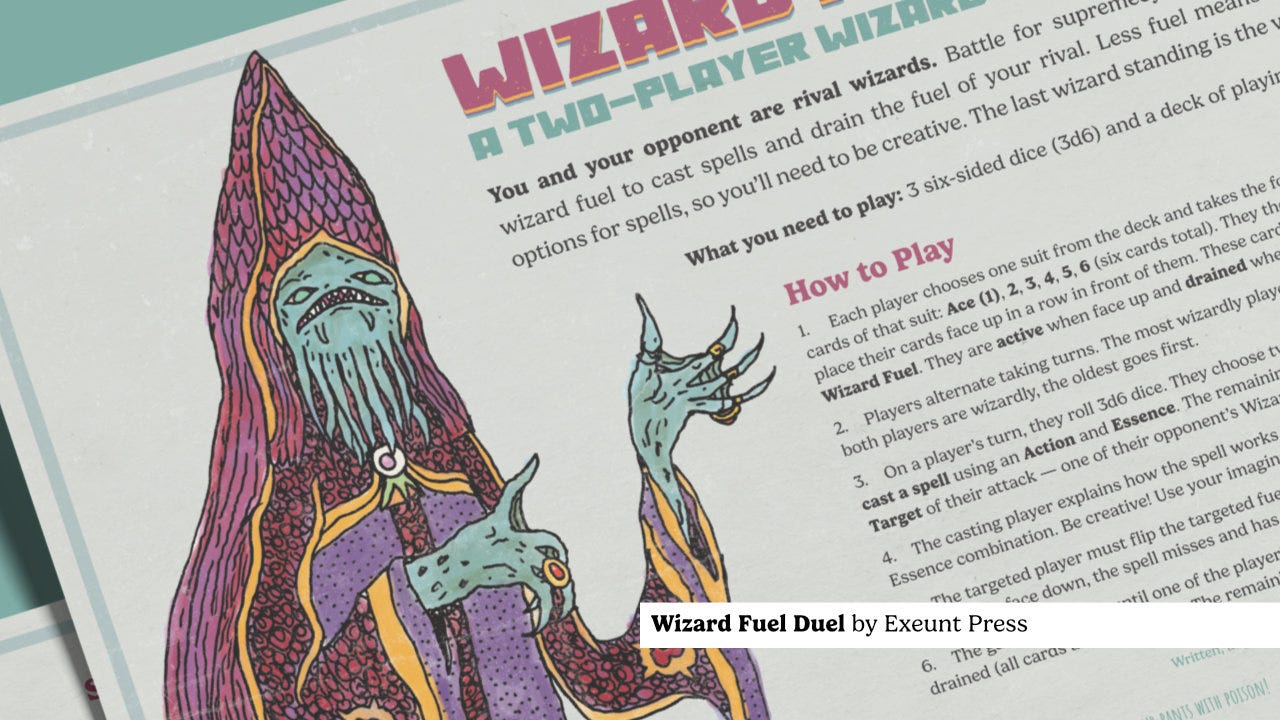
During a recent run I got the phrase “fuel duel” stuck in my head. That somehow turned into Wizard Fuel Duel, a very silly two-player wizard battle game. And thus was born my second jam entry.
Although I usually prefer increasing decision spaces, Wizard Fuel Duel uses ever-shrinking ones. Each player begins with 6 face-up cards in front of them, representing their wizard fuel and ability to cast spells. You then take turns rolling 3d6, choosing two dice to be the Action and Essence of your attack and the remaining die to be your rival’s card that you are targeting. Drain your opponent’s ace card and they can no longer use the Summon action or the Undead essence.
We had fun during the playtest with this one as you eventually are forced into combinations such as Ignite Animal (“I pull a frog from my pocket. It bursts into flames as I throw it at you!”) and Infuse Object (“I fill your pants with poison.”).2
3. SELVES
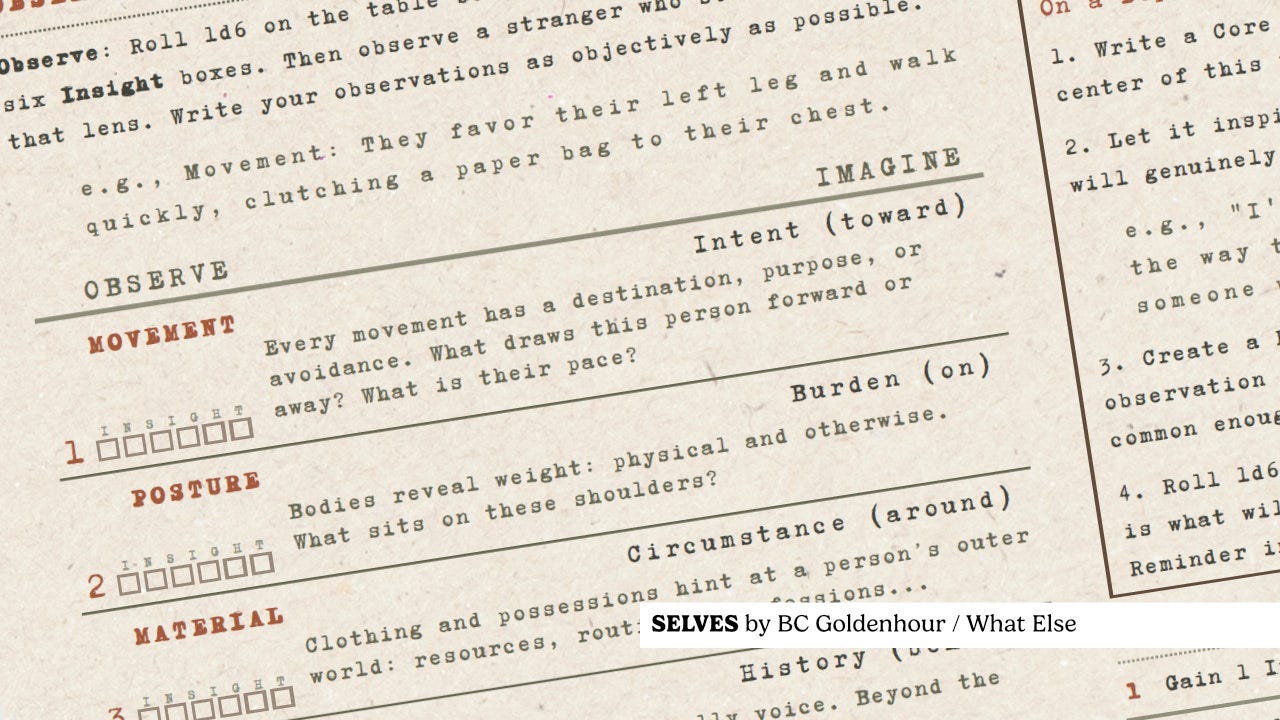
I love games that blend real world aspects into the world of the game. SELVES is “a deeply human field journal RPG” by What Else that does just that. It’s a game about people watching that can be done anywhere you might be able to “observe respectfully.”3
You’ll observe one of 1d6 aspects of the stranger: Movement, Posture, Material, Mark, Expression, or Habit. This part is objective and based on what you can directly observe. Then you’ll use a depth crawl mechanism to imagine a story about them, eventually creating a core truth and a reminder for the future (outside of the game).
4. Creature Comforts
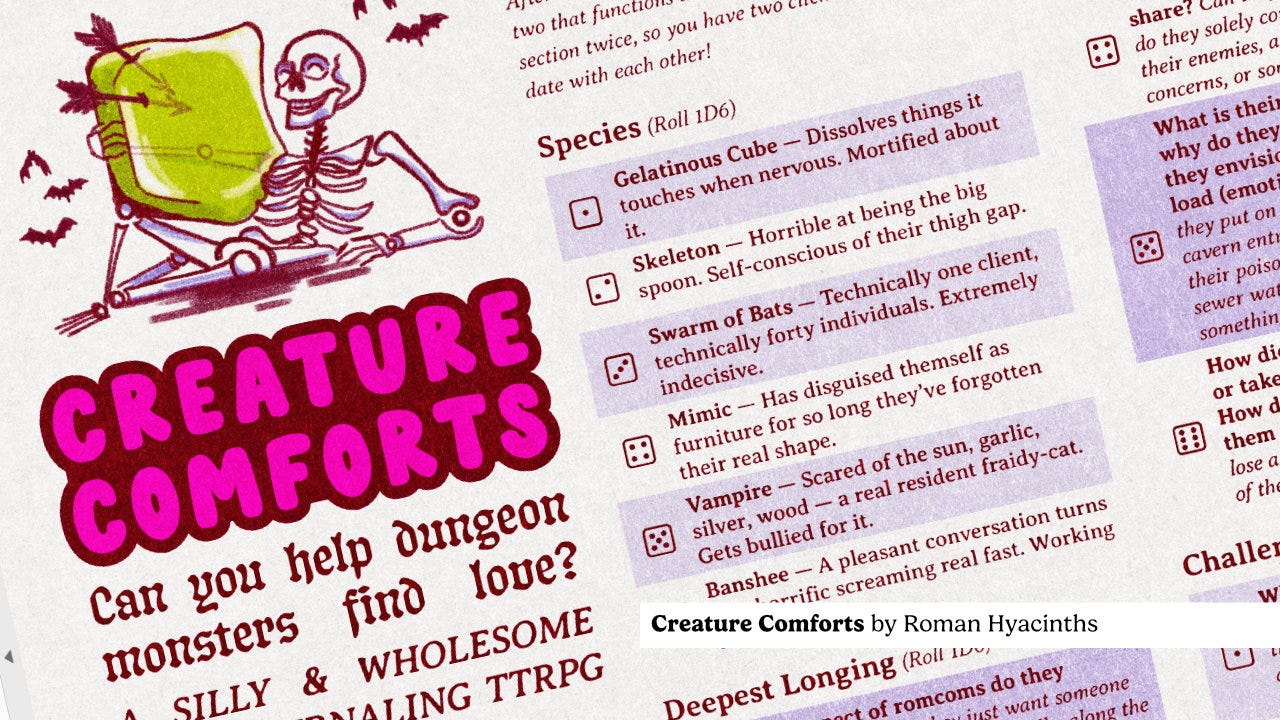
Can you help dungeon monsters find love? In Creature Comforts by Roman Hyacinth, you are a dungeon matchmaker “specializing in the misunderstood.” You’ll meet a new client (with longings and insecurities), set them up on a date, and see how it goes.
It’s a good example of how a game with little (or no) player agency can make you feel something and create a fun gaming experience. I’ve discussed before how not all games need player agency (in the mechanical sense).
I’m just rolling dice, but I am emotionally invested in my blundering skeleton who always dreamed of living with a partner. How did their first date (in the treasure vault) go with a gelatinous cube who’s worried about their food allergy?!
5. FRINK!
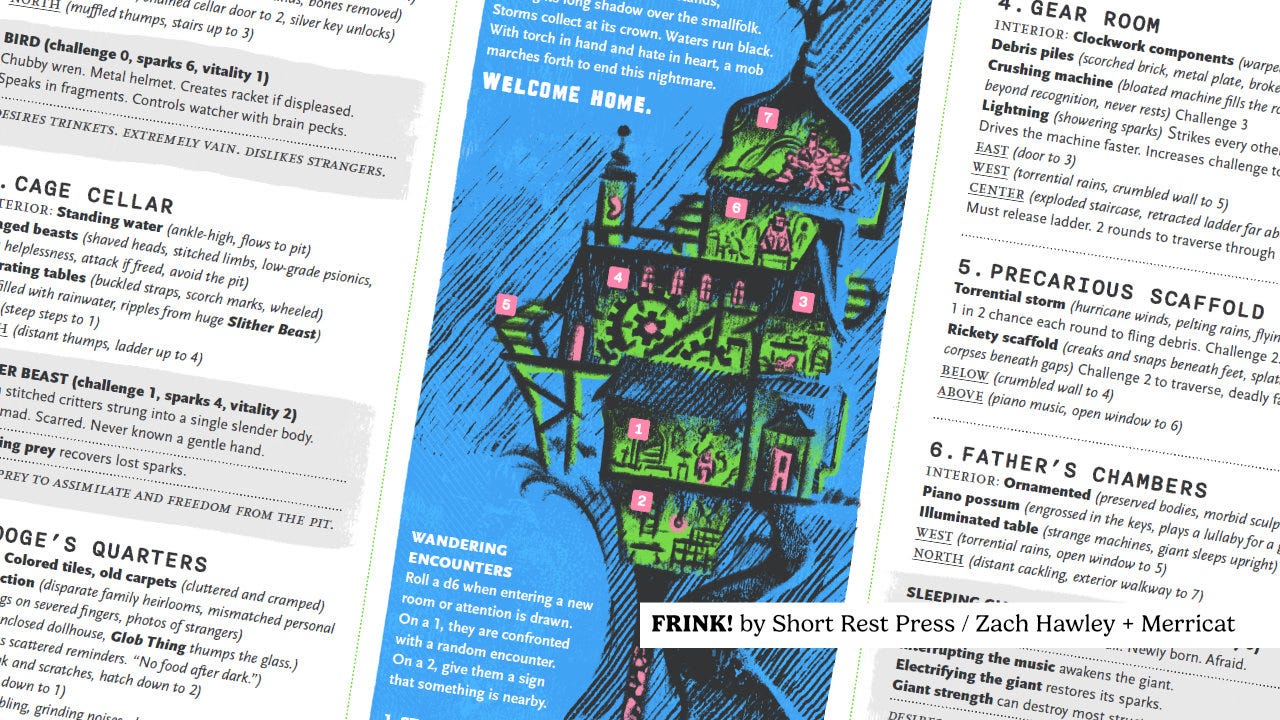
You are a FRINK! — a monster made of parts and pieces. Each player is one of those pieces, such as an arm, leg, or head.4 The head issues commands to the body, which may or may not follow the orders. The system of tests, challenges, and attacks is all based on d6 dice pools with advantage/disadvantage.
The included “Homecoming” adventure has 7 areas packed with weird and evocative details, all laid out in a format reminiscent of the “Rotblack Sludge” adventure in the MÖRK BORG core rulebook. Descriptions are terse and keywords are bolded. There’s even a list of D6 Wandering Encounters.
The One-Page RPG Jam always has a lot of solo journaling game submissions because they naturally lend themselves to the constrained format. This year also has quite a few duel (or duet) games that support two players. FRINK! is, however, a stand-alone TTRPG with resolution mechanisms and a fully stocked dungeon. It’s a good example of how an entire game can fit into a one-page trifold brochure.
6. I Got Reincarnated in a Magical World and Must Use my Art Skills, Empathy, and this Box of Old Magazines to Convince People I’m a Witch!
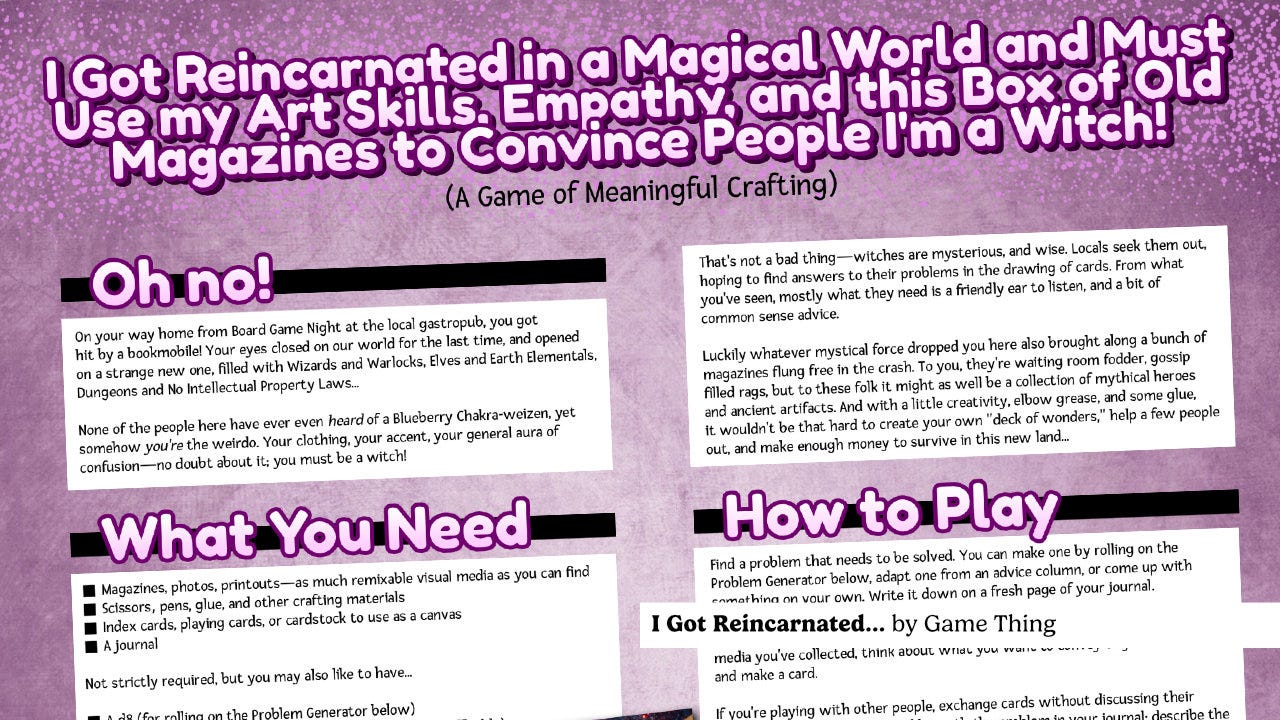
In I Got Reincarnated… (with charming isekai-style title), you’ll be cutting up old magazines and photos and creating cards with scissors, glue, and other crafting materials — not unlike Jerry’s deck of cards.
After an unfortunate bookmobile accident, you are transported to a world of elves and magic. You are now a witch, and you’ll need to start acting like one. Roll dice on the D8 Problem Generator and craft a card to solve their problem. At the end, you’ll use the cards to tell the Queen of the Land what will happen in the future.
I love how the artifacts of play are the point in this game, and the mechanisms are the way to facilitate that.
Conclusion
Some things to think about:
Many kinds of one-page RPGs: I appreciate that Unknown Dungeon’s One-Page RPG Jam doesn’t get hung up on strict definitions. All sorts of games are submitted that blur the line between board game and TTRPG. There are traditional RPGs with a GM, solo journaling games, drawing games, collaborative storytelling, combat, exploration, and other more mechanical games. It’s the wide variety of submissions that I find so compelling about the jam.
Practice analyzing games: I chose the games above because they each demonstrate some aspect of game design.5 Taking a moment to look hard at a game, to think about the core game loop, and to find one really interesting bit is a skill that can be practiced and developed. After a while, it becomes hard not to do it!
There’s still time to make your own: By the time you are reading this, there are probably about 10-12 days left to make your own one-page RPG to submit to the jam. I’ve posted a big list of resources to help you do that, including sources for free public domain art. I strongly encourage you to give it a try!
Did you make a one-page game for this year’s jam? Are you working on one with one eye on the looming deadline? I want to hear about it! Please share/promote your one-page game in the comments. Give us the pitch and include a link. (Note: This is for the 2026 jam only!)
— E.P. 💀
P.S. Get We are Mushrooms (Print + PDF) in the shop! Be the mushroom you’ve always wanted to be. Skeleton Code Machine readers can use code IMAFUNGI for 10% off your order. Offer expires August 7, 2026. 🍄
Skeleton Code Machine is a production of Exeunt Press. All previous posts are in the Archive on the web. Subscribe to TUMULUS to get more design inspiration. If you want to see what else is happening at Exeunt Press, check out the Exeunt Omnes newsletter.
Skeleton Code Machine and TUMULUS are written, augmented, purged, and published by Exeunt Press. No part of this publication may be reproduced in any form without permission. TUMULUS and Skeleton Code Machine are Copyright 2025 Exeunt Press.
For comments or questions: games@exeunt.press
There are certain to be more games submitted before the end of the jam and after this article is published. This is not intended to be a list of the “best” one-page RPGs, as if such a list could even be compiled based on the different kinds of fun. Instead, this is simply some of the ones that caught my eye as being particularly interesting.
No frogs were harmed in the making of or playing of Wizard Fuel Duel.
The game recommends “café windows, platforms, waiting rooms, & park benches.”
Well, yes, I also included two of my own games. This is to be expected, but I also think that they really do illustrate some design aspects. The Walden Paradox takes a historical theme and mixes it with an unexpected time travel element, using dice to create some end-game tension. Wizard Fuel Duel is my first attempt at a “competitive” TTRPG where the players are using their imagination and roleplaying to augment the mechanical bits. There are free community copies for both games, so please claim them!
I just submitted my second game to the jam: Play as a melting Greenland glacier caring for a struggling polar bear in "It's a warm day in the arctic and you are a Greenland glacier", my solo TTRPG of arctic ecology that is part journaling game, part dice-management game.
🧊❤️
https://sleepy-badger-games.itch.io/its-a-warm-day-in-the-arctic-and-you-are-a-greenland-glacier
I made a social deduction game called Ace of Shades that I'm really pleased with!
You and your friends are performing a heist whilst simultaneously trying to show off for your mentor, but among your number is an Ace who is secretly attempting to sabotage the operation.
The mechanics are fairly simple: you each play a card and whoever plays the highest wins the attention of your mentor. But if the combined value of your cards exceed the level of discretion you must maintain, the guards grow suspicious and the Ace draws one step closer to foiling your plans...
There's a really fun tension in having to simultaneously work with and against one another that I'm delighted with, one that I feel feeds well into the storytelling. You can find the game here if you're interested: https://gus-the-gamesmith.itch.io/ace-of-shades
I'm very proud of the layout on this one - I was inspired by your previous entries to the Jam, and wanted to make something that was both legible and nice to look at. So thank you for all of the examples and resources that you've shared here!