
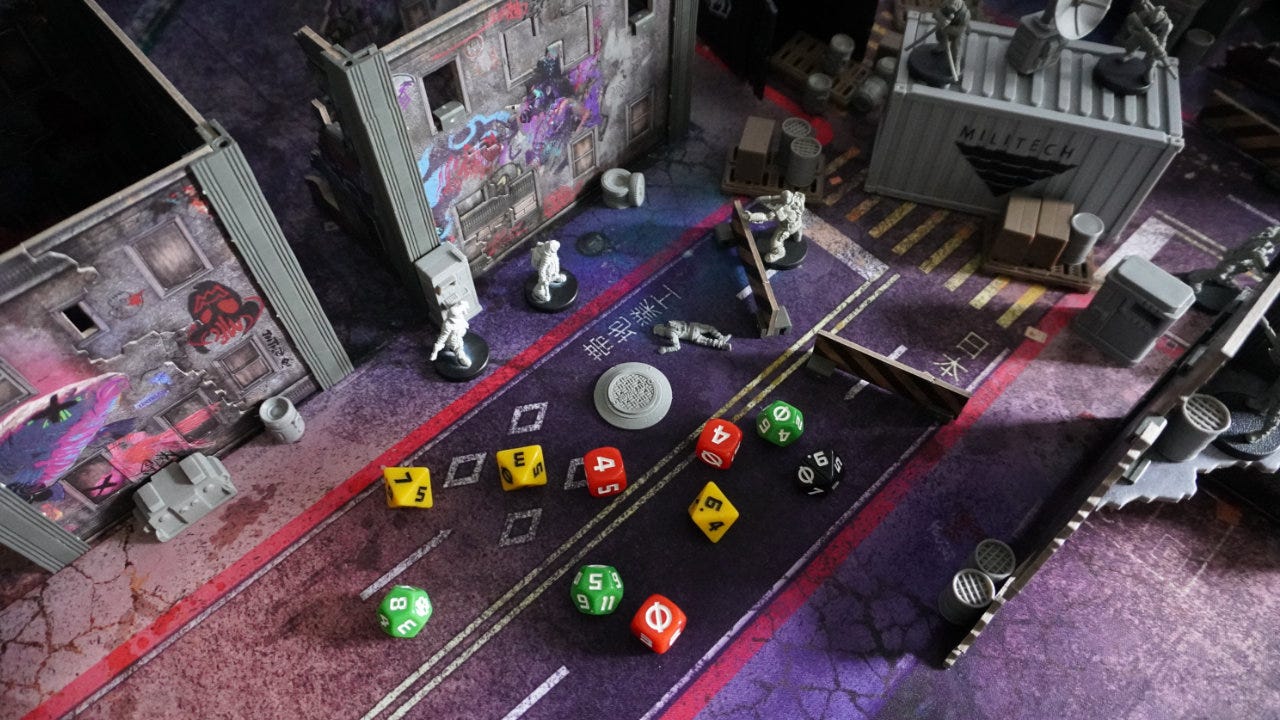
We’ve recently looked at simplifying mob combat and a bee-based resource system. This week we are looking at how Cyberpunk Red: Combat Zone uses a unique combined action and health system.
Cyberpunk Red and the Combat Zone
If you aren’t familiar with the Cyberpunk TTRPG franchise, this can be rather confusing. So let’s start with a quick refresher on how the various media are related.
Cyberpunk Red (2020) is the fourth edition of the Cyberpunk tabletop roleplaying game designed by Mike Pondsmith. The first edition was simply called Cyberpunk and was published in 1988. The franchise has been around for quite a while and gone through multiple iterations.
At its core, the Cyberpunk is a gritty, cyberpunk setting focused on heists, combat, megacorps, hacking (netrunning), and the impact of cyberware on humanity.1 The Cyberpunk 2077 video game and the Netflix Cyberpunk: Edgerunners animated series have made the setting widely popular, well beyond the TTRPG.
Cyberpunk Red: Combat Zone (CZ) is the tabletop miniature wargame (skirmish game) version of Cyberpunk Red, released in 2023 in collaboration with R. Talsorian Games and Monster Fight Club.
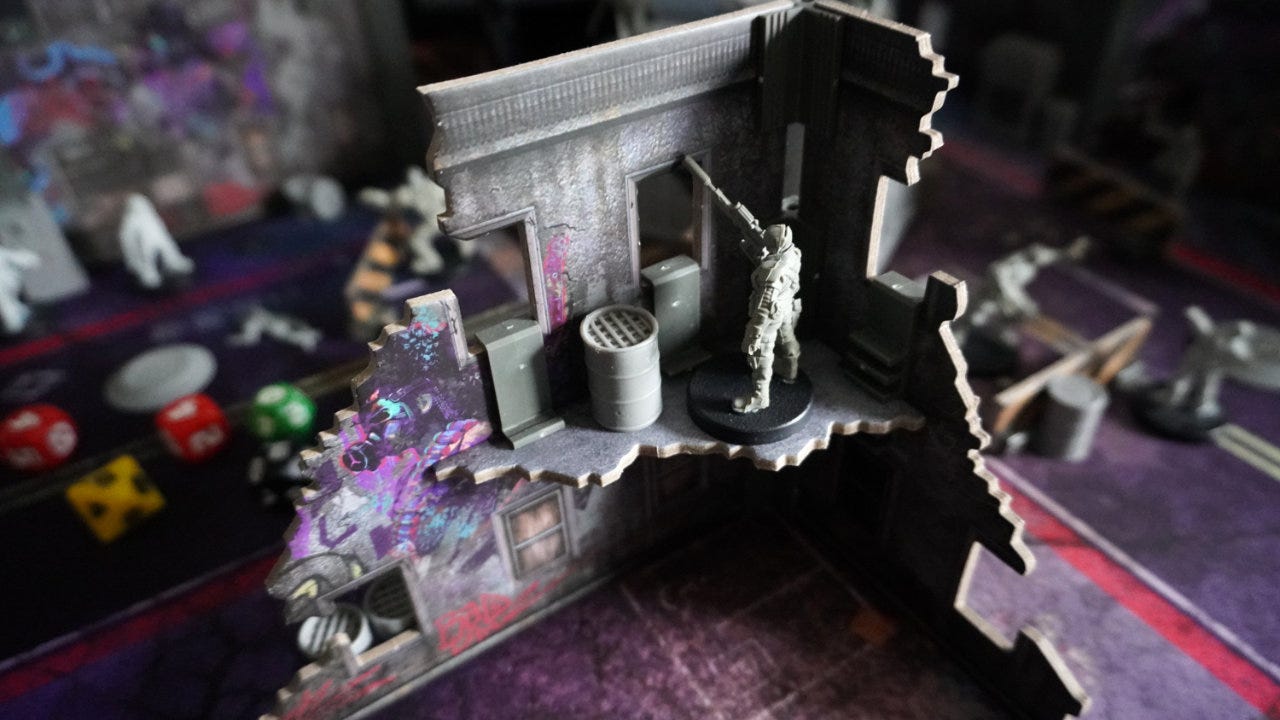
In CZ, players take control of rival gangs battling in streets of Night City. Some of the available gangs (factions) will be familiar if you’ve played Cyberpunk 2077. Maelstrom and the Tyger Claws are included in the core box. Expansions allow you to run as Lawmen, Zoners, Arasaka, the Danger Gals, or other gangs.
Mechanically, the game uses Monster Fight Club’s [RE]action System, which uses three different colors of dice that link to the three colors of actions available for each character. I’m no skirmish or miniature combat expert, but I found the system to be really interesting. The special part to me is how the character’s actions and “hit points” are melded into a single system.2
But first, we need to look at how characters are structured in the game.
CZ characters
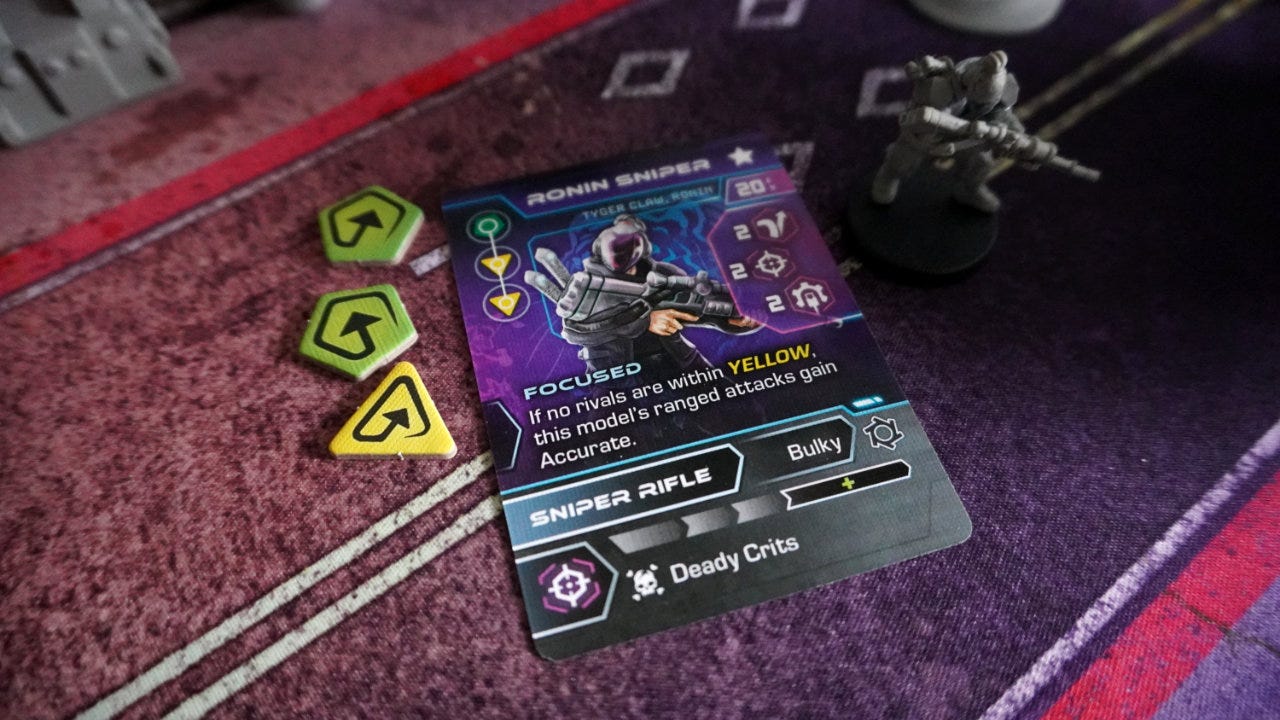
At the start of a CZ game, each player uses a point-buy system to create their gang. Each faction has a stack of character cards to choose from, as well as gear and netrunner apps that can be attached to each one. Everything has a cost. You might have 150 EB to spend on your team with a character costing between 15-25 EB plus their gear cost. In total, each side might field 4-7 characters in a typical game.
Characters have a name, cost, skill bonuses, possibly a special ability, and sometimes some built-in gear. For example, Arasaka’s Technical Specialist (15 EB) is a netrunner with a +2 Tech skill, 1 point of armor, and has a piece of gear called a Neural Reprogrammer. The card art matches the miniature (model) that is used in the game.
Importantly, each character card also has actions listed down the left side.
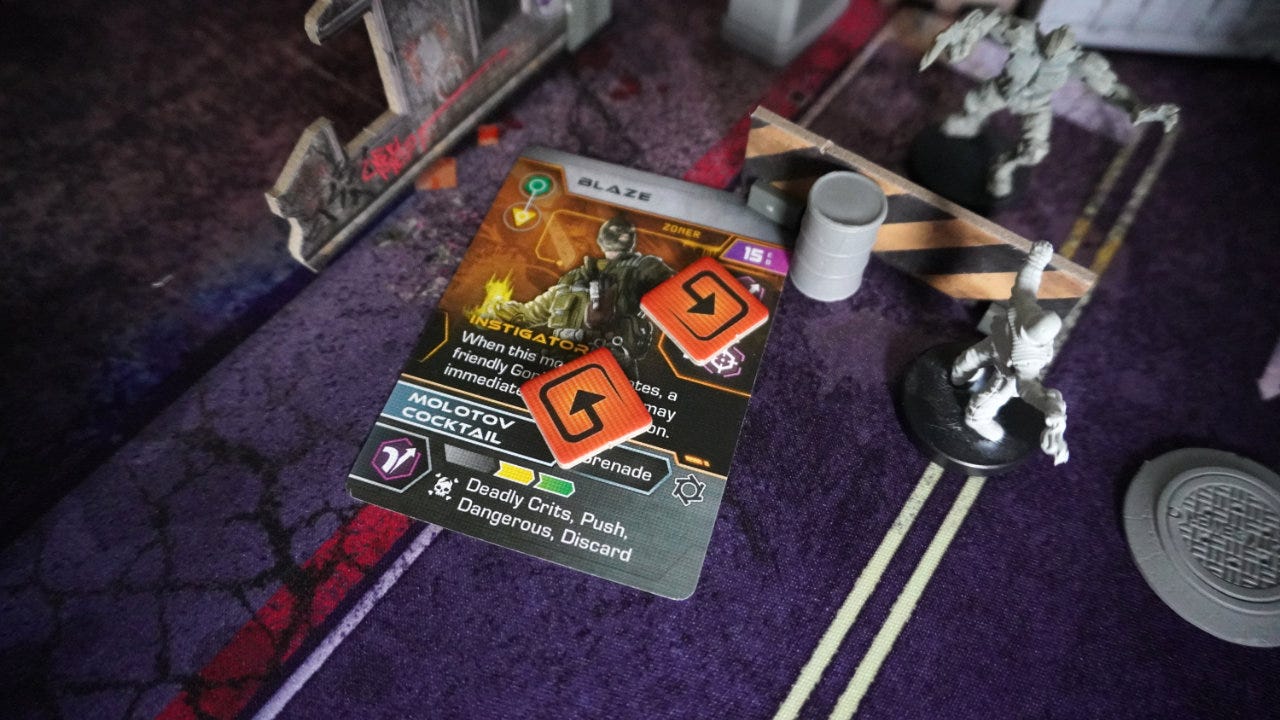
Blaze from the Zoners gang has two actions available — one green action and one yellow action.3 Note that in the photo above, he’s shown with two (red) wounds and out of the game.
Players take turns activating characters. When the Zoner side activates Blaze, he will get up to two actions during that activation. These actions can be to move, attack, heal, or use some form of tech. The die that is used for the action is tied to the color for that action — each being a different-sized die:
Green = d12
Yellow = d8
Red = d6
In general, green dice (d12) are better than yellow (d8) which are better than red (d6). Each die has one fumble (automatic fail) side and one crit (automatic success) side.
Rolls are always opposed, meaning that each side will roll a die.4 If Blaze shoots at a foe (i.e. ranged attack) using his green action, he rolls a green die. The defending foe chooses one of their actions and rolls the matching color die. The higher roll wins.5 If Blaze’s roll is higher than the defender’s roll, the defender takes a wound.
Characters in CZ do not have hit points. Instead, wounds cause their actions to be degraded. Unsuccessfully defending with a green action turns that green action into a red action. That action is now a worse die and stays that way unless healed.
Actions as hit points
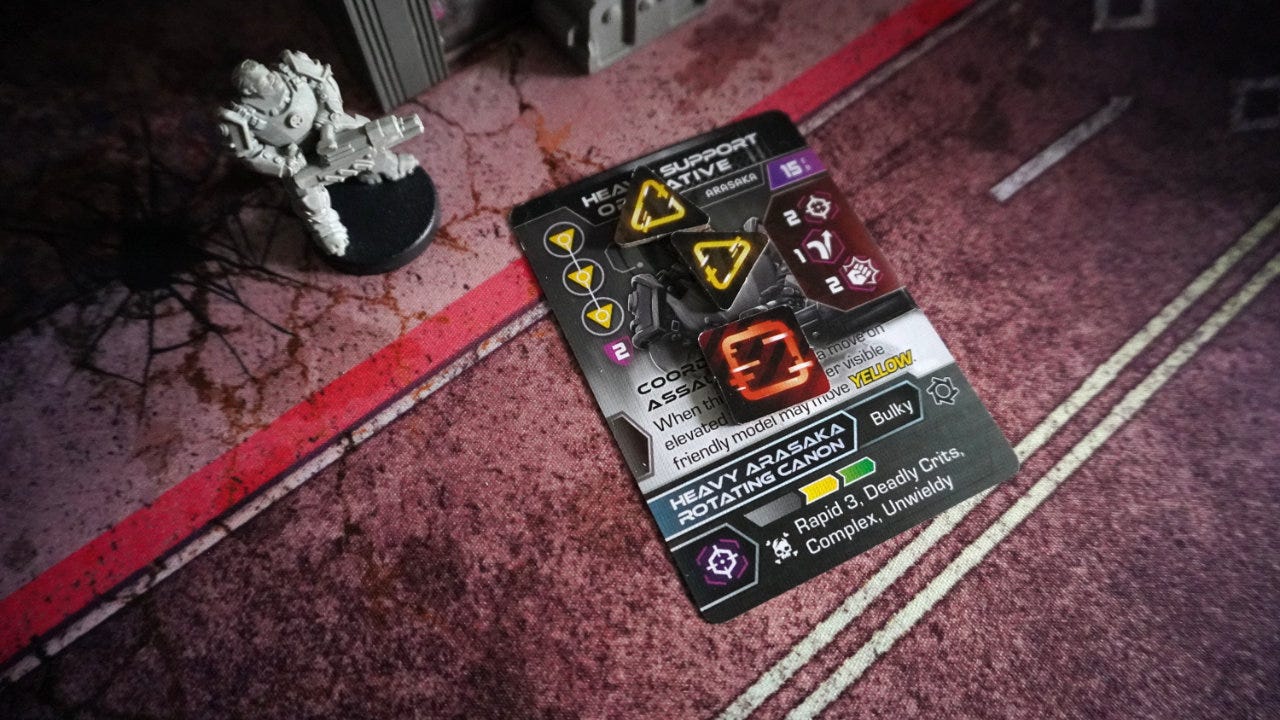
After a play or two of CZ, it becomes shockingly clear that the game is all about the action economy. Each time you take an action, you flip that action token to show it has been spent. Characters can’t do anything if all of their actions are spent, which can be devastating if not carefully planned. You’ll need to take an full-turn refresh (called “Inspire”) to flip all of your gang’s action tokens back to face-up ready.
So it makes sense that a character with four actions is better than one with two. They can do twice as much before needing a refresh.
More than that, however, those actions act as hit points. The character with four actions can take three wounds and still be in the game. The fourth wound takes them out.6
Additionally, the wounds cause the character to become less effective.7 Regardless of its starting color (green or yellow), taking a wound causes an action to immediately become a red action. This creates a potentially tough choice when defending against an attack: Do you defend with your green action (d12) because you have a better chance of success, but also a more painful wound? Or do you defend with yellow (d8), which gives you a worse chance of success, but is also less costly?
It’s an elegant little mechanical system. There’s no hit point tracking. Thematically, the wounds feel impactful. It also creates some interesting choices along the way.
Gonks vs. characters
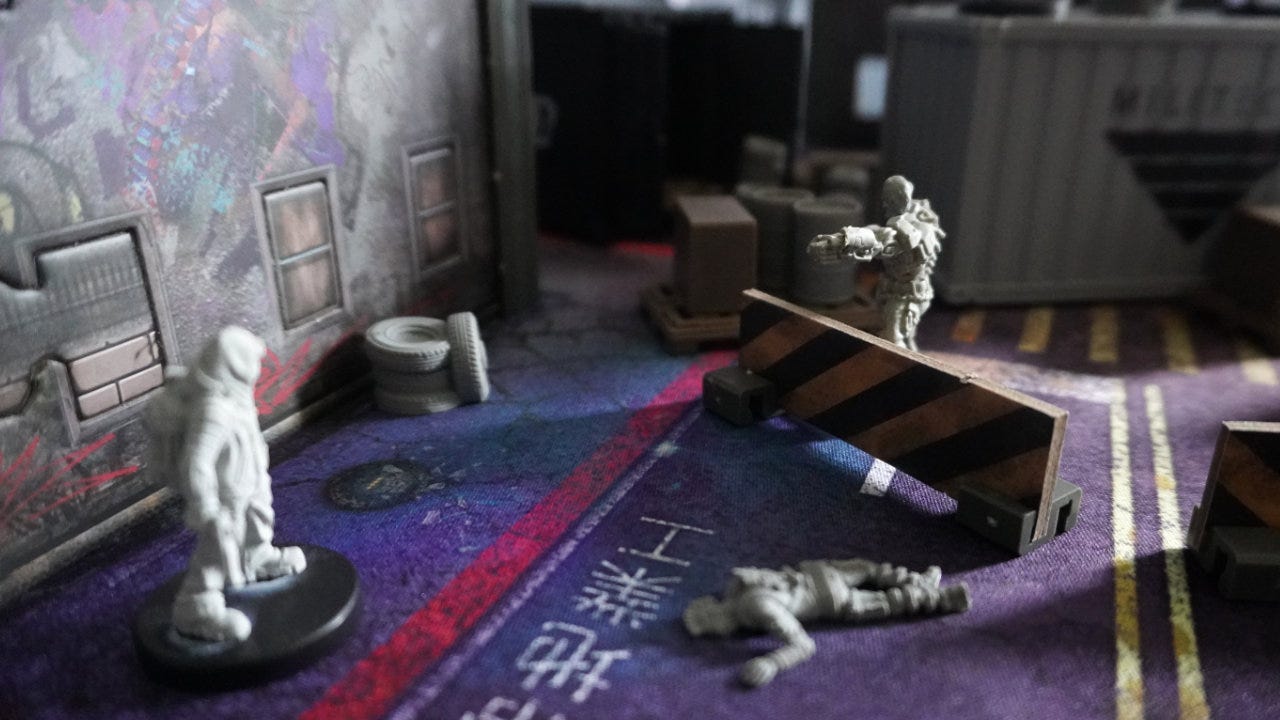
This is a bit of a diversion, but I think it’s worth mentioning the gonk system in CZ.
Gonks don’t count as characters in the game, even though they have models out on the field and can take actions like characters. They get a single yellow action and usually lack any special abilities. That single action means that just one wound takes them out of the game.
You also can’t directly activate a gonk like you would a character. Instead, when you choose to Inspire as your turn (i.e. refresh all the actions on your characters), you can activate all of your gonks. This prevents the dreaded “I refresh” turn that can appear in some tabletop games, where the player really doesn’t get to do anything on their turn. With gonks on the table, you at least get to move some weak units and do something rather than nothing.
It feels like a good solution to keep the game interesting on every turn.
Conclusion
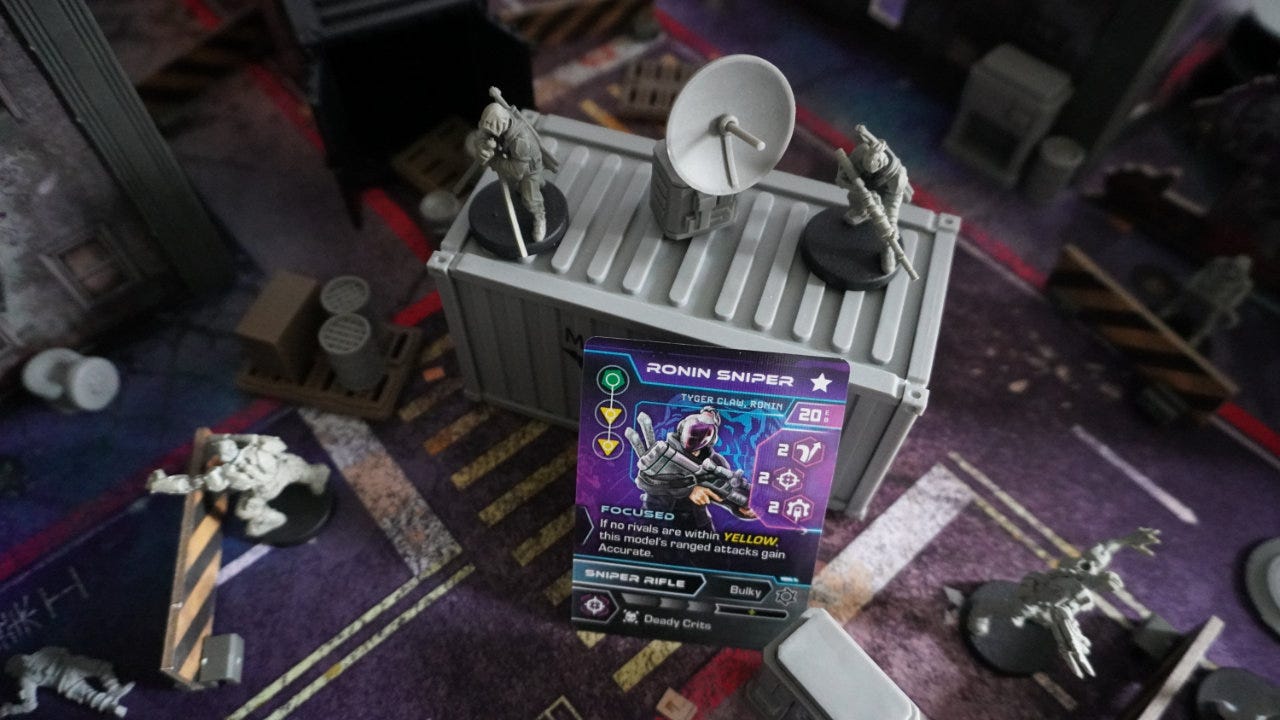
Some things to think about:
Miniature skirmish games: I find skirmish games to be fascinating. They are (to me) so much work to get the models ready, build the terrain, set it all up, and then somehow get it all back into the box. And yet, every time I’ve played one, I’ve had a blast! I’d love to do it more, but it’s not easy.8
Cyberpunk Red: I find that many people have no idea that the Cyberpunk 2077 game and the Cyberpunk: Edgerunners show are based on a TTRPG.9 The setting has been around for so long and has so much depth at this point. If you love the cyberpunk genre, it’s worth checking out.
Keep it simple: I would imagine most designers would assume wounds should be tracked separately for each character in a skirmish game, either as hit points directly or some proxy version of hit points. Combining wound tracking with the actions keeps it all tightly bound and simple.
What do you think? Have you played other games where the character’s actions are also their hit points?
— E.P. 💀
P.S. Give the gift of Tumulus this holiday season! 🩻
Skeleton Code Machine is a production of Exeunt Press. All previous posts are in the Archive on the web. Subscribe to TUMULUS to get more design inspiration. If you want to see what else is happening at Exeunt Press, check out the Exeunt Omnes newsletter.
Skeleton Code Machine and TUMULUS are written, augmented, purged, and published by Exeunt Press. No part of this publication may be reproduced in any form without permission. TUMULUS and Skeleton Code Machine are Copyright 2026 Exeunt Press.
For comments or questions: games@exeunt.press
It’s actually a lot more complicated than this. It touches on themes of social inequality and what it means to be a human — far more than I could cover or convey in this article.
I’m putting “hit points” in quotes here because CZ characters don’t have hit points. That’s sort of the whole point of this article, so you’ll want to keep reading. ;)
What Blaze lacks in actions, he makes up for in special abilities. Being able to activate another model for free during his activation is huge, as the game is largely about action economy. In addition, he has a built in (single-use) Molotov Cocktail that has deadly crits.
There’s also a black die included for actions that aren’t opposed by the other player’s gang. For example, moving over an obstacle or climbing terrain.
Higher roll plus any modifiers and skill bonuses technically. This is not a full rules explanation for the game.
If a character ever has a all red actions or they ever unsuccessfully defend with a red action, they are “red-lined” and out of the game.
Hellboy: The Board Game has a similar system. As agents take wounds, they will eventually sustain an injury. The injury downgrades the dice they roll and reduces the total number of dice rolled when taking actions.
I didn’t forget about Skirmish Week. So many readers wrote in with their picks for what games I should cover, but it turned into a very large project. Trying the games is no small task, but I do still want to do this at some point.
The Cyberpunk 2077 TCG looks interesting too. I’m hoping to check it out at PAXU.