
Quick update before we get started. Tumulus 07 “Slay the dragon.” has arrived from the printer and will be shipping out soon. If you are a subscriber, watch for a shipping notification in the next week or so. A limited number of Tumulus 06 “Hammer a nail in the coffin” copies are now available as back issues. Grab one before they are gone.
And now, let’s collect food, adopt some stray cats, and maybe dress them in adorable frog costumes. Cat Lady by Josh Wood will teach us why bundling options creates interesting decisions for players.
Cat Lady
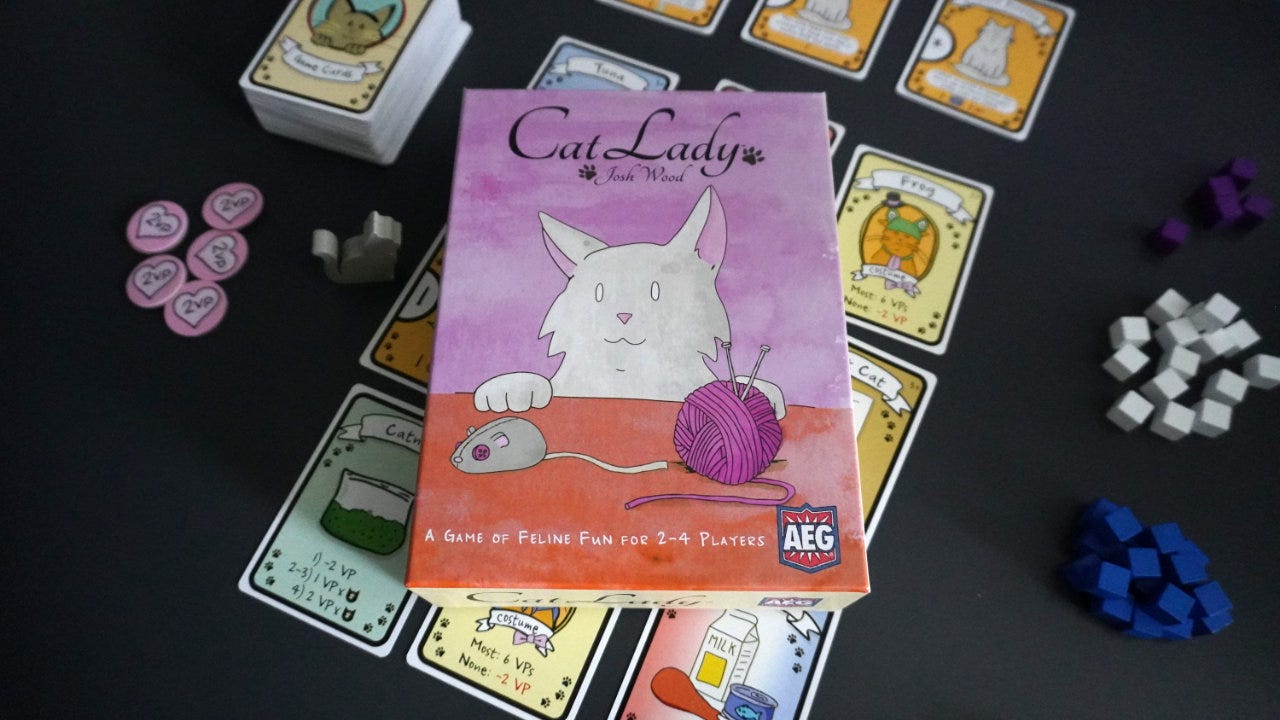
In Cat Lady (Wood, 2017), you are a cat lady. This makes you (as the game points out) part of “an elite group of people including Marie Antoinette and Ernest Hemingway.”1
It is a card drafting and set collection game. The main market (card display) is always 9 cards arranged in a 3x3 grid. Cards consist of food (chicken, tuna, and milk), costumes, catnip, toys, lost cats, and spray bottles. There is also a secondary market of 3 stray cats.
Players take turns drafting cards from the grid until an empty row or column needs to be refilled and there are no cards remaining in the deck.
At the end of the game, all cards are added up.
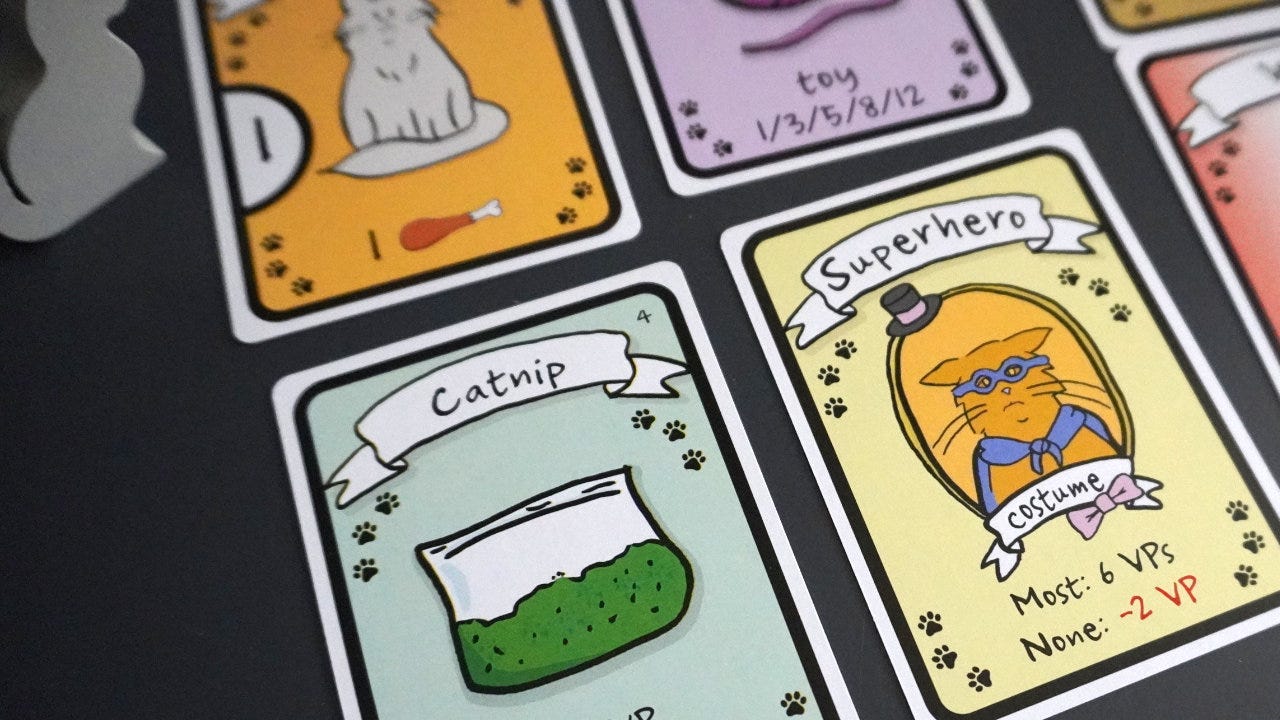
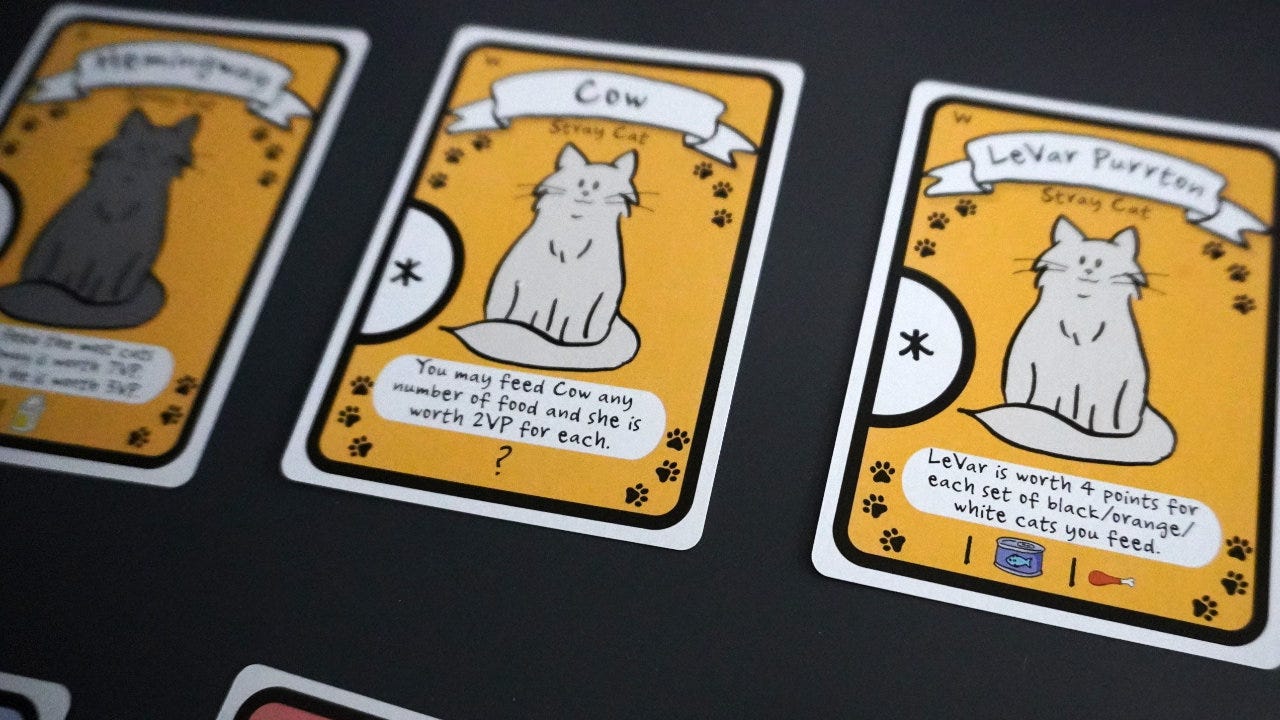
Cat cards must be fed the food specified on their cards (e.g. Bronte requires 2 tuna). If you’ve adopted a cat that can’t be fed, you lose 2 VP for each unfed cat.
The player with the most costume cards gains 6 VP and those who do not have at least one costume card lose 2 VP. Catnip cards award extra VP for fully fed cats, but only if you have more than 1 catnip card. Toy cards award points based on how many different toys you have.
After all of this is calculated, the player with the most VP wins.2
Grid-based drafting system
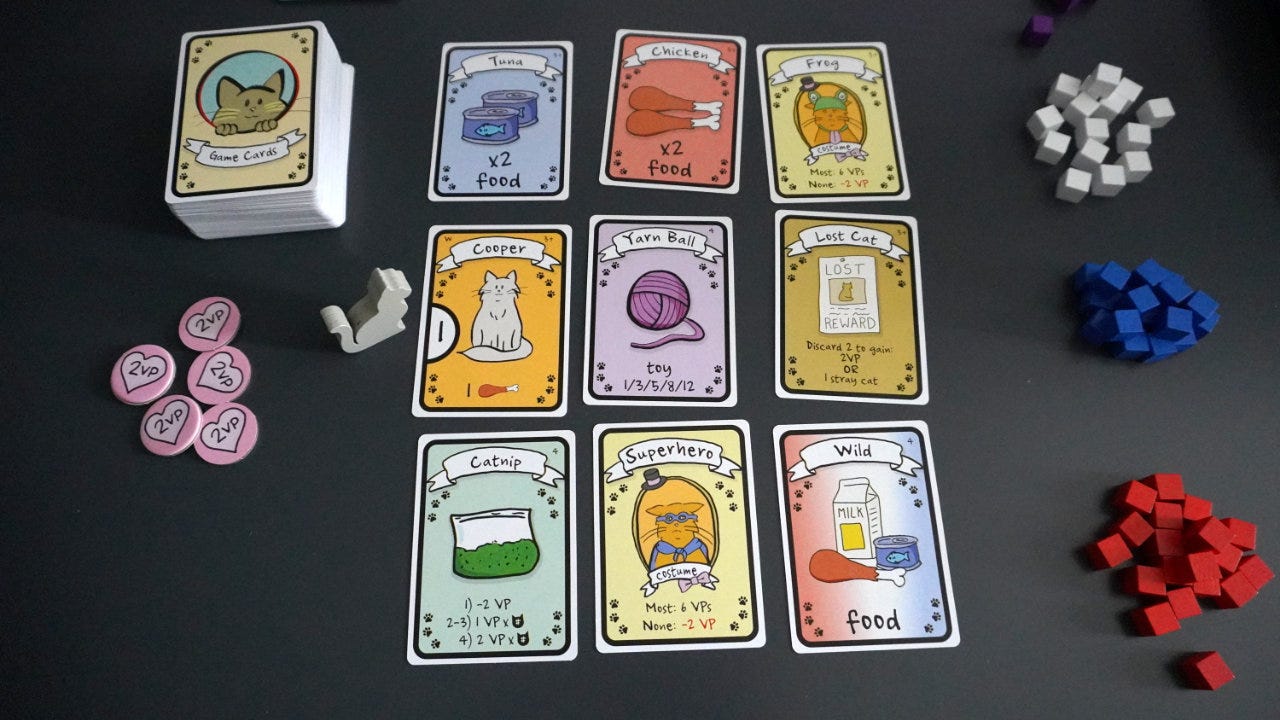
It’s the 3x3 grid-based drafting system that I think we can learn from the most in Cat Lady. It uses an exceptionally simple system to create interesting choices:
You must take an entire row or column of three cards on your turn.
You may not take the row or column that currently has the cat token.
At the end of your turn, place the cat next to the row/column you just took.
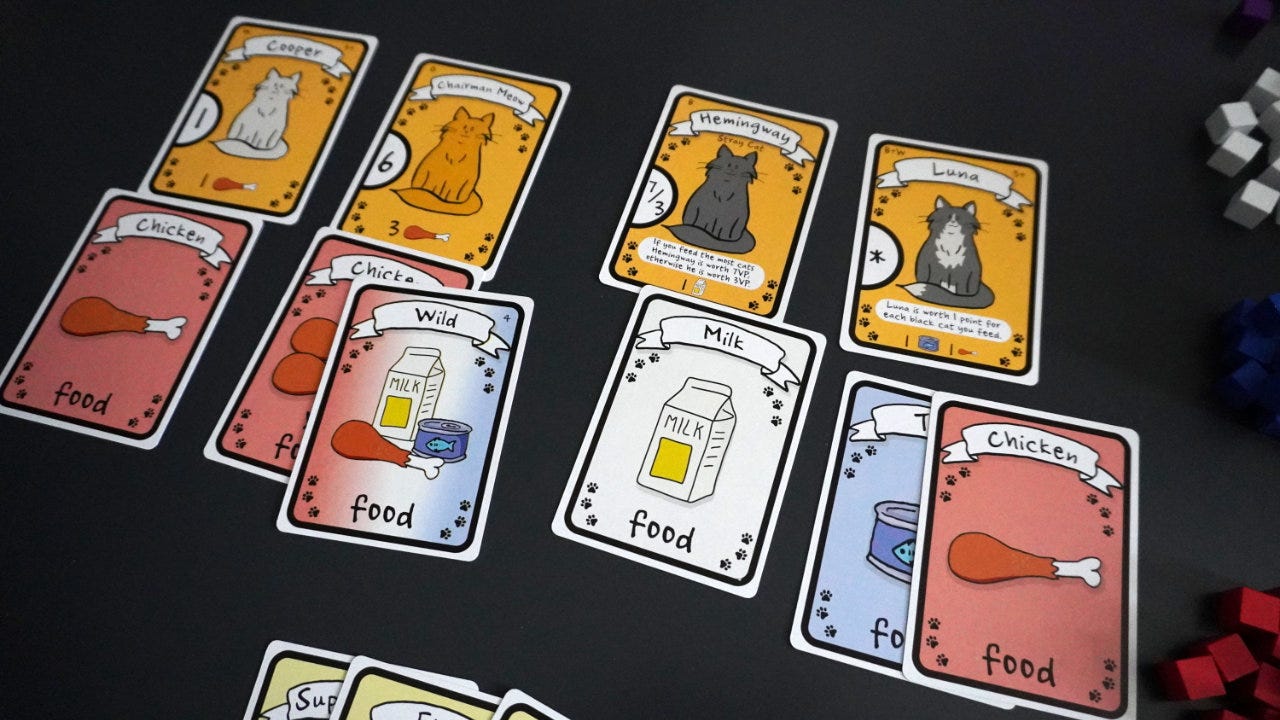
In the photo above, for example, you could draft the Tuna, Chicken, Frog Costume from the top row or the Tuna, Cooper, Catnip from the first column. You could not, however, draft the Cooper, Yarn Ball, Lost Cat from the second row because the cat token is currently blocking it. After selecting a row or column, you’d move the cat token so the next player couldn’t select the same row or column you just did.3
The decision space for any player during their turn is small. There are 3 rows and 3 columns and one is always blocked by the cat — 5 total options.
It’s a solid system that prevents grabbing the same row or column twice, but what makes it a tough decision is the bundling of options.
You can never take just one card. You get three cards whether you want them or not.
Just one more cat… oh no.
You are choosing a package of items on your turn, not just a single card. Each bundle may contain cards with positive value, some with negative, and some that require future actions.
For example, LeVar Purrton requires 1 tuna and 1 chicken to be fed. You could grab the first column in the photo to gain 2 tuna, but you’d also adopt Cooper who will need 1 chicken for himself. You’ll need more food for this new cat. You’d also gain a catnip which is worth negative VP if you don’t get more catnip cards before the game ends.
You could, instead, grab the top row. You’d get 2 tuna and 2 chicken and also a frog costume. That’s good, but having the most leftover food at the end of the game will lose you 2 VP. You’ll need to get some more cats if you take that bundle.
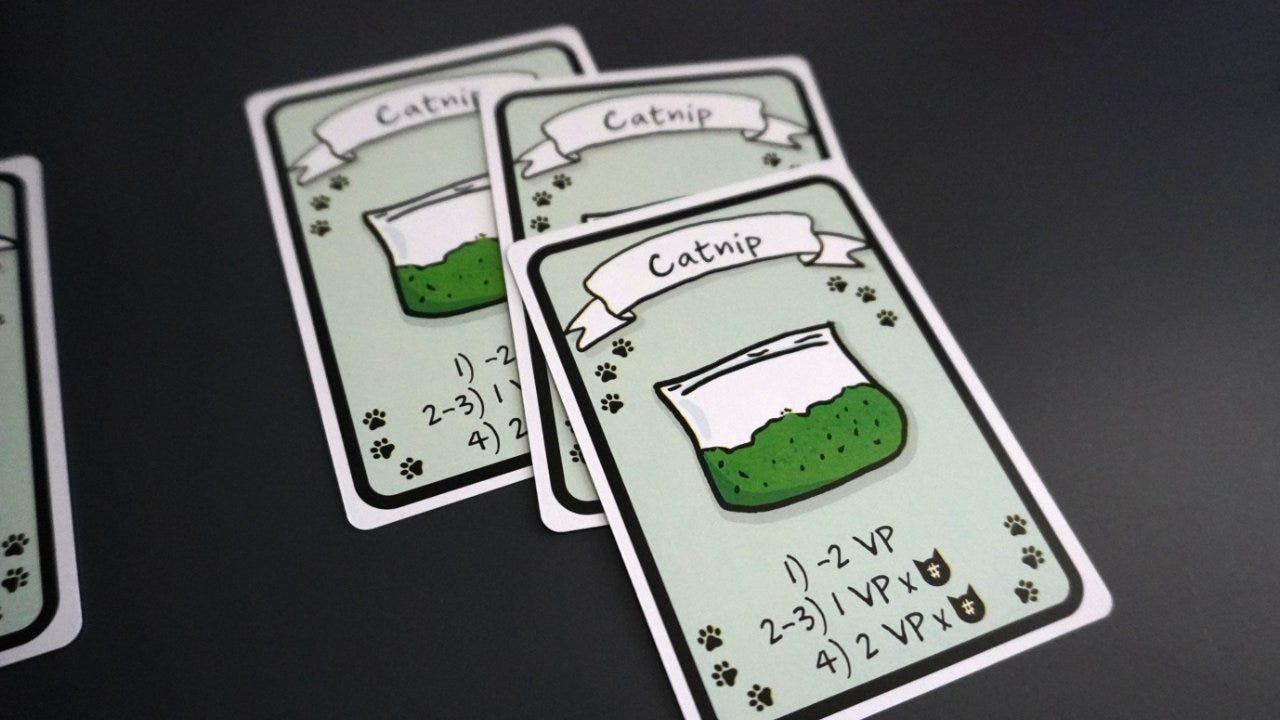
In practice, this game works like a never ending seesaw of cats and food. You don’t have enough food so you draft food cards, but then you have too much food. You pick up a cat, but end up with two and maybe some extra food you don’t need. Now you’ll need more food, which results in more cats, which results in more food. Meanwhile the end of the game is quickly approaching.
You get this, but also that.
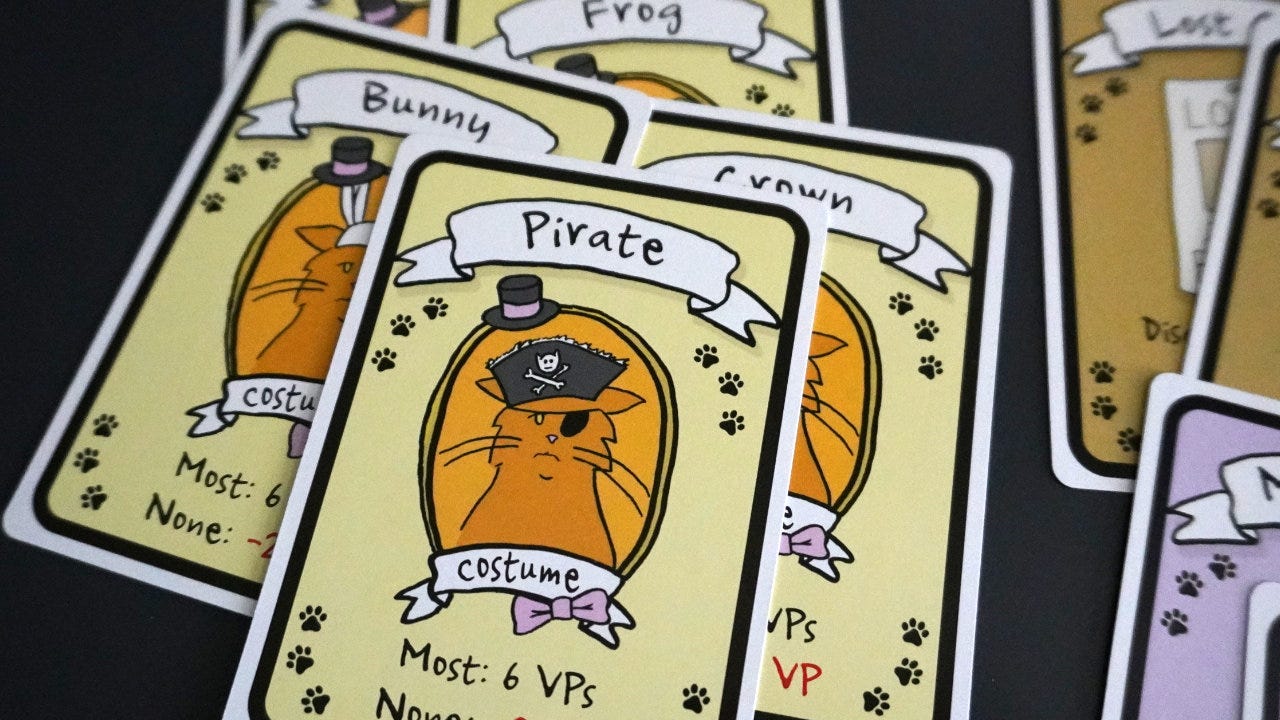
I think what makes Cat Lady special is that you can never get what you want in isolation. You can usually pick up the can of tuna or chicken leg you need. You can often snag a costume or two. Each time you take these items, however, you’ll also get things you don’t want. This avoids a game design where you simply grab the most valuable item. Instead, you must evaluate packages which (as we saw with the fair cake cutting in Pacts) is a frustratingly difficult task at times.
In some ways, I think this an important design concept in TTRPGs as well.
If the party has a selection of simple quests to choose from, they will simply pick the one with the highest value item at the end of it. If the quests are bundles of outcomes, however, it becomes increasingly hard to evaluate them. Once they each have positive, negative, and questionable value tied to them, it is a tough choice indeed.
Perhaps you can accept the quest and retrieve a powerful artifact that will come in handy later, but it will also cause a faction to become hostile. The artifact is the only way to defeat a Big Bad Evil Monster later, but will also result in a curse. Killing the monster will also result in something awful — plague or famine.
The best bundles, in my opinion, are those where you get an immediate benefit (e.g. the can of tuna you need right now) but at a future cost (e.g. one more cat you’ll need to feed before the end of the game).
To put it another way, each quest option needs three outcomes at the same time:
Positive value: Gaining a powerful item, defeating something evil, wealth, fame
Negative value: A curse, a new threat, a major setback, permanent wounds
Debt (future cost): A loan to be paid back, a timebomb that must be defused
This bundling is made explicit (and abstract) in Cat Lady, but can be thematically integrated into TTRPG quests.
Conclusion
Some things to think about:
Constraints not more options: Cat Lady creates interesting choices for players not by adding more and more options, but by constraining the few options given. Only 6 options and 1 is locked out each turn.
Bundle the options: Players can often (though not always) take the card they want or need, but it always comes with cards they don’t want. It’s a very rare draft in the game to get three cards of equal value.
Immediate benefit at future cost: A particularly interesting framing is when players can get exactly what they need right now, but force themselves into VP debt for the future. Picking up two more cats now doesn’t seem bad until the game is about to end and you still need to feed them.
What do you think? Where have you seen bundling of options (e.g. quests, rewards, items, draft choices, etc.) in games?
— E.P. 💀
P.S. Want more in-depth and playable Skeleton Code Machine content? Subscribe to Tumulus and get four quarterly, print-only issues packed with game design inspiration at 33% off list price. Limited back issues available. 🩻
Skeleton Code Machine is a production of Exeunt Press. All previous posts are in the Archive on the web. Subscribe to TUMULUS to get more design inspiration. If you want to see what else is happening at Exeunt Press, check out the Exeunt Omnes newsletter.
Skeleton Code Machine and TUMULUS are written, augmented, purged, and published by Exeunt Press. No part of this publication may be reproduced in any form without permission. TUMULUS and Skeleton Code Machine are Copyright 2025 Exeunt Press.
For comments or questions: games@exeunt.press
One might be slightly suspicious of wanting to be part of this group of people, as neither one had a very pleasant end to their lives.
As always, this is not a full rules explanation. There’s more to the game than is described here. This is just enough to be able to discuss the grid-based drafting system.
The spray bottle cards allow you to move the cat token away from a row or column so players could potentially draft the same one twice in a row. Spray bottle cards otherwise have no value and are not worth VP at the end of the game.
I was just telling someone how much I love the digital version of this game! I play the digital version solo quite a bit because it's quick, cute, a fun little balance puzzle, AND in the digital version you have a little parlor room that fills up with trophies and decor! Every play tracks how many orange cats you feed, how many toys you take, how much catnip you get, etc. and when you fill each achievement, a piece of decor is added to your cat lady parlor room.
Take three to get one...cards....
An old card game rule, this.
To get one benifit but with drawbacks....applible to many other games, indeed!