
Last week we looked at how Reiner Knizia’s simple game of Goal could be adapted for use in other games. This week we are looking at another simple game with a lot of potential: Yahtzee!
Yacht and Yahtzee
Most people agree that Yahtzee is derived from a public domain dice-sequence game called Yacht which dates back to at least 1938. If you’ve ever played Yahtzee, you’ll immediately find Yacht to be familiar:
Roll five six-sided dice (5d6).
Choose which of the dice to keep and which to reroll.
Reroll the dice you want to reroll.
Again, choose dice to keep and reroll.
Reroll the dice you want to reroll.
Score the dice by choosing scoring categories based on values and combinations (e.g. three-of-a-kind, four-of-a-kind, full house, straight, etc.)
Each scoring category may only be used once per game. It is possible to score zero points on your turn. The game ends after 12 rounds and the player with the highest score wins.
Yahtzee is the commercialized and trademarked version originally produced by Milton Bradley which is now part of Hasbro.1 The differences are mostly in how scoring works and the various bonuses awarded.
Generala, Yatzy, and other variants
The history of Yahtzee is fairly complicated with many different variants and similar games. I won’t try to determine which version came first here, but it is worth noting some similar games:
Generala: A game for 2+ players from Latin America. Players roll five dice, decide which to keep, and reroll the others. Maximum of 3 rolls per turn. Players gain points from specific values (1, 2, 3, 4, 5, 6), straights, full houses, and four-of-a-kind. The Generala (all dice have the same value) is worth 50 points the first time and 100 points the second time.
Yatzy: This Scandinavian version can be played solo or with others. Same as the others with rolling five dice, keeping some, and rerolling others. Maximum of 3 rolls per turn (i.e. 1 initial roll + 2 rerolls). You must log a score each round.2 Maximum possible score is 374.
Crag: A faster version of Yahtzee played over 13 rounds. Roll three dice instead of five. You only get one reroll rather than two. Each scoring category (e.g. three-of-a-kind, low straight, high straight, etc.) can only be used once per game. Maximum score is 244.
The list of similar traditional games is long, but they all involve rolling dice with optional rerolling of some or all of the dice. It is the scoring and other rules in which most of the variation happens.
Modern examples
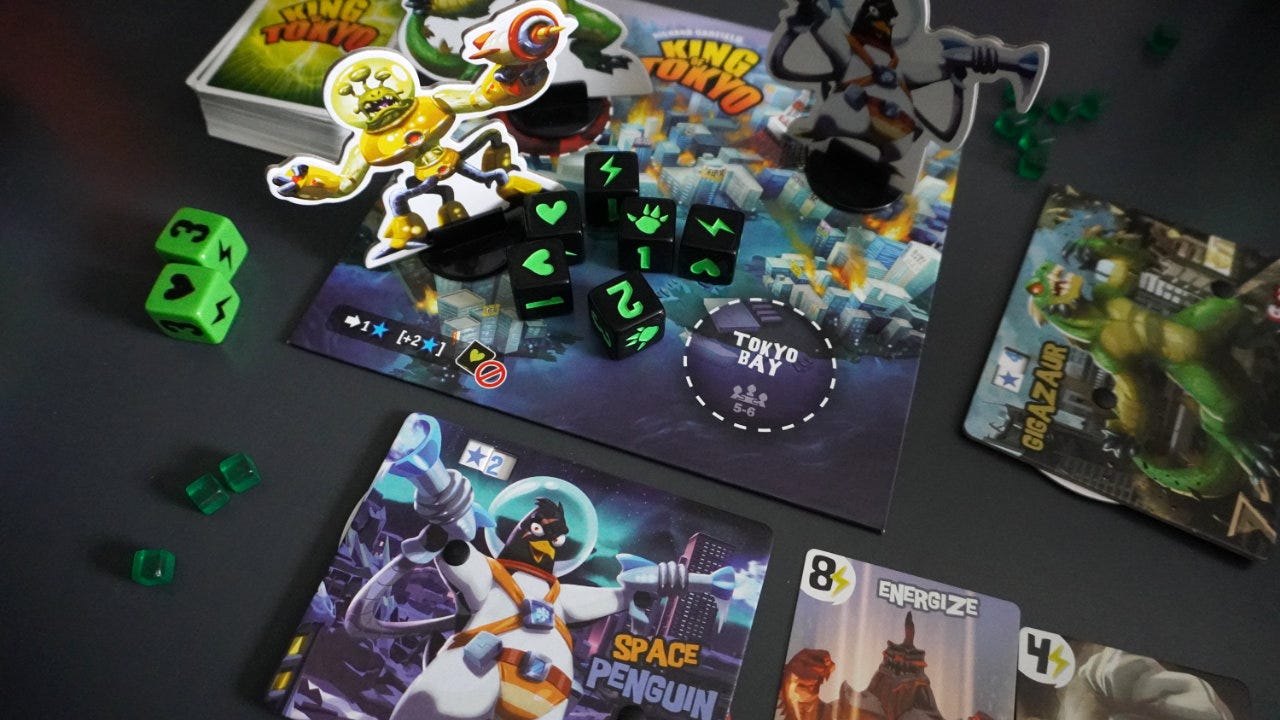
There are many modern board games that use a Yahtzee-style mechanism in their gameplay. Dice Throne (Chatellier, Hein, et al., 2018) and King of Tokyo (Garfield, 2011) are perhaps two of the most well-known board game examples.3 Players roll dice, try to get specific combinations, and can reroll dice in additional attempts.
In Dice Throne, you are rolling five dice with two optional rerolls to match offensive and defensive abilities on your player board. The dice define which actions you can take.
In King of Tokyo, you roll six dice with two rerolls. The goal is to get a mix of victory points, energy, attacks, and healing on the dice. Energy can be spent to purchase cards. Attacks damage other players and healing restores your health.
Re-rolling and locking
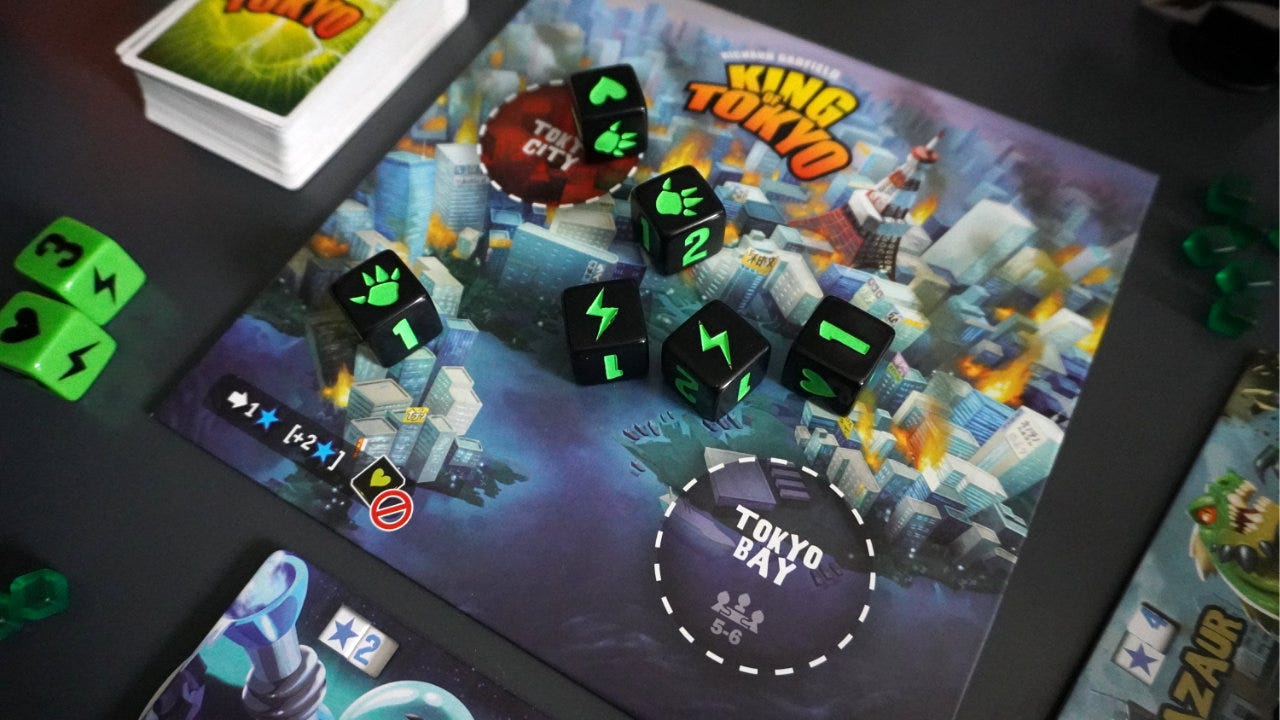
In the traditional game examples above, any set-aside dice can be rerolled during any attempt. Just because you kept a die from the first roll doesn’t mean you can’t reroll it during a later attempt. Dice are never locked.
Modern games have introduced the concept of locking dice when you keep them. This means that once you decide to keep a die, it is locked. It may not be rerolled during a later attempt.
To Court the King (Lehmann, 2006) is a good example of dice locking.4 You roll three dice and must then set aside at least one of them. Any remaining dice may be rerolled. You must again set aside at least one and can reroll the others. This continues until all dice have been set aside.
Elder Sign (Launius & Wilson, 2011) also uses a form of dice locking. You roll six dice and can use some of the dice to complete a task on an adventure card. Once those dice are voluntarily used to complete the task, they may not be rerolled or used again while resolving that adventure card. They are locked and unavailable.
Conditional locking
Escape: The Curse of the Temple (Østby, 2012) is a cooperative real-time game that uses dice rolling as the core mechanism. Players simultaneously roll custom dice to gain symbols that allow them to take actions.
Like Yahtzee, players can roll and reroll their dice to achieve the combinations they want. They can even put aside some dice and choose to not reroll some of them. Unlike Yahtzee, however, any time a black mask symbol is rolled, that die becomes temporarily locked. Black masks can’t be rerolled and must be put aside. This shrinks the player’s dice pool and makes it hard to get the symbol they want.
The only way to get the black mask dice back is to roll a golden mask. A golden mask “breaks the spell” on up to two black masks and those dice go back into the player’s pool. Players can also use their golden masks to help other players regain their dice.
This is an interesting example of conditional locking where the dice are out of play but only temporarily. Other game conditions allow those dice to be unlocked and brought back into play.
Conclusion
Some things to think about:
Yahtzee-style mechanisms: Once you become familiar with Yahtzee-style mechanisms, you’ll begin to see them everywhere. It’s a popular mechanism that shows up in a lot of games — and for good reason. Rolling dice with limited rerolls is a great way to mitigate luck.
Rolling and locking: Traditional Yahtzee allows for any dice (even those set aside) to be rerolled later. Forcing the player to lock one die each attempt can create a tighter and more interesting decision space. I also think locking any dice that are (optionally) set aside would be a fun mechanism.
Conditional locking: If you don’t mind additional rule complexity, it can be interesting to allow for conditional locking of dice. Dice are temporarily locked and unlocked depending on actions and the game state. You could also have mechanisms to allow for dice to be added to or removed from the player’s dice pool during the attempts.
What do you think? Do you have a favorite game that uses a Yahtzee-style mechanism? I’m curious if you’ve seen rolling and locking used in TTRPGs as well. I wasn’t able to find many examples of it.
— E.P. 💀
P.S. Want more in-depth and playable Skeleton Code Machine content? Subscribe to Tumulus and get four quarterly, print-only issues packed with game design inspiration at 33% off list price. Limited back issues available. 🩻
Skeleton Code Machine is a production of Exeunt Press. All previous posts are in the Archive on the web. Subscribe to TUMULUS to get more design inspiration. If you want to see what else is happening at Exeunt Press, check out the Exeunt Omnes newsletter.
Skeleton Code Machine and TUMULUS are written, augmented, purged, and published by Exeunt Press. No part of this publication may be reproduced in any form without permission. TUMULUS and Skeleton Code Machine are Copyright 2026 Exeunt Press.
For comments or questions: games@exeunt.press
There’s more to the history of the game than just Milton Bradley. It begins with Edwin S. Lowe and his trademark application for the game in 1956. The game was produced by the E.S. Lowe Company up until 1973 when that company was purchased by Milton Bradley. Lowe is the same person credited with creating the game Bingo as we know it today.
I originally said this game ended after 5 rounds, but that was possibly incorrect. See the comment section for some discussion and clarification of this.
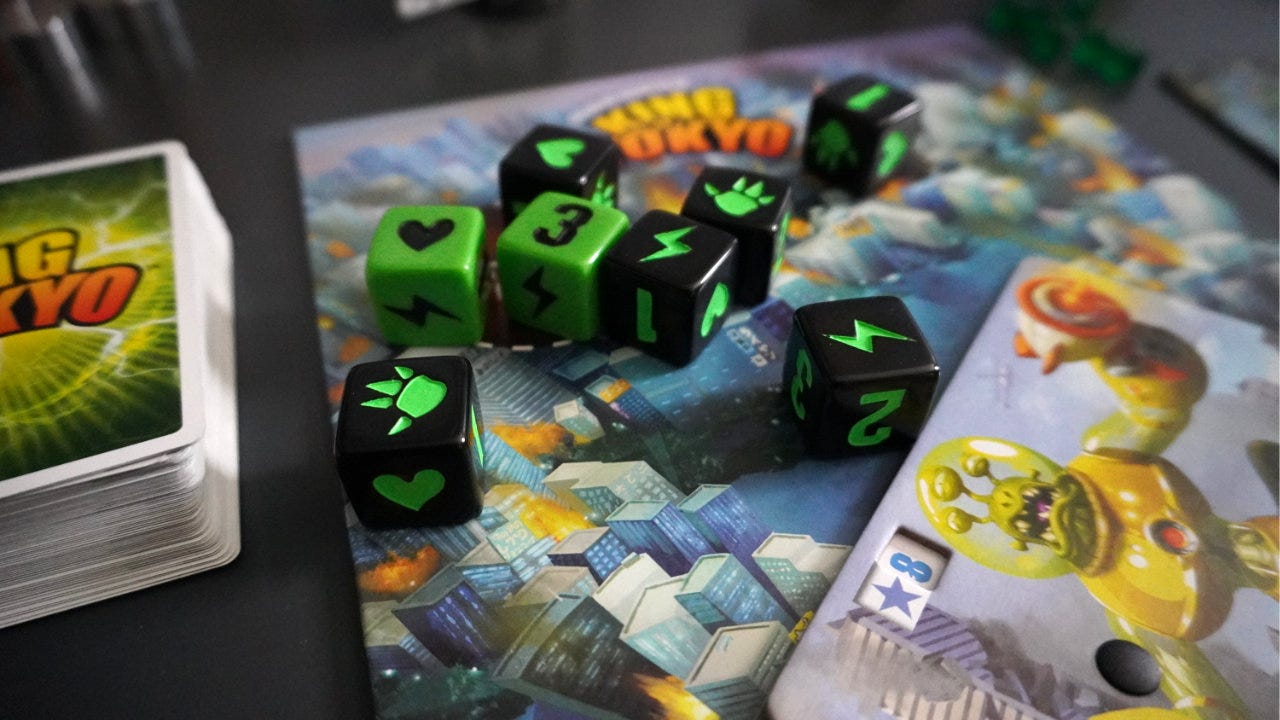
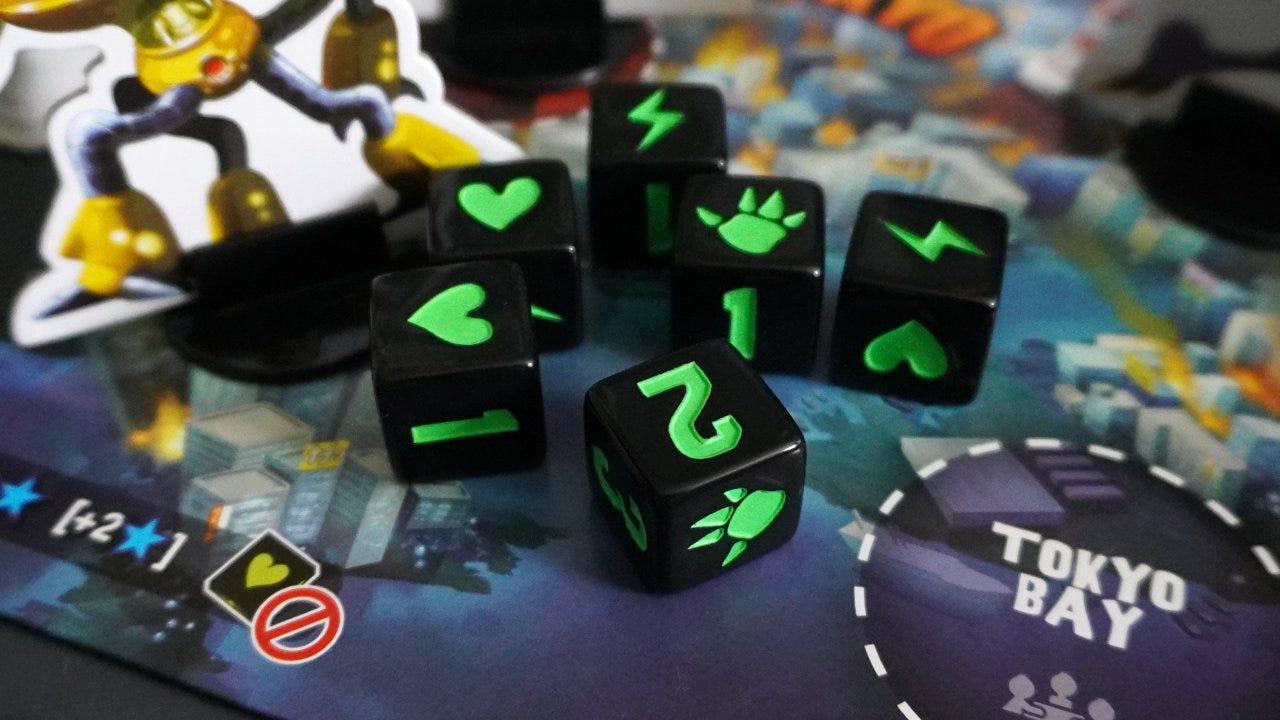
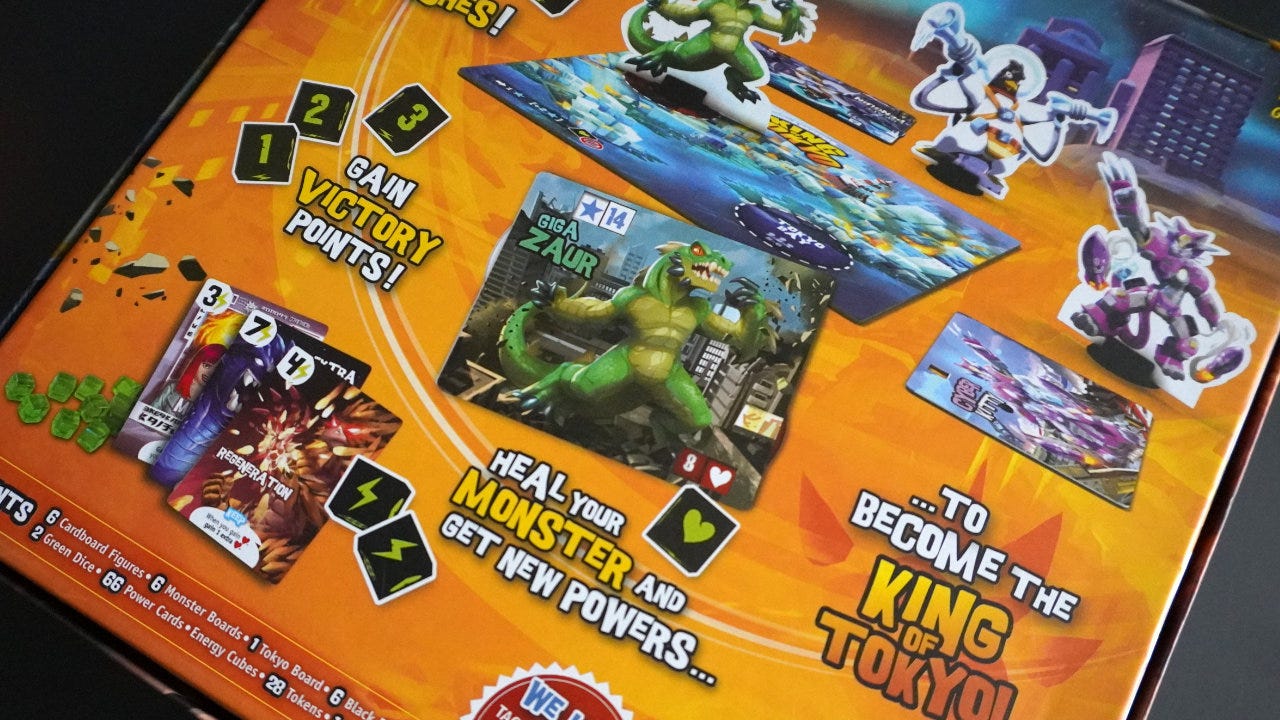
All the photos in this article are of King of Tokyo. Why? Because I had it available and it’s a really good looking game. Yahtzee just isn’t much to look at. I decided a lot of King of Tokyo was better than stock photos of dice. Space penguin!!!
This game was reimplemented as Favor of the Pharaoh (Lehmann, 2015).
Another game with this mechanic is Trains and Stations (Lang, 2013). You roll a set of (IIRC) six dice that will either let you build a building or lay rail if you get the right combinations. You get two rerolls, but the added trick is that one face on each die is a "locked" train. That can still be used to lay rail, but it can't be rerolled. In addition, if you get three locked trains you discard all your dice and your turn ends. So, there is a risk in rerolling a lot. There are additional complications (some dice might stay on the board for multiple turns, reducing the number you have left to roll in future turns, for example) but that is the main mechanic.
The conditional locking idea is especially interesting it adds tension without taking away the fun of chasing that perfect roll.