

The original version of this article had the Tumulus issue numbers wrong. Please see update below. The article has been corrected. — E.P. 3/3/2026.
It’s March! That means that limited copies of Tumulus Issue 05 “Step into the fairy ring.” are now available as individual back issues.1
It also means that subscribers will soon be receiving shipping notifications for Tumulus Issue 06 “Hammer a nail in the coffin.”2 This issue is all about vampires, ghosts, and the dangerous dead. It includes a haunted house generator, an article about vampire mechanisms in Blood Borg, a playable game called A Place for All My Corpses with exercises to improve it, and more.3
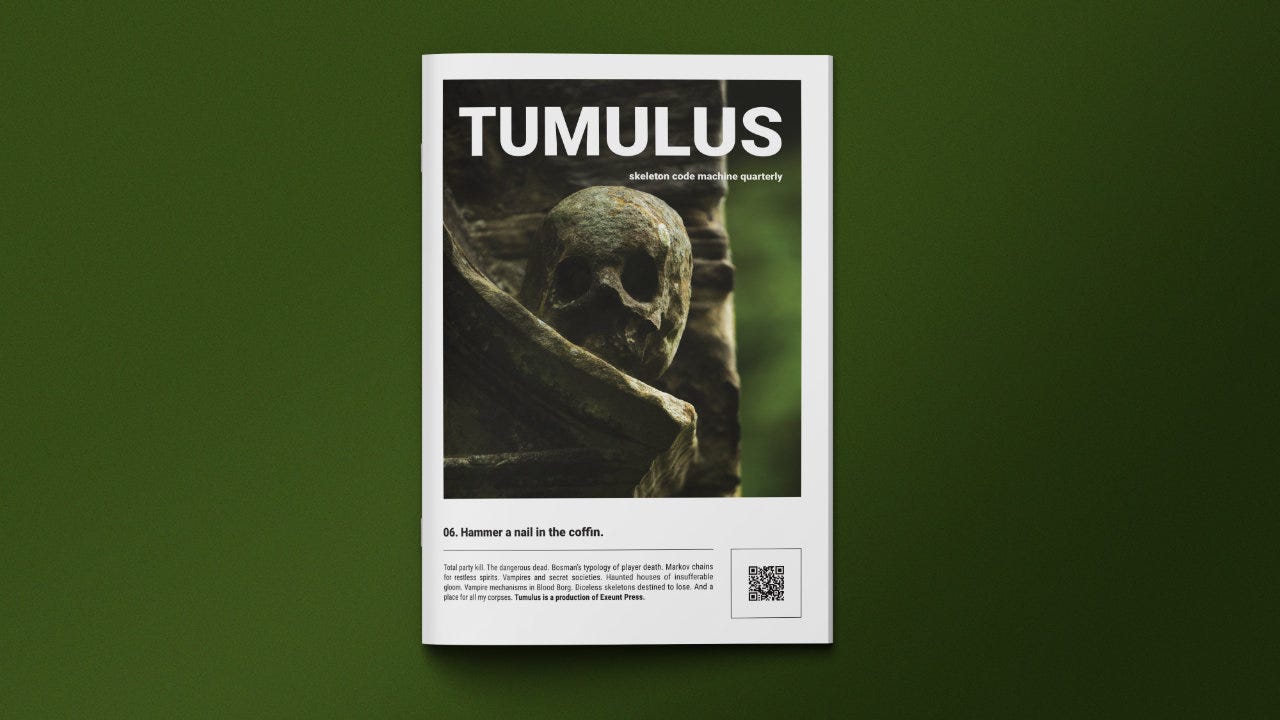
Please consider supporting Skeleton Code Machine with a Tumulus subscription. Be sure to select the issues you want when subscribing.4
This week, while you are waiting for your next issue of Tumulus to arrive, we are looking at a solo journaling game called We Shall Be Monsters.5 It’s a Frankenstein-themed companion creator that uses an interesting circuit-based attribute selection mechanism.
We Shall Be Monsters

I picked up a print copy of We Shall Be Monsters at the Good Luck Press booth at last year’s PAX Unplugged.6 The cover is unassuming — almost all black with white title text. The pitch for this 17-page solo journaling game designed by Seb Pines is what drew me in.
Using a very Frankenstein-esque setting, in We Shall Be Monsters you are a reclusive scientist endeavoring to build your own perfect companion:
“Shape their body as you shape your futures together. Infuse them with vitality and see what you have created come to life and take their place beside you.”
Of course, you can’t exactly just stop by the local market and pick up a new body for your companion. Instead you’ll be creating them “from parts harvested from the dead” and you’ll stitch those parts together using an unnamed machine.
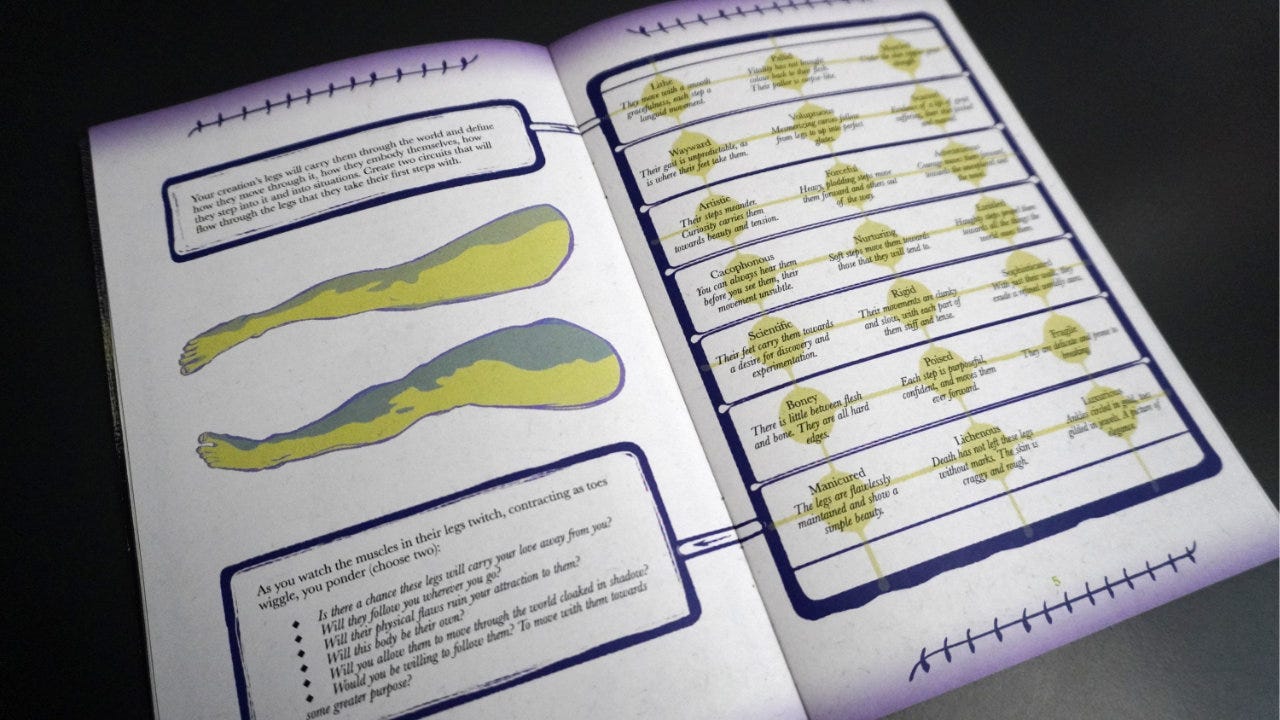
Starting with the legs, you’ll add some body parts, imbue them with life, and then move on to the next parts. Arms, torso, head, organs, brain, heart, are all required components. By the end, you’ll have a complete companion.
We are told that these parts come with a mixture of desires and ideals that are both our own (as we provide the vitality) but also from the part itself as “even dead flesh holds memory.” It won’t be simply a pair of legs, but legs that have a bit of our own personality in them as well as the personality of the former owner.
What I found interesting was the way in which the attributes are selected.
Creating attribute circuits
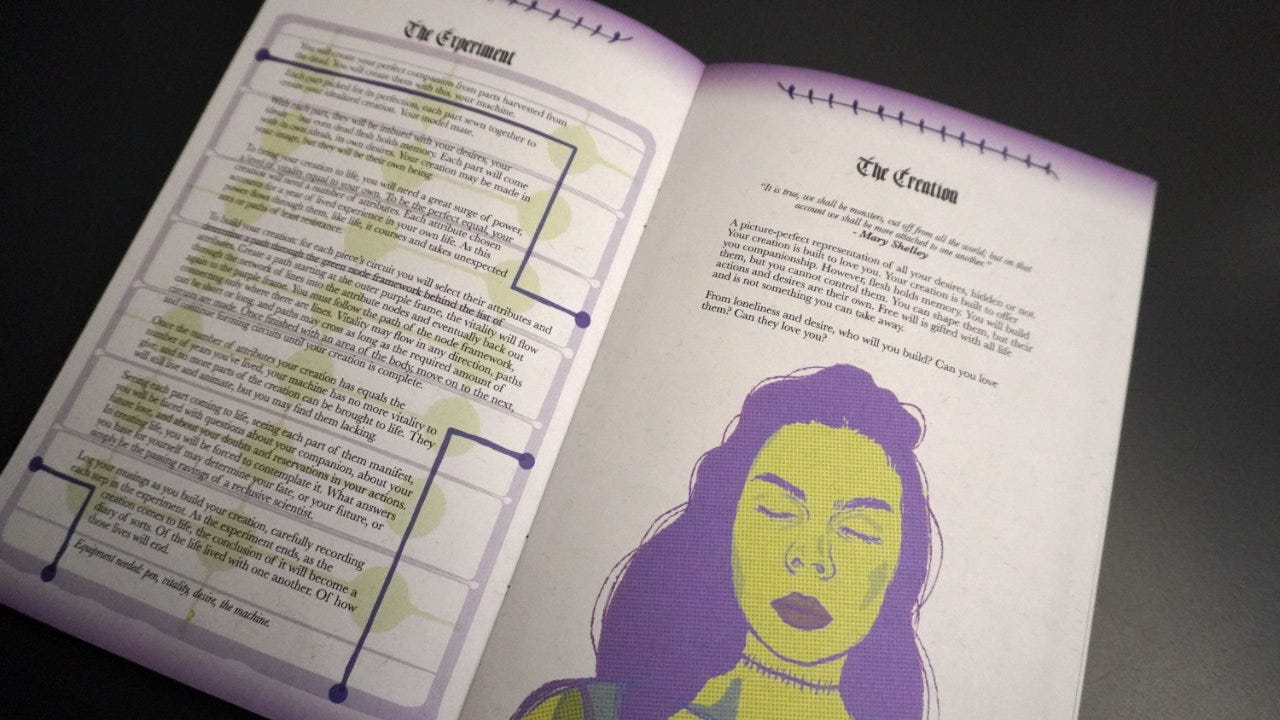
While many solo journaling games rely on either dice rolls or drawing cards to generate prompts and outcomes, We Shall be Monsters takes a different route. It uses what it calls circuits.
Each body part section has a matching node framework of varying size — connected green dots within a thick purple frame. Each green dot has an attribute word and description written on it. For example: “Lithe: They move with a smooth gracefulness, each step a languid movement.” or “Fragile: They are delicate and prone to breaking.”
The player selects attributes for their creation by starting anywhere on the outer purple frame and following the green connection lines until they exit the frame at another location. In the case of the legs (the first body part to be activated) the grid is a 3 x 7 matrix of attributes — wayward, nurturing, boney, poised, adventurous, entitled, manicured, and so on. Selecting two circuit routes through this matrix, the player adds some number of first attributes to their soon-to-be companion.
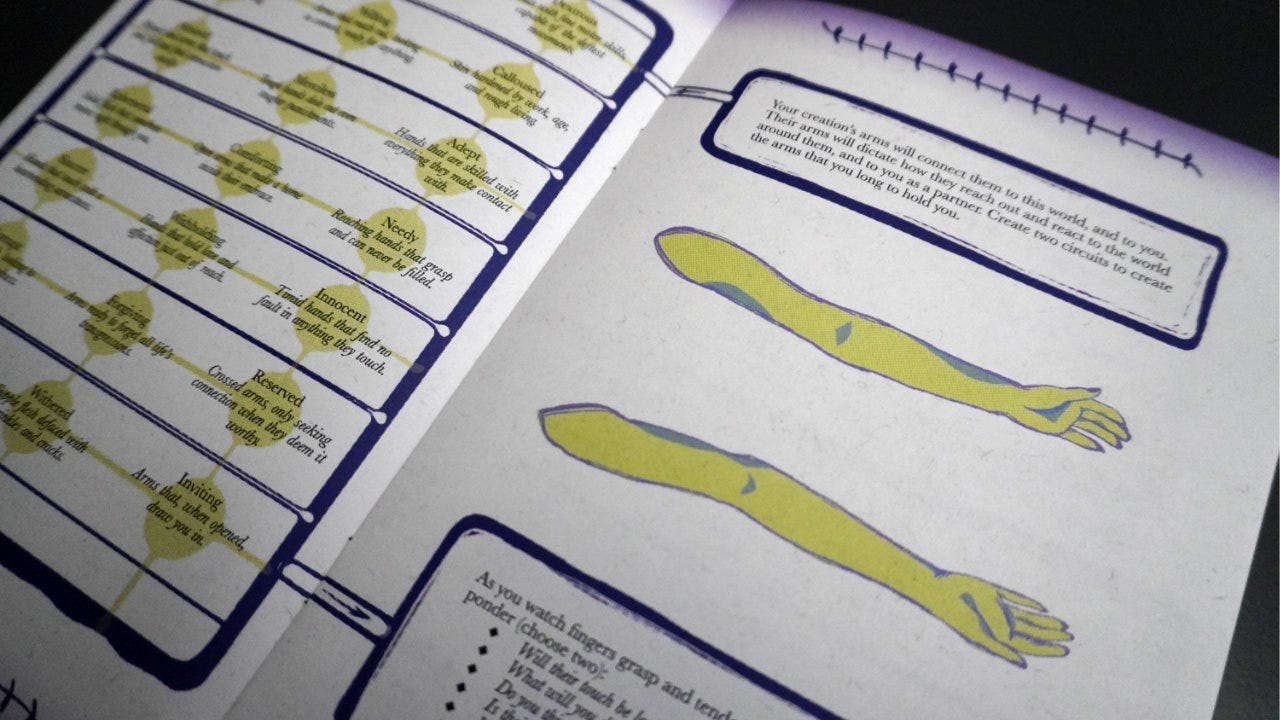
After answering some additional leg-related questions (e.g. Will they follow you wherever you go?), the process is repeated for the arms.
The torso matrix is particularly large, a 13 x 3 grid of 39 unique attribute names and descriptions. This continues to the final components.
Into the chest and skull, you place the heart and brain. The things that make them the most of who they are instilled into their reanimated flesh. With this, they will think and love. With these two final pieces, your creation is complete.
After a short epilogue, your new creation becomes your companion.
Open but structured
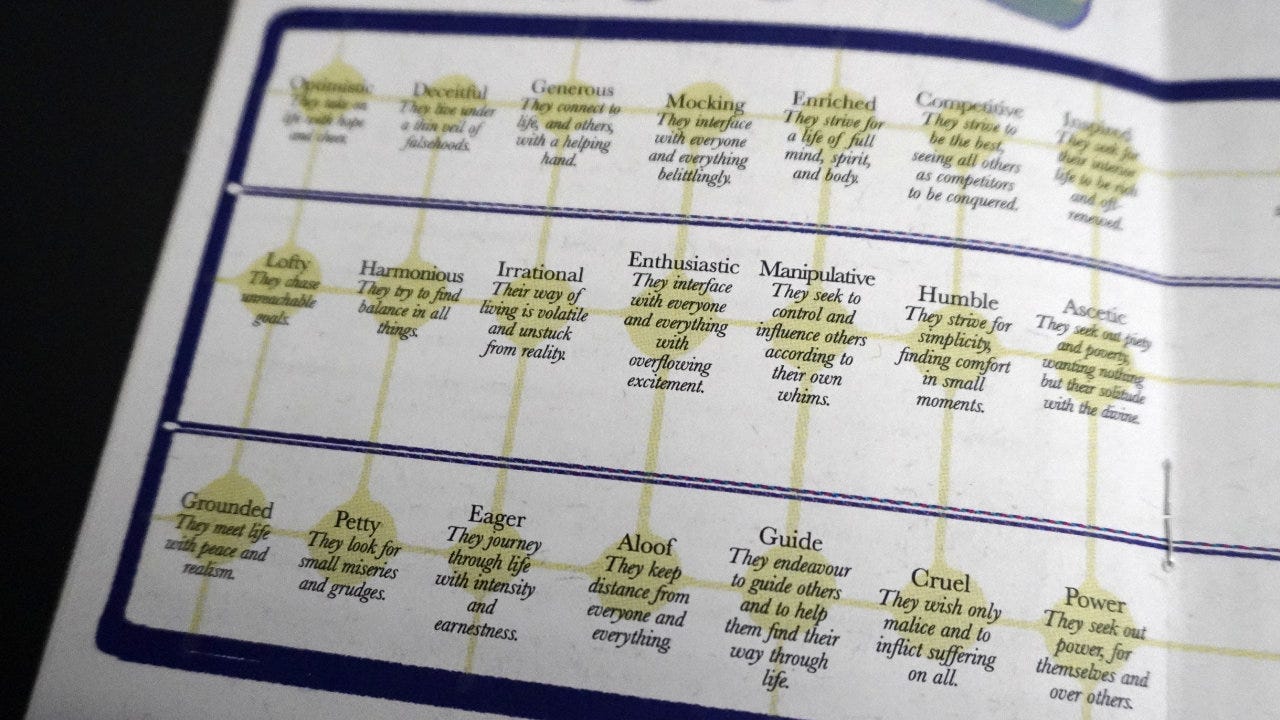
What I found interesting about the circuit mechanism is that it is completely zero luck — there are no dice or cards. The player acts with full agency in selecting which attributes the route takes as it crosses from one side of the circuit frame to the other.
Notably, players must follow the connected lines but otherwise may proceed how they wish. The circuit can flow in either direction. They can be short or long. The circuit line can even cross over itself. The only true restrictions are that you draw the number of circuits indicated and that you end when “the number of attributes your creation has equals the number of years you’ve lived.”
Having a list of attributes and asking the player to select X number from the list would be almost mechanically equivalent. Using a simple list would, however, be different in two important ways:
A list wouldn’t have any structure to it. The player would need to look at the entire list at the same time and make a choice.
A list wouldn’t have any thematic connection to the game. The concept of building Frakenstein-style electrical circuits to jolt your creation to life would be lost.
The grid forces players to look at only adjacent attributes while building circuits.
Take for example the torso. If you chose Lofty you need not (indeed can not) consider all other 38 attributes. Instead the mechanism forces you to only consider the three adjacent: Optimistic, Harmonious, and Grounded. Choosing Grounded means only Petty is available next. While you certainly could double back to grab a desired attribute, the mechanism creates a sharp focus on just a few.
In addition, once your circuit has made it most of the way across the frame, it is hard to go back and pick just one specific attribute. Gaining Adored might also mean picking up Violent along the way.
It’s a mechanism without randomness, but the thematic structure of it creates interesting, focused choices.
Conclusion
Some things to think about:
Zero-luck journaling games: We Shall Be Monsters made me realize that many (most?) solo journaling games choose the prompts randomly.7 Rarely, in my experience, is the player simply provided with a list of prompts or questions and then asked to choose. Using the circuit mechanism allows for player choice in a way that feels thematic and satisfying.
Public domain settings: I’ve written before about adapting public domain works for use in board games and TTRPGs. Frankenstein, while not heavily used in We Shall Be Monsters, is clearly an inspiration.8 From Alice in Wonderland to Dracula, public domain settings are there to be mixed and remixed into new and interesting games.
Thematic mechanisms: Not every mechanism can be made to be highly thematic. Sometimes a die roll is just going to be a die roll. But there are times we can we make a mechanism feel like what it represents. Keep an eye out and don’t pass up those opportunities.
UPDATE: This article originally said (incorrectly) Tumulus 07 was shipping soon. That was in error. It should have said Tumulus 06 is shipping soon. The issue number was wrong. The SCM editor (Murphdog) has been sacked. — E.P. 3/3/2026
— E.P. 💀
P.S. Want more in-depth and playable Skeleton Code Machine content? Subscribe to Tumulus and get four quarterly, print-only issues packed with game design inspiration at 33% off list price. Limited back issues available. 🩻
Skeleton Code Machine is a production of Exeunt Press. All previous posts are in the Archive on the web. Subscribe to TUMULUS to get more design inspiration. If you want to see what else is happening at Exeunt Press, check out the Exeunt Omnes newsletter.
Skeleton Code Machine and TUMULUS are written, augmented, purged, and published by Exeunt Press. No part of this publication may be reproduced in any form without permission. TUMULUS and Skeleton Code Machine are Copyright 2025 Exeunt Press.
For comments or questions: games@exeunt.press
Back issues of Tumulus are available at full list price until they are sold out.
I’m going to try my best to get Tumulus 06 shipped to all subscribers before Unpub, but I can only make Murphdog work so fast. Shipping will be paused from March 12 - 15, 2026.
Why yes, it absolutely was inspired by A Place for All My Books.
To learn more about how Tumulus subscriptions work, see tumulus.exeunt.press.
You really should subscribe to Tumulus. You get four issues with a subscription and no annoying auto-renew. Each one has a different theme and it’s packed with creative inspiration for tabletop game designers and players. If you like Skeleton Code Machine, you’ll love Tumulus. It’s also easy to give as a gift.
Please note that We Shall Be Monsters comes with a significant list of content warnings. Be sure to check those first to know if this game is for you.
This was, in fact, one of the key things I wanted to play with when creating Caveat Emptor. I wanted the player to be presented with multiple journaling prompts and then have to choose. On top of that, I wanted there to be more reward given for choosing one prompt versus other. The idea of having to choose between an “easy” prompt that was low value and a “hard” prompt that was high value was appealing.
The title of the game is taken from a line in Chapter 17 of the book: “It is true, we shall be monsters, cut off from all the world; but on that account we shall be more attached to one another.”
Interesting concept.
One thing leads to another kind of building.
what a fascinating game! and certainly one that's not for everyone ^^" while i voted "no way!" in the poll, that is for me as me; in games, i'd totally be up for playing such... complicated to say the least... characters ^^
super interesting mechanics. i *love* prompts in my ttrpgs, which is why games like "Under Hollow Hills" and other PbtA-style games work so well for me; but there it's usually in picklists, like eg when choosing things for your character, or in Under Hollow Hills for the MC to create an Occasion for the circus to perform. i could see some interesting variation on that, where it could be some kind of branching diagram, or indeed a circuit, where one prompt in one list opens up a separate list of prompts, or perhaps narrows the amount of "accessible" prompts in the next list...
thank you for sharing <3