
I’m back from my first Break My Game playtesting event at MEPACON, and it was a fun time. I was able to get two plays of Ratsail completed, both of which provided a ton of valuable feedback.1 If you were one of the players, thank you so much!
Last week we looked at how Neighborhood Robots adapts a solitaire card game, turning it into a narrative TTRPG about communities.
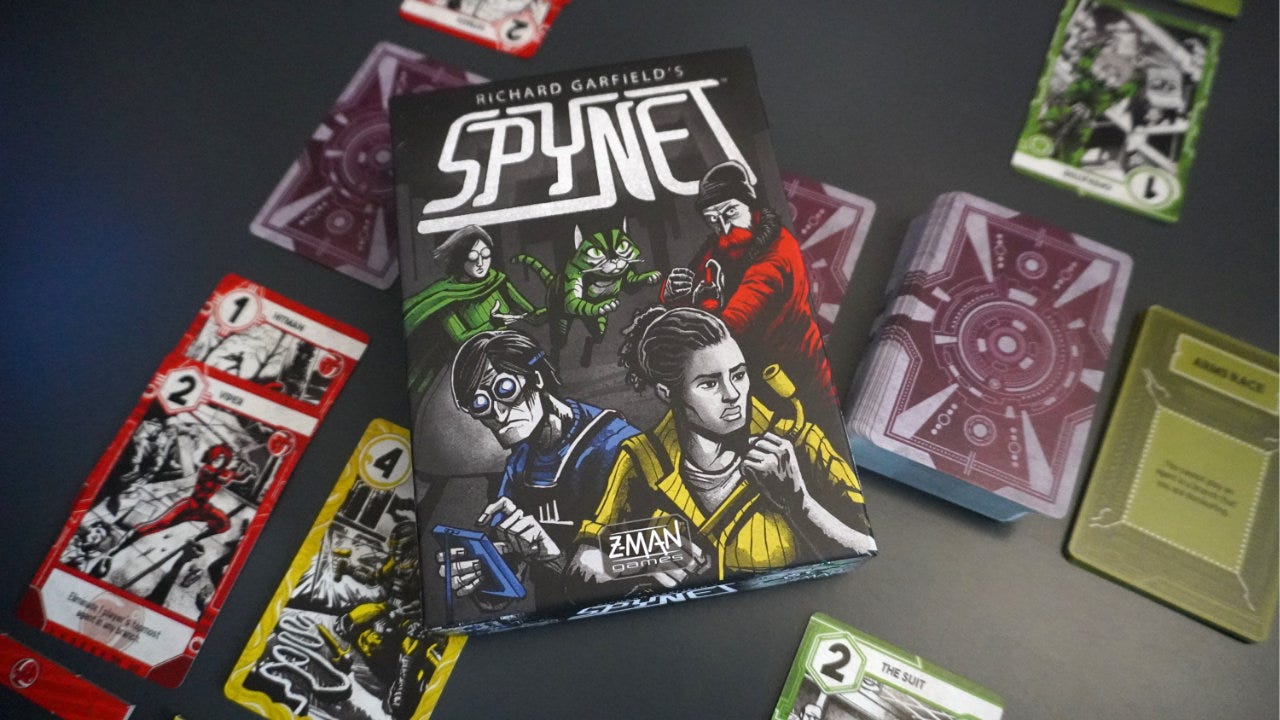
This week we are looking at SpyNet — a card drafting game from Richard Garfield.
New to Skeleton Code Machine? Welcome!
Not sure where to start in the 200+ post archive? Start here!
SpyNet by Richard Garfield
I first heard of SpyNet via an interview with Richard Garfield on the Shelf Stable podcast. Richard is the creator of Android: Netrunner (2012), King of Tokyo (2011), KeyForge (2018), and a little game you may have heard of called Magic: The Gathering (1993). The interview is fascinating, and I highly recommend checking out the whole thing.
During the interview, Richard was asked if he plays any of his own games.2 He said that the only one he still plays regularly is SpyNet. This caught me by surprise because I had never heard of it.
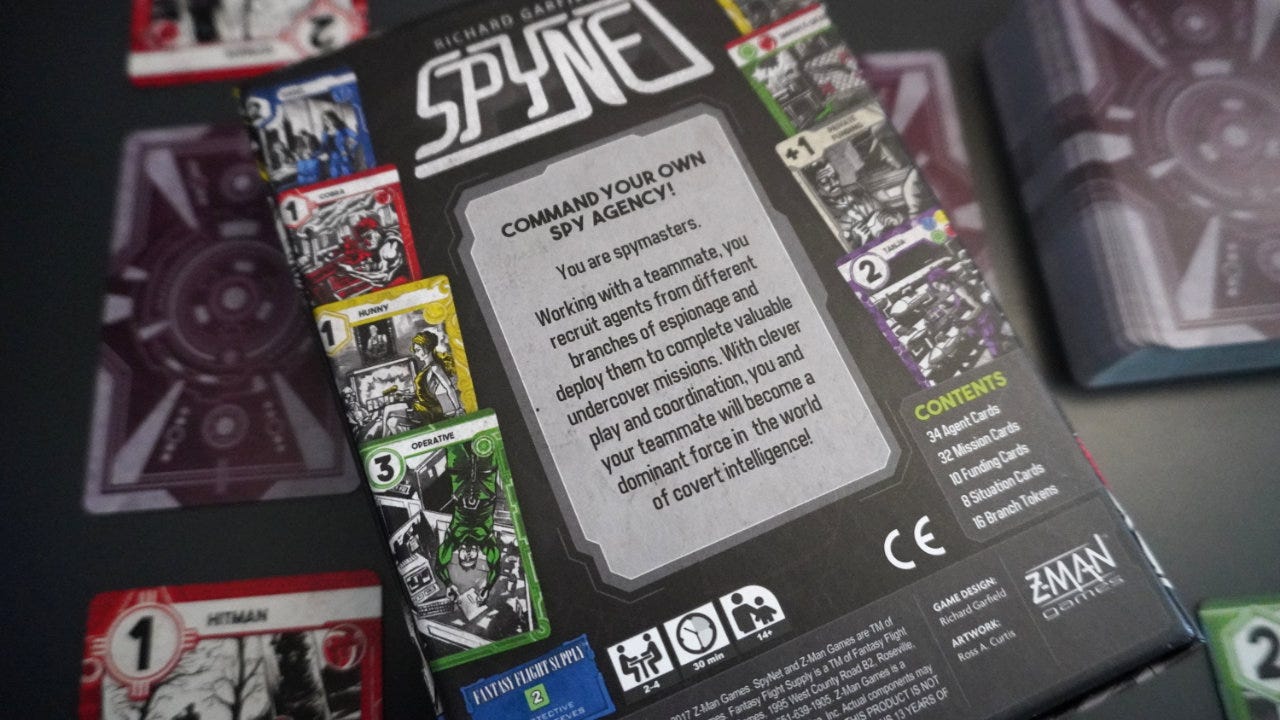
It’s a game originally published in 2017 by Z-Man games that is mostly an abstract card game:
“You are a spymaster. Your mission: Dominate the world of undercover intelligence by deploying agents to complete vital missions. To complete your mission, you must first build an underground network of highly trained agents from different branches of espionage.”
It is played in 2v2 teams with 4 players or 1v1 with 2 players.3
The goal is to play cards into four different branches that are set up much like you’d expect in a lane battler — red, yellow, blue, green. If you dominate one of the lanes (i.e. higher value played than opposing players), you can play a mission card to that lane. Mission cards earn victory points (stars) at the end of the game.
Play continues until the deck runs out. Mission points are added up, and the player (or team) with the highest score wins.4
I’m going to use the terms branch and lane interchangeably in this article.
Agents, funding, and missions
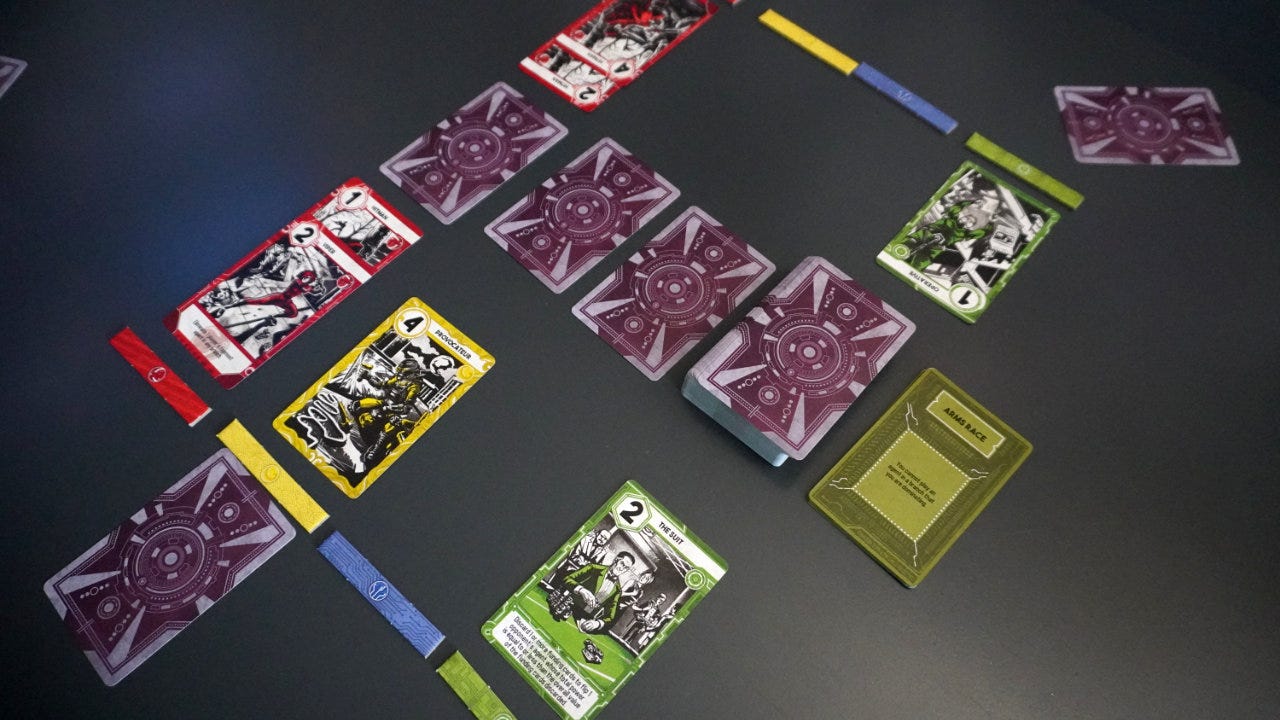
There are only three types of cards in the 76-card SpyNet deck:
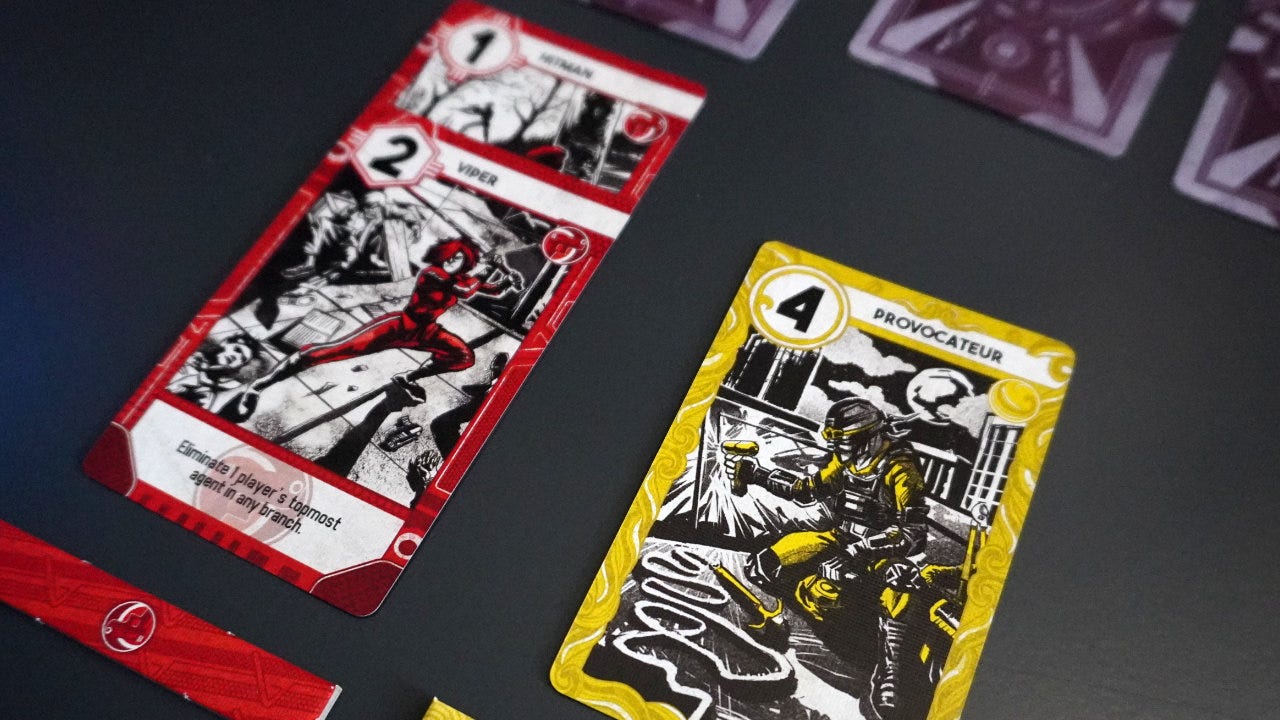
Agent (34 cards, 45%): Add power to branches based on face value. Must be played to a matching branch color (red, yellow, green, blue).
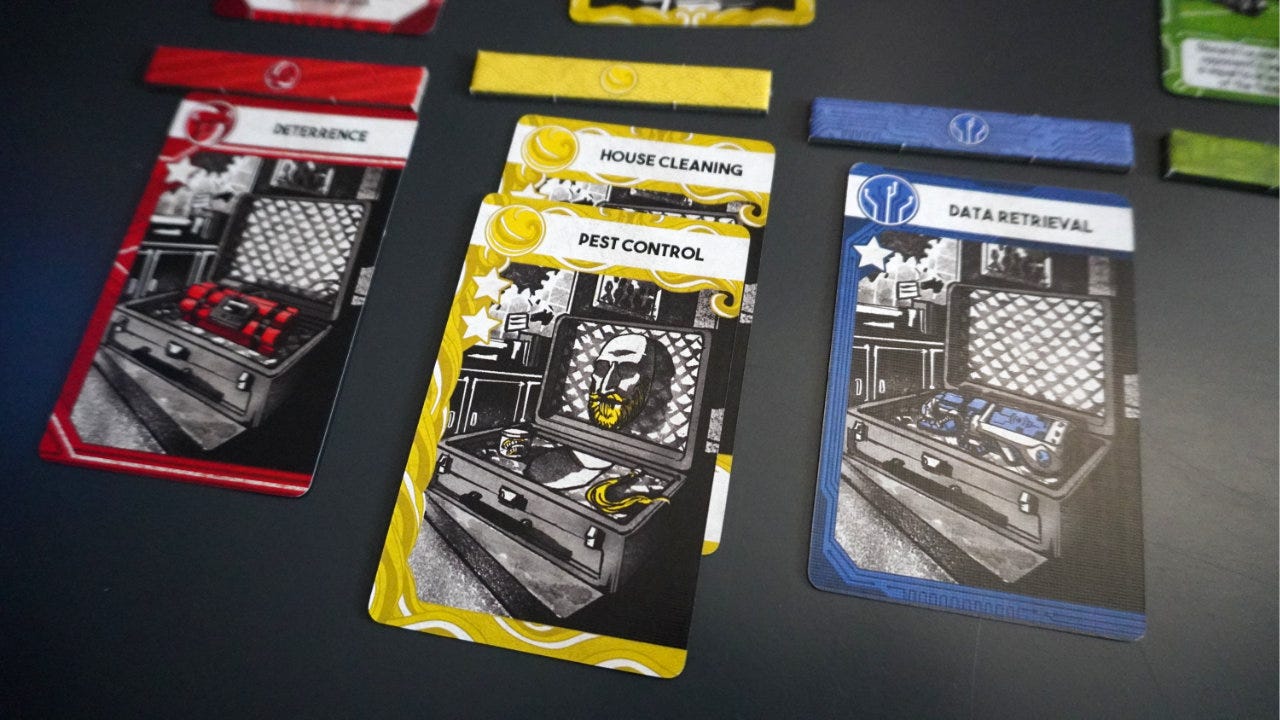
Mission cards (32 cards, 42%): Score points if played. May only be played to a branch dominated by your agents.
Funding cards (10 cards, 13%): Played with an agent to increase its power.
Players either recruit (draft) cards or deploy (play) cards on their turn. With only one starting card in their hand, it’s important to get cards quickly. And because which cards you get relies on chance (including the mission cards) drafting becomes a very important part of the game.
The way SpyNet handles this is to have players draft from a 3-card shared market if they choose the recruit action on their turn. The way the market works, however, is really interesting.
Drafting cards from a market
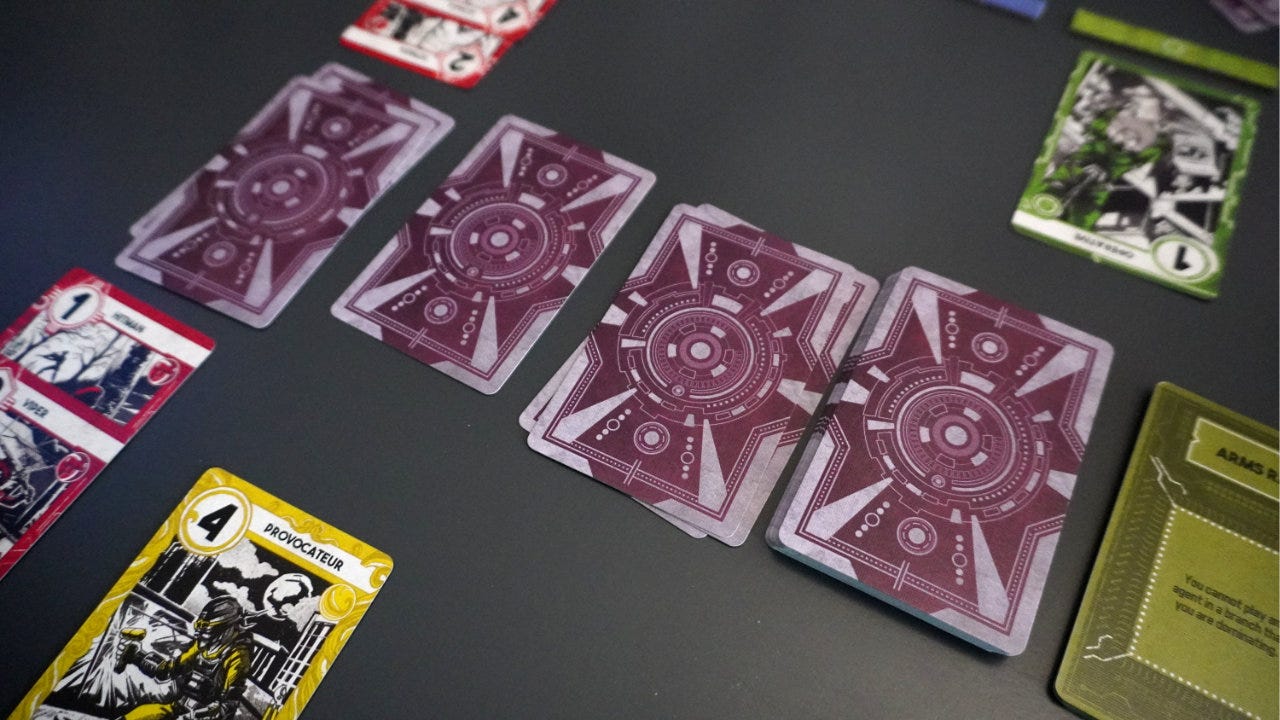
There is a facedown deck and a market (i.e. available cards) of three facedown piles of cards. Let’s call them Pile 1, Pile 2, and Pile 3 going left to right. This is already different from most drafts because the cards aren’t visible to everyone.
The recruiting player can look at Pile 1 and decide if they want to take the cards or not. If not, they can look at Pile 2 and take them if they want. If they don’t want that pile either, they can look at Pile 3 and take that pile. Finally, if they don’t want any of the piles, they can take a random card from the top of the deck.
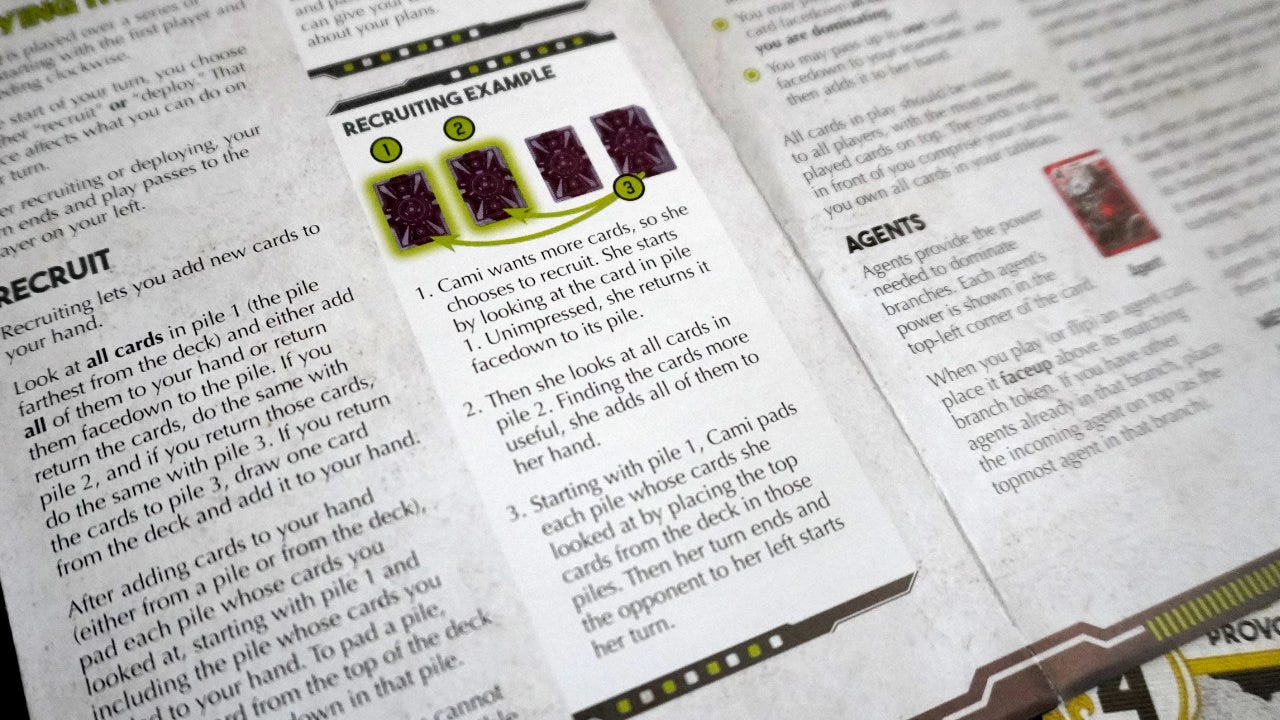
If they select one of the three piles of cards (after looking at it), three new cards are drawn to refill or pad the piles. This means each pile gets one new card on top of it, regardless of how many cards are in it. The pile that was just taken would have one card in it.
This means that less desirable cards in the market begin to accumulate more cards on top of them. That makes them more attractive when deciding which pile to take.
It also creates an interesting choice: Take one card I really want? Or take a pile of 3+ cards that might be helpful in the future?
Is this a Dutch auction without currency?
Over the last few years, I’ve become quite enamored with Dutch auctions in tabletop games.5 I’ve written about Dutch auctions and dynamic markets previously. If you ever meet me in person, there’s a good chance that I’ll work Dutch auction mechanisms into the conversation.
Here’s a quick review in how they work from the BGG Auction: Dutch page:
“A simultaneous single-bid system in which the lot starts at a very high price, and then is gradually decreased by the auctioneer or other controlling mechanism, until someone agrees to claim the item at its current price, ending the auction. The first bidder to accept the current price is the winner, such that there are no ties. A Dutch Auction is sometimes also called a one-bid auction because of this feature that the first bid made is also the only bid in the auction.”
In practice, however, many games use a slight modification of this. The players add coins to less desirable cards, effectively lowering the price of each card. The price (cost) of a card can eventually go negative. A negative cost means the player gains money by taking the card — they gained more coins than they spent.
When I added this Dutch auction style mechanism to Turtchester to unclog the market, it meant that I had to add a currency (coins) to the game.6 I didn’t see a way around it. How can you bid or auction without coins?
SpyNet handles this challenge (i.e. ensure the market doesn’t get clogged) in a similar way to a Dutch auction, but with an elegant difference. Additional cards (not coins) are placed on top of the pile not taken. The less desirable piles gain ever more cards, ensuring that eventually someone will be bound to take the pile.
Is it a Dutch auction? Perhaps not based on strict definitions. The biggest difference is that cards are added to every pile regardless of position.
It feels adjacent to a Dutch auction to me and a really interesting way to implement it without the addition of coins to the game.7 The mechanism in SpyNet prevents the market from being clogged, acts as a timer on the game (i.e. when cards run out), and can be implemented without any additional components.
Game design inspiration delivered to your door each quarter with Tumulus — a print-only magazine from Skeleton Code Machine. Issue 6 is available now.
Conclusion
Some things to think about:
There are always games I’ve missed: I consider myself to be fairly well versed in board games. I play a lot of games and consume a ton of board game media. And yet there are always older games from well-known designers that I’ve never heard of.8 I was fortunate to hear about this one on a podcast and able to pick up a used copy for just a few dollars.
Drafting: In many ways, drafting is simply choosing one option from a set of available options such that others can’t take the same option. For example, you take a card from a hand of cards and pass the hand to the next person so they can choose a card. It’s simple, but has endless permutations and possibilities.
Dutch auctions are cool: Or more accurately, mechanisms that create increasing incentives to take less desirable options (e.g. cards, etc.) are cool. It’s a good way to keep open drafting markets dynamic and prevent them from getting clogged. SpyNet shows that adjacent mechanisms can be implemented without the need for a currency and/or coins.
What do you think? Have you ever heard of SpyNet or played it? Have you seen examples of other Dutch auction style mechanisms (i.e. incentives for less desirable options) in other games? What are some other examples I should check out?
— E.P. 💀
P.S. Want more in-depth and playable Skeleton Code Machine content? Subscribe to Tumulus and get four quarterly, print-only issues packed with game design inspiration at 33% off list price. Limited back issues available. 🩻
Skeleton Code Machine is a production of Exeunt Press. All previous posts are in the Archive on the web. Subscribe to TUMULUS to get more design inspiration. If you want to see what else is happening at Exeunt Press, check out the Exeunt Omnes newsletter.
Skeleton Code Machine and TUMULUS are written, augmented, purged, and published by Exeunt Press. No part of this publication may be reproduced in any form without permission. TUMULUS and Skeleton Code Machine are Copyright 2025 Exeunt Press.
For comments or questions: games@exeunt.press
Ratsail, formerly known as Turtchester, is an area influence / bidding board game I’ve been slowly working on. I’ve run playtests at Unpub, but never at a Break My Game event. One of the two playtests at MEPACON was technically in the lobby and not part of Break My Game, but was just as valuable as the other.
I always find this to be an interesting question. Many designers rarely play their games ever again after they are published for varying reasons. Some are exhausted from so much playtesting and others hate the feeling of the game being “locked in” and unchangeable now that it’s been published.
I’ve heard that it is best with 4 players, but haven’t been able to try it that way yet. The two players on each team aren’t allowed to communicate directly, but can pass cards to each other.
As usual, this is not a complete summary of the rules. The rules are indeed short (only about 7 pages), but I’m just covering the parts necessary to be able to talk about the card drafting.
I feel obligated to note that when I say Dutch auction I mean it in the sense of the board game mechanism and not a strictly defined Dutch auction used for buying and selling goods. If you’ve ever played Pax Renaissance, Pax Pamir, or Canvas, that’s the Dutch auction style mechanism that I mean.
I use the term “currency” quite a bit when talking about games but realized I’ve never directly written about the topic here at Skeleton Code Machine. Mary Flanagan talked about currency and resources in games in the Playing Oppression episode of Game Design Deep Dive a while back. Really interesting topic.
Coins immediately add cost and complexity to the production of a board game. The economy has to be balanced so that there is a steady flow of coins into the game. It needs to be able to handle a player who wants to hoard coins. It needs to be implemented in a way that uses a reasonable number of actual coin tokens.
Is a game from 2017 an old game? In the current board game market, that is considered older I think!
Huh, I knew Garfield designed the 1996 version of Netrunner--was he involved in the actual production of the 2012 reboot as well?
This is equivalent of MTG's Winston draft format. I don't know who invented or formalized it, but it very well might be Richard Garfield as well.
https://mtg.fandom.com/wiki/Winston_Draft
I found it interesting, especially for three players.
A considerable property of it that everybody usually gets all colors (as a lot of varied cruft is accumulated in the first pile), while regular draft usually tends to players naturally specializing in certain colors. This should work well for factionless games, but would negatively impact games where players are supposed to specialize.