
I was surprised at how many people at the ALA Game Jam panel last week read Skeleton Code Machine! A few people stopped by after it was done and shared some very kind words that I really appreciated. It reminded me that this newsletter grows organically by readers like you sharing it.1
So here’s my ask: If you’ve gotten something out of these weekly explorations of tabletop game mechanisms, share this article with one person you think would enjoy it too. (And if someone shared it with you — welcome! Skeleton Code Machine is free and comes out every Tuesday rain or shine. The best place to start is here!)
Done? Nice!
Now let’s dig into Sanctum — a storytelling game about dungeons that uses its inherent structure rather than detailed mechanisms.
A story about a dungeon
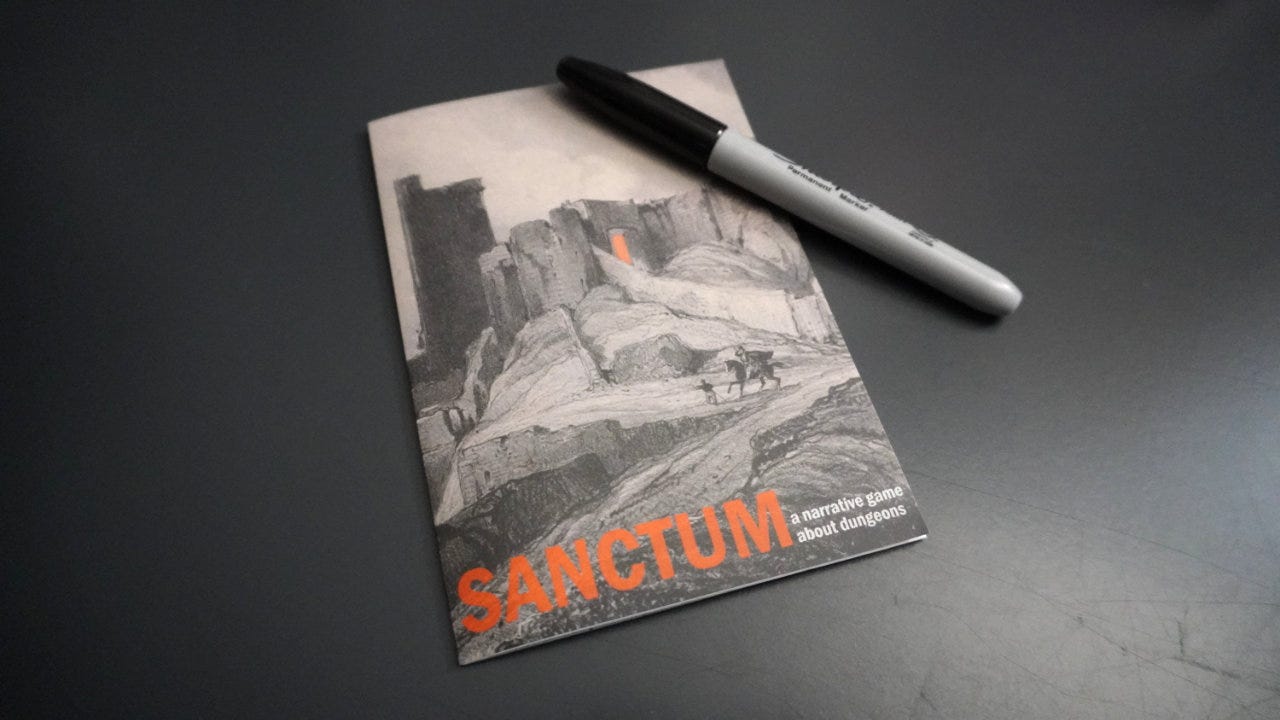
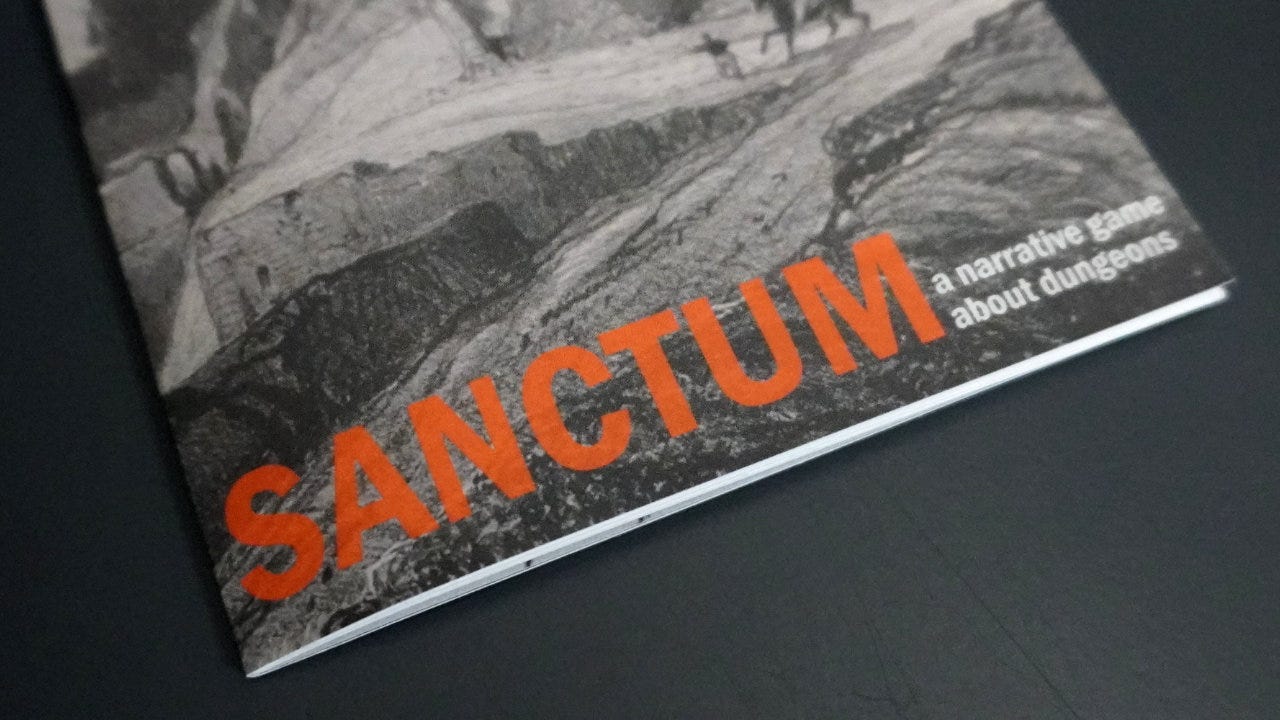
With writing and layout by James Pianka, Sanctum (PDF, Print) is a “no-prep, all-verbal storytelling game” for three players, although it can be played with anywhere from one to four players with some modifications.2
Over the course of three acts, players will create a story about a dungeon and the adventure that happens within it.3 Players take turns clockwise around the table, each one adding more detail to the current act:
Act 1: Dungeon (site, prize, guardian)
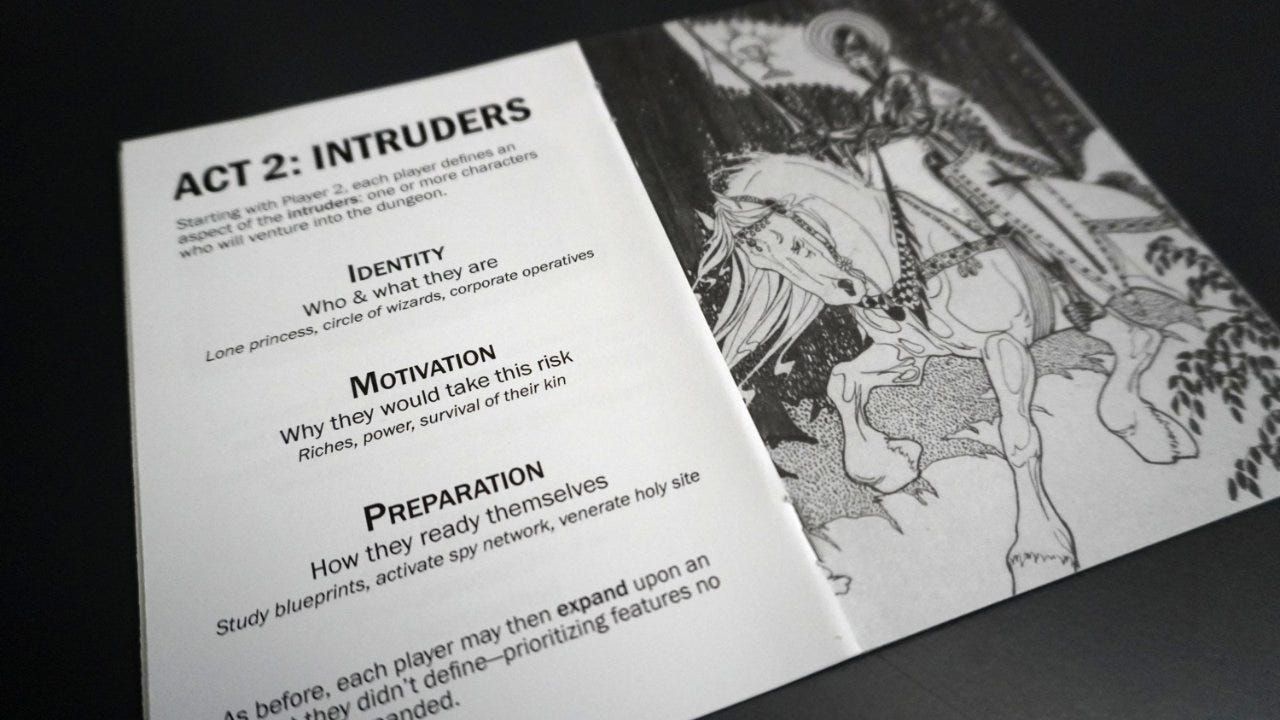
Act 2: Intruders (identity, motivation, preparation)
Act 3: Adventure (approach, complication, resolution)
The first player’s task is to define where the dungeon is location or what it is (i.e. “the site). Dungeons aren’t just tunnels underground with stone floors and walls filled with skeletons and green slimes. It could be a cyberpunk corpo building, a pirate ship, or an alien fortress. The goal is to, as the game emphasizes, “stay high-level and archetypal, leaving room for development.”
Subsequent turns have players defining the prize (e.g. a chest of gold) and the guardian (e.g. a stone knight).4 Again, the point is to keep it broad and vague — not to provide overly detailed descriptions.
Expanding on the ideas of others
There’s no dice rolling, no combat results tables, and indeed very little mechanical structure in Sanctum. It’s a very simple game.
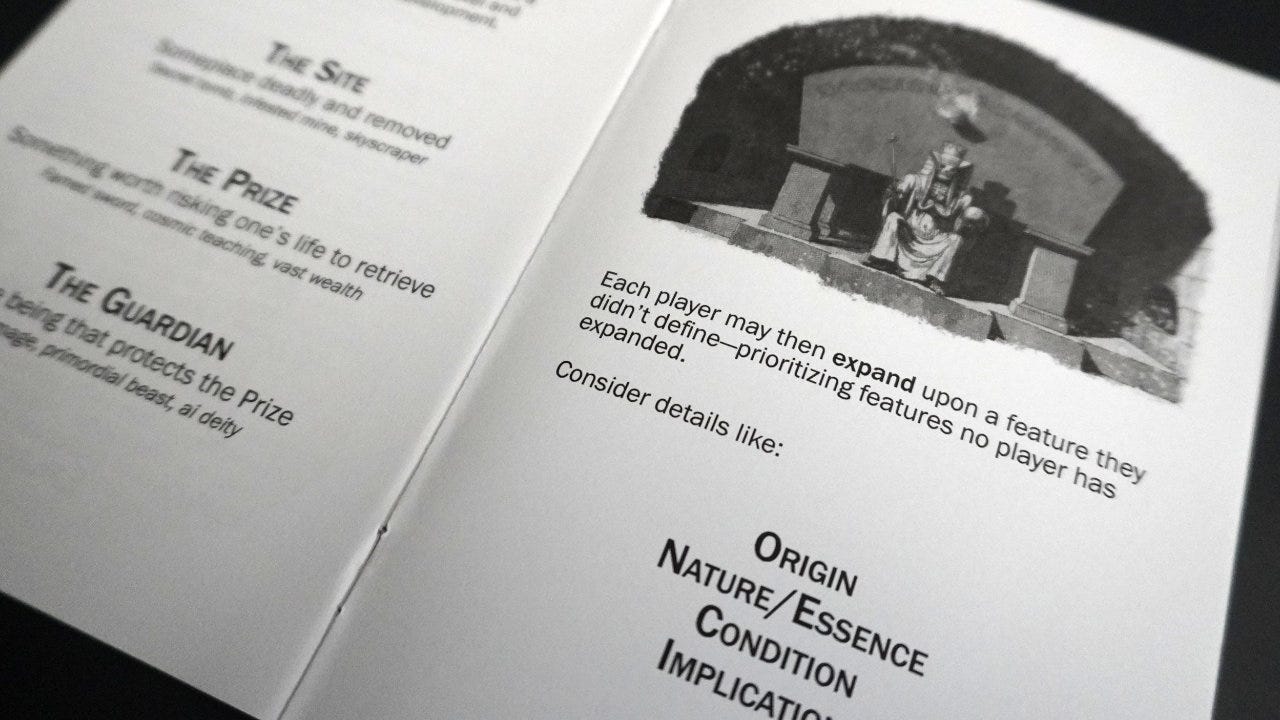
Where Sanctum has an interesting twist is that it structures the game so players expand on the ideas of others. After, for example, players have broadly defined the site, prize, and guardian of the dungeon in Act 1, players then take turns expanding those ideas.
They aren’t expanding their own features, however. Instead, they are expanding a feature defined by someone else: “Each player may then expand upon a feature they didn’t define — prioritizing features no player has expanded.”
One player says that the intruders (those who enter the dungeon) are goblin mages and they leave it at that. The next player says they are motivated by finding a relic to save their clan. The third player adds that the mages acquired a map, key, and magic skull to prepare for their adventure.
These are just a few aspects of the intruders. Each one is then expanded by another player, giving a background and names to the goblins or explaining the purpose of the skull.
Making storytelling more accessible
In my experience, many collaborative storytelling games have each person add a fully-defined “thing” to the game. They might add a whole building (and its history) to a city or create an entire monster with a full description. Particularly for those new to storytelling games or when playing with strangers, this can be a real challenge.
By having each player just add a very small piece of the story and keeping each piece intentionally broad, it reduces this burden on players.
Many times, it is easier to riff on someone else’s idea and expand it than create one of your own. Again, this reduces the potential stress of playing a very open-ended storytelling game.
Conclusion

Some things to think about:
Structure, not mechanisms: Sanctum could have employed more mechanisms to try to accomplish the same goal: dice-based turn order, cards, tokens, trackers. Instead it simply structures the game in a way that facilitates a certain kind of play — an important lesson that more mechanisms isn’t always the answer.5
Three acts: Ensuring that your game has a game arc is critical. Sanctum makes it explicit and part of the game. It is quite literally divided into three acts.
Simplicity in design: Sanctum is by no means a “big” game that will last for hours. The introduction says it should take “no more than 30 minutes,” although I can see it going longer that (in a good way). It’s a good example of how a simple game can still be fun and lead to an interesting, emergent story.
What do you think? Have you played a storytelling game like Sanctum before? If so, let me know in the comments.
— E.P. 💀
P.S. Want more in-depth and playable Skeleton Code Machine content? Subscribe to Tumulus and get four quarterly, print-only issues packed with game design inspiration at 33% off list price. Limited back issues available. 🩻
Skeleton Code Machine is a production of Exeunt Press. All previous posts are in the Archive on the web. Subscribe to TUMULUS to get more design inspiration. If you want to see what else is happening at Exeunt Press, check out the Exeunt Omnes newsletter.
Skeleton Code Machine and TUMULUS are written, augmented, purged, and published by Exeunt Press. No part of this publication may be reproduced in any form without permission. TUMULUS and Skeleton Code Machine are Copyright 2025 Exeunt Press.
For comments or questions: games@exeunt.press
Rather than massive ad spend and non-stop social media posting and algorithms.
At 1 player, Sanctum is essentially a solo journaling game. At 4 players, it is recommended that one of the players acts as a Facilitator rather than a regular player.
There’s also an Epilogue at the end of the game which is optional, but I would recommend always adding it. Instead of using the turn structure of the three acts, the epilogue is created as a group. It’s a chance to wrap up the story and add some cognitive closure.
This reminds me a little bit of the 5 Room Dungeon concept as explained by Johnn Four.
And before you say, “But EP, the structure of the game IS a mechanism,” yes, you are certainly welcome to that opinion. That is not how I’m using that term. ;)
building on each other's ideas is so much fun :D i love games that encourage that :) and it's something i tend to bring in to other games i play, even if not explicitly stated ^^ somewhat relatedly, i had an amazing session of one of the tours i'm running of Under Hollow Hills, the Baker's fairytale circus game, where we talked out-of-character for about an hour for one play one of the characters made "seeing through" an NPC, where we really did just that :)
(that play, one of the Lostling's [a human who came to fairyland a long time ago and barely remembers the mortal earth any longer], is one of my favourites in the game –
"When you see through someone, roll. On any hit, call a quick break in play
and talk them over with the MC and your fellow players. See if you can
collectively figure them out in symbolic or metaphoric terms: not only who
are they really are, but what do they represent, what do they mean in the
game. Take these insights back into play with you. On a 7–9 hit, they realize
that you’ve seen through them, and can react accordingly. On a 10+ hit, they
don’t. On a miss, ask the MC what goes wrong. Perhaps they’ve drawn you in
somehow instead.")
This rocks—I'm a big fan of narrative games like this that give players a skeleton to hang their story on. (Like my own Roguelike, for two players: https://majcher.itch.io/roguelike-duo)