
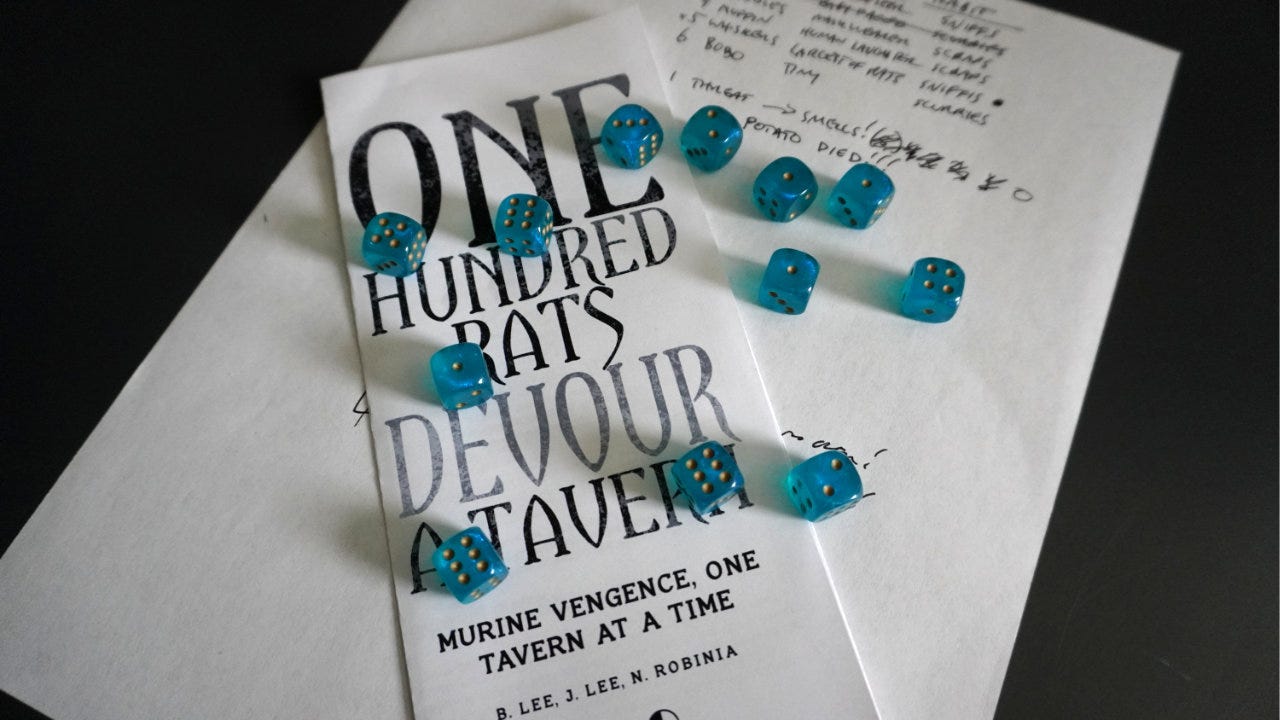
The jam is upon us!
Unknown Dungeon’s One-Page RPG Jam 2026 is happening right now.1 It runs from July 12 through August 16, 2026, giving you more than 25 days to make a weird little game to submit to it.
It’s a perfect time to go through the submissions from previous jam years and get some inspiration. This week we are looking at one from last year’s jam called One Hundred Rats Devour a Tavern. It has a fun theme, tight core game loop, and uses an interesting way to generate a map.
One Hundred Rats Devour a Tavern
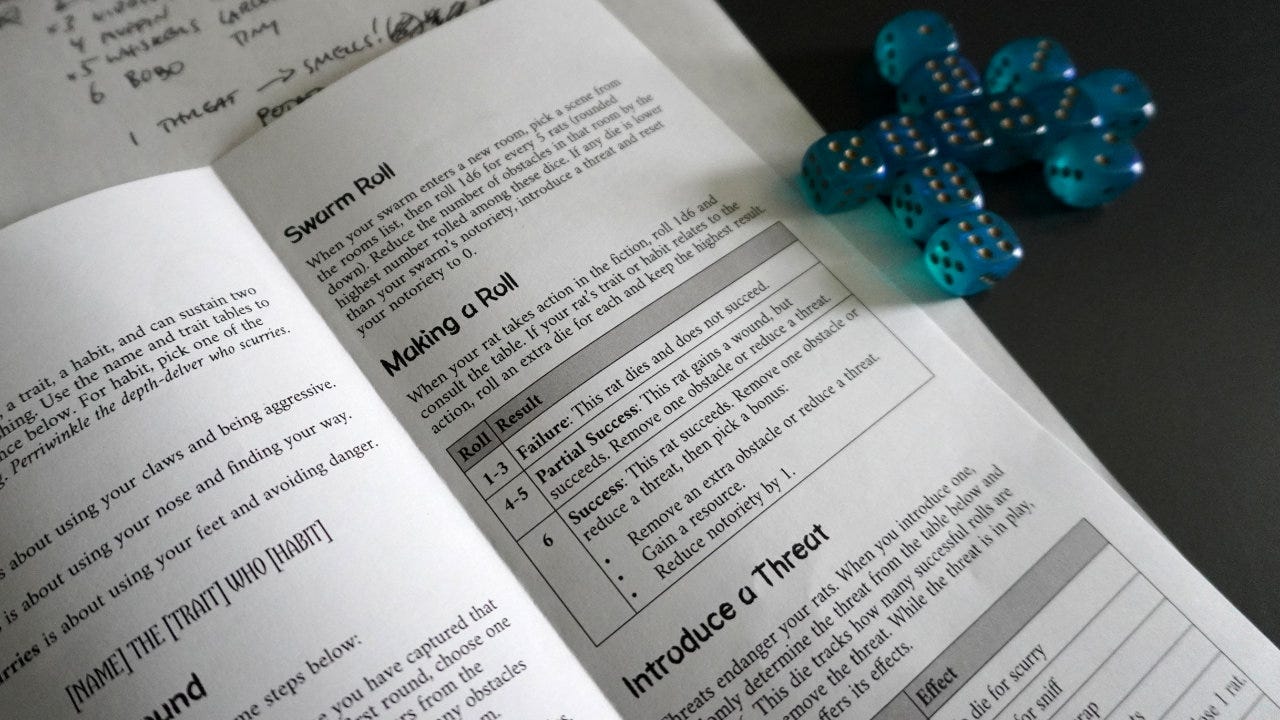
One Hundred Rats Devour a Tavern is written by B. Lee, J. Lee, and N. Robina. It is published by The Ravensridge Press.2 The hook is simple and effective:
“You are a sentient swarm of vengeful rats. For too long have your kind been trapped, kicked, poisoned and killed. It’s time to fight back. This tavern has been unkind to your kin, but now it’s time for revenge. Cause havoc and repel the foul humans.”3
Rather than the player assuming the role of a single entity or character, they instead play as a group of characters. Each game has the player rolling up five new rats, each with a name (Potato), trait (baby-faced), and habit (scurries).
The core game loop involves choosing the next available room of the tavern and checking for obstacles and threats. Obstacles could be something falling over or the humans launching a counter-attack. Threats are trickier and apply de-buffs.
Your rats can then take turns attempting to beat obstacles or reduce the threats by rolling dice. It’s a harsh system where rolling a 1-3 results in not only failure but the death of a rat. My poor baby-faced Potato died in the first room while trying to reduce the threat of “delicious smells” coming from somewhere in the tavern.
The rats must be fed with available food (or starve and die), and then the process continues. The goal is to conquer each room of the tavern and “burn it all to the ground.”
Making a map with dice
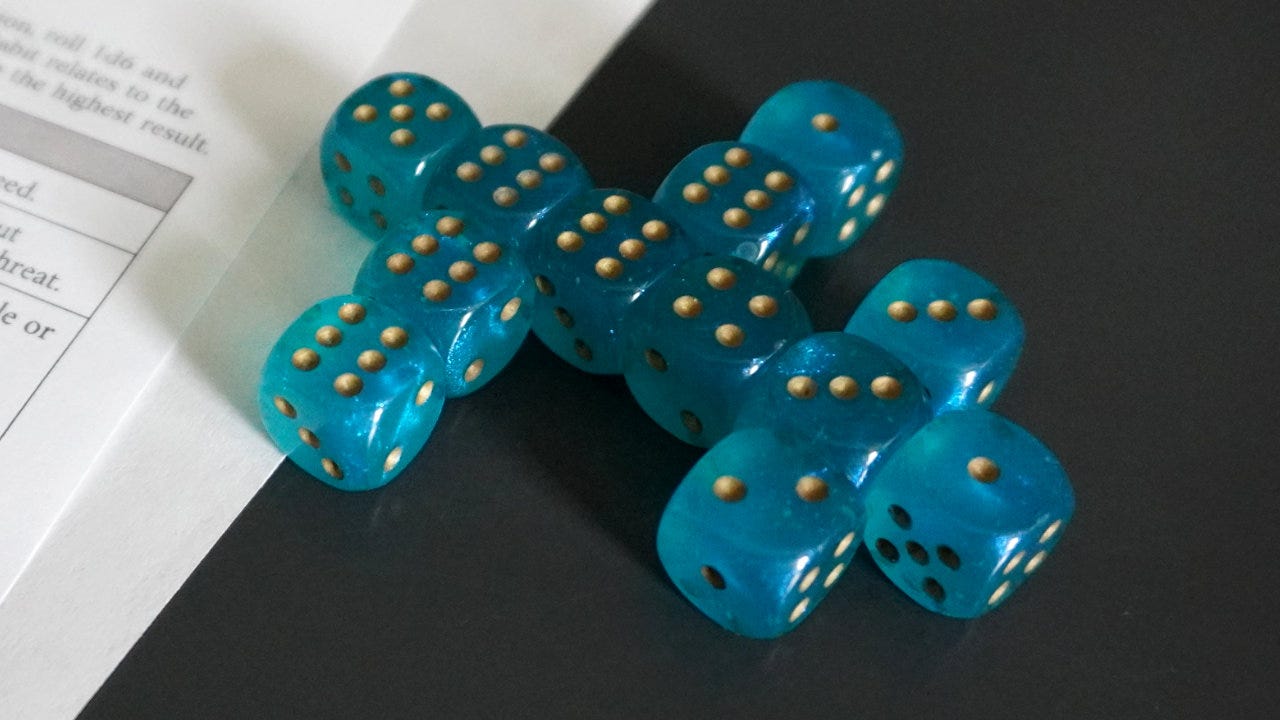
I found the process for making the tavern map to be particularly interesting. Not only because it was quick and easy, but also because it could be explained in the very tight space of a one-page RPG.
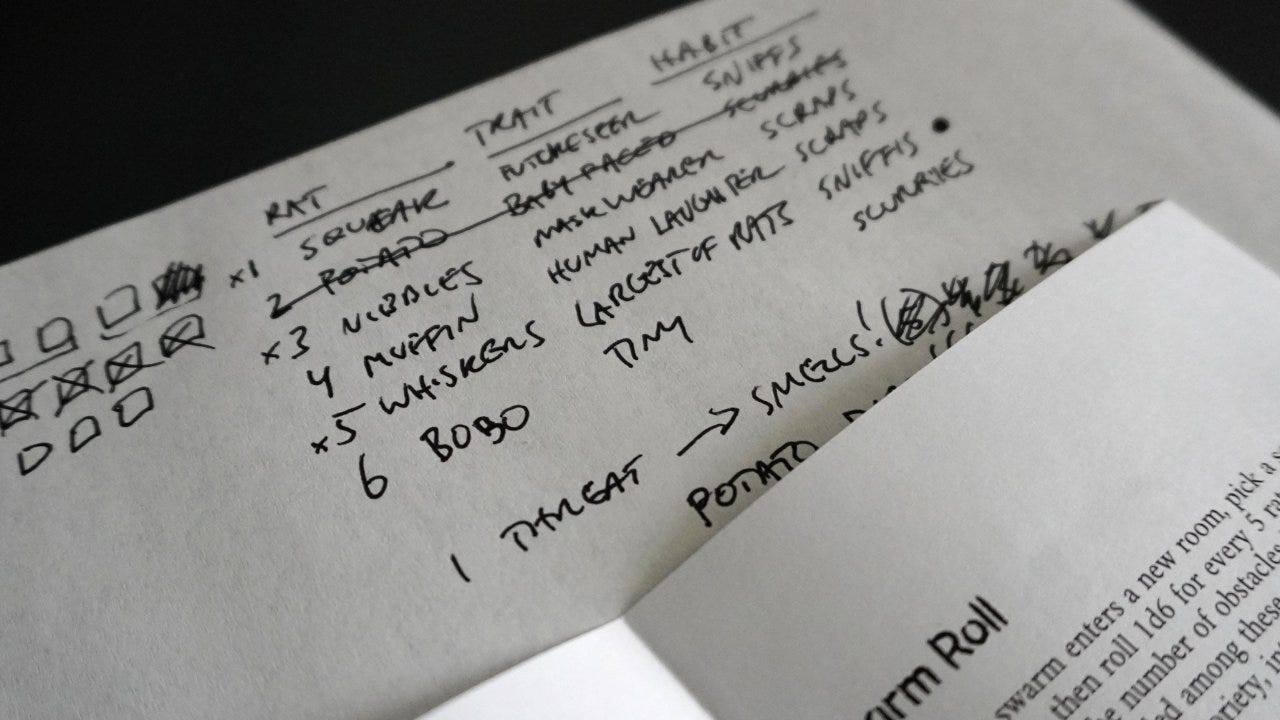
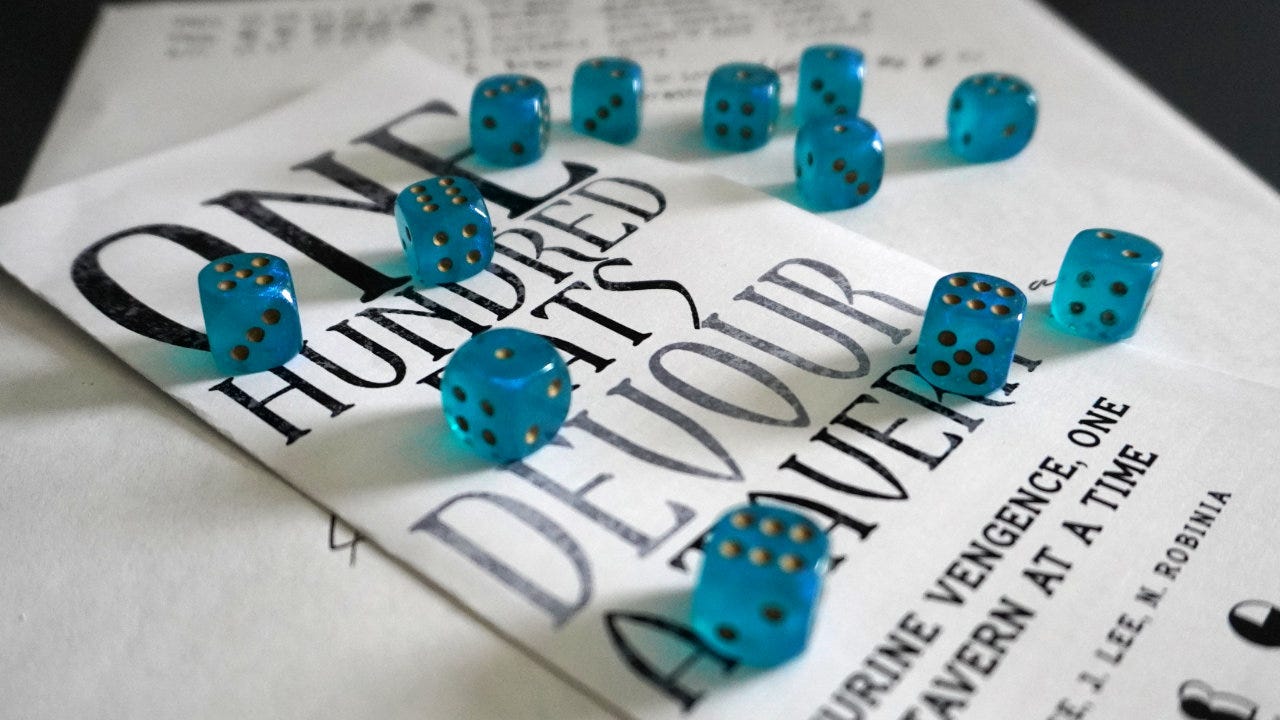
After rolling 12d6, they are placed on the table following some specific rules:
A new die must be placed adjacent to a die with the nearest number of pips.
Dice with 1 pip are placed last and can’t be placed adjacent to another die with just 1 pip.
If a die can’t be placed, it is removed from the game.
Each die placed in this way represents a room in the tavern. For example, 1s are entrances and 5s are kitchens. Four dice are added after the random ones to ensure that there are at least two entrances, one kitchen, and one larder. The full tavern map, therefore, has 16 rooms at the start of the game.
Generating dungeon maps
I’ve written about the challenges of generating dungeon maps before, including methods that involve rolling dice. Dark Fort is a good example where you roll for the room contents, shape, and number of exists.4 It’s an easy method that is quick to use.
In that article, I also looked at card-driven rooms, card grid exploration, and custom tiles (e.g. geomorphs). Each has its own pros and cons.
The dice method in One Hundred Rats Devour a Tavern avoid many of the cons listed:
It doesn’t require custom components (e.g. tiles or special dice).
It avoids excessive dice rolling.
Dead ends are unlikely.
The immediate problem I thought of was if you don’t roll any 1s, there would be no entrance. That was easily handled by the included rule where four dice are held back and set to specific values (1, 1, 5, 6).
The simple placement rules ensure that the highest value rooms are toward the center of the tavern while lower value (and therefore lower risk) ones are toward the edges.5
I’m not sure if this dice-based map generating system is inspired by another game, but it’s the first time I’ve seen something like this. It’s quite interesting!
Conclusion
Some things to think about:
Generating maps: Having the player create a dungeon map is a tricky task. While it increases replayability, it also increases the risk of burdensome mechanisms or suboptimal (broken) maps. The method above seems to be a good solution.
Core game loop: One thing I appreciate about One-Page RPGs is that it forces designers to be clear and explicit about their game’s core game loop. The game is distilled down to its essence on a single sheet of paper. It can, however, be expanded later — as is being done with One Thousand Rats Devour a City.
Playing as many characters: I’ve been fascinated by TTRPGs where you play as a group or team of characters rather than a single one. Playing as a swarm of rats (many of whom will die quickly) is a good example.
What do you think? Have you seen this map-making method used in other games?
— E.P. 💀
P.S. Want more in-depth and playable Skeleton Code Machine content? Subscribe to Tumulus and get four quarterly, print-only issues packed with game design inspiration at 33% off list price. Limited back issues available. 🩻
Skeleton Code Machine is a production of Exeunt Press. All previous posts are in the Archive on the web. Subscribe to TUMULUS to get more design inspiration. If you want to see what else is happening at Exeunt Press, check out the Exeunt Omnes newsletter.
Skeleton Code Machine and TUMULUS are written, augmented, purged, and published by Exeunt Press. No part of this publication may be reproduced in any form without permission. TUMULUS and Skeleton Code Machine are Copyright 2025 Exeunt Press.
For comments or questions: games@exeunt.press
Exeunt Press / Skeleton Code Machine is not affiliated with Unknown Dungeon or the One-Page RPG Jam. I’m just a fan.
Ravensridge Press also publishes Cartograph: Atlas Edition and Caught in the Rain.
Who wouldn’t want to play as a swarm of vengeful rats?
You’d think this would lead to an overly random dungeon, but the game can be surprisingly thematic.
This may not always be the case, but it is how it worked out in my initial play. I placed dice from highest to lowest, thinking that was the rule. It’s not, but might yield the best results.
this seems like a lot of fun :D i love rats :) seems like a really neat way of making a dungeon, indeed!
only kind-of similar thing i can think of is some games i've seen where you roll a bunch of different kinds of dice at once onto a sheet of paper, and you create a map from their positions on the paper, the type of location being determined by the numbers you get (on which type of die)! i believe Lamplighter's Festival would be one such example... (haven't played it yet, but i have it in my collection from at least one charity bundle...)
playing as multiple characters is definitely a fun idea! reminds me of another thing i got from some charity bundle... a paladin oath for DnD called "Oath of the Hive", where you play as a swarm of bees!
(a small gripe, is the use of "sentient" in the quote from the game [since you only quote, definitely not blaming you, and it's misused very frequently as well] – all rats are already sentient! i guess, to be charitable in my interpretation though, if they are referring to the swarm as its own entity, then i'm on board :)
[otherwise a 'better' word might be "sapient", or "with human-like intelligence" to be extra clear, if that is what is meant... "sentience" is the capacity for feelings and sensations, and something we humans share with all our fellow animals :D but like is pointed out in the wikipedia page for "sentience", it has often been used interchangably with eg "sapience" in for example science fiction, somewhat regrettably in my opinion, since it might cause people to underestimate what other animals are capable of... {and to be clear, i very much dislike implying there is any hierarchy in intelligences – hence "human-like" and not "human-level" above! we are simply differently intelligent to other animals, being adapted for different things ^^}]
Great article. That seems to be a clean way to generate a dungeon.