
Last week we looked at the only Richard Garfield game that Richard Garfield still routinely plays — SpyNet. Specifically, we explored how it creates incentives to keep the market from clogging. Be sure to read the comments for more about Dutch auctions and Winston drafts!
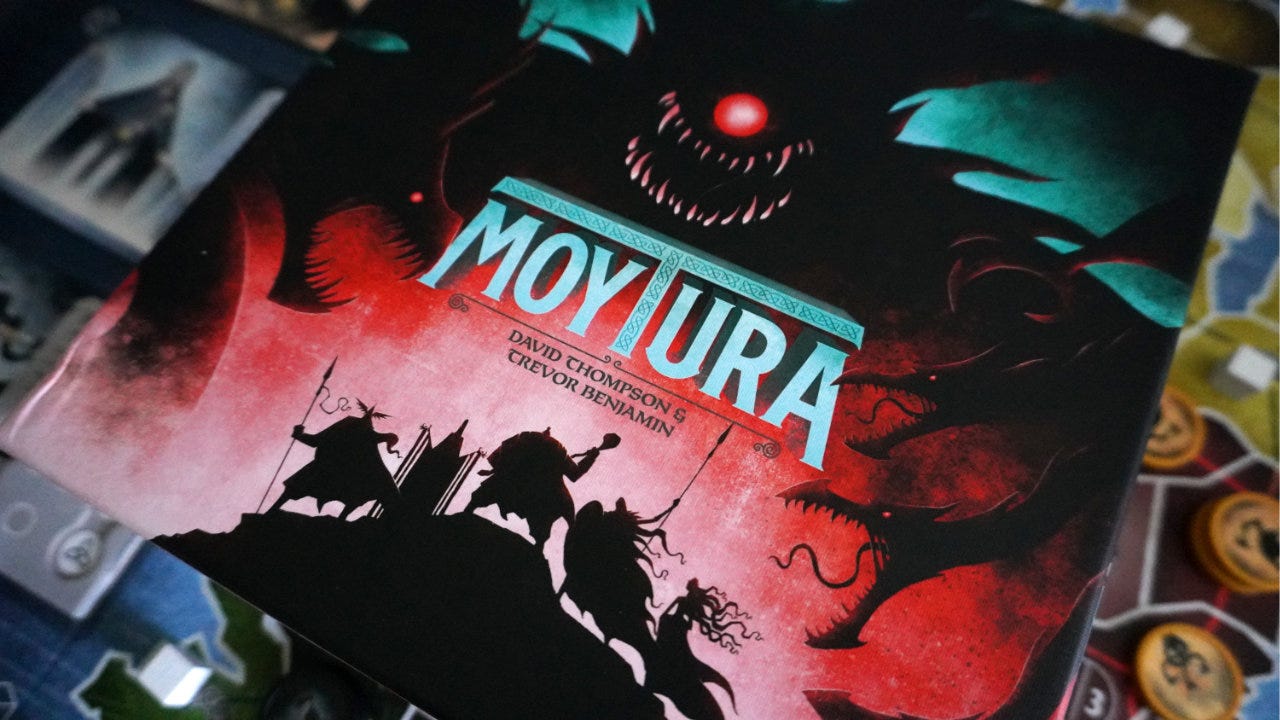
This week we are digging into another board game, but this one was just released. Moytura by David Thompson and Trevor Benjamin uses one simple rule to transform the game from a routine area control battle into something unique.
A note on area control vs. area majority
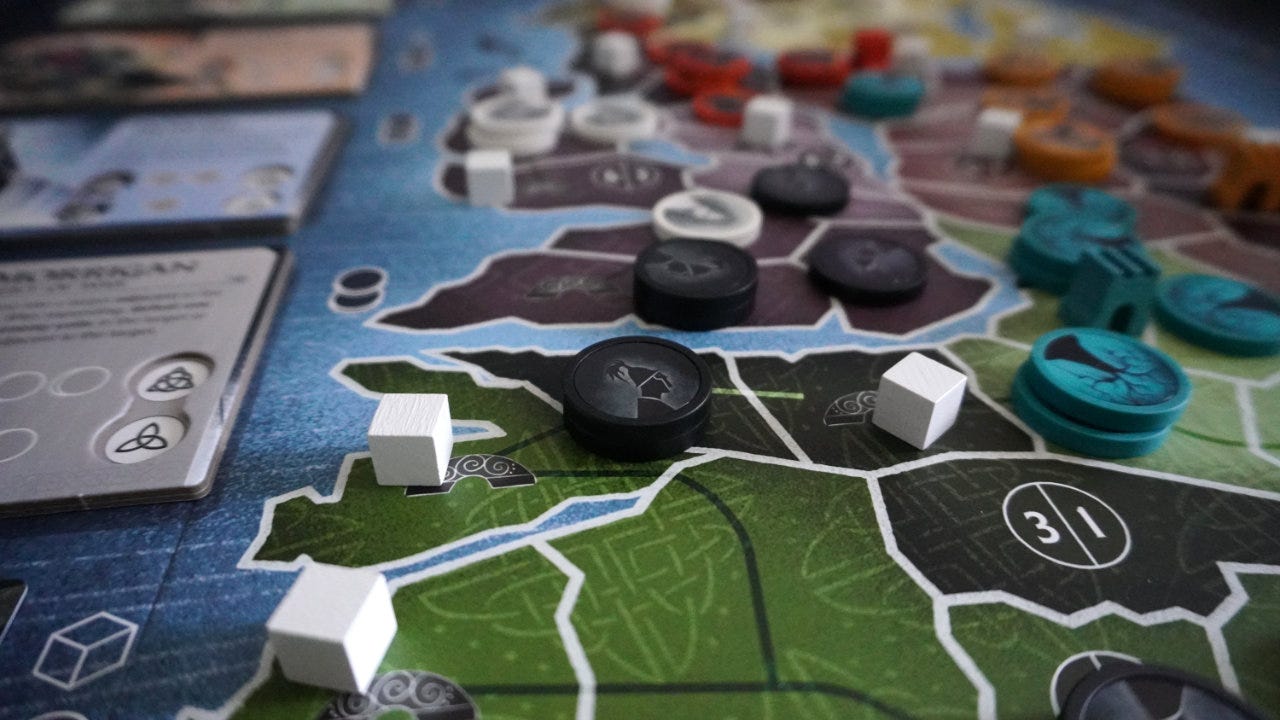
I’ve written before about the differences between area control, area majority, and area influence games. These terms include similar and overlapping mechanisms, but in short area control implies that total domination of an area is required. Area majority is similar but the most powerful faction in the area is considered first, but there might be second or third place rewards as well.
Moytura would most accurately be called an area majority game, but I tend to use the terms interchangeably. Given a choice, I prefer to just call them area control games. That’s what I’ll do in this article.
Battling for control of ancient Ireland
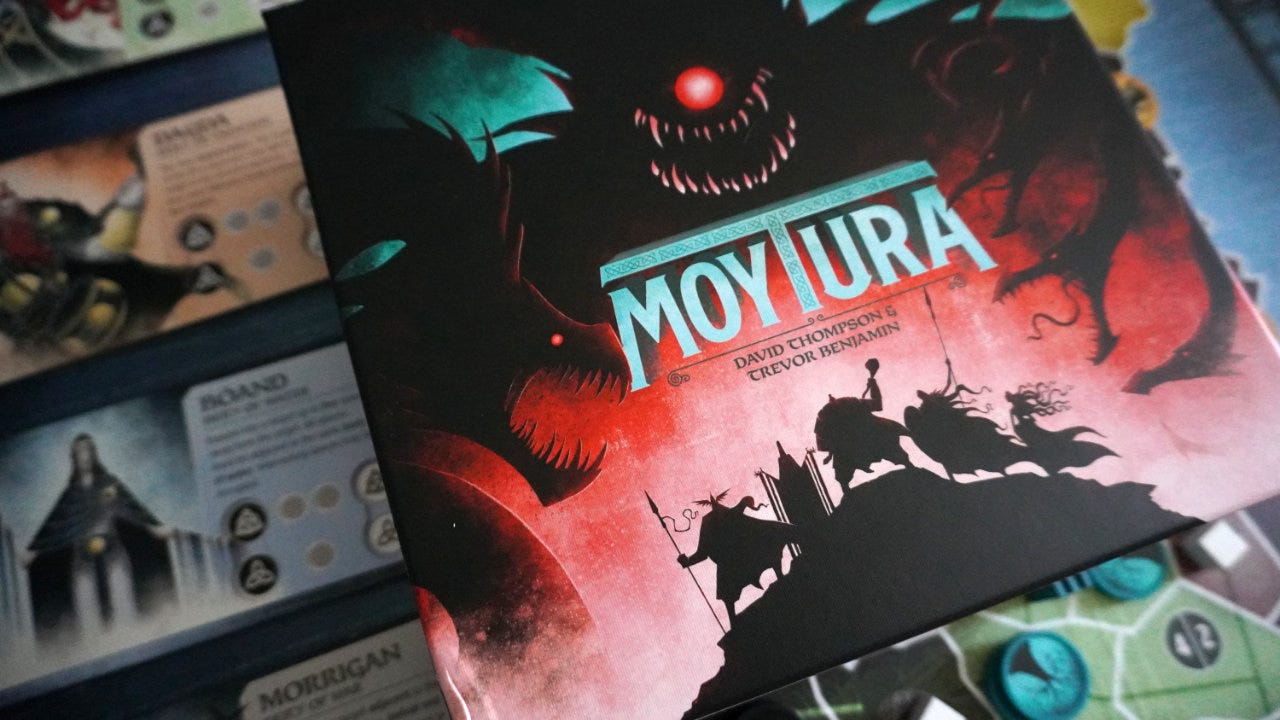
Moytura (Thompson & Benjamin, 2026) is the third in the Mythos Collection of “2-player games of strategy and mythology” from Bitewing Games.1
“The battle of Moytura has begun. As a leader of the Tuatha Dé Danann, spread your influence across the land to succeed in your quest to become High Ruler of Ireland, invoking the powerful deities of the Tuatha Dé Danann to aid you in your cause with their command of water, travel, war, and creation — but the road will not be easy for in your path to legend stand the sinister Fomorians and other mythical beings hungry for battle, not to mention a rival clan with ambitions of their own. Steel yourself and prepare for a legendary struggle.”
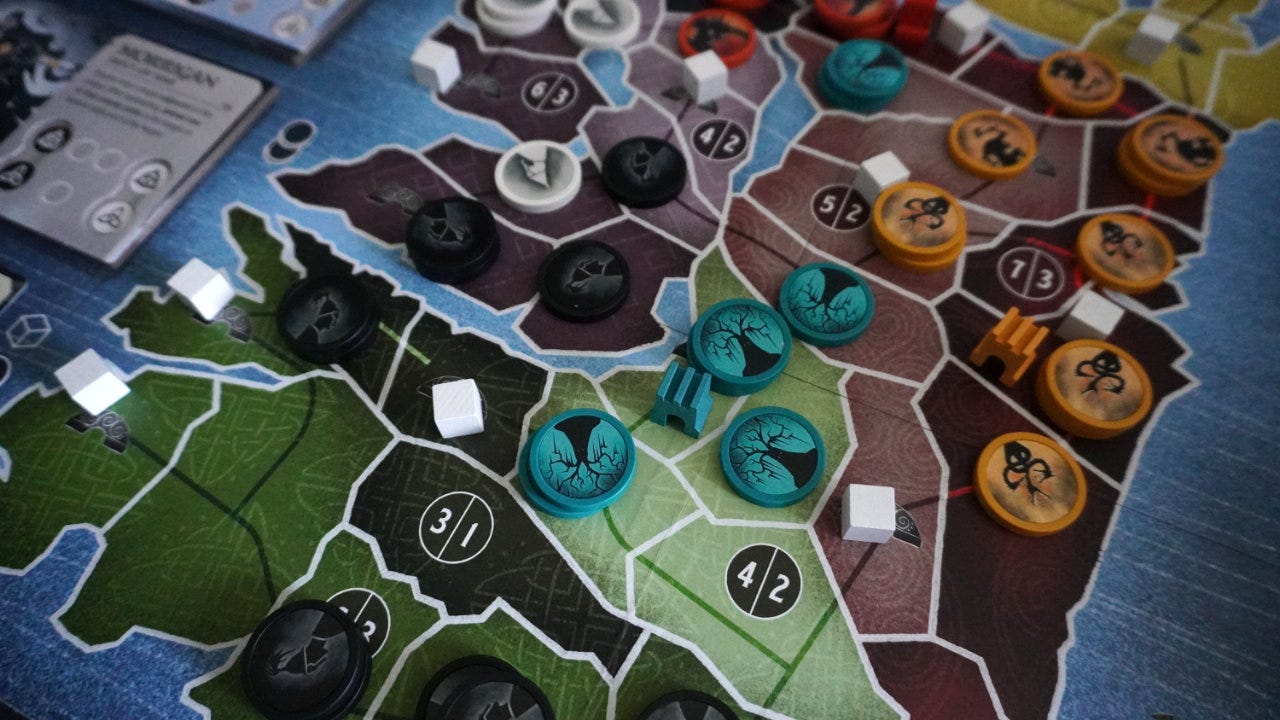
Play takes place on a map of mythical Ireland split into color-coded regions. Each region is subdivided into a number of spaces.
One player is the white faction and the other is the black faction. There are also three other Fomorian factions on the board controlled by the game. Each round, players select one of the five available deities which determines the type of action they can take. Eriu allows your followers to expand two spaces away. Boand allows expansion up to five spaces away but only when connected by water. Morrigan automatically defeats two enemy units when expanding. The cost of selecting and upgrading these deity abilities changes each round.
After each player has taken their turn, the Fomorians expand across the map based on a card draw. Originating from their largest group, they spawn new groups of 1 or 2 more Fomorians in multiple directions.2
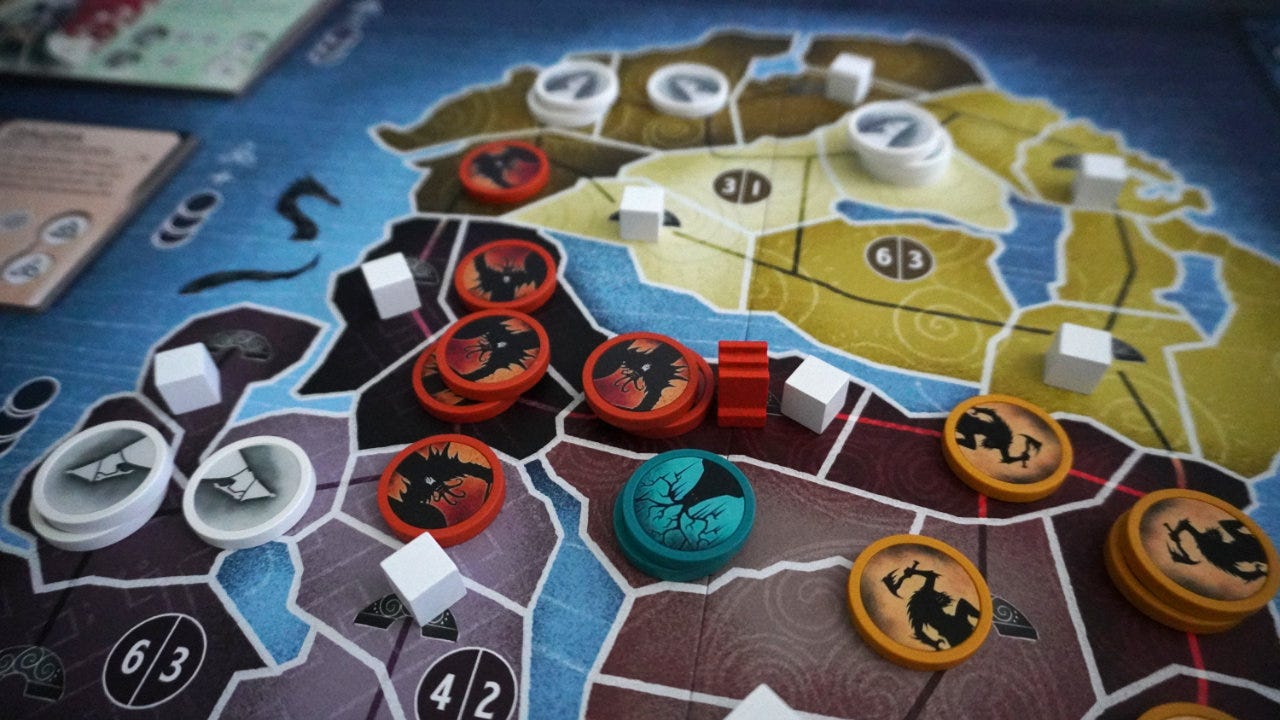
Victory points are awarded only twice during the game — after Round 5 and after Round 10. The faction with the majority control in each region gets the most VP. A smaller number of VP is awarded to the second place faction.
The game-controlled Fomorians can gain points and even win the game in Moytura. This means it’s possible for both players to lose if the game ends with the Fomorians in the lead. So it’s a three way race for the entire game.3 It forces players to work together at least a little bit (similar to a semi-coop game) lest the Fomorians run away with the lead and they both lose.
That twist on the genre is worthy of exploration by itself. For me, however, the real twist is that players can’t attack each other directly.
No conflicts vs. the other player
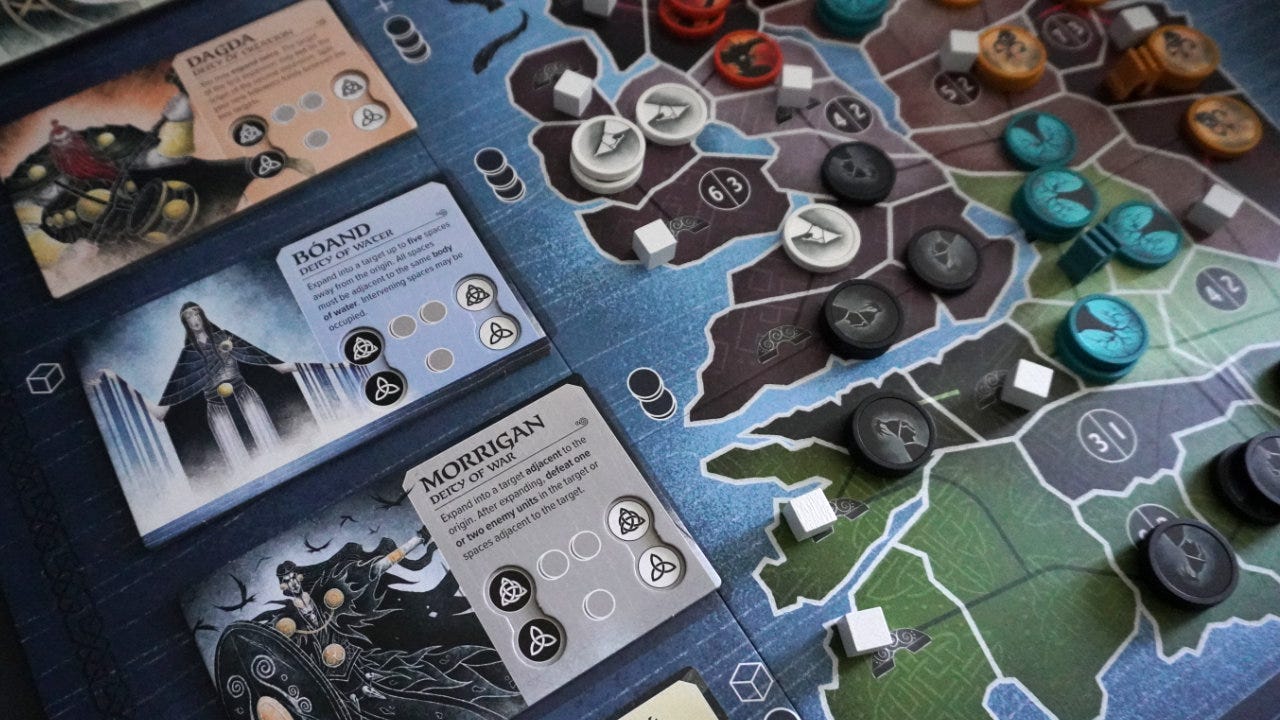
Area control games (similar to lane battlers) are rooted in conflict. Battling or having the ability to reduce the power of opposing factions is almost always a core part of the game. What would Blood Rage be without the Loki strategy? Would Rising Sun be the same without zero-luck combat?
It is, of course, present in Moytura as well. When player followers and Fomorians end up in the same space, a conflict occurs. Tokens are removed two at a time (one from each faction) until there is only one faction left.4
What you can’t do, however, is start a conflict with the other player (emphasis in the original):
3. Expand
Choose an origin space to expand from and a target space to expand into. The origin must contain one or more of your followers. The target cannot contain either player’s followers or the enemy’s stronghold marker. It can contain enemy units.5
I’ll admit that we had to re-read that a few times during our first play of the game because it was so shocking. What do you mean I can’t attack the other player? Doesn’t that mean they will just expand unopposed for the entire game?
Area control without direct combat
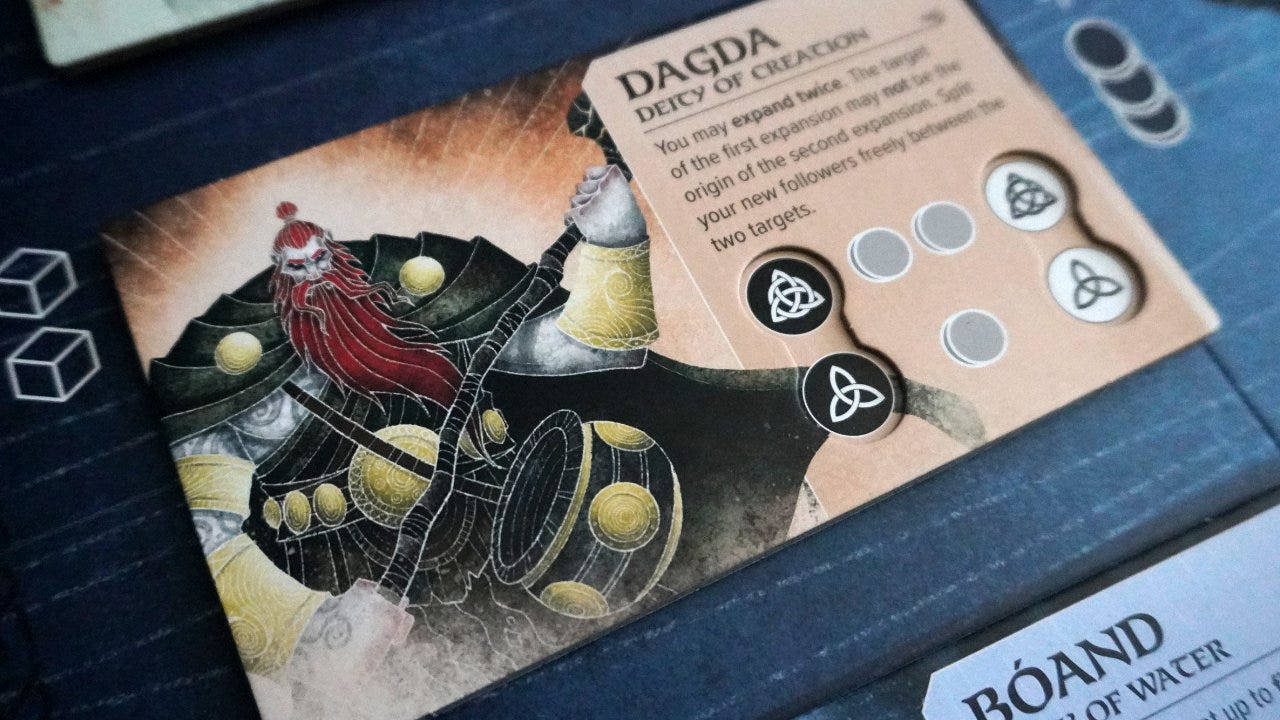
This is the most interesting aspect of the game for me: You need to keep the other player in check, but you can only ever act indirectly.6
So instead of launching an attack to remove your opponent’s followers (tokens), you need to deny them victory points in more subtle ways:
Expand into their regions to prevent them from getting the first place victory points. Or, if possible, prevent even second place.
Intentionally allow the Fomorians to expand so they steal the majority from your opponent.
Expand and remove Fomorians through conflict to split their forces, causing them to expand into your opponent’s regions instead of yours.
Select the deity (action type) they want so that it rotates to the top, most expensive position — snatching it out of your opponent’s reach for the round.
All of the above are ways a player can exert influence on the game state without direct conflict with the opposing player. Throughout all of these methods, white and black factions never directly expand into each other’s spaces.
No movement after expansion
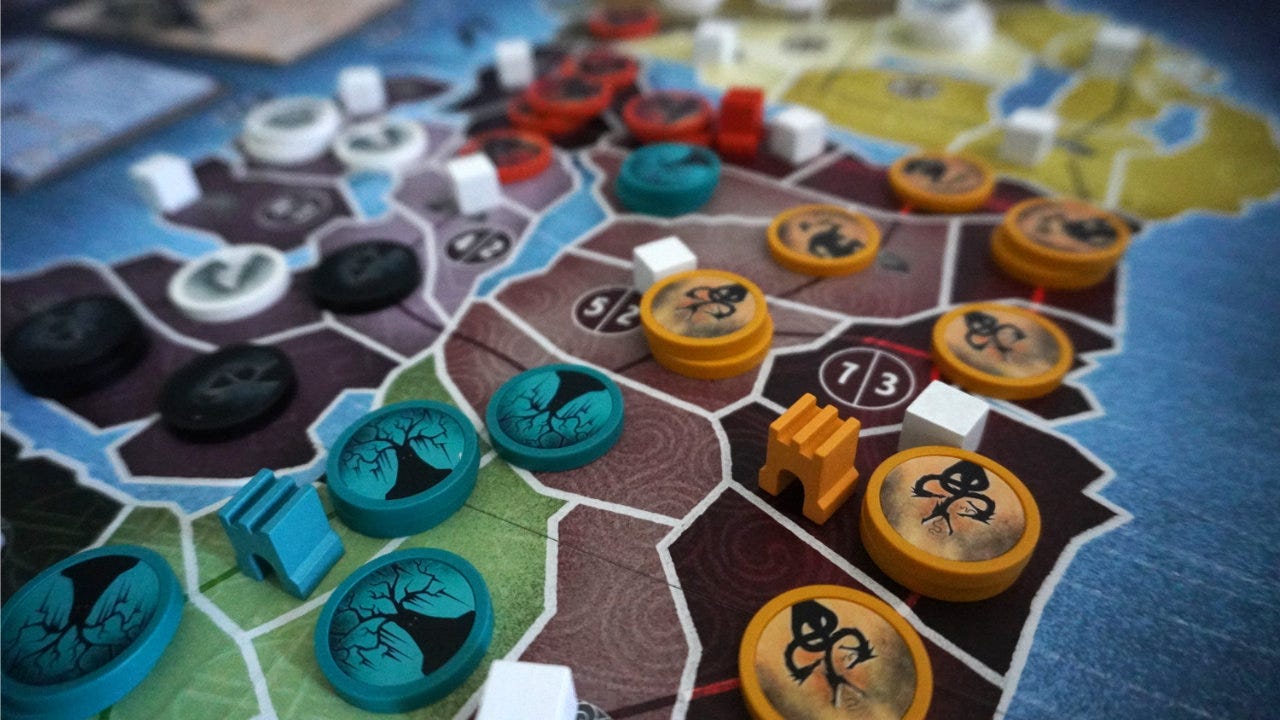
There is one more design aspect that makes the game even more challenging: There is no movement or “marching” mechanism in the game! Once they are placed, you can’t move your followers.
This means you can effectively (but temporarily) block your opponent from expanding into spaces on the map. The tough decisions come, however, in deciding how many followers to commit to a space. They are a limited resource and not to be wasted. Do you drop five followers so they will survive against potential Fomorian conflicts? Or just drop one and hope for the best?
Challenging assumptions of the genre
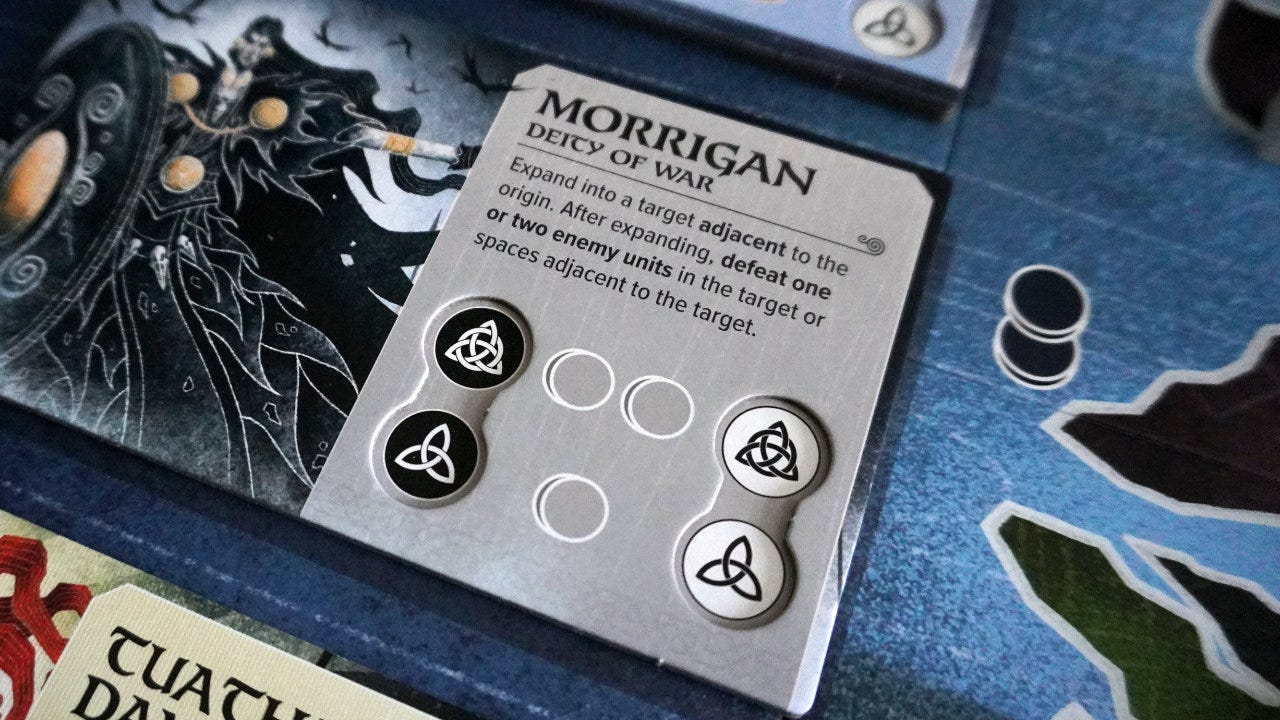
David Thompson and Trevor Benjamin are well-respected masters of the conflict game and area control genres.7 Perhaps this is how they were able to take the genre in new directions by subverting some of the elements I would have assumed were necessary: direct player conflict and unit movement.
Although the games are completely different, it reminds me of how The Skeletons is a TTRPG without a core resolution mechanism (e.g. dice rolling). I’d have assumed that every TTRPG had to have such a thing, but removing it creates a fascinating new game.
Knowing the conventions and assumptions of a genre allows you to break them: Can I make a dungeon crawl without combat? Can I make a progression system without levels? Can I have a wargame without direct conflict?8 What if you couldn’t move your units?
In fact, I’d offer this as an exercise this week: Choose your favorite genre of tabletop game and try to list out some of the assumed components. Examples might be combat in dungeon crawls, resources in eurogames, or cards in trick-taking games. Then think about what a game would look like if you inverted some or all of those assumptions!
Conclusion
Some things to think about:
Area control never gets old: At least it never gets old for me. Every time I think the genre might stagnate or that I’ve seen it all, a new game comes along that reinvigorates my interest in it. Never assume a tabletop game genre “has been done already.”
Lean to identify assumptions: If you play a lot of games, you can probably accurately describe genres: trick-taking, area control, TTRPG, and so on. It is a tougher challenge to make an actual list of assumed components — items most people would believe are required to be present in a game of the genre.
Then break the conventions: I continue to believe that listing the assumptions and then trying to subvert some or all of them is a great way to spark design inspiration. You don’t need to implement all the inversions. Even just thinking about them might be enough to get you started on something unique.
What do you think? Have you play Moytura or a game that uses influence versus control when competing with other players? What other assumed components exist in wargames and area control games?
— E.P. 💀
P.S. Want more in-depth and playable Skeleton Code Machine content? Subscribe to Tumulus and get four quarterly, print-only issues packed with game design inspiration at 33% off list price. Limited back issues available. 🩻
Skeleton Code Machine is a production of Exeunt Press. All previous posts are in the Archive on the web. Subscribe to TUMULUS to get more design inspiration. If you want to see what else is happening at Exeunt Press, check out the Exeunt Omnes newsletter.
Skeleton Code Machine and TUMULUS are written, augmented, purged, and published by Exeunt Press. No part of this publication may be reproduced in any form without permission. TUMULUS and Skeleton Code Machine are Copyright 2025 Exeunt Press.
For comments or questions: games@exeunt.press
Bitewing describes the series as follows: “Bitewing’s goal for this line of games is to recruit the best 2-player game creators in the industry and assemble the most renowned line of 2-player games the world has ever seen. The Mythos Collection is made by and of legends.” The first two games in the series Illiad and Ichor (a Tiku reimplementation) were designed by Reiner Knizia.
Note that I didn’t have any good photos of the game I played, so I had to set it up to grab photos for this article. While I made an attempt to make the setup be accurate, it is not the result of actual play. I’m sure a particularly observant reader could find illegal or impossible follower and enemy placements in the pictures.
All three Fomorian factions are counted as a single faction for the purposes of scoring.
This is such a fast and elegant way to resolve conflicts in the game. I appreciate that in a game with this level of abstraction.
There is a large note on p. 6 of the rules explaining that Follower always refers to the black and white units controlled by the players. Enemy always refers to the third Fomorian faction made up of the three Fomorian clans. Enemy never refers to the opposing player.
If you’ve been reading Skeleton Code Machine for a while, you know that I love games where you influence the game state rather than directly manipulate it. The King is Dead is the clearest example of influence vs. control, but it appears in Pax Renaissance and Pax Pamir as well.
Although I think most players prefer Undaunted: Normandy, I continue to prefer Undaunted 2200: Callisto as the best game in the series and have written previously about how it uses negative optimization. I much prefer the theme and how the shooting starts almost immediately.
Twilight Struggle is another wargame without, in my opinion, direct military conflict.
i LOVE breaking expectations/assumptions like this :3 wonderful article, seems like a cool game! and the whole concept is indeed super generative ^^ fun exercise! although, right now, i only came up with examples i already have counterexamples to... would love to find something that hasn't already been challenged! (i guess, starting out more specific and seeing what you can break while still belonging to some smaller genre could be more "successful" in finding that, perhaps) anyhow, here's what i got on a quick think-through...
a few general TTRPG assumptions (with counterexamples):
- randomisation (see eg Belonging Outside Belonging/No Dice No Masters)
- playing a role (see eg worldbuilding games, ie Microscope, Exquisite Biome...)
- player-specific characters (see eg games with shared characters ie, [i was in a playtest of one not long ago, called Coven], Yazeba's Bed and Breakfast)
- one 'game-master' (see eg gm-less/gm-full games (like all the above), solo games...)
- binary failure/success (see eg PbtA, etc)
- rules (see eg lyric games)
- all players playing by the same rules (see eg You Will Die In This Place, Seven-Part Pact)
etc