
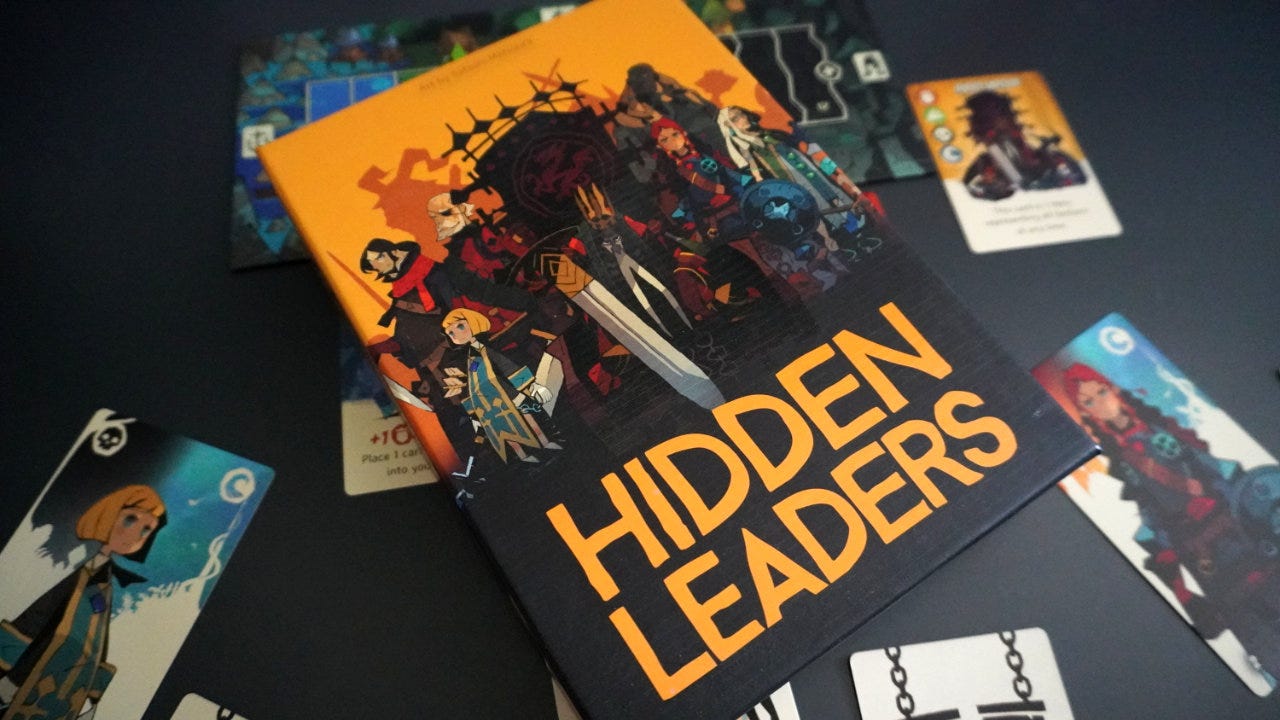
Tumulus 07 “Slay the dragon.” has shipped to all subscribers. If you are a subscriber, you should have received a shipping notification. Check your spam folder if you haven’t seen it yet. Also, Tumulus 06 “Hammer a nail in the coffin” copies are now available as back issues.
This week, the emperor has died and there’s a battle for power! Hidden Leaders can show us how tug of war mechanisms are perfect for games of influence vs. control.
Following the death of the emperor…
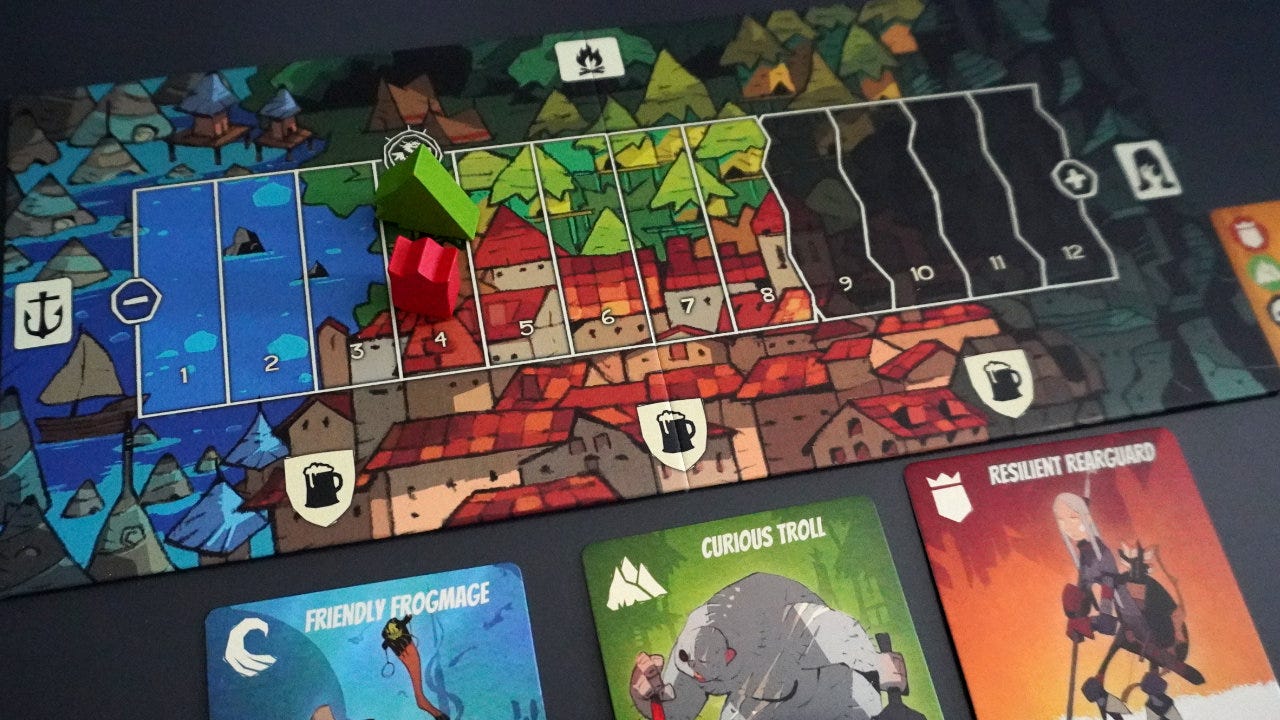
In Hidden Leaders (Stocker, Markus Müller, et al., 2022) the emperor has died and the kingdom has descended into turmoil:
The island of Oshra is in turmoil. Following the death of the Emperor, the conflict between the Hill Tribes and the Imperial Army escalated. While the Water People try to maintain balance between the old rivals, the Undead aim to escalate the war. All hope rests on the six children of the Emperor: Who of them will claim the throne?
Players become one of six Leaders who are each aligned with two of the four factions: Hill (green), Army (red), Water (blue), and Undead (black). During the game they will influence the power of the Hill and Army factions which will result in victory for one of the four factions.
The game is one of influence vs. control, a concept I’ve been playing with in the upcoming Proxwar Zero game I’m working on.1
Only players who are aligned with the winning faction can win the game.
If multiple players have the correct alignment, there are tiebreakers to determine a winner of the game.
Adding heroes to your party
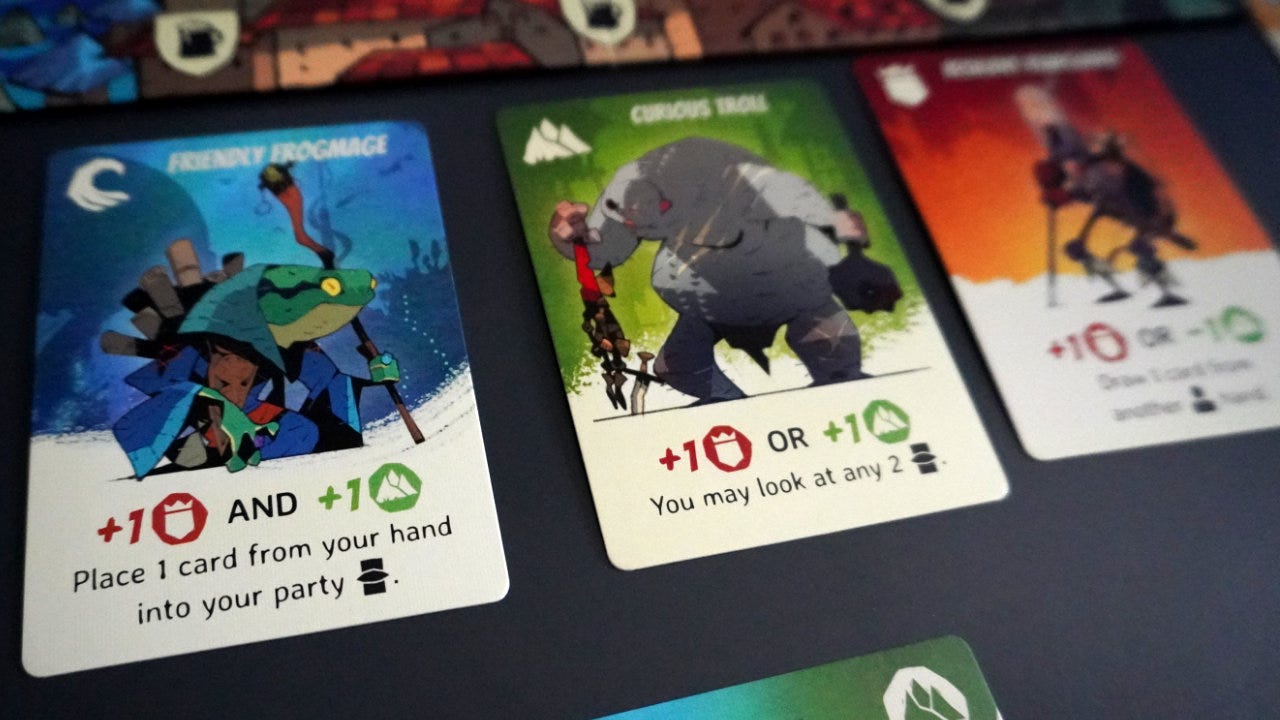
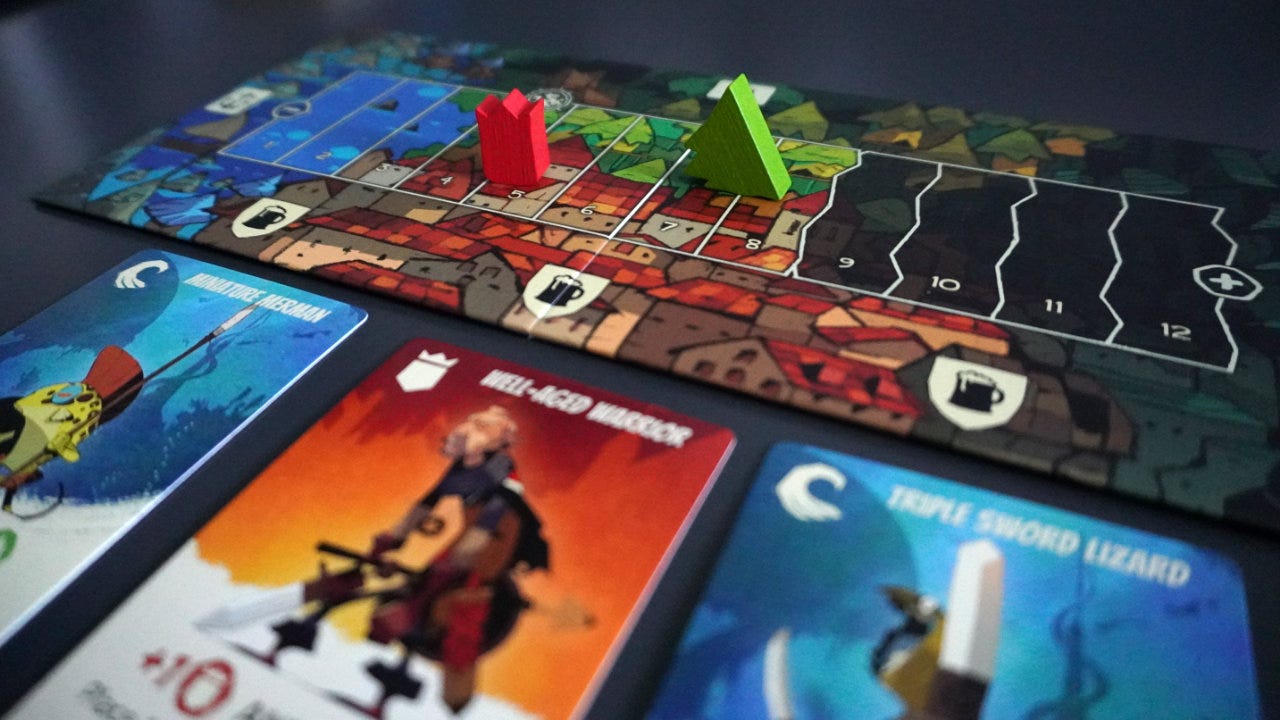
Hidden Leaders uses a double tug of war mechanism to track the power of the competing Hill and Army factions. They are represented by green and red tokens respectively on a board with 12 linear spaces.2 They both begin the game in the 4th space from the left.
On your turn, you play 1 hero card from your hand face up in front of you. These face up cards are called your party. Then you move either the Hill or Army faction token the indicated amount (either left or right) as indicated by the played card.
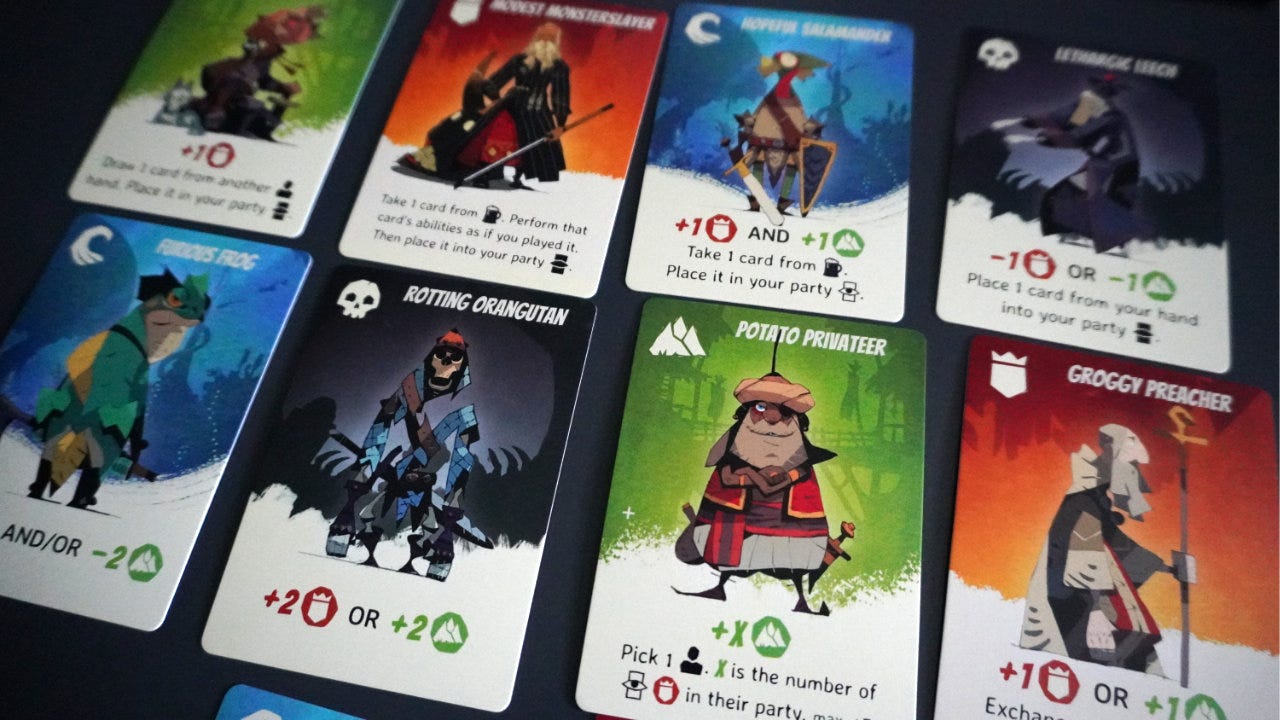
For example, the Battle Connoisseur card moves the Hill faction marker 1 to the right while the Spirited Shaman moves both the Hill and Army factions 1 to the left each. Other cards base the movement on number of cards discarded or give the player a choice, like the “-2 Army and/or -2 Hill” of the Furious Frog card.3
Many cards also have other effects that trigger when played like taking extra cards or turning cards face down (hide) or face up (reveal).4
The game ends when any player has a certain number of face-up heroes in their party. This end game trigger number ranges from 5-8 heroes depending on player count.
A tug of war with an end zone
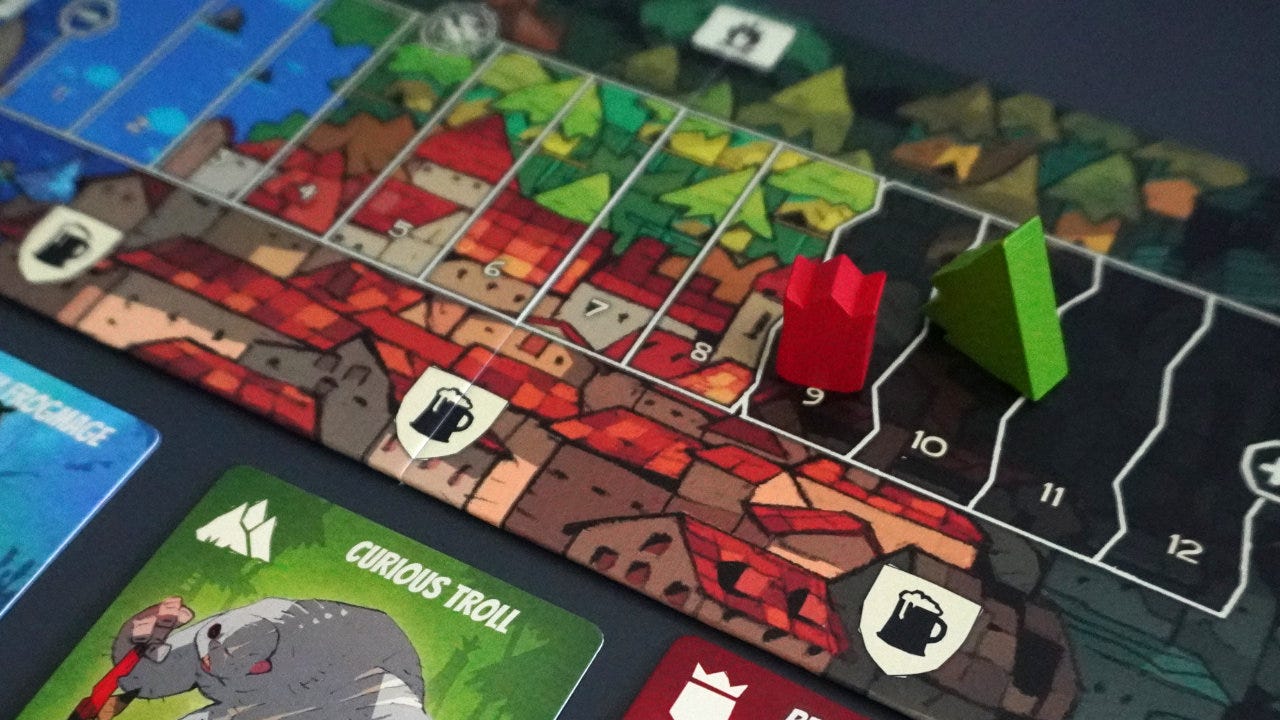
While one might expect that whichever token (Hill or Army) is closest to an end would determine the strongest faction, Hidden Leaders does add an interesting twist. The board is 12 spaces, but the final four spaces (i.e. spaces 9-12) are marked as Undead. This creates a special “end zone” on the right side of the board. All the other spaces (i.e. spaces 1-8) are the same.
There are only two markers on the board but four possible factions. This means there are multiple outcomes for the tokens:
Undead win if both the red and green markers end up in the Undead end zone at the end of the game (spaces 9-12).
Water wins if the red and green spaces are next to each other.
Army wins if the red marker is 2+ spaces ahead of the Hill marker.
Hill wins if the green marker is 2+ spaces ahead of the Army marker.
I think this is the most interesting part of the game. It creates a four-way tug of war which is not something that is easily represented in board games.5
Carefully influencing factions
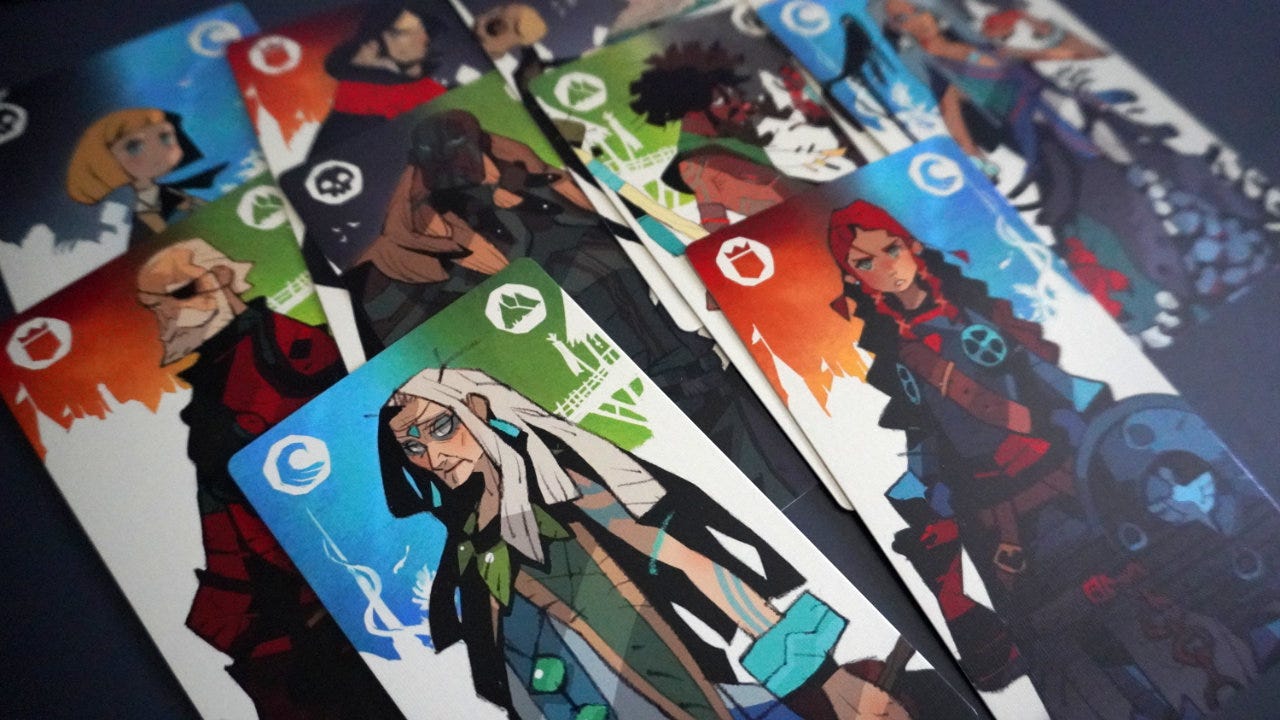
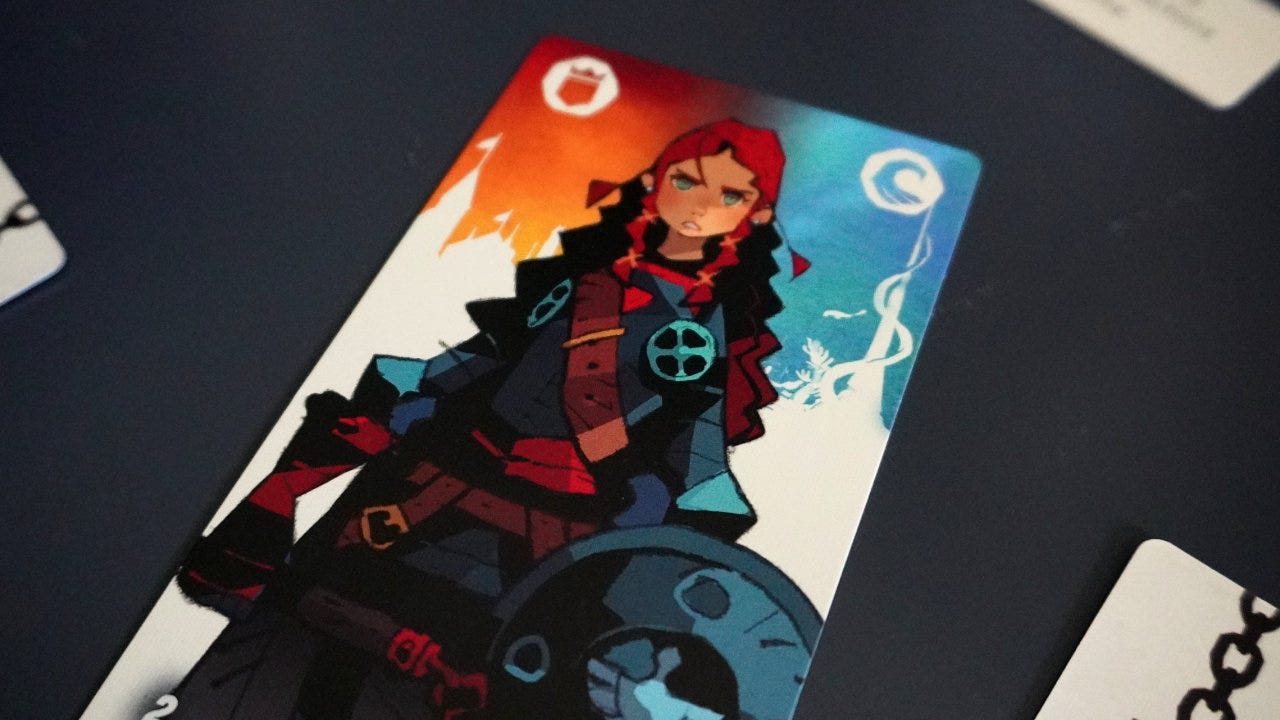
Remember that each Leader is allied with two of the four factions based on the card you drew at the start of the game.
Let’s say your leader is allied with Water and Undead. You would win the game if either: (a) both red and green markers end in the far right Undead zone, or (b) both markers end up next to each other. During the game you don’t necessarily care where the markers are, but you want them near each other. Failing that, you’ll want to boost the power of both as much as possible to get them into the Undead zone.
On the other hand, if your Leader is allied with Army and Water, you’ll want to boost the power of Army (red) when you can. If you increase it too far, however, it’ll end up in the Undead zone and you’ll run the risk of Undead coming out on top. So you want it to be high, but not too high. Also, to win with Water you’ll want the green marker to be nearby, but that increases the risk of it surpassing red.
It creates a good mix of wanting to boost the power of your favored faction and the need to not push it too far.
Games of influence
I’ve written before about games that use influence of factions rather than direct control. The King is Dead: Second Edition (Sylvester, 2020) is my favorite example of this genre because the design is so clean and elegant. It has a two-sentence rule that captures the core conceit of the game:
Whenever you take an action you will summon a follower to your court, increasing your influence with one of the factions. Each follower you take will solidify your claim to be that faction’s preferred ruler, but will weaken their ability to win power struggles.
Every action strengthens your position with a faction while, at the same time, weakening that faction’s position on the map. It makes every choice in the game painful (in a good way).
The Pax games such as Pax Renaissance: 2nd Edition (Eklund & Eklund, 2021) and Pax Pamir: Second Edition (Wehrle, 2019) are the other prime examples. Imperial 2030 (Gerdts, 2009) takes Risk and changes it into a game of influence.
In the above examples, no one player controls the pieces on the map. Players do not “have a color” as in many games.6
It’s a tough concept to wrap your head around the first time you encounter it, but a concept that I’ve really grown to love.
Conclusion
Some things to think about:
Tug of war: Think about using tug of war mechanisms in your games. They don’t necessarily require a board as in Hidden Leaders. Tollund uses two piles of tokens and no board, but it is still essentially a solo tug of war.
Bidding and market games: Games of influence are essentially bidding and market manipulation games. You are trying to increase the stock value of your preferred faction while owning the most shares of it. I haven’t played many cube rails or 18XX games, but I wonder if they would have a similar feel.
Try an influence game: I really think anyone interested in tabletop game design should try an influence vs. control game at least once. It really changed how I think about game design, and it might spark your creativity in unexpected ways.
What do you think? Which influence vs. control games are your favorite? Have you seen multi-direction tug of war games before?
— E.P. 💀
P.S. Want more in-depth and playable Skeleton Code Machine content? Subscribe to Tumulus and get four quarterly, print-only issues packed with game design inspiration at 33% off list price. Limited back issues available. 🩻
Skeleton Code Machine is a production of Exeunt Press. All previous posts are in the Archive on the web. Subscribe to TUMULUS to get more design inspiration. If you want to see what else is happening at Exeunt Press, check out the Exeunt Omnes newsletter.
Skeleton Code Machine and TUMULUS are written, augmented, purged, and published by Exeunt Press. No part of this publication may be reproduced in any form without permission. TUMULUS and Skeleton Code Machine are Copyright 2025 Exeunt Press.
For comments or questions: games@exeunt.press
Title of the game is subject to change, but playtesters have reported that the “proxy war” name helped them understand the core concept of influencing factions. If it changes, it will probably remain some variation on that.
The special edition of the game comes with a double-sided board that has a forked path on the reverse side. I honestly just noticed that while preparing for this article and have yet to try it. Seems interesting.
On the cards a minus sign (-) means move to the left and a plus sign (+) means move to the right.
There is (to me) surprisingly little hidden information in Hidden Leaders after just a few turns. Players begin with just 1 of their 5 cards face down, and many cards act to reveal any new face down cards.
Mark Herman uses a three-way tug of war in Churchill (Herman, 2015) and possibly in Pericles: The Peloponnesian Wars (Herman, 2017). Though I’m not sure the latter is actually three ways. If you have other examples, please let me know in the comments.
When playing games with me, you have two options: (a) I get to be the green player, or (b) I accidentally move the green pieces for the entire game.
Really cool article. For a while I’ve been thinking about what would happen if 2+ players control only one token in the board, all sharing agency over the results. And this looks quite like it (or at least enough to open new possibilities for me). Another item for my wish list 💪
fellow green player :D if there are colours assigned to players in a game, chances are that's who i'm playing, and so has it been for a very long time ^^
seems like a really cool game — i love that each leader is aligned with two factions, that alone seems like it would create some interesting situations :) gives me TTRPG ideas too, for a campaign or such of some sort, where the player characters could potentially be aligned with multiple different factions ^^ thank you as always for sharing <3