
If you are one of the attendees of the free public library class I just taught in Baltimore, welcome! I had a wonderful time with the class and really enjoyed chatting about game design for two hours on Saturday.
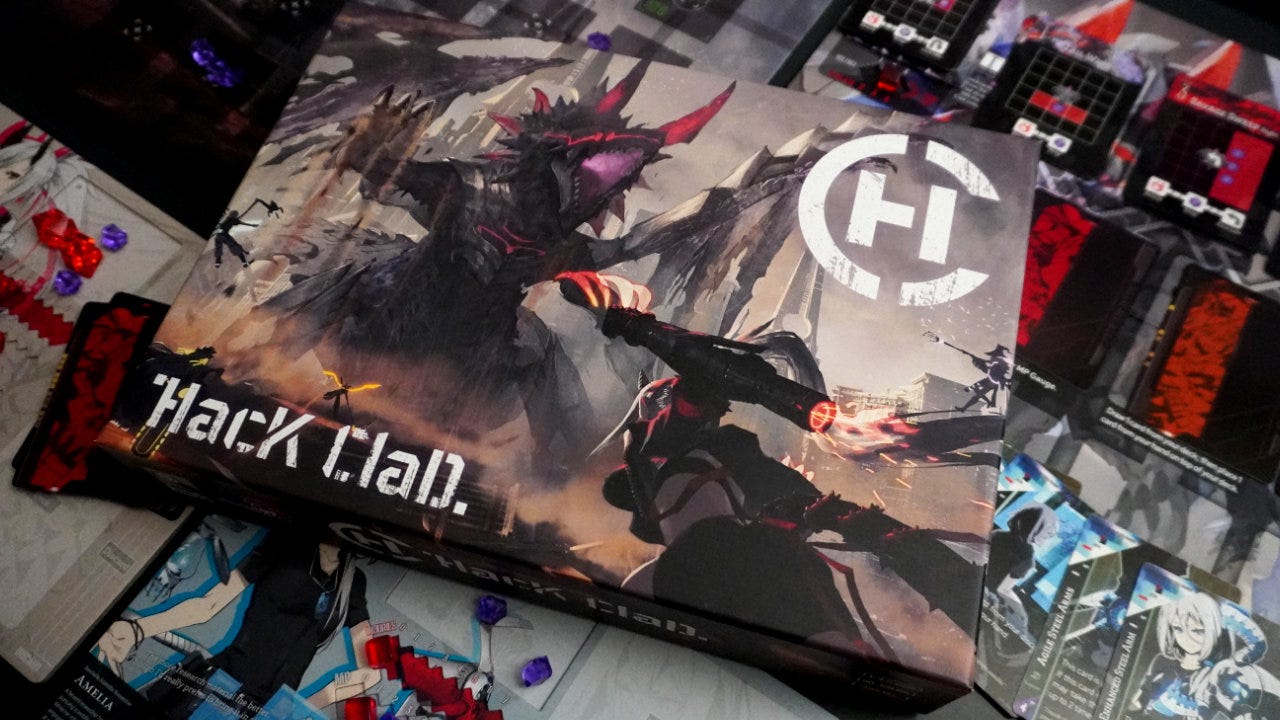
This week’s game is HacKClaD — a “tactical deck-building arena battler” designed by Kaku and published by Japanime Games.1 There’s a lot going on in the game, but I want to focus on just one part: drafting turn order at the start of each round.2
HacKClaD
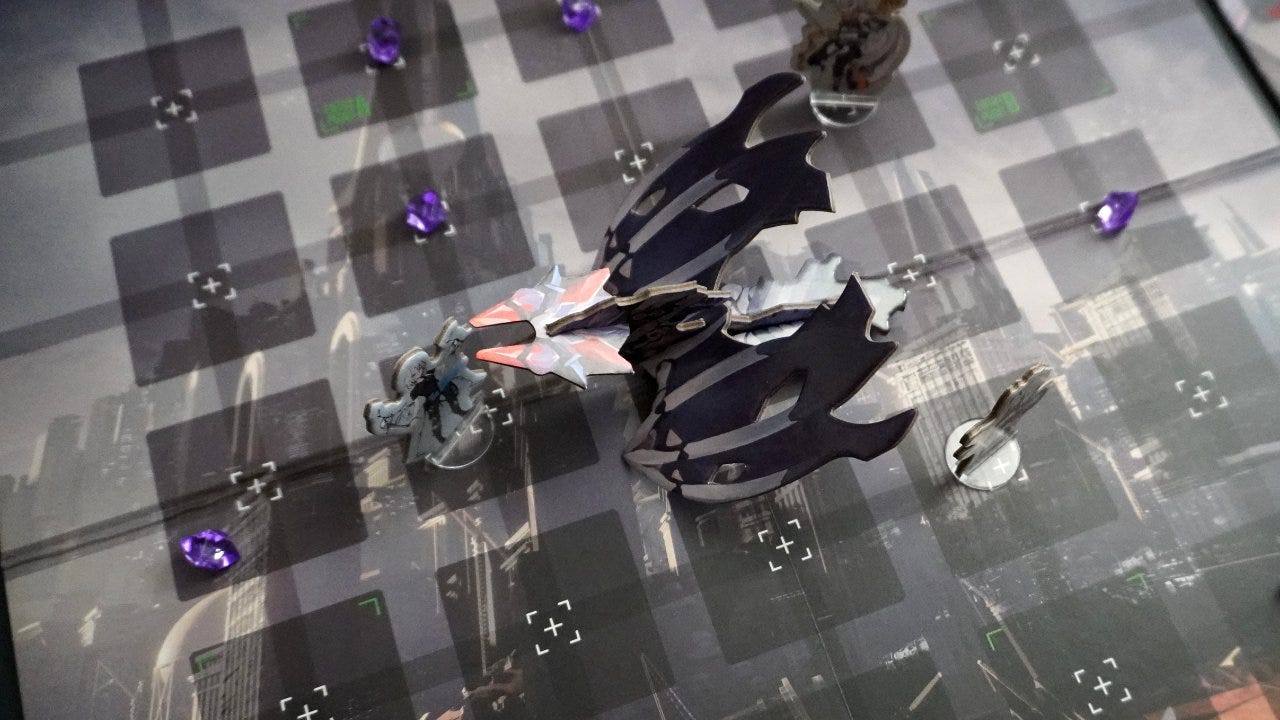
You are a Witch. Your ability to see into the future and use magic weapons make you uniquely able to battle the Clad — a giant monster attacking humanity:
Humanity is under relentless assault from the Clad, catastrophic entities that reshape the battlefield with every strike. To answer this threat, five extraordinary Witches enter the fray, each wielding a customizable arsenal of skills, affinities, and tactics. Their mission is simple: survive the Clad’s onslaught and gather the most Magic Shards to claim victory.
That’s the story behind HacKClaD (Kaku, 2021).
As a game, I’d consider it to be a rather abstract boss battle game. Each player is a witch with variable player powers and all witches are battling a single giant monster called the Clad. When witches successfully attack the Clad, they are rewarded with crystals that are worth victory points (VP) at the end of the game. If they are injured by the Clad, they drop some of their acquired crystals onto the map.
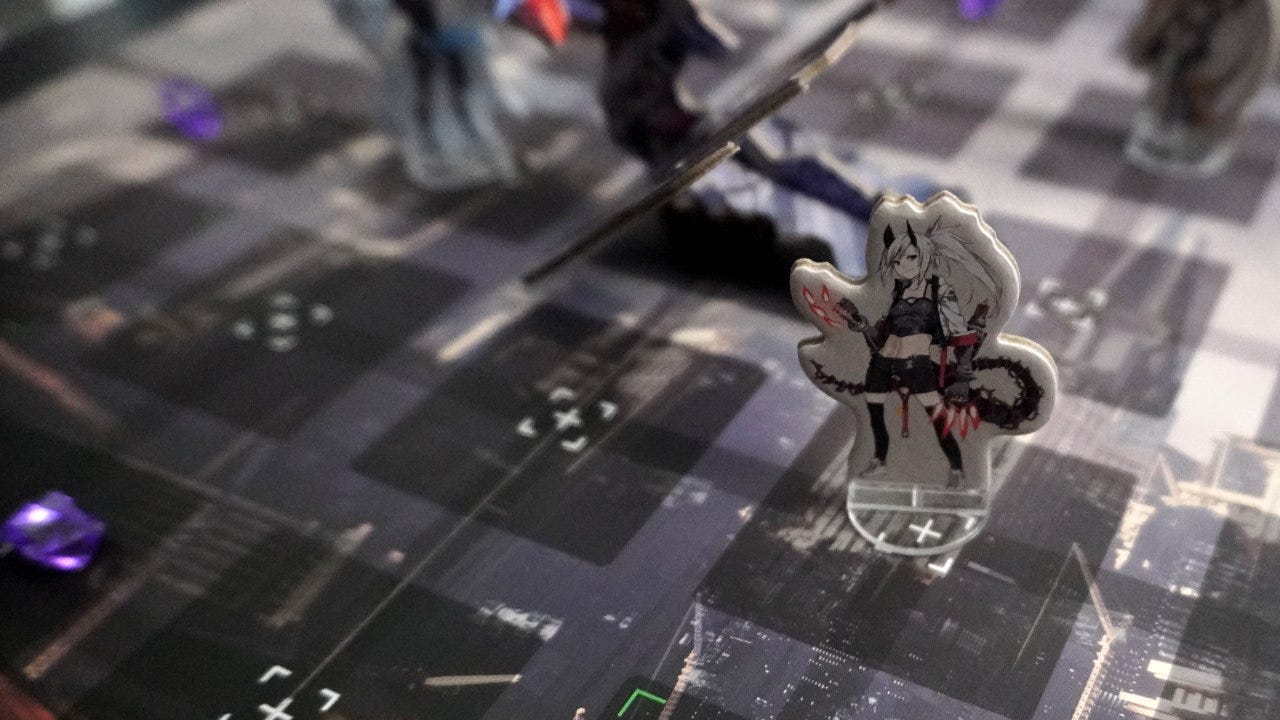
It’s a race over the course of 9 rounds to do the most damage possible to the Clad while also picking up any dropped crystals on the map.3
Strangely, the Clad is never defeated during the game.4 Damage is applied, but the Clad keeps moving until the end of the 9th round. Similarly, the witches are never killed or knocked out of the battle. When injured, they lose some crystals and respawn at one of the designated points on the map.5
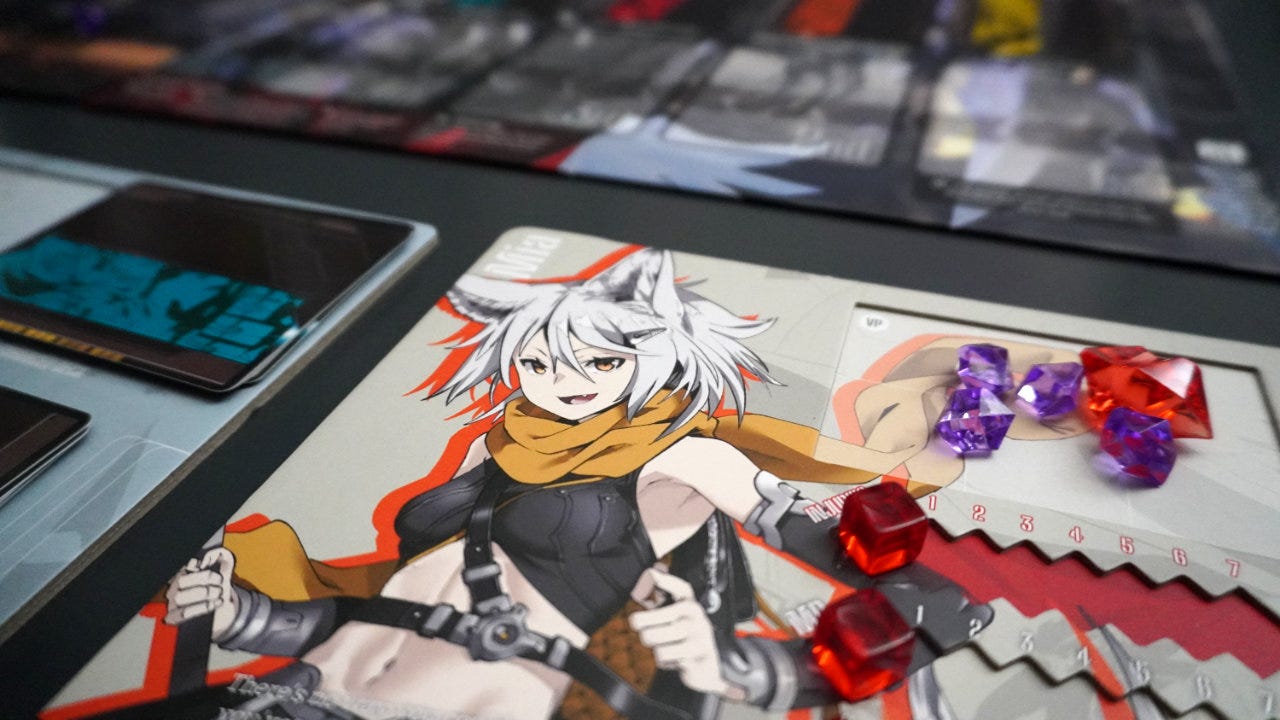
Together, these mechanisms give the game the feel of a video game — more akin to Diablo than a more simulationist or realistic approach. There’s no reason to hold back and no time to be overly defensive. It’s a pure race to pound on the Clad and make crystals pop out like a slot machine.
Using precognition to battle the Clad
The core game loop for HacKClaD is:
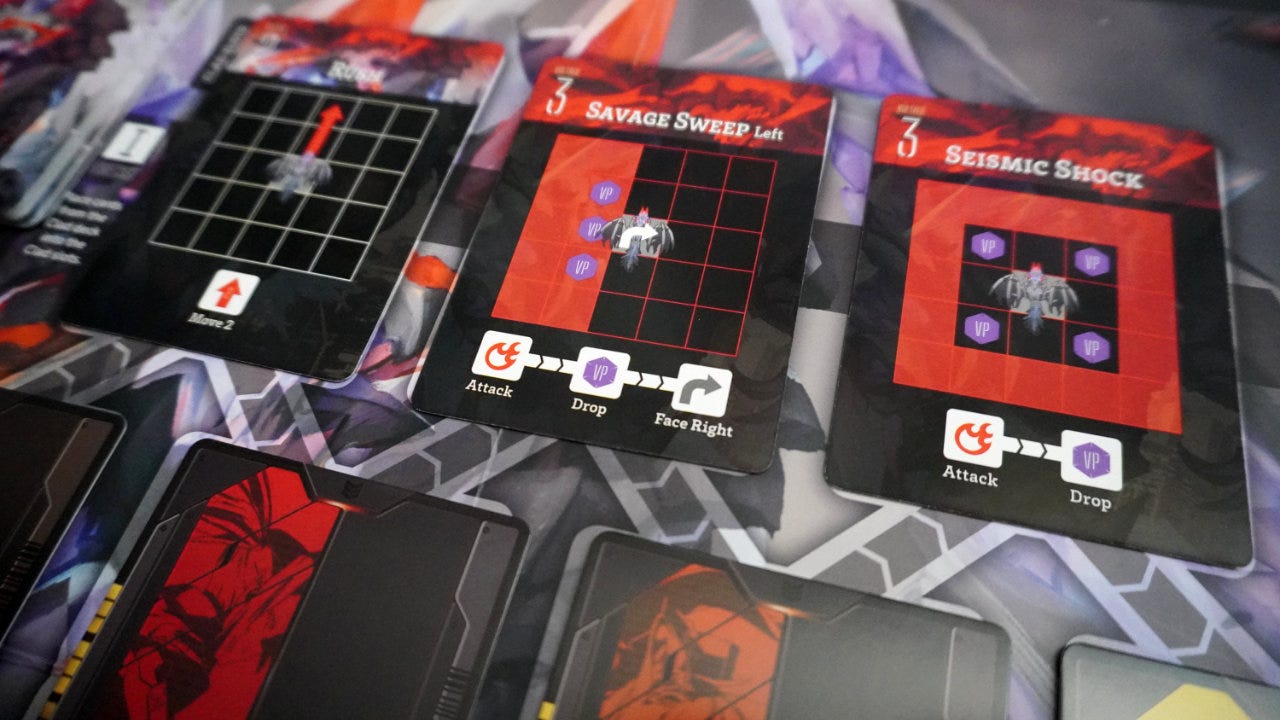
Forecast Phase: Draw and reveal three Clad cards, showing what it will do.
Draw Phase: Draw three action cards from your deck.
Draft Phase: Determine turn order.
Action Phase: Resolve player and Clad actions in order.
During the Forecast Phase, witches use their precognition ability to know what the Clad is going to do each round. This is implemented by a deck of Clad cards that are drawn, three at a time, and displayed at the top of the board. Each card details how the Clad will activate: turn, move, drop crystals, or attack. Attacks usually hit a zone of adjacent squares on the map indicated by a red highlight.
The Clad cards will activate left to right each round and they are open information for all players. You know when and how the Clad will move and attack.
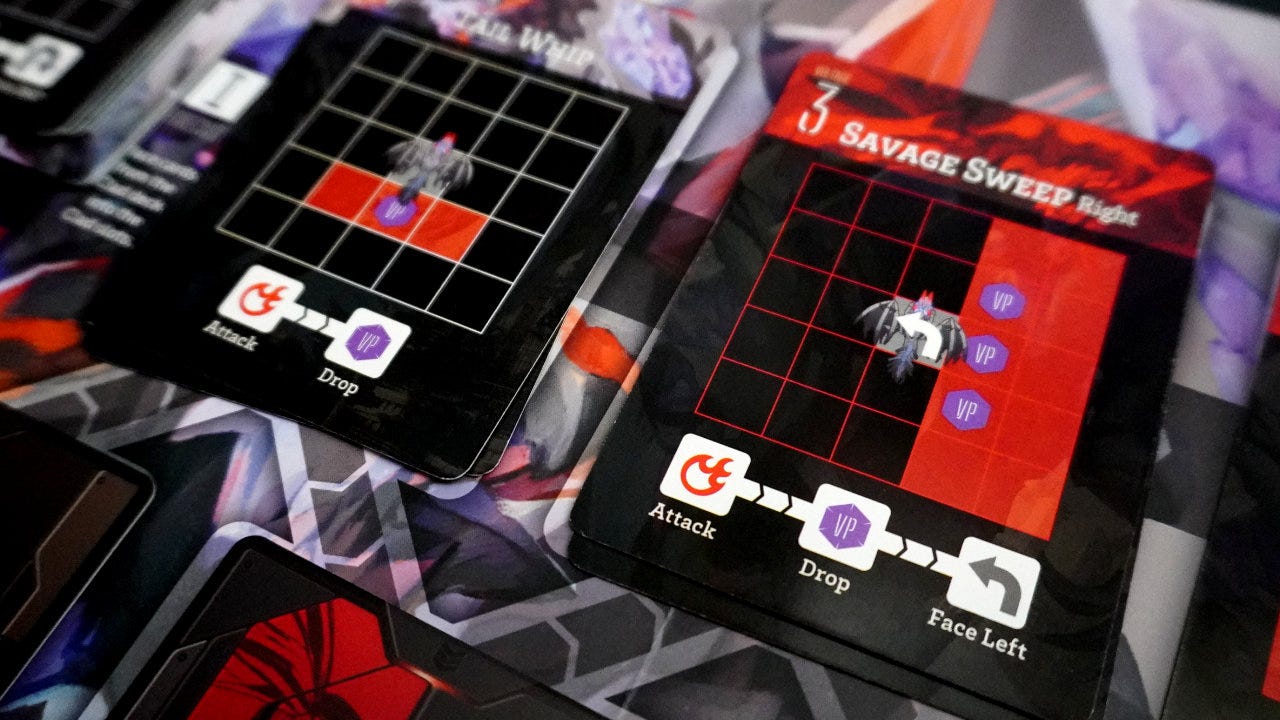
During the Action Phase, activations alternate between witches and the Clad: Player 1, Clad, Player 2, Clad, Player 3, Clad, Player 4.
This turns the battle into a puzzle to be solved. Each round you’ll draw 3 cards from your deck with various actions: attacks, blocks, movement. You’ll need to figure out how and when you want to execute those to maximize your attacks.
Although all players are battling the Clad and not each other, it is still a competitive game.6 You can push the Clad into other players, dealing trample damage. You can pick up dropped crystals before others can.
The main way to compete, however, is in how you draft your turn order.
Drafting turn order
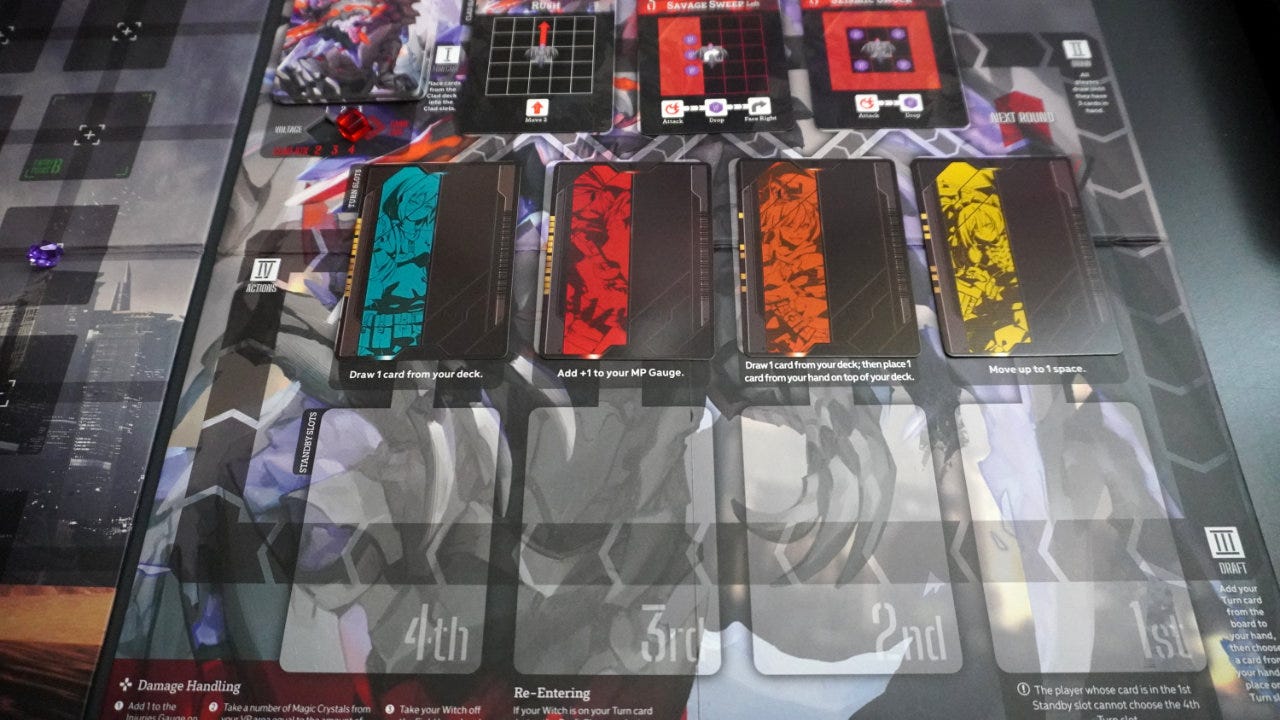
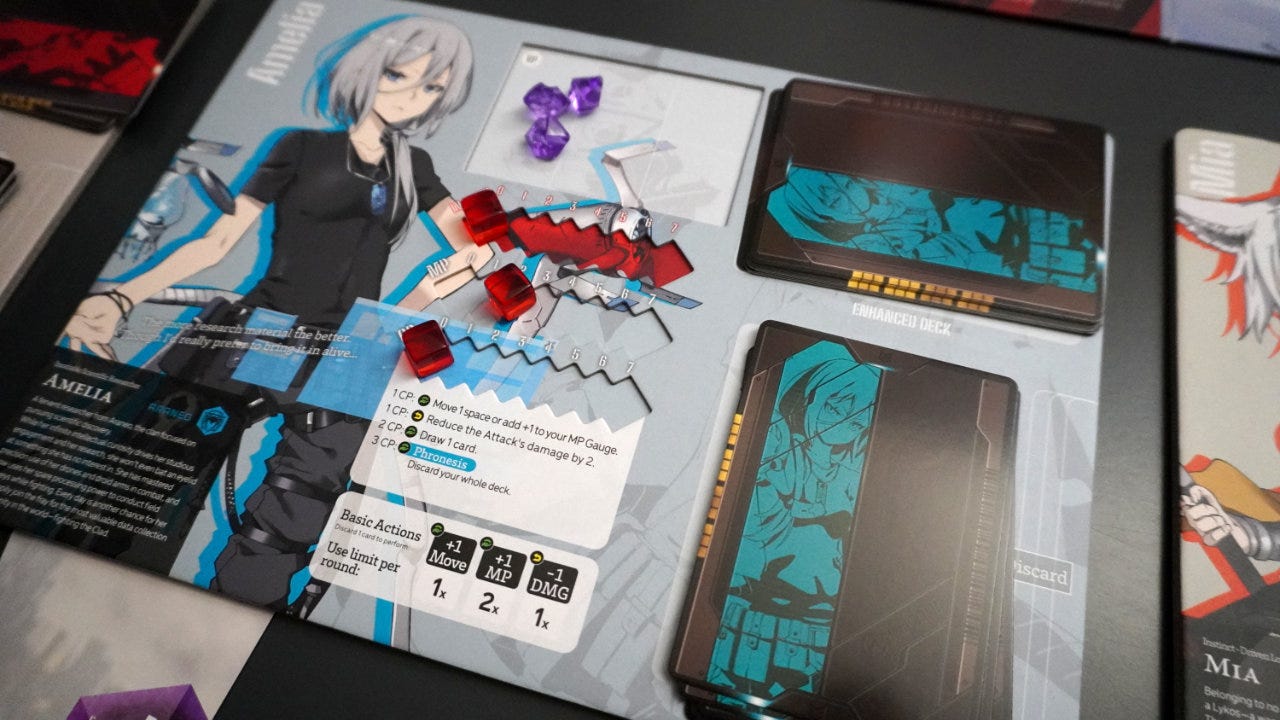
The Draft Phase is interesting but a little hard to explain without having the cards in front of you to see how it works. The upper row of slots on the board shown above are the Turn Slots. The lower row are the Standby Slots.
The player with a card in the rightmost Standby Slot goes first. I’ll explain what the Standby Slot is in a moment.
They take their card from the Standby Slot and return it to their hand.
They then choose an empty Turn Slot and place one of the cards from their hand into it. This indicates their turn order for the round.
They gain the effect under the Turn Slot that was chosen.
Then the next rightmost player follows the same process until all players have drafted a Turn Slot.
After everyone has drafted turn slots, actions are taken in order starting with the leftmost player Turn Slot. They alternate (as noted above) between players and Clad. Each player gets one turn to take all of their actions before it moves to the Clad. When players go to take their turn, they slide their card in the Turn Slot down to the Standby Slot.
An interesting turn drafting system
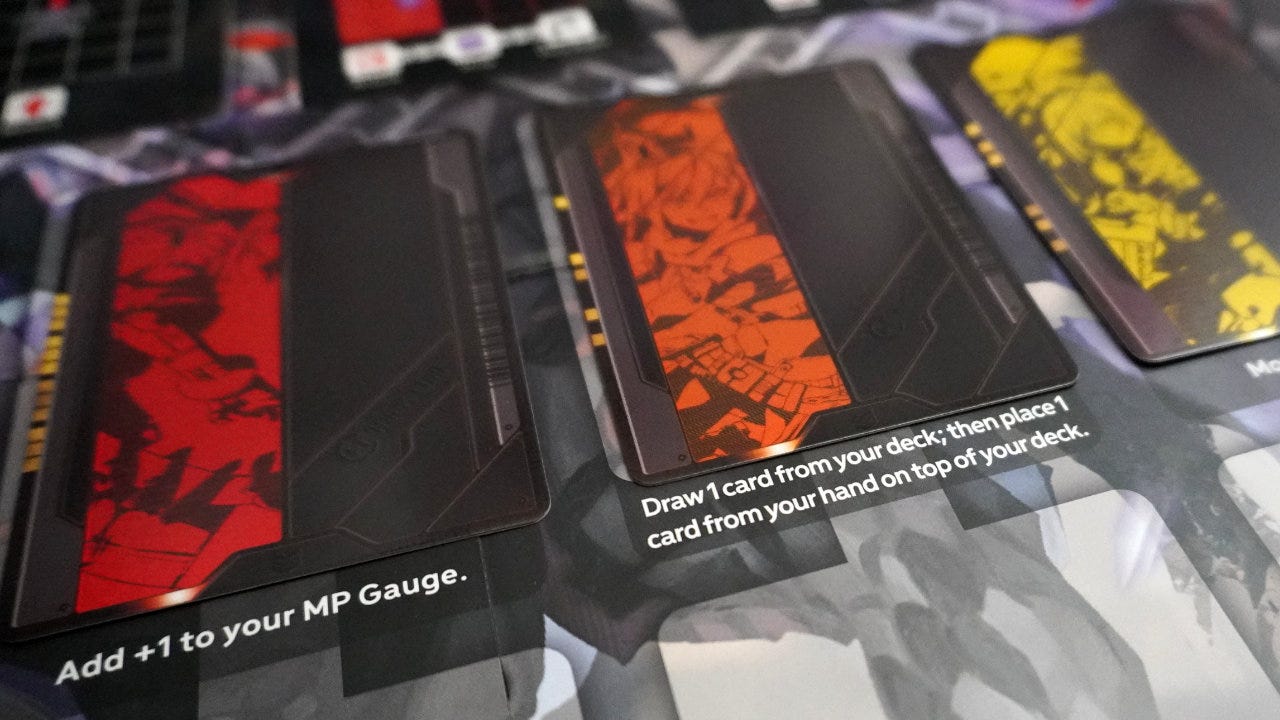
This turn order drafting system does a couple of things:
Rotating draft order: Turns Slots are resolved left to right but Standby Slot drafting order is right to left. This means that taking an earlier turn slot will mean you get a later draft pick in the next round. Conversely, taking a later turn slot will give you an earlier draft pick in the next round.
Choice of benefits: Each turn slot has an associated benefit under it: draw 1 card, +1 Magic Point, draw card and top-deck a card, or a free move. All of those are good so it factors into your turn order choice.
Draft with a card: You have to use one of your action cards to draft (reserve) your turn order slot. That card will, however, move to the Standby Slot below it and then you’ll return it to your hand in the future. You don’t lose the card, but it’s unavailable for a while.
Visible and easy to track: Players just slide their card from the Turn Slot down to the Standby Slot below it. From there, it’s easy to know who drafts first next round.
It can be incredibly difficult to line up attacks. Each attack only hits a certain zone and many need to be adjacent to the Clad to work. You can see what the Clad will do via the Forecast Phase, but it is impacted by the chaos of the other players.
Sometimes it makes sense to grab the Turn 1 slot so you get to take your turn before the Clad moves too much. Othertimes, it makes sense to go later to get a better benefit or a better draft pick in the future.
Turn order in solo mode
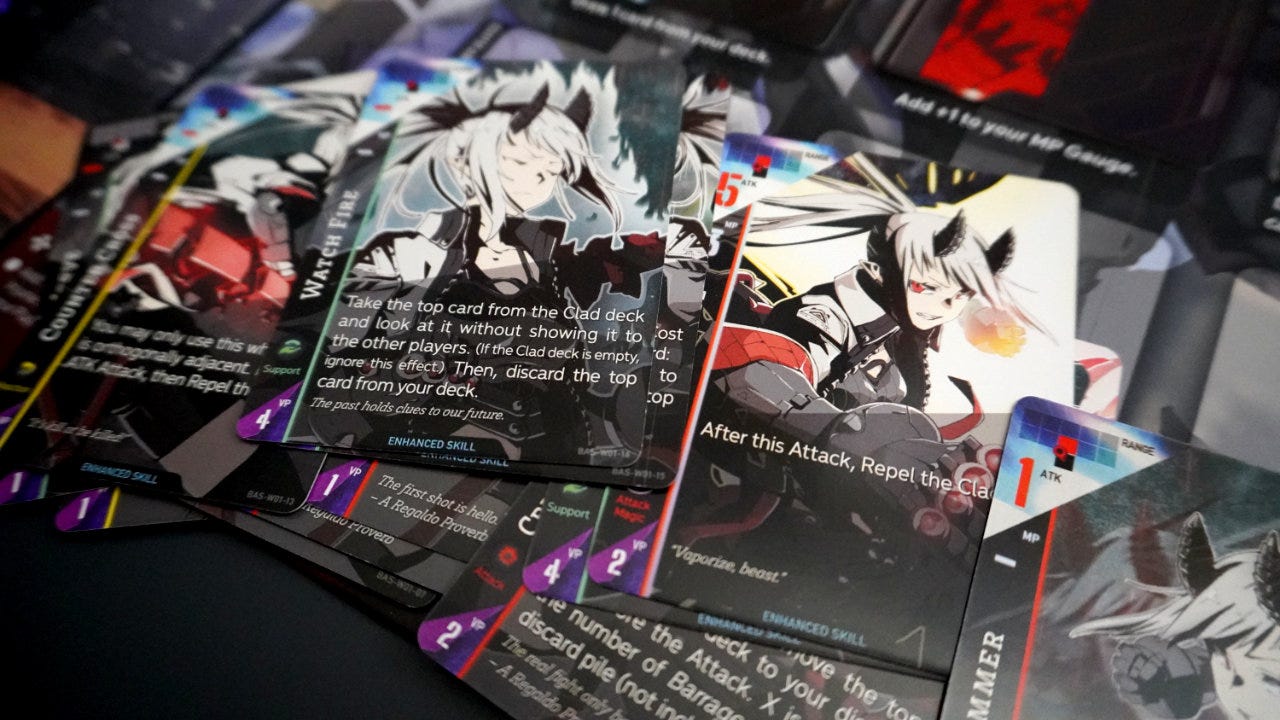
While the game is designed to be best at 3-4 players, it can be played at 2 players and there is a solo mode. In solo mode the draft works in a similar way, but with an important change.
You draft your turn order slot and take your turn as usual. When you slide your card down from the Turn Slot to the Standby Slot, however, you mark the turn slot with a crystal. That slot is unavailable until all slots have a crystal (i.e. they have all been used), at which time all crystals are removed and the process starts over.
Options become limited in this way and it feels even more like a puzzle to solve.
Applications in initiative systems
I’ve written about initiative systems before, including the system in A Gest of Robin Hood and For What Remains. It’s a topic I always find interesting because it has important applications in both board games and roleplaying games.
The HacKClaD system reminds me a little bit of the slot-based initiative used in Emberwind RPG, especially how it alternates between player and foe. I’m not aware, however, of a TTRPG that uses a drafting system like this one.7
I think this initiative system could be directly applied to solo roleplaying games, particularly ones with combat systems.
HacKClaD is puzzle-based and abstract, so it doesn’t feel out of place. Could this system be integrated into a highly thematic solo TTRPG? I think it could, but it would need to be done with care. It would certainly risk breaking the immersion of combat and making it feel like an abstract puzzle.
Conclusion
Some things to think about:
Abstract vs. thematic games: HacKClaD looks like a highly thematic game. It has a backstory, impressive art, and character backgrounds. The mechanisms, however, are focused on hit points and ignore some expectations of the genre such as actually defeating the boss and having meaningful consequences for character death.8
Turn order matters: Many games have first player advantages or last player advantages. It’s one of the trickiest things to balance and handle in game designs. By using an active drafting system, it turns what could be something that must be “designed out” of a game into a challenging part of the game itself.
Initiative systems are tough: Random initiative order is easy but might feel unfair at times. More complicated systems can be perfectly balanced but start to feel abstract and like a puzzle or minigame to be solved. There is no right answer here — only an attempt to pick the system that fulfills the promises your game makes to the player.
What do you think? What other games have you played where you draft or compete for turn order? Have you played any TTRPGs that use turn order drafting?
— E.P. 💀
P.S. Want more in-depth and playable Skeleton Code Machine content? Subscribe to Tumulus and get four quarterly, print-only issues packed with game design inspiration at 33% off list price. Limited back issues available. 🩻
Skeleton Code Machine is a production of Exeunt Press. All previous posts are in the Archive on the web. Subscribe to TUMULUS to get more design inspiration. If you want to see what else is happening at Exeunt Press, check out the Exeunt Omnes newsletter.
Skeleton Code Machine and TUMULUS are written, augmented, purged, and published by Exeunt Press. No part of this publication may be reproduced in any form without permission. TUMULUS and Skeleton Code Machine are Copyright 2025 Exeunt Press.
For comments or questions: games@exeunt.press
The deck-building is pretty minimal. You get a chance to swap one of your deck’s cards for a better one each time you reshuffle. It’s not a deckbuilding in the way that Undaunted or Dominion are deck-builders.
I really struggled with the rulebook for this one and ended up watching videos and reading a lot of forums to piece together how it works. It’s possible I was just tired at the time. If you catch a rule that I got wrong, please let me know in the comments. Also (as always) this is not a full rules explanation for the game. I just covered the parts necessary for the article.
New, harder cards go into the Clad deck each time it gets reshuffled. So there’s a game arc that emerges.
The Clad has no health bar and no hit points. Attacks on it generate crystals (VP) but do not impact the abilities or actions of the Clad except for pushing it around the map.
Lost crystals are dropped on the map and become available for other witches to steal.
There is a team mode in the base game and a cooperative mode (I believe) in the Crossfire expansion. I picked up both at Games & Stuff but have only played the base game so far.
I read a little bit about “popcorn initiative” and “elective action order” but I’m not sure those are the same thing either. Feel free to share thoughts on those in the comments.
While there is an endgame VP penalty for injuries and number of injuries is a tie-breaker, I felt like it could be a good thing to take an injury in the game. You basically lose a few VP but get to teleport to one of the four starting locations on the map.
super interesting! while i haven't seen a drafting initiative like this, there are so many interesting ways of doing initiative :) Wild Talents for example has players declare what they want to do in order of some stat (i forget which), then make their rolls, and get to act in the order of the "widest" set of matching numbers they get on all their dice – if there are many different sets of matching numbers, they choose one set (which can lead to interesting choices, do you choose the "widest" match (ie highest number of matching dice) which makes you go earlier, or do you choose the "highest" match (ie highest numbers on the dice) which makes your move "better"?). Savage Worlds meanwhile has initiative that changes round to round, based on new cards being drawn from a standard deck of playing cards. And then like you mentioned there's "popcorn" initiative, where the person whose turn it was gets to choose who goes next (with the caveat that each person can only go once per full round)... Really cool, in any case :D thank you as always for sharing <3
I was brought up on ugo/igo turn sequence even as adult. Different move orders only came in with the birth of RPG play. Hence I come late. So you want to ambush enemy? Near impossible in traditiobal war/biard games. GM required, .. Solo games recently are working around this, as it aint a viedoe game, true; but to actally put suprise back into suprise is hard