
Last week we looked at limited communication in Glatisant, an Arthurian-themed game for two players.
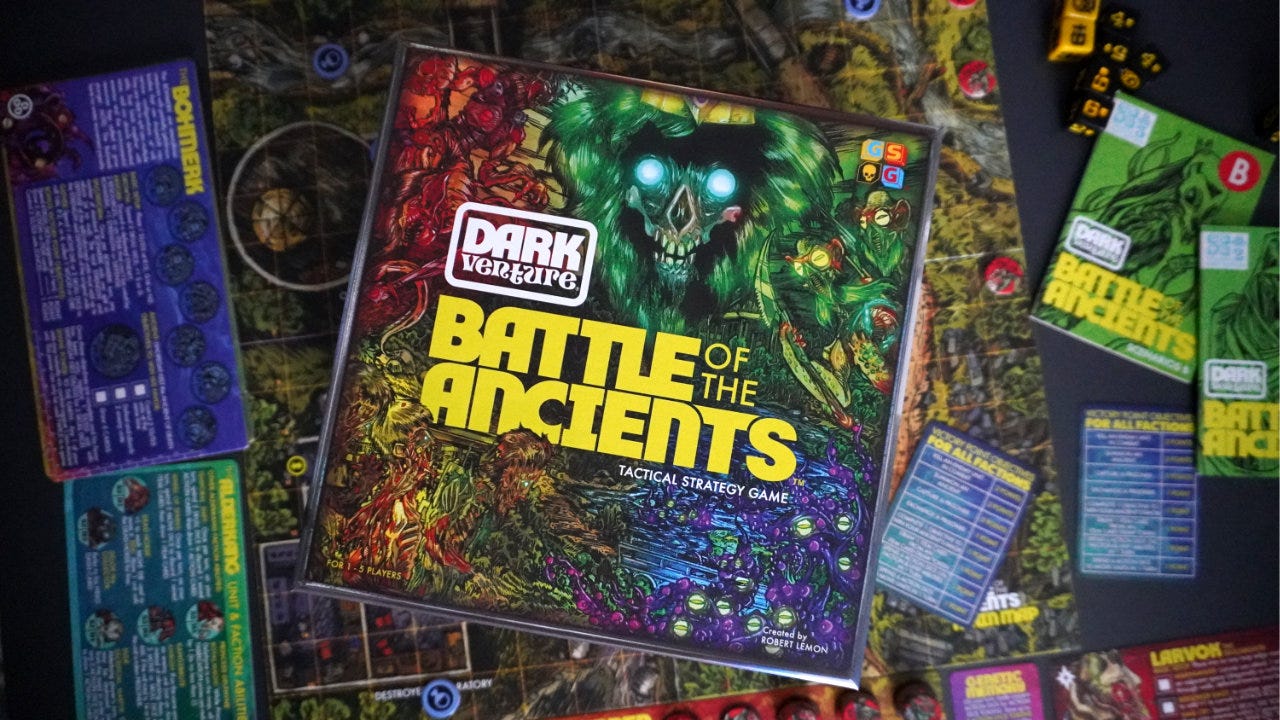
This week we are exploring how the Dark Venture: Battle of the Ancients board game uses an interesting roll-and-move mechanism that includes some tough choices.
Dark Venture: Battle of the Ancients
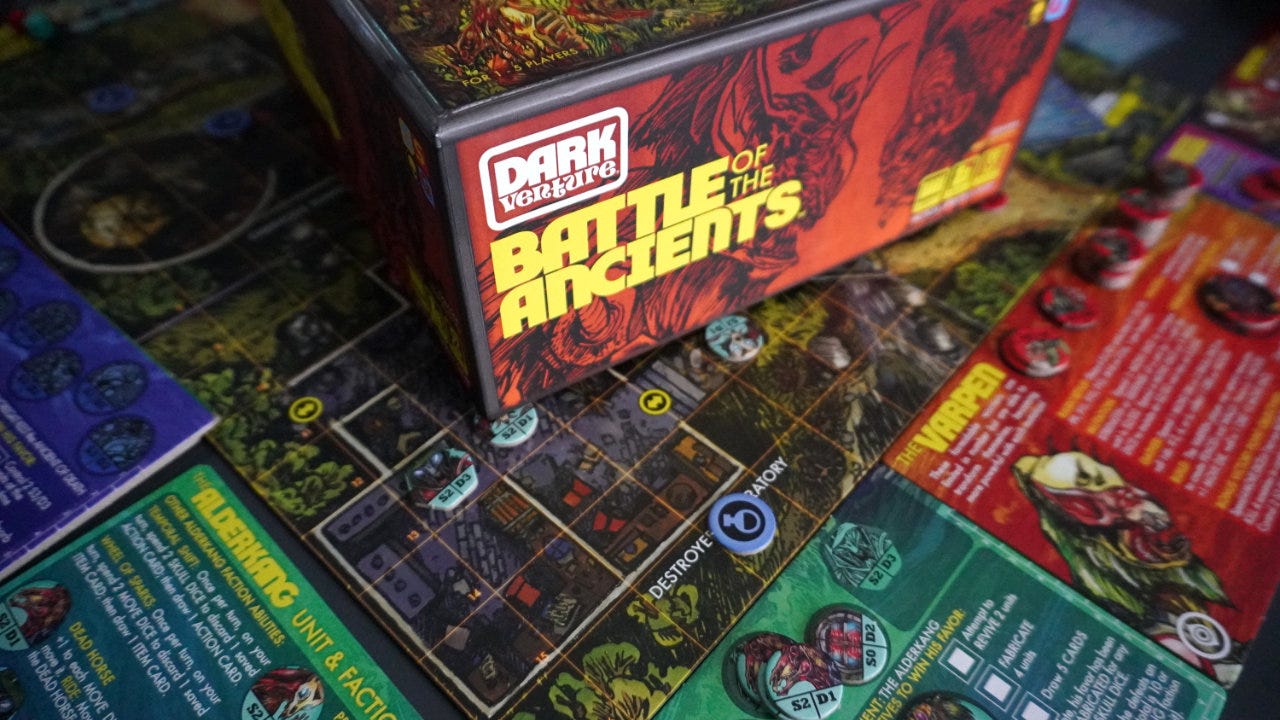
The dark, weird art of designer and illustrator Rob Lemon is what attracted me to Dark Venture: Battle of the Ancients (Lemon, 2022).1 The over-the-top description of the game is very fitting:
In a dark, destroyed world ruled by chaos, hordes of otherworldly creatures battle against one another for dominance and survival. Amidst the shrill call of battle horns, the ground rumbles as squadrons of mutated abominations rush into combat!
The game is a dark sci-fantasy skirmish game that supports solo, cooperative, and competitive modes on a grid-based map. Players move their units, attack, gather resources, acquire items, and capture objectives.
For the basic competitive mode, the goal is to gain victory points to win the game. In the scenario modes, players need to complete specific objectives detailed in the two included scenario books. For example, getting specific units to a location on the map, killing a leader, or building structures.
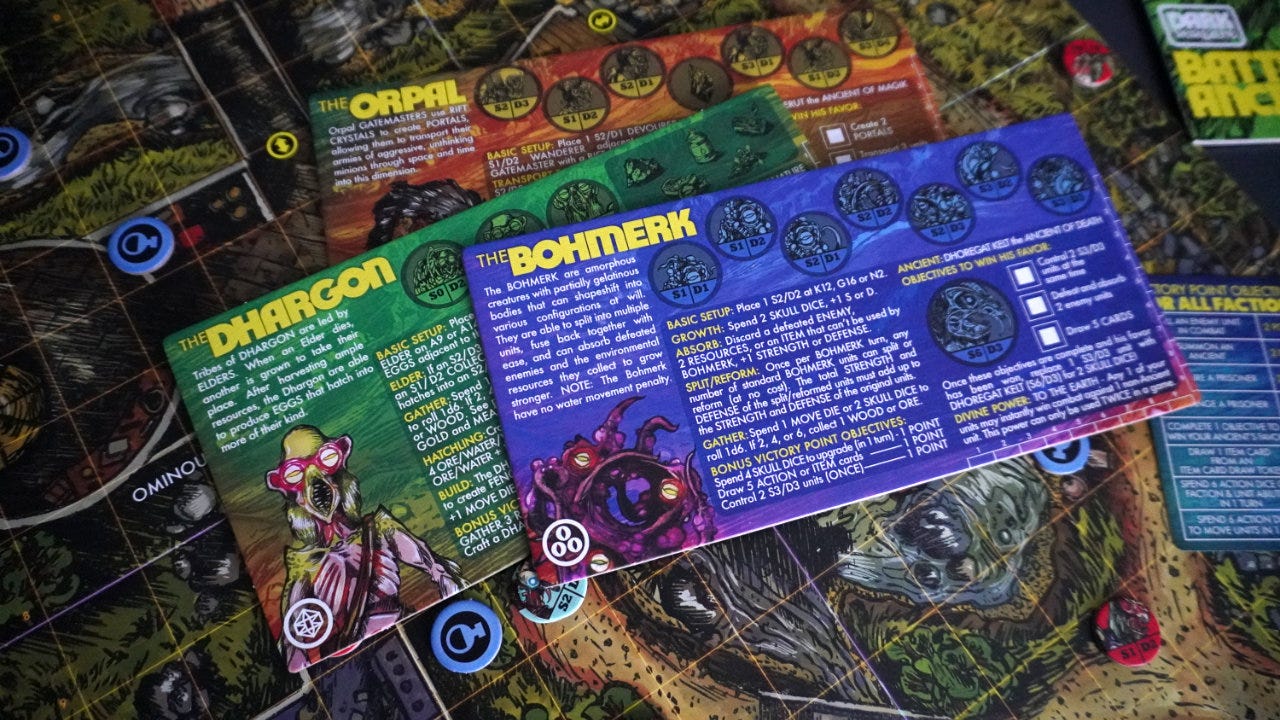
It’s a highly asymmetric game with five playable factions — each one with its own rules and powerful Ancient.2
The Bohmerk (blue): Amorphous, gelatinous, shapeshifting creatures able to split into multiple units and then fuse together. They absorb enemies to grow stronger.
The Dhargon (green): When their Elder dies, another grows from an egg to take their place. More resources means more eggs to spawn more units.
The Orpal (yellow): They use rift crystals and a bag-draw mechanism to transport units around the map using portals.
The Alderkang (teal): The gene-splicing Alderkang can capture units and perform an extraction on them. Once extracted, they can fabricate identical units.
The Varpen (red): Marauding demons that can mutate. Units get progressively stronger over the course of the game.
The combat system is very straightforward. Roll a number of six-sided dice equal to your faction’s strength or defense value, add the results, and compare. The complexity comes from all of the faction abilities and rules that can bend the core rules of combat.
It is the action system, however, that I found particularly interesting.
Roll the action dice
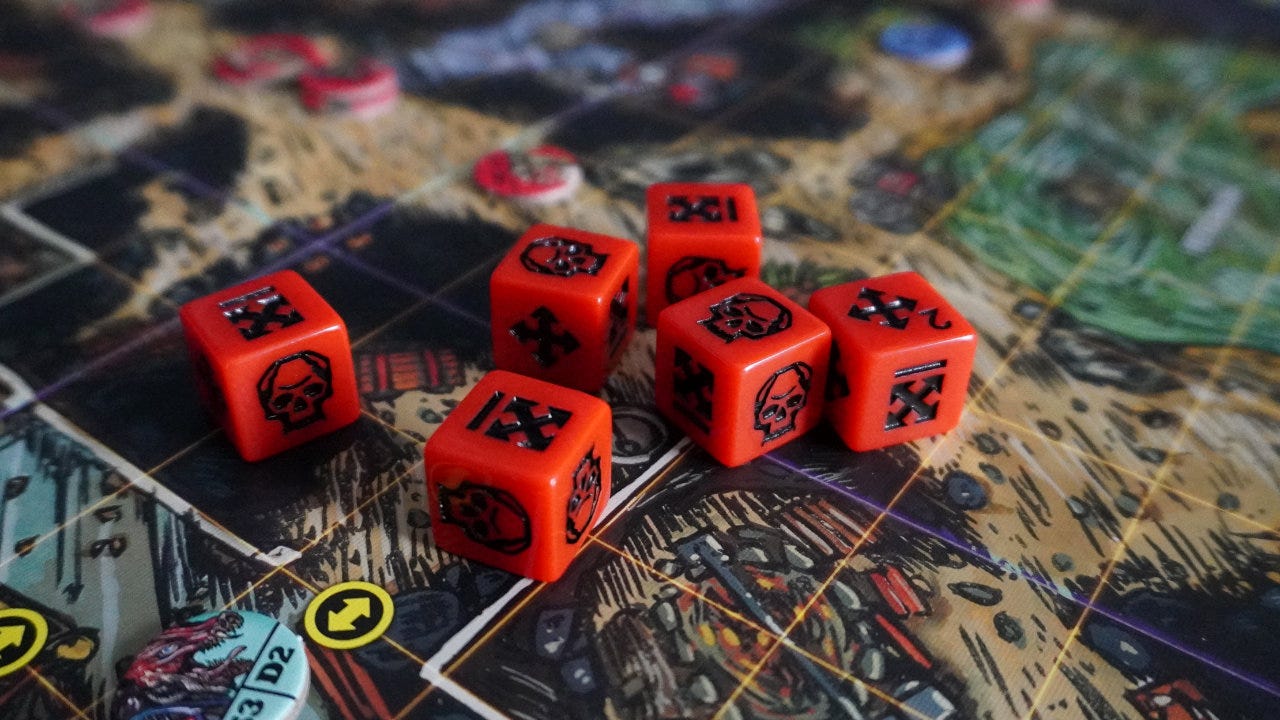
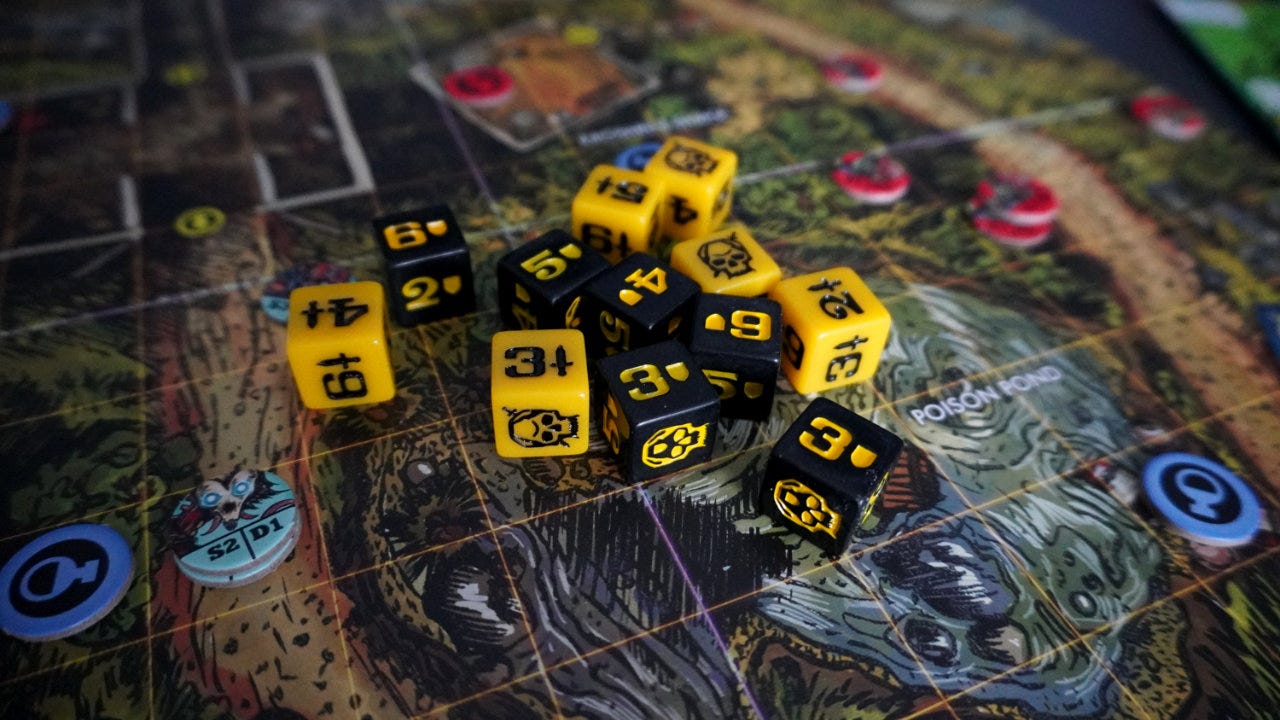
At the start of each player’s turn, they roll six action dice. The red dice have four possible faces that dictate movement:
1 x Move Orthogonal (2 spaces)
1 x Move Orthogonal (1 space)
2 x Move Diagonal (1 space)
2 x Skull (no movement)
For each die rolled, there’s a 33% chance of orthogonal movement, a 33% chance of diagonal movement, and a 33% chance of getting nothing. With six dice rolled each time, chances are slim that they would all be skulls.3
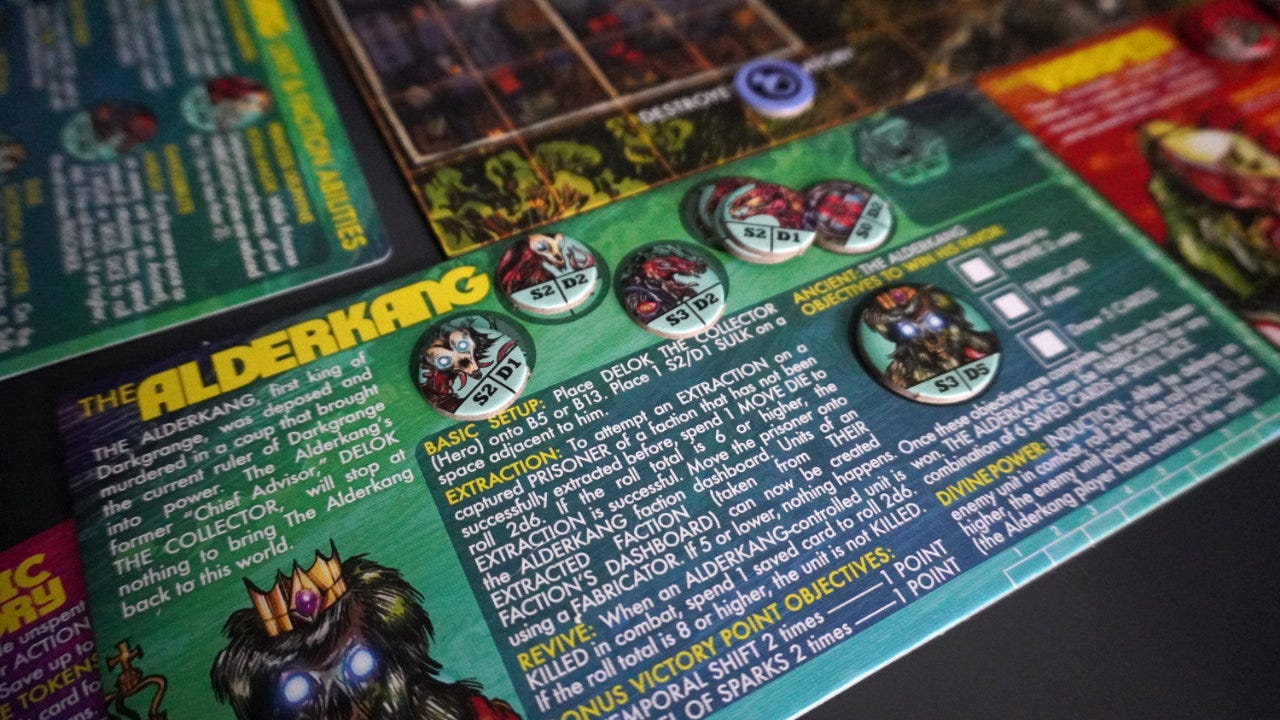
Each die can then be applied to units on the map. For example, the Alderkang can use a Move Orthogonal 1 die and a Move Diagonal 1 die to move their Kangsbrute unit two spaces on the map. Any number of dice can be used for each unit, but each die can only be used once.
It’s an interesting system because you never know exactly how far or in which direction you will be able to move your units. It’s not quite roll-and-move, but it is something a little similar.
It also means that while the factions are highly asymmetric, the movement for each faction is basically symmetric — it is the same for all factions. Everyone rolls six red dice at the start of their turn. A bad roll is equally bad for all factions.
Movement and terrain
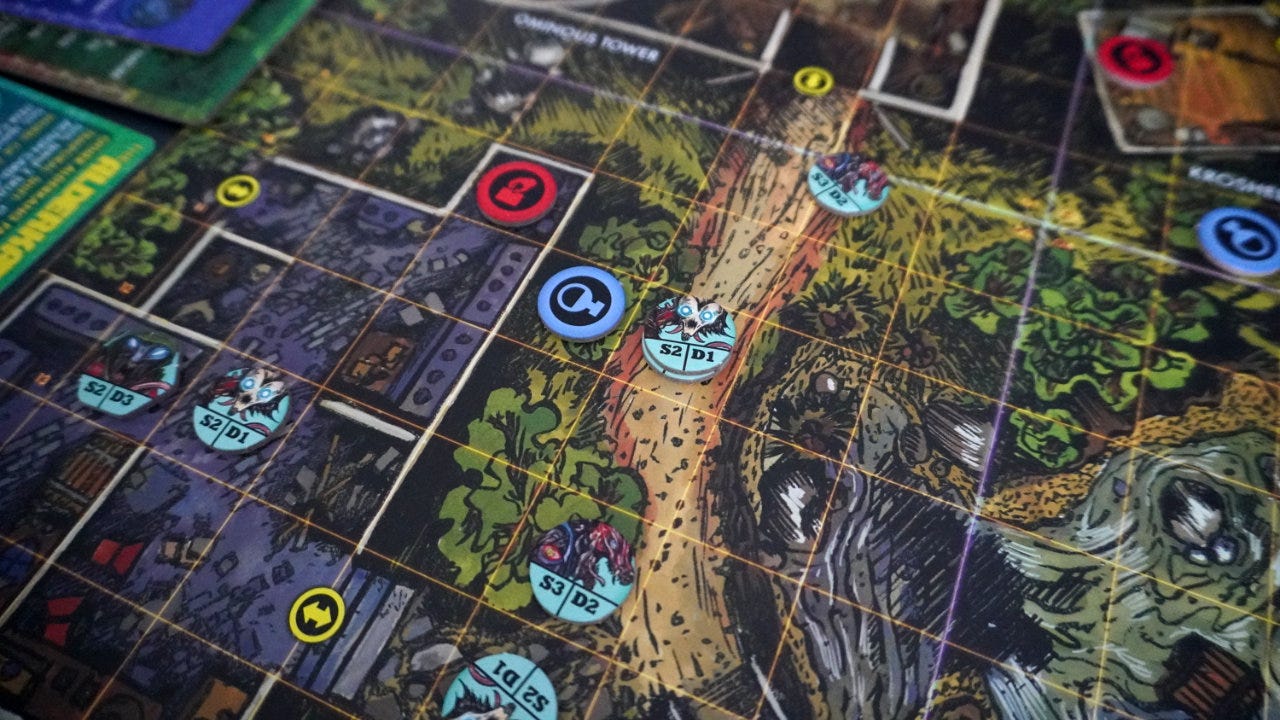
Terrain on the map works similarly to other skirmish and wargames like Burning Banners. There are rivers, water, roads, and other obstacles.
Crossing into a river costs an extra movement point (MP). If a Varpen warrior wanted to cross a river and come back out the other side, it would cost 2 MP to move into the river and another 1 MP to exit on the other side, for a total of 3 MP.
Some factions have the ability to convert resources (e.g. wood and stone) into new obstacles on the map. The Dhargon can build fences and walls that add 1 MP or 2 MP penalties to cross. In a game that has such variable and limited movement, this can create a significant advantage for the Dhargon.
Thankfully, Dark Venture has some luck mitigation built into the game in the form of genetic memory.
Genetic memory
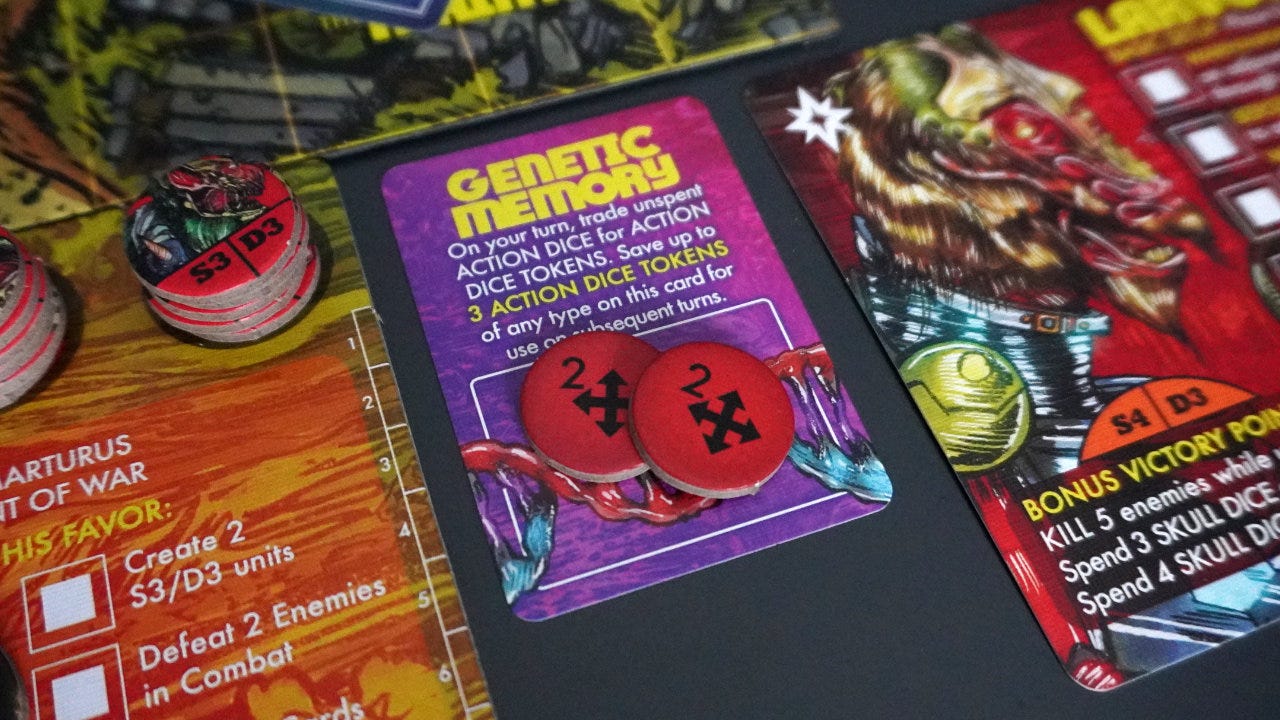
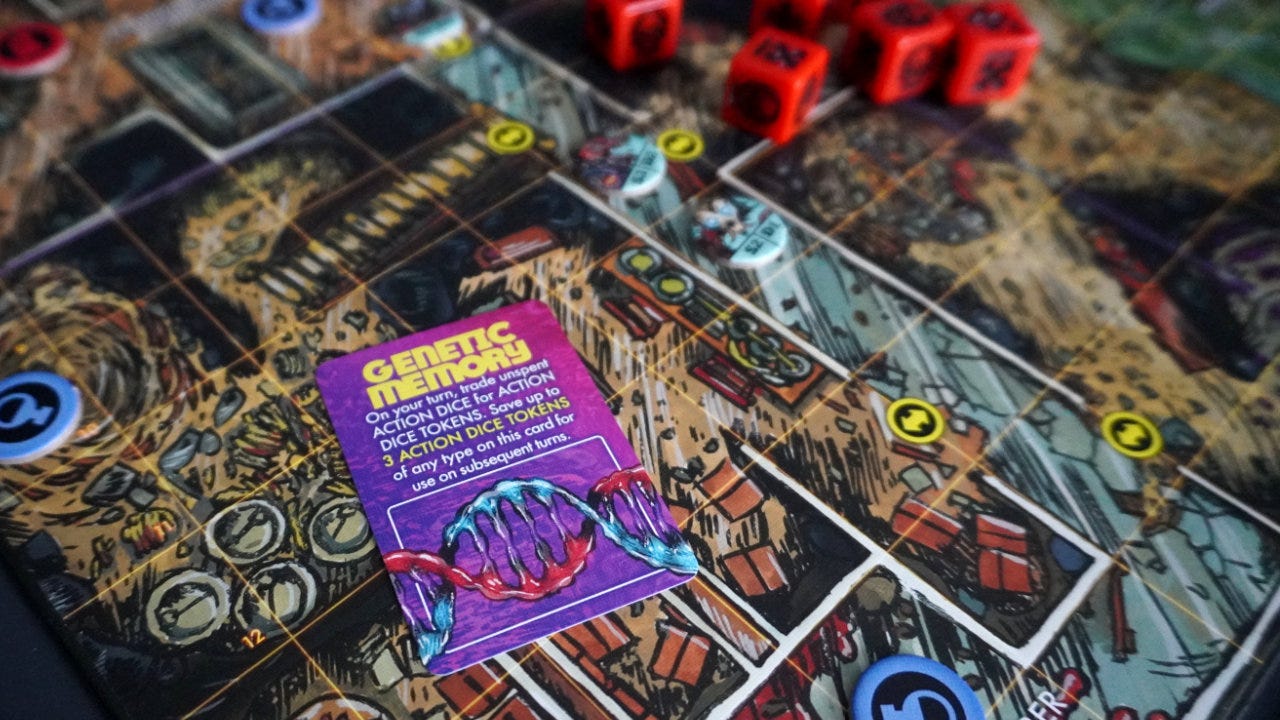
Thematically, genetic memory exists because “the magik of the Cataclysm has left a temporal imprint within the cells of the creatures of this land.” Mechanically, it acts as a way to store actions for a future turn.
Each player has a Genetic Memory card that they keep near their faction player board. After rolling the red action dice at the start of their turn, they can store unused actions. This is done by placing a red token matching the die face stored (e.g. Move Diagonal). Up to three actions can be stored in this way, to be spent at any time during their turn.
This allows players to control the tempo of the game to some extent. They can choose to take fewer actions on some turns to bank actions for a big later turn. It also helps mitigate the luck of a particularly poor action dice roll by pulling from saved actions.
It’s a rather clever way of adding some player agency and strategy to an otherwise random action and movement system.
Conclusion
Some things to think about:
Roll-and-move is valid: I’ve called roll-and-move an outdated game mechanism in the past, but even then I noted that “in better cases, the roll might be mitigated or modified in some way.” Dark Venture mitigates luck by allowing actions to be banked for later use via the genetic memory mechanism.
Adding player agency: While not a strict rule, I think it’s a good design method to look at each part of a game and ask (1) is there player agency and (2) can the player be given a choice.4 The genetic memory mechanism does this by allowing the player to choose not to use the dice and save them for a later turn. This can be a tough decision at times.
Component bloat: The Dark Venture: Battle of the Ancients box contains 358 tokens, including 64 action dice tokens. It should be noted that adding the ability to store actions for later created a need for additional tokens. In a game that supports five players, that’s a lot of tokens. There’s nothing wrong with that, but it is good to consider component impacts when making design decisions.
— E.P. 💀
P.S. Want more in-depth and playable Skeleton Code Machine content? Subscribe to Tumulus and get four quarterly, print-only issues packed with game design inspiration at 33% off list price. Limited back issues available. 🩻
Skeleton Code Machine is a production of Exeunt Press. All previous posts are in the Archive on the web. Subscribe to TUMULUS to get more design inspiration. If you want to see what else is happening at Exeunt Press, check out the Exeunt Omnes newsletter.
Skeleton Code Machine and TUMULUS are written, augmented, purged, and published by Exeunt Press. No part of this publication may be reproduced in any form without permission. TUMULUS and Skeleton Code Machine are Copyright 2025 Exeunt Press.
For comments or questions: games@exeunt.press
Not to be confused with Dark Venture (Lemon, 2019) from the same designer. That one is an adventure card game, but it does share the same thematic universe.
The Ancients in the game are summoned when a player completes three specific objectives on their player board, usually a mix of defeating units, drawing cards, crafting items, or gathering resources. Having the ancient on the map grants that faction a special divine power that can be used.
If my math is right (which it rarely is), there is a (1/3)^6 chance of rolling all skulls or about a 1 in 729 chance — about 0.14%.
I like the mechanic of saving dice but wonder if there isn't a cleaner solution that reduced tokens and avoided the 'bad feel' turn of rolling a bunch of skulls, even after using up your saved resources.
I'm sure the designers put a lot of thought and intent into their system, and this is idea is just a quick riff...
What if instead of saving dice, Skulls had a positive but different effect? A faction ability that helped a bad roll result in the player's forces regrouping, giving a one-time effect or other faction-unique result? Some factions might spend a skull to reroll another Action die (so the odds improve while the dice pool is reduced). Other factions might have stranger effects like for each skull you can sacrifice a unit/hit point to cast a spell.
Anyways, thanks for the article. Fun read.
your math is correct :) and a great article :D being able to save resources for later is an interesting mechanic, even for cases where it's not that you're afraid of not having enough of them due to random reasons later; i could imagine cases where it's more that it's not as useful as it could be, to use some ability/move etc in some kind of turn-based game, but it boardgame or rpg ^^