
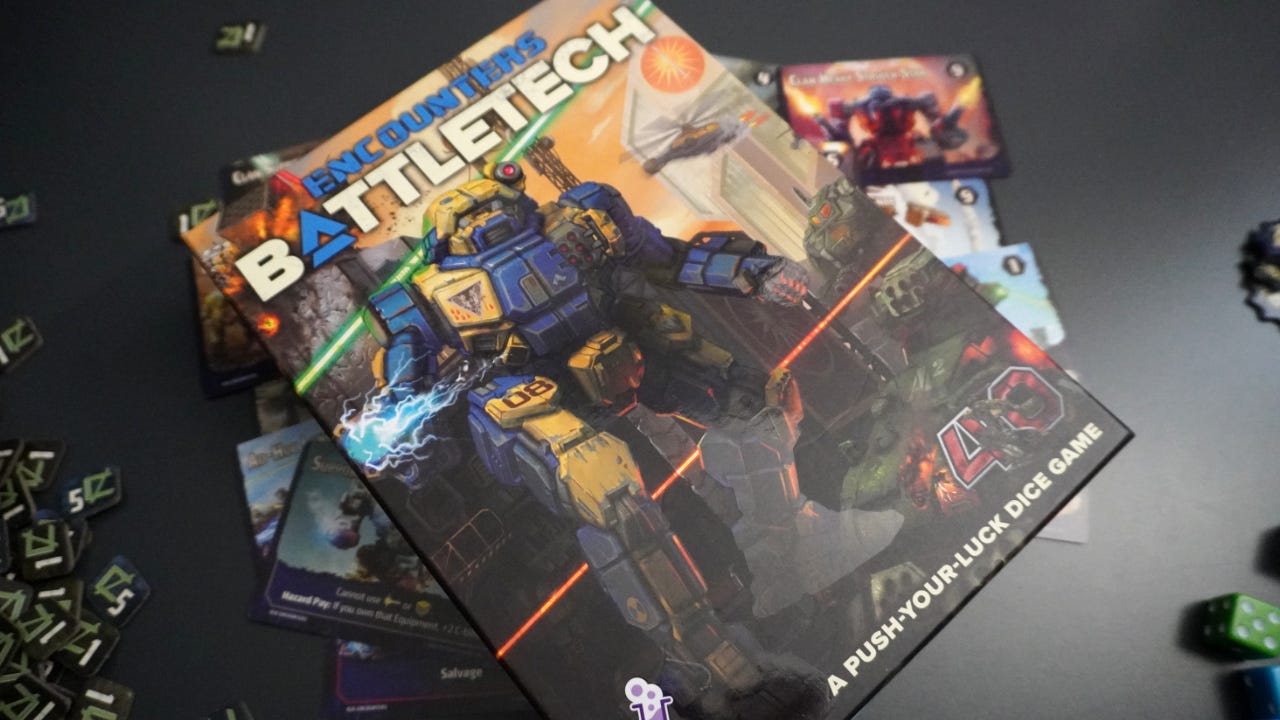
As we wait for Tumulus 07 “Slay the dragon.” to arrive from the printer this week, let’s explore a dice pool mechanism.1 Encounters: BattleTech uses a (mostly) 6d6 dice pool and some push-your-luck to allow players to be mercenary commanders completing dangerous contracts for the Great Houses.
Encounters: BattleTech
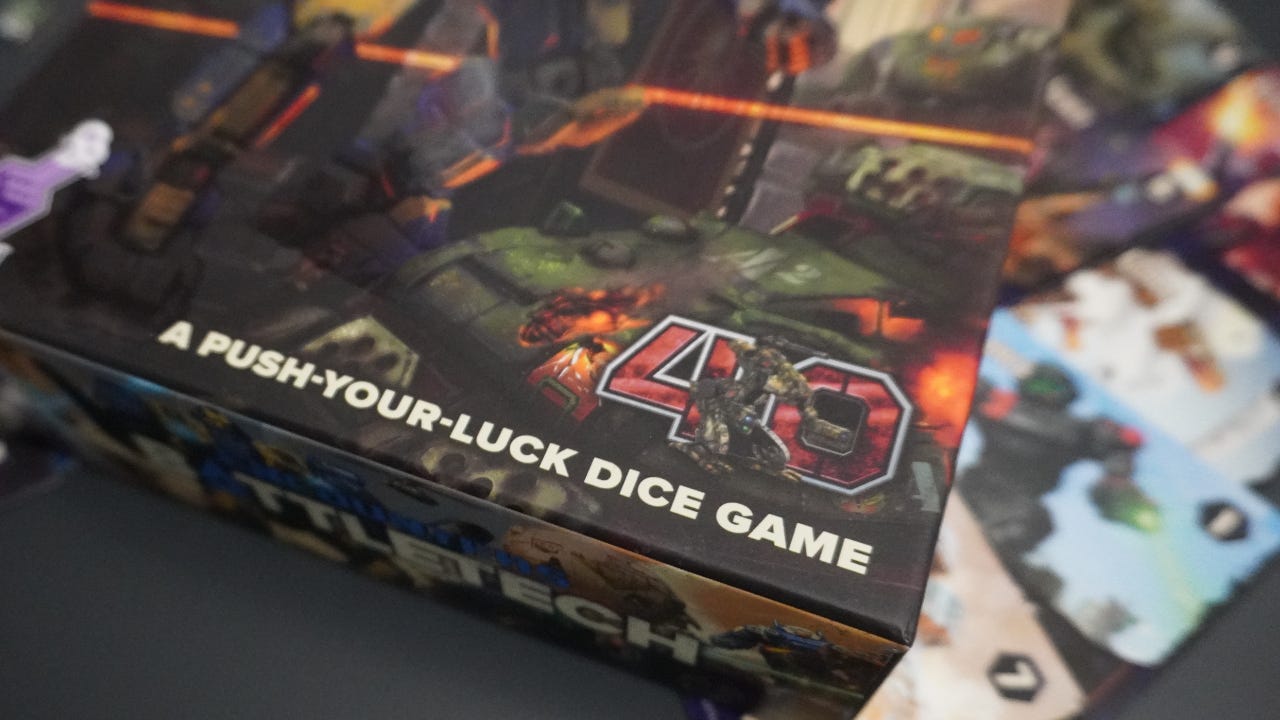
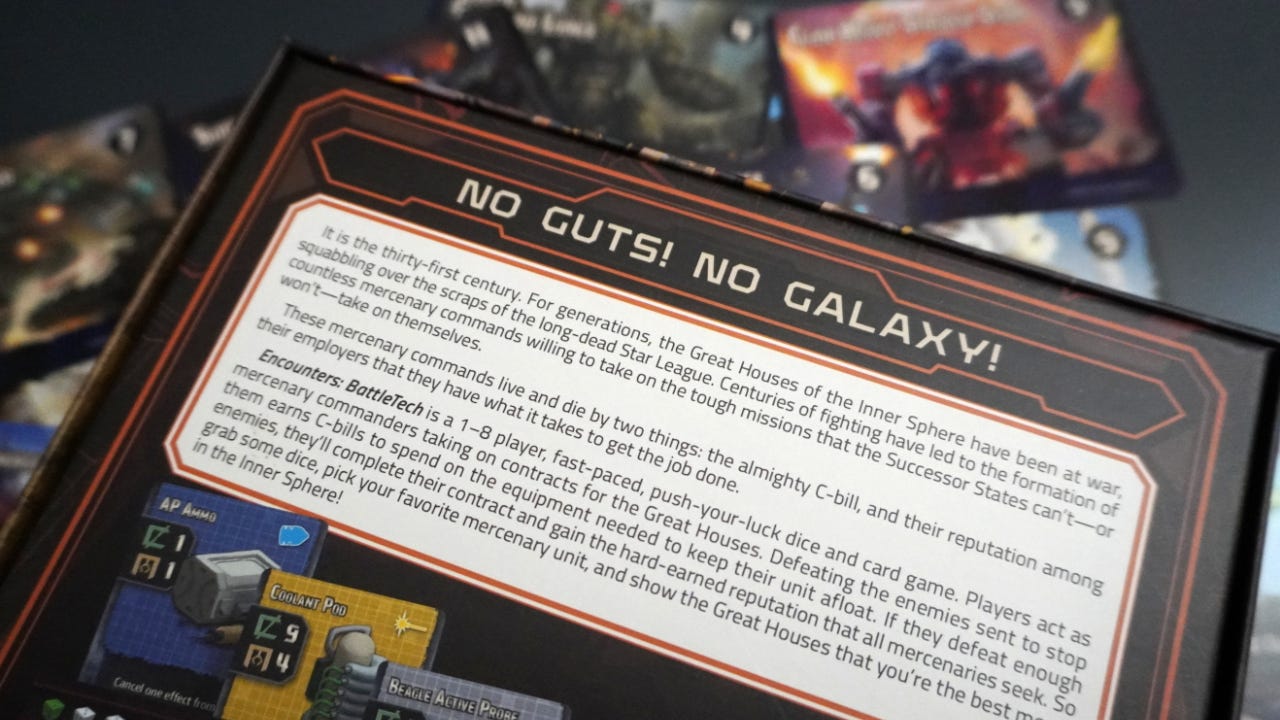
Reimplementing the same system used for Encounters: Shadowrun (Bills & Knudson, 2016), Encounters: BattleTech (Kirtley & Knudson, 2024) adapts the system from cyberpunk to battle mechs.2 The backstory is filled with the Great Houses of the Inner Sphere, as one would expect from the venerable BattleTeach franchise.3
In this game you are one of the mercenary commander executing contracts for the Great Houses. Each one is a chance to earn some C-bills (money) to buy upgrades for your mech. Earn enough reputation and you win the game.
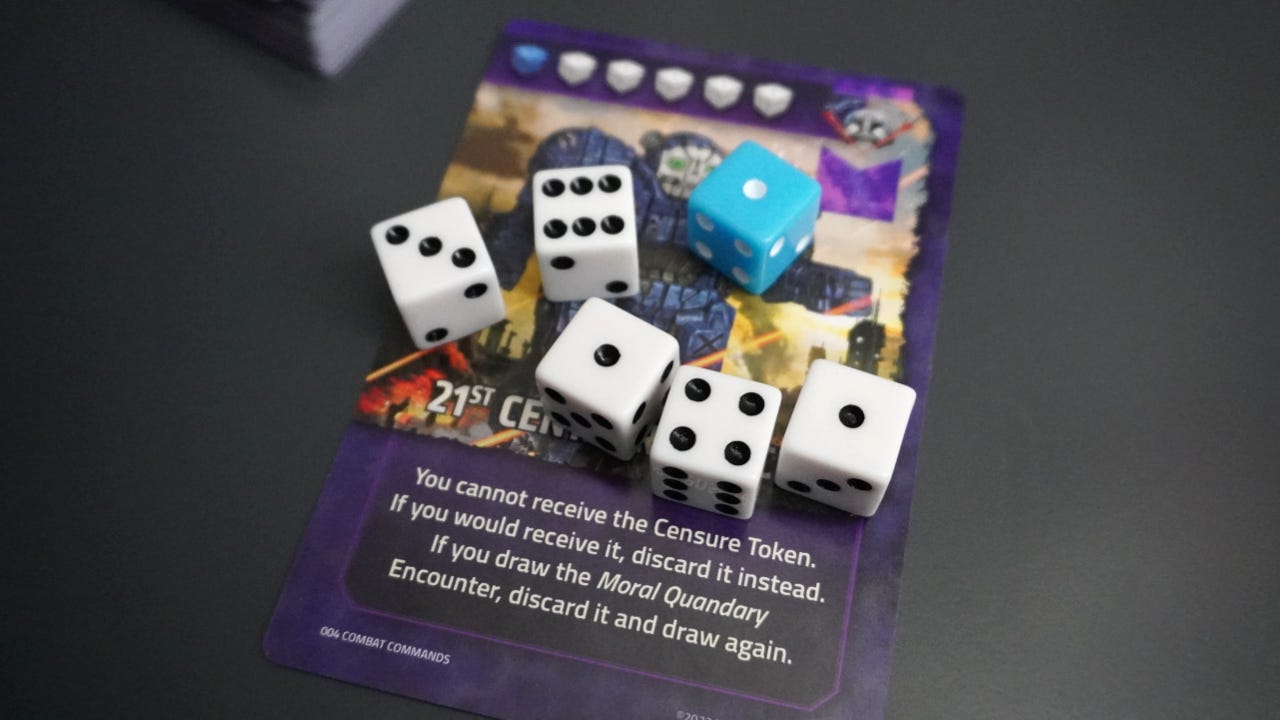
That’s the theme. Mechanically, the game is a dice-based push-your-luck game. Each player takes a Combat Command card to get started. The cards define which dice colors will be used by that player and provides a unique variable player power (e.g. “The first equipment card you buy each turn costs 1 fewer C-bill.”).
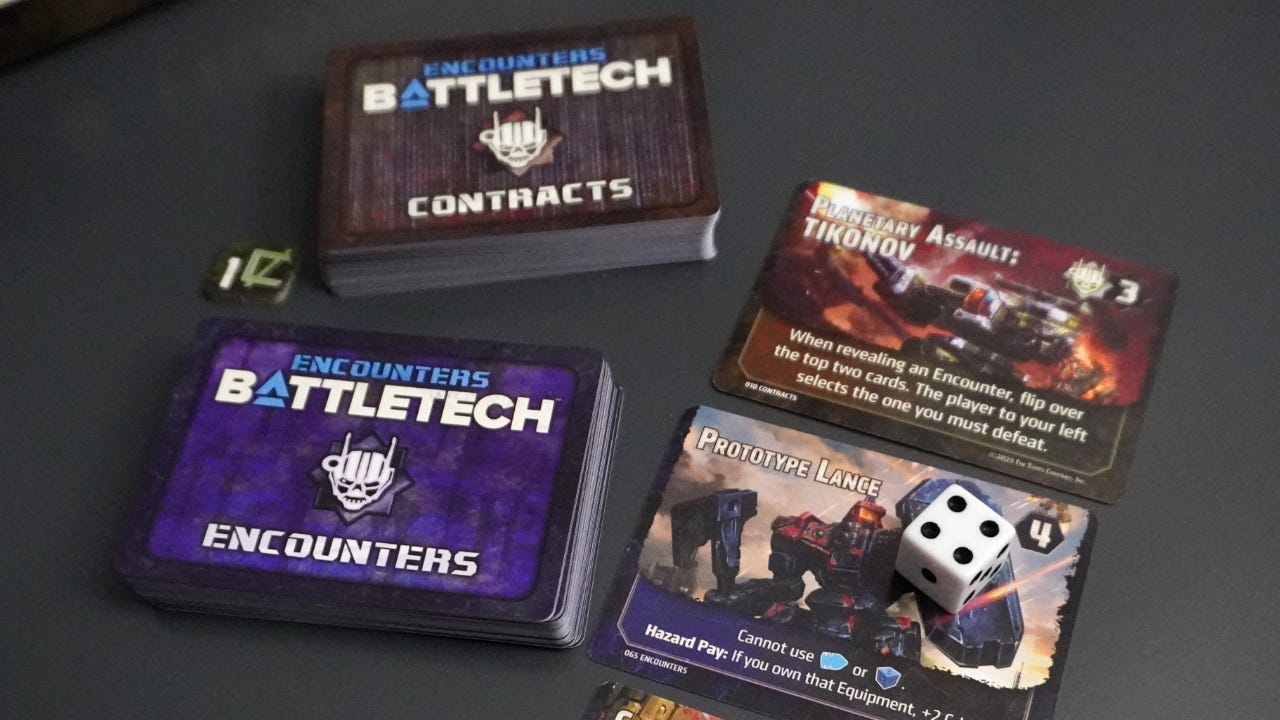
On a player’s turn, they select a contract card that has a stated reward and also some special effects. The player can then attempt to complete the contract by defeating encounters. Encounters are drawn from a separate deck and a number called the Encounter Value (EV). That’s the target number required to defeat the encounter.
As the player proceeds, they can either keep defeating encounters or they can decide to quit. If they quit, they retain the C-bills earned (allowing the purchase of better equipment), but get no Reputation (victory points to win the game). If they make it to the end, using all their dice, they get both C-bills and Reputation.
There’s a surprising amount going on in this small-box game, so I won’t attempt a full rules explanation. Instead, I’d like to focus on the method used to defeat the encounters.
Defeating encounters
You begin your turn with dice from the dice pool as defined on your Commander Card. This is always 6 six-sided dice (6d6) with one of the dice being a different color (yellow, blue, green, or black). Then you roll all your dice.
Each encounter has a target number on it between 1 and 13. To defeat the card, you need to place dice on it that add up to exactly the target number. If the target is 12, you could place: 4+3+3+2 or 6+6 or 5+5+2. You could not place 5+5+3 because that would take you over the target number.
Assuming you continue, you’ll need to defeat the next encounter card with your remaining dice. Dice used on previous encounter cards are locked and may not be used again during this contract run.
This continues until you are down to just a few dice. On that last encounter, if you are able to use (i.e. “lock”) all of your dice, you complete the contract and earn some Reputation (VP).
This is, of course, increasingly hard to do with fewer and fewer dice each encounter. You might pull an encounter card with a target value of 1. If you don’t have a die showing a 1 you are out of luck. It’s why you might want to bail before you get to that point, collect your C-bills and try again another day. If you ever make it to the end of the encounters and can’t place your dice to defeat it, you get nothing.
A note on equipment upgrades
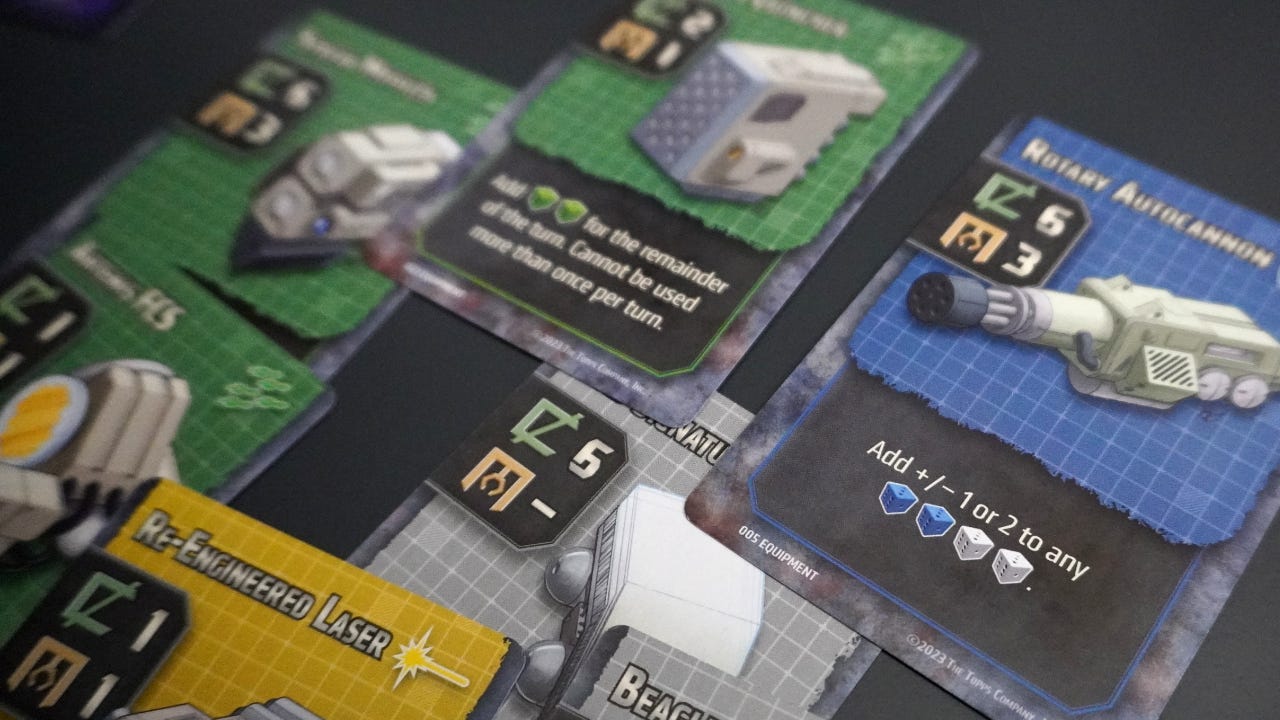
While I think the “lock dice to defeat a target number” is the interesting bit from this game, the equipment upgrade system must be mentioned.
As noted above, it is almost impossible to finish a contract with the default 6d6 dice pool. This is particularly true when the special effects and conditions from the contract and encounters are applied. So how does one ever earn victory points?
The C-bills earned from exiting a contract before total failure can be cashed in on equipment. Thematically, equipment cards are Precision Ammo, Autocannons, Handheld Lasers, Streak Missiles. Mechanically, each one allows you to add dice to your pool and modify them after they are rolled. It’s a form of luck mitigation that is absolutely necessary to win the game.
It actually creates a rather nice game arc. Players begin the game able to defeat some encounters but then must escape before they fail and get nothing. They do partial contracts, gaining C-bills to put toward future equipment upgrades. Eventually they purchase an item or two and encounters become a little easier. By the end of the game everyone has a tricked out mech that can rip through encounters. It’s then a race to the 10 Reputation required to end the game.
Applications in other games
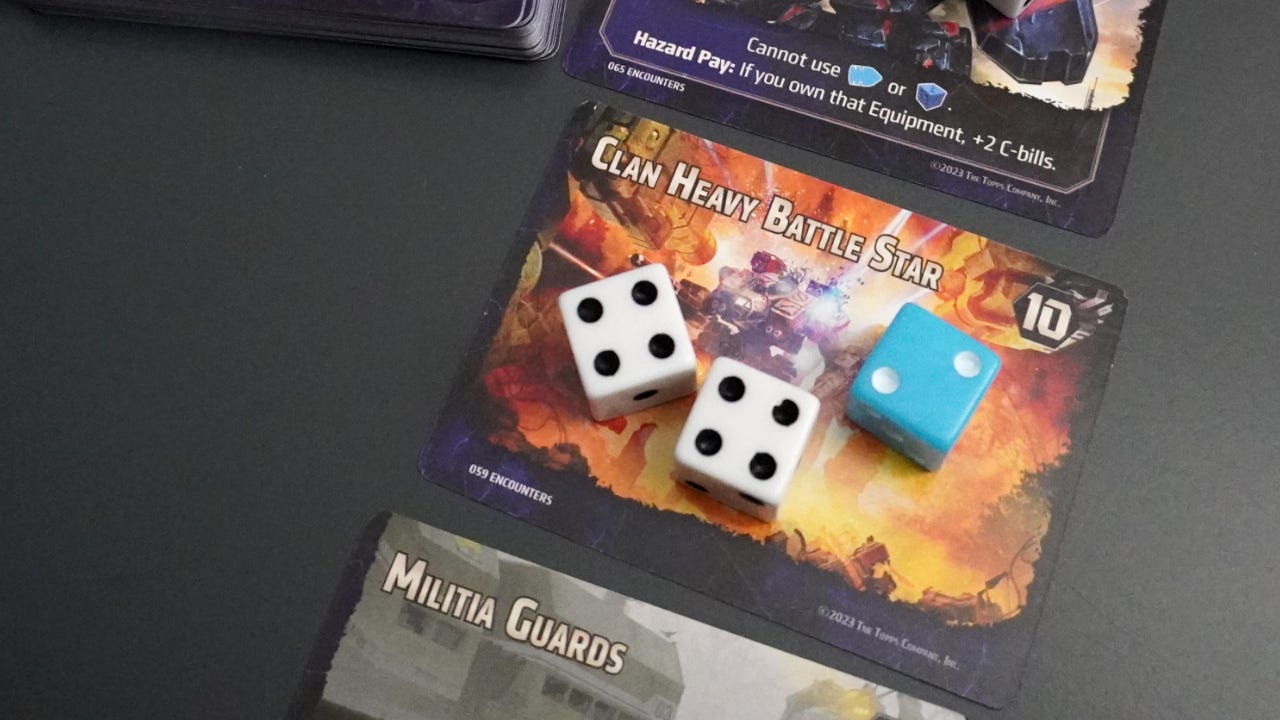
While I’m sure a similar “use dice to add up to an exact number” mechanism has been used before, this might be the first time I’ve seen it. There are many “use dice that add up to at least X or greater” systems, but requiring an exact match makes it a bit trickier. In fact, it’s because it is almost impossible at first that makes the dice-modifying equipment cards so important.
I could see a similar mechanism used for combat in fantasy TTRPGs. It’s an easy adaptation because the system is already themed around combat where the dice-modifying cards are largely weapon types. The original Encounters game was one set in Pendleton Ward’s Adventure Time universe called Encounters: Bravest Warriors (Knudson, 2014), so it’s not too far of a stretch.
I also think this system would be an interesting one to use for a solo cyberpunk hacking game. Similar to how Before the Bog God used a dice game for competing rituals, this target number system could be how a player hacks networks. They could gain dice to their pool by collecting data and then modify rolls with enhanced gear or a better rig.
Conclusion
Some things to think about:
Small changes make a big difference: If the encounter system said “lock dice equal to or greater than the target number” it would be significantly easier to defeat encounters. There would be less reason to gain C-bills to buy equipment upgrades. The entire game would feel different.
Making a system: Brian Knudson created a game system when he made Encounters — one that could be adapted to Shadowrun, BattleTech, and Adventure Time. There’s value in thinking about how your game design can turn into a platform for many games.
Theme vs. mechanism: While the system is mechanically interesting, it would be a stretch to call it a highly thematic one. As someone who used to play some BattleTech, I didn’t really get the BattleTech feel when playing Encounters: BattleTech. That’s not necessarily a bad thing, but it does illustrate how thematic integration is hard.
What do you think? Is the Encounters system interesting enough to support many different re-themes? More importantly, could it work in a TTRPG?
— E.P. 💀
P.S. Want more in-depth and playable Skeleton Code Machine content? Subscribe to Tumulus and get four quarterly, print-only issues packed with game design inspiration at 33% off list price. Limited back issues available. 🩻
Skeleton Code Machine is a production of Exeunt Press. All previous posts are in the Archive on the web. Subscribe to TUMULUS to get more design inspiration. If you want to see what else is happening at Exeunt Press, check out the Exeunt Omnes newsletter.
Skeleton Code Machine and TUMULUS are written, augmented, purged, and published by Exeunt Press. No part of this publication may be reproduced in any form without permission. TUMULUS and Skeleton Code Machine are Copyright 2025 Exeunt Press.
For comments or questions: games@exeunt.press
I did include a small re-print of Tumulus Issue 01 “Do not trust robots.” due to popular demand so many people asking for it. The initial print run for that issue was smaller than for other issues. It makes sense to print some more at this time. Watch Exeunt Omnes to get notified when the become available.
What is a mech, you ask? Oh, that’s no easy question to answer!
There’s even an 8-page BattleTech Primer included in the box detailing the Great Houses. No doubt recycling lore blurbs from some of the many other BattleTech products.
super interesting, as always :) thank you for sharing <3
while not exactly the same, this reminds me of two classes from two different TTRPGs – the Sorcerer from Defy the Gods, and the Muzeiiyd Mercernary from You Will Die In This Place! the former rolls dice hoping to form specific "patterns" to be able to cast different spells (if they are unable to form any pattern they have unlocked, chaos breaks out (as is the results if they get 'snake eyes')); the latter rolls dice for their "stamina pool" which they can then allocate to different actions (the pool is, generally, reduced every round – one of the dice they used for action(s) that turn gets discarded, the others re-rolled)... there's a lot more to them than that, but just to draw attention to the broad similarity and some of the differences :)
TUMULUS #1 reprints!?! YEEEEEESSSSS!!! This makes my morning! Take my money!