
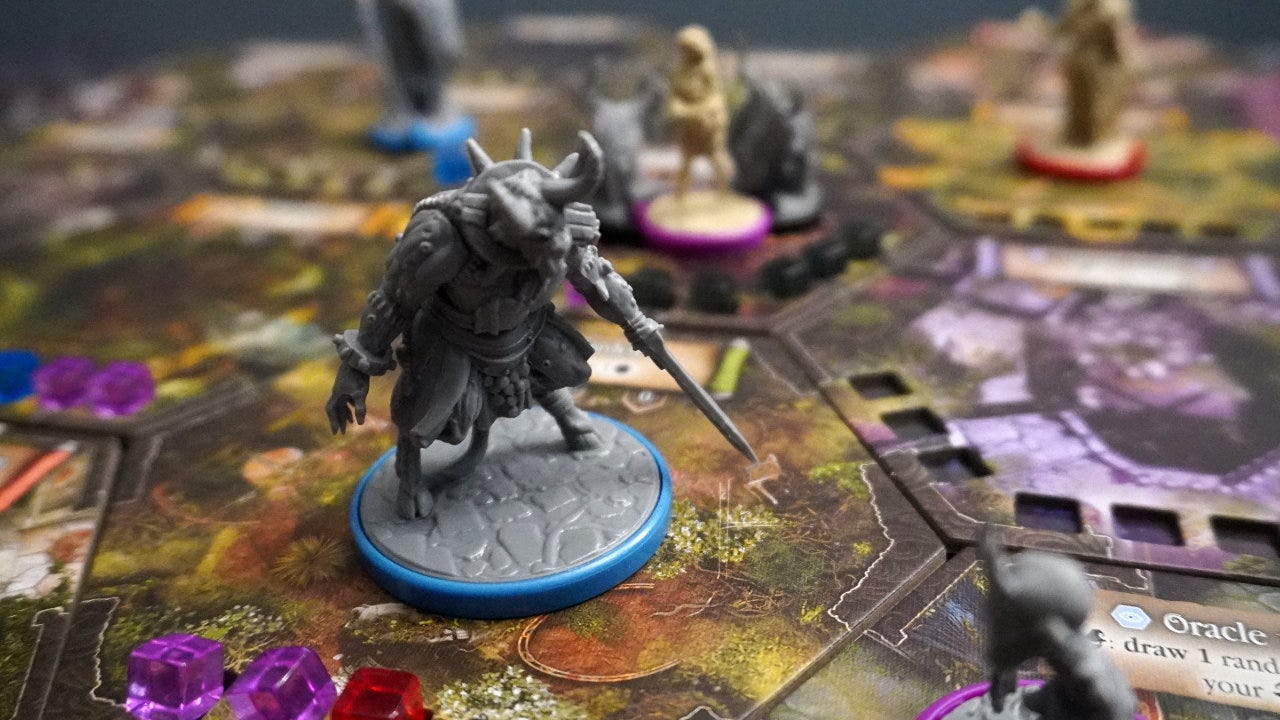
This week we are exploring how Black Rose Wars: Rebirth uses an action queue system to turn combat and conflict into a tricky puzzle to solve.
But first…
I’ll be at the ALA Annual Conference this week in Chicago! Come to the GameRT Mage’s Program: Creativity, Community, and Connection: Why We Can’t Shut Up about Game Jams:
This panel brings together librarians and game publishers to share their experience and ideas on hosting game design workshops at your library! From iterating on existing games to creating original ones, from board games to tabletop roleplaying games, from single-day events to a month-long event, come learn how play can foster creativity, facilitate community, and build connection with library resources and services.
This is only the second time I’ve ever been on a panel, and I’m very excited for it!1 If you’ll be there, please let me know in the comments!
Now, on to the battle for the power of the Black Rose!
Fighting to rebuild the Lodge
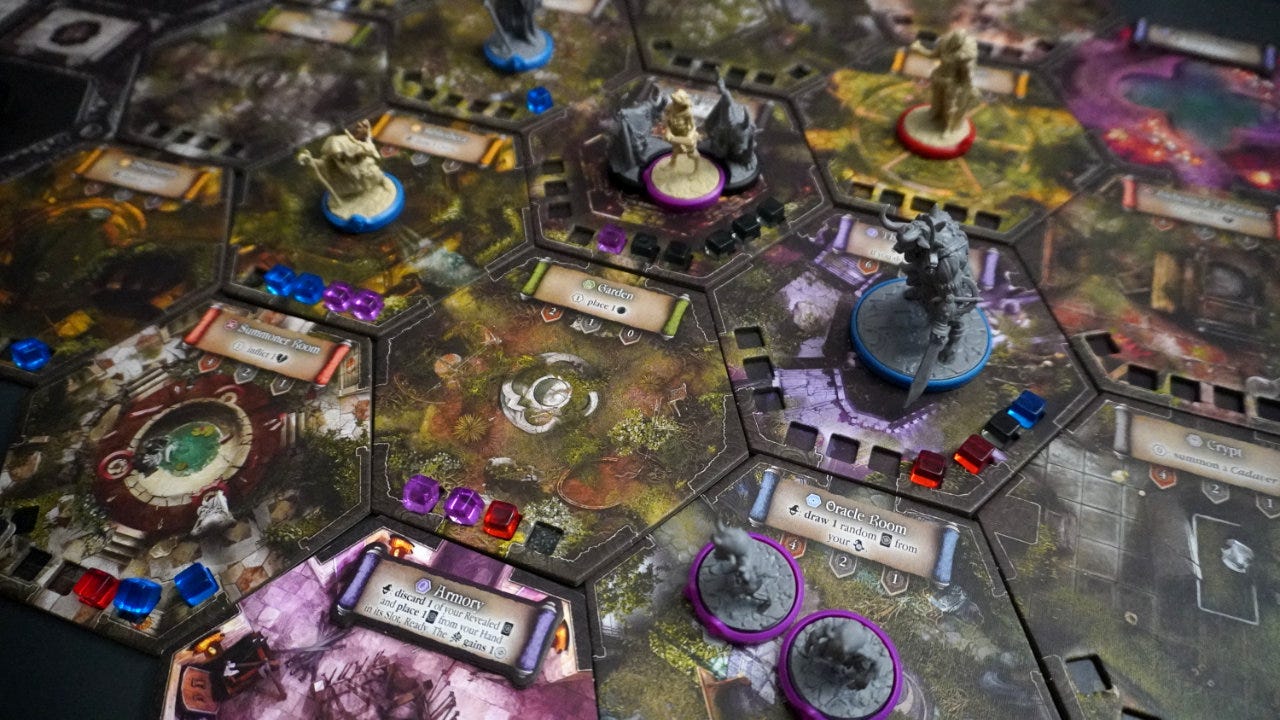
Black Rose Wars: Rebirth (Colletti, Fonseca, et al., 2023) is fantasy combat strategy game with a setting that is a little bit confusing. There’s a powerful Black Rose entity that controls the Lodge and all of its rooms. It was destroyed in the past and now mages are competing to rebuild the rooms. Or something like that:
Every player represents a Mage in this struggle to prove themselves as the true beholder of the Black Rose’s power. The mages will program spells to their board and execute them in turn order. Those spells may disable other mages spells, arm traps, arm powerful defensive moves, deal damage, or summon otherworldly beasts.
The game is played on a large, modular, hex grid of tiles. Each tile represents a room in the lodge such as the Armory, Observatory, Garden, and Pleasures Room. All tiles begin on their destroyed side. Throughout the game, players will place Instability Cubes in the available slots in each room. Once full, that tile can be flipped and victory points are gained.
Players (mages) will also be battling each other while attempting to rebuild the rooms via traps, summoned creatures (“evocations”), spells, and direct attacks. There is, however, no player elimination. If your mage ever receives damage equal to their Health Value, they are simply returned to their starting room and begin again. The player who applied the most damage that resulted in the defeat receives victory points.
There’s a lot going on in this game, and it’s far too much to explain in this article. The part I want to focus on is how players program their spells for use each round.
Schools of magic
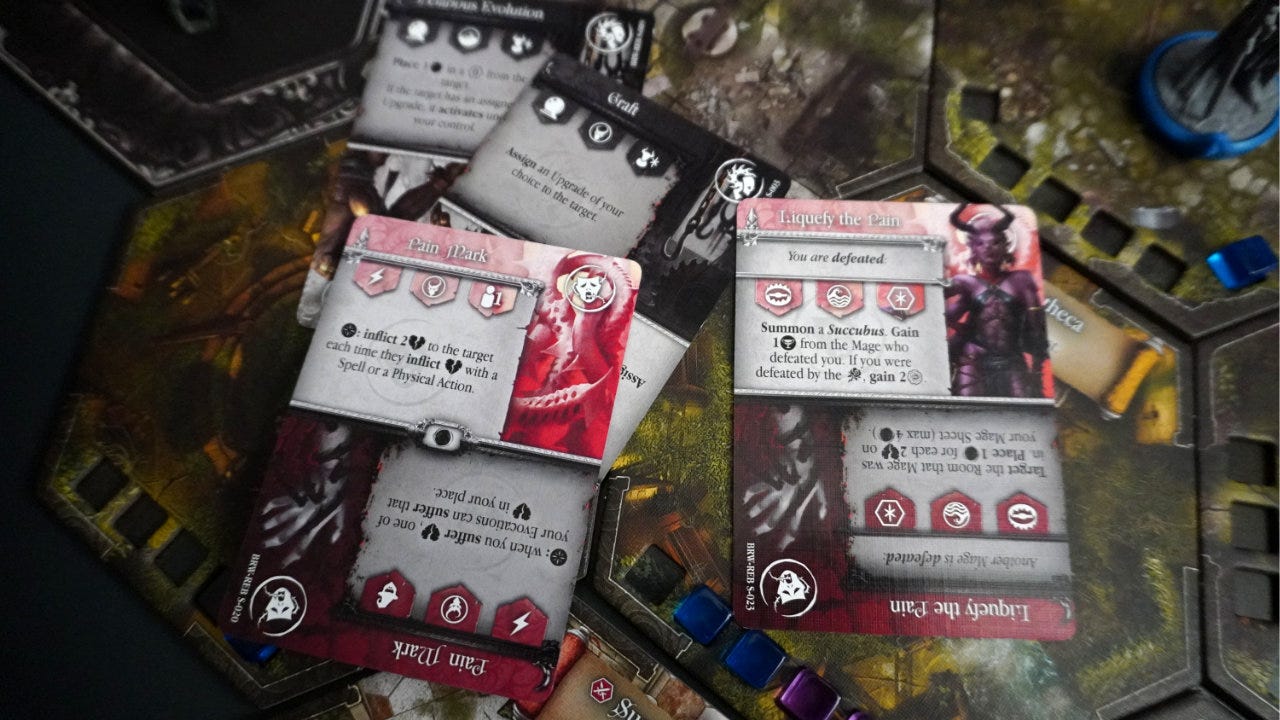
There is an element of deck building in Black Rose Wars: Rebirth. Each round, players draw two cards from their deck and add two cards from various Schools of Magic including Agony, Alchemy, Hex, Nightmare, Shamanic, and Technomancy. Players end up with a mix of cards from the school, each card with its own ability. Some act as traps (triggered by a specific action by another player) and others are direct attacks that deal damage. Some add an Instability Cube to a room (to rebuild it) and others nullify incoming spells.
During the Study and Preparation phases, players are drawing and selecting which cards they want to be able to play in the upcoming round. Players can only select 4 spell cards to ready and the others will remain in their hand.
The interesting twist is that the spells must be put into an action queue before players begin taking turns.
Spell programming
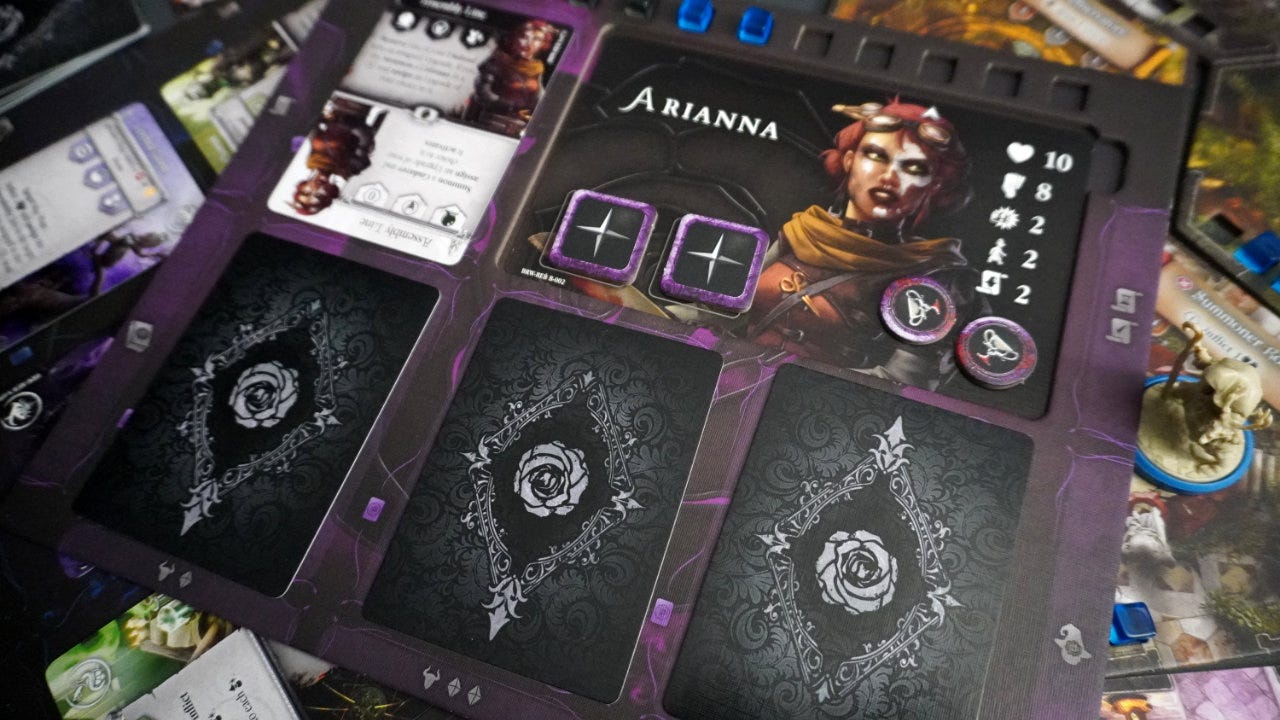
Black Rose Wars: Rebirth uses a batch action queue system for spells. Players choose 4 spells to ready and place them on their board in order. One slot is a Quick Spell and can be used out of order. The other three must be used in order: Slot 1, then Slot 2, then Slot 3 last.
During the action phase, each mage performs one or two actions in turn order. The first player might activate/prime a trap spell and then move two hexes to activate a room’s ability. The next player might use a spell to add Instability Cubes to a room and not use their second action. This continues around the table until all players have exhausted all of their actions.
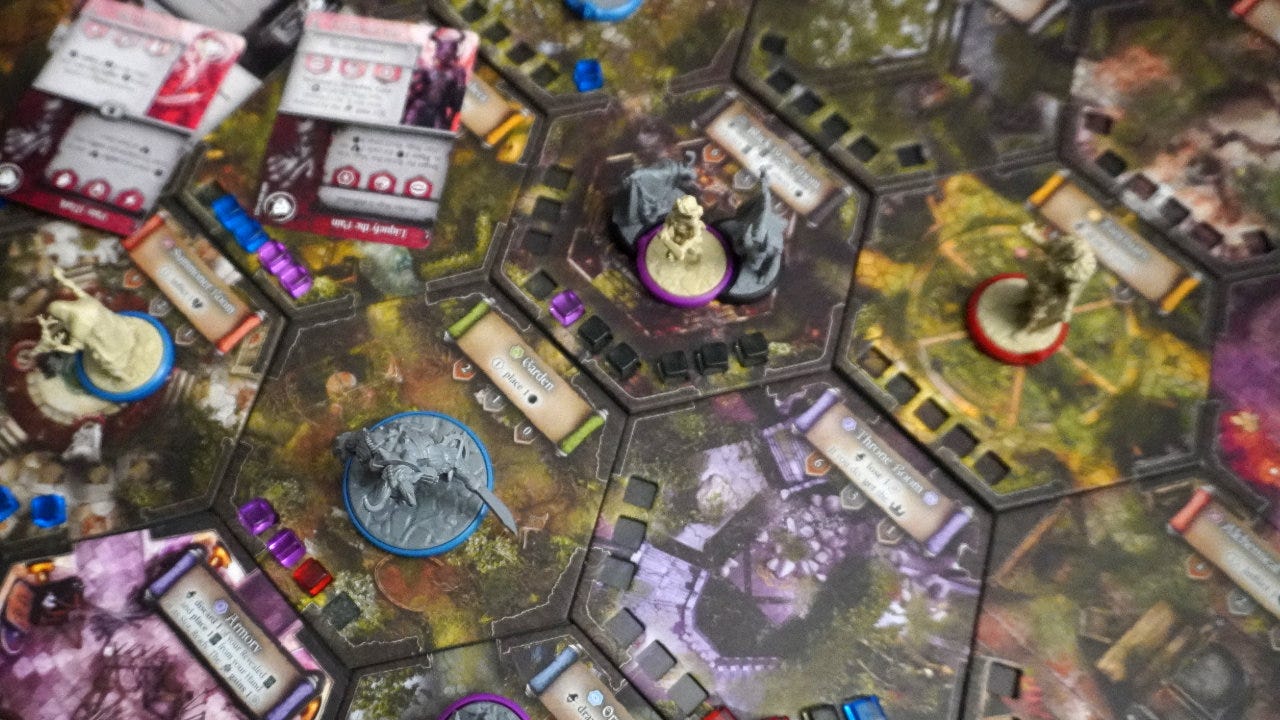
The trick is that you programmed your actions before everyone started moving around and taking actions. You may have thought that one of your rivals would be in range, but now they decided to move to the other side of the map. Even worse, you might think you could deal the final two damage to a mage only to have someone else steal the kill right out from under you. It’s also possible that you end up being defeated earlier than expected and sent back to your room to start over.
The Quick Spell slot helps mitigate this because it can be used at any time during your turn. The other spells, however, must be used in the order you arranged them.
Setting traps
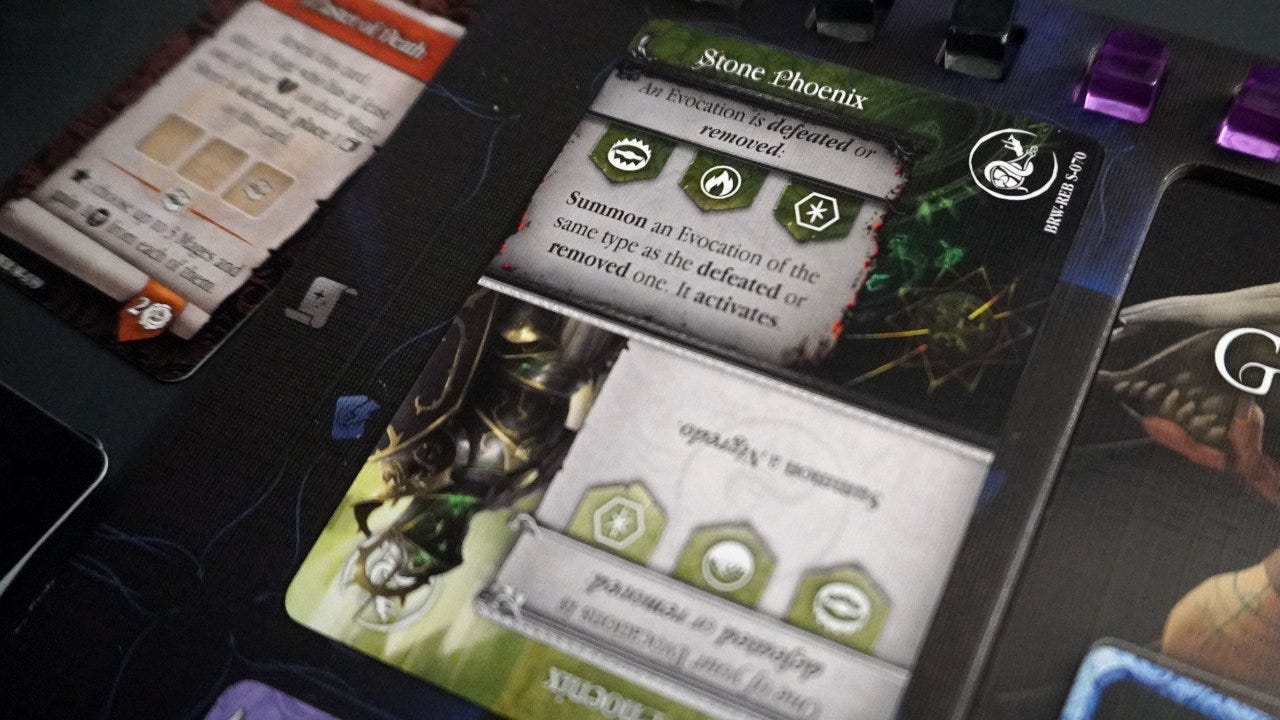
Trap spells are one of the most interesting uses of this batch action queue mechanism.
First, trap cards must be activated. The spell programming order still applies here, so if your trap is last in the queue, it won’t be activated until all other spells are used first.
Second, a trap card has a triggering condition that must be met: “An Evocation is defeated or removed” or “Another mage enters a Red or Yellow room.” If the condition is met, the trap fires and its effects are resolved.
Of course, the effects of a triggered trap might trigger someone else’s active trap which might even trigger yet another trap. It gets a little complicated at times, but it’s one of the most memorable parts of the game when it happens.
A different kind of tactical play
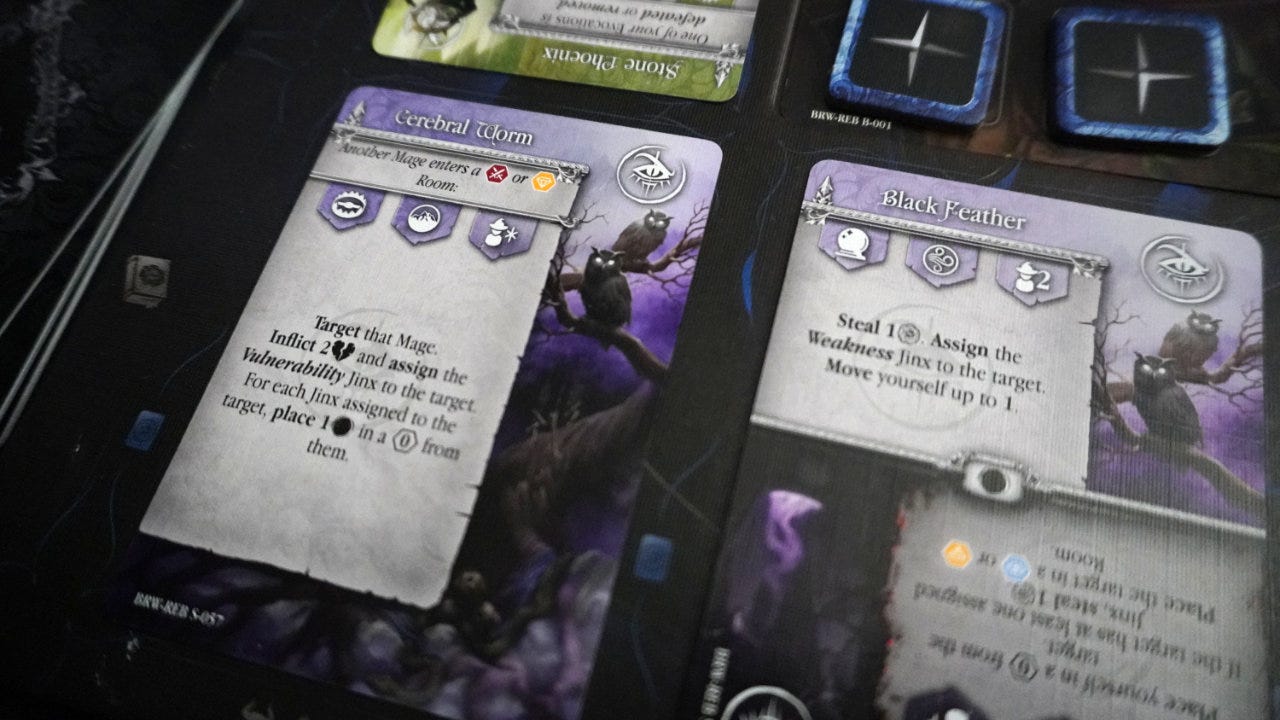
In many strategy games, you choose your actions and you execute them during your turn. Certainly you are reacting to other players, but usually you can change your mind on which action you are about to take.
Batch action queue (programming) systems like Black Rose Wars: Rebirth create a different kind of feel. You lay out your plan and then hope for the best. Your tactical changes during the action phase aren’t which card to play, but instead where to move (if moving) and who to target (if attacking). It’s a mix of pre-made decisions and tactical control that leads to everyone taking unexpected (and yet still fulfilling) turns.
Conclusion
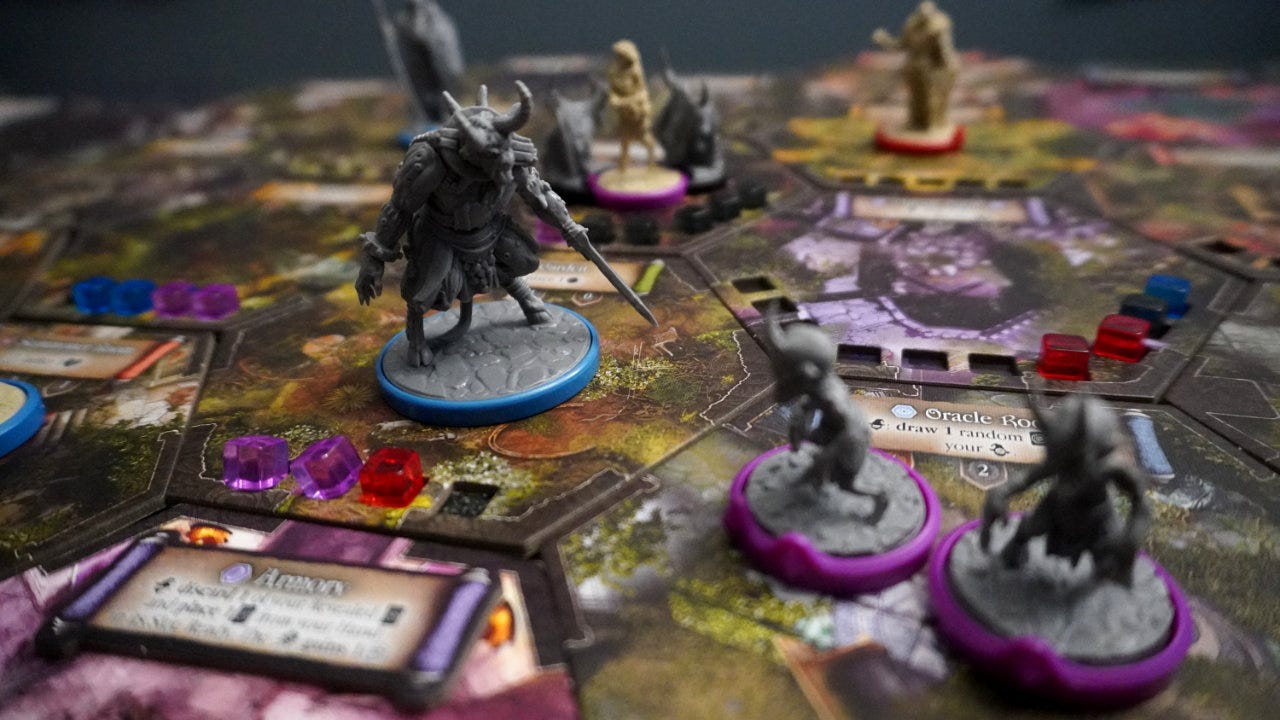
Some things to think about:
Action queues are cool: While I’m absolutely awful at playing the birds in Root (Wehrle, 2018), action queues and action programming are fascinating mechanisms.2 Take a look at Mechs vs. Minions (Cantrell, Ernst, et al., 2016) for more inspiration.
Mitigated chaos can be fun: I’m not sure the spell programming system would be nearly as fun if not for the Quick Slot and the fact that players get two general purpose “physical actions” each turn. The action queue is a key part of the game, but it is mitigated to allow some flexibility.
Laying traps feels great: I found one of the most satisfying parts of the game to be activating a trap and then quietly waiting for someone to trigger it — just hoping they attack me or activate a certain type of room. The fact that they can start a chain reaction of traps makes it that much better. I’d love to see this sort of thing in other games.
What do you think? Have you seen action queues or programming in other games? I’m particularly interested in TTRPG examples, so please share in the comments!
— E.P. 💀
P.S. Want more in-depth and playable Skeleton Code Machine content? Subscribe to Tumulus and get four quarterly, print-only issues packed with game design inspiration at 33% off list price. Limited back issues available. 🩻
Skeleton Code Machine is a production of Exeunt Press. All previous posts are in the Archive on the web. Subscribe to TUMULUS to get more design inspiration. If you want to see what else is happening at Exeunt Press, check out the Exeunt Omnes newsletter.
Skeleton Code Machine and TUMULUS are written, augmented, purged, and published by Exeunt Press. No part of this publication may be reproduced in any form without permission. TUMULUS and Skeleton Code Machine are Copyright 2025 Exeunt Press.
For comments or questions: games@exeunt.press
The first was the Small Publisher Diaries Q&A Panel at Unpub.
I famously caused the Eyrie to go into turmoil on the first or second turn of the game. Not my proudest gaming moment.
Great article.
One thing I've been thinking about is the kind of *fictional situations* where programming-style mechanics make sense in a TTRPG.
Imagine two warriors locked in close-quarters combat, each pre-programming three actions in advance. Watching someone commit to a series of sword strikes only to swing at empty air because the situation changed feels a little comical. On the other hand, the same mechanic seems much more natural for spellcasters who need to chant incantations, draw magic circles, prepare rituals, or set magical traps ahead of time.
That got me wondering: could a TTRPG intentionally use both traditional turn-by-turn actions and pre-programmed actions as class-specific mechanics? For example, martial characters might react moment-to-moment during combat, while wizards, artificers, summoners, or other preparation-focused classes would plan sequences of actions in advance. It seems like an interesting way to reinforce the fantasy of different archetypes through the rules themselves.
I suppose the obvious tabletop example of preloading effects would be RoboRally (https://en.wikipedia.org/wiki/RoboRally), which is a fantastic game at any time. But I have to admit, this game makes me think of a much older game called Waving Hands (http://www.gamecabinet.com/rules/WavingHands.html , designed by well-know designer Richard Bartle), in which mages weave a series of spells in a duel by making a series of physical gestures. That one doesn't pre-queue, but it does have a series that needs to be observed and interrupted or avoided, which leads to interesting tactical and strategic choices.
In the RPG space itself, I can't think of a lot of examples. En Garde! (https://www.engarde.co.uk) from 1975 has you plot your maneuvers in advance, which is kind of cool. Plus you don't see a lot of 17th century Parisian swashbuckling on the table much, which adds a certain level of excitement.
Burning Wheel/Mouse Guard/Torchbearer does scripted maneuver combat, which ends up being quite cool. Each exchange is a series of three volleys, which come from your maneuver set. Of the lot, I would probably suggest looking into Torchbearer (https://www.drivethrurpg.com/en/product/448193/torchbearer-2e-core-set-pdf-bundle) if it intrigues you. I find that Burning Wheel is just too much weight for not enough payoff.