
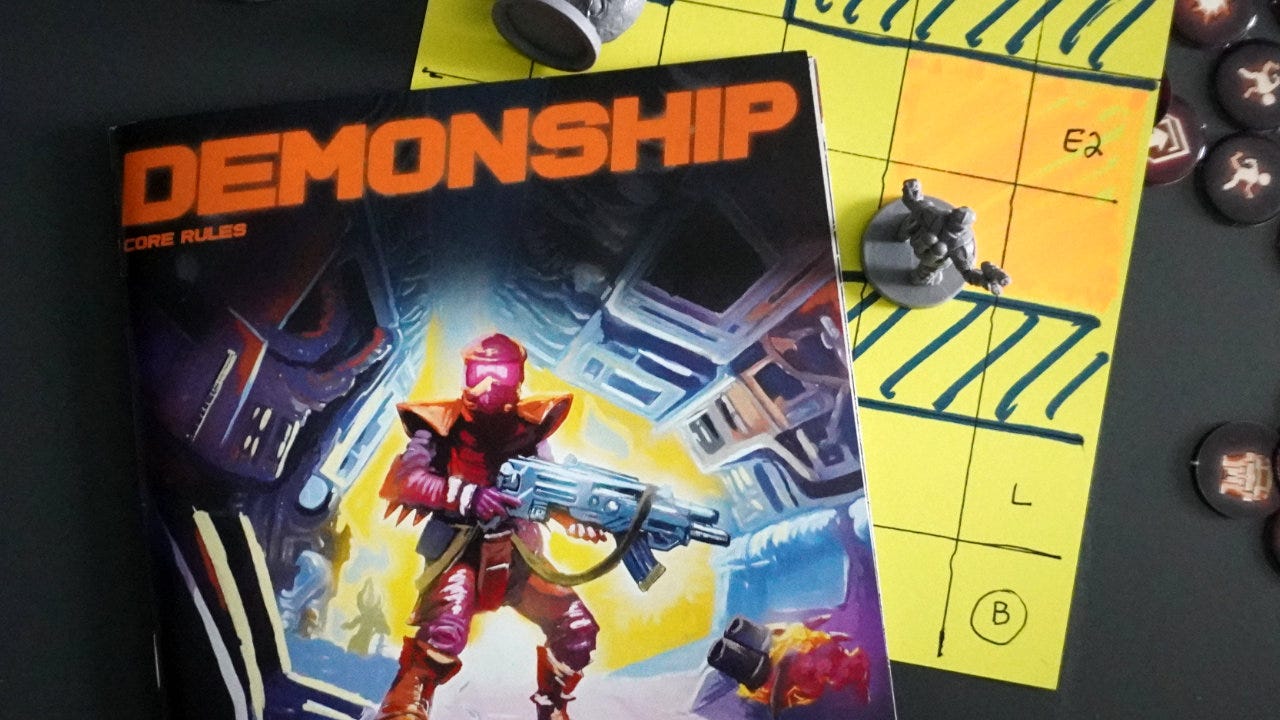
Last week we looked at how everything is auction. This week we are powering up space engines and trying to escape the DEMON SHIP! It’s a small, solo skirmish game from Black Site Studios with a particularly interesting health/action system called Pulse Rate.
But first…
Kind words for Dark Mall
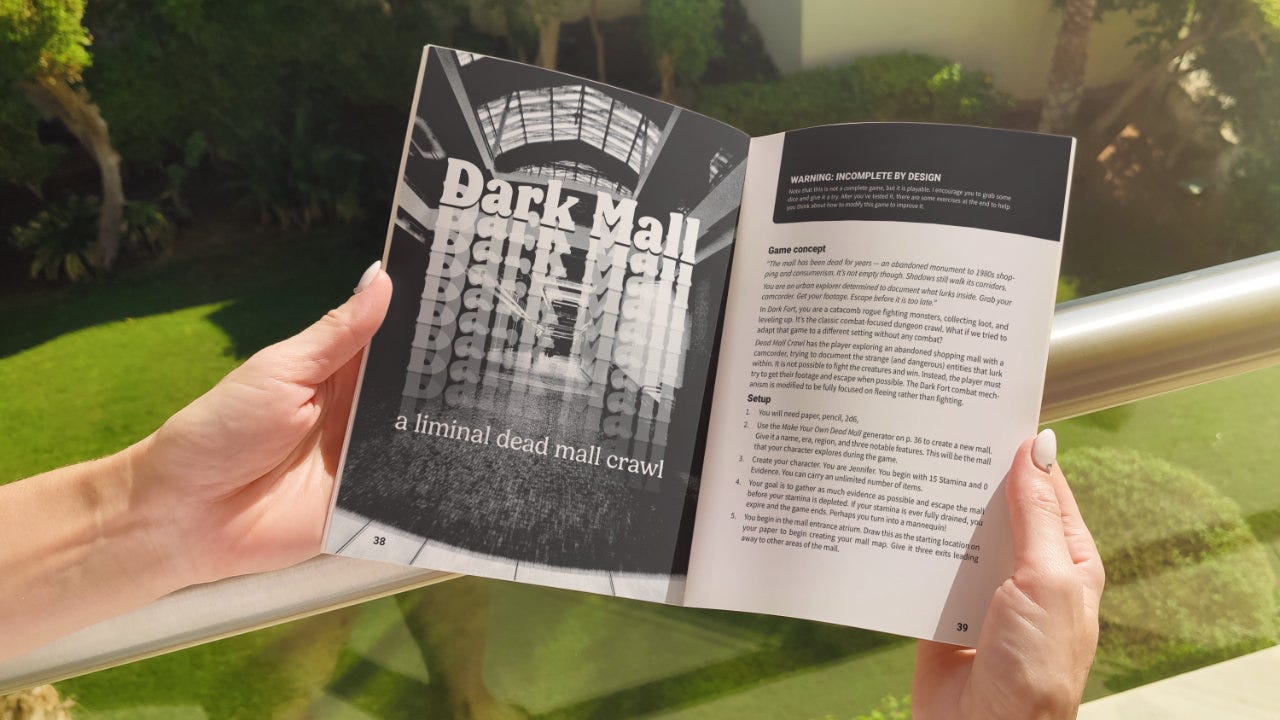
Saw the nicest Bluesky post from Almost Bedtime Theater recently about Tumulus Issue 8:
“For solo RPG club today I played Dark Mall, a liminal dead mall crawl in this issue of TUMULUS. I survived gathering video evidence of the Whistler, the Mall Walker, and the Balloon Cloud before barely escaping! And I love the included exercises that get you thinking about ways to improve the game.”
I can’t explain how exciting it is to hear that people are playing the games inside each issue of Tumulus. Even better, however, is that the included exercises are getting people to ponder how they might improve the “incomplete by design” games.
Just a post that really brightened an otherwise not-so-bright day, and I wanted to share. Thank you!
I’ve had it with these demons on this ship!
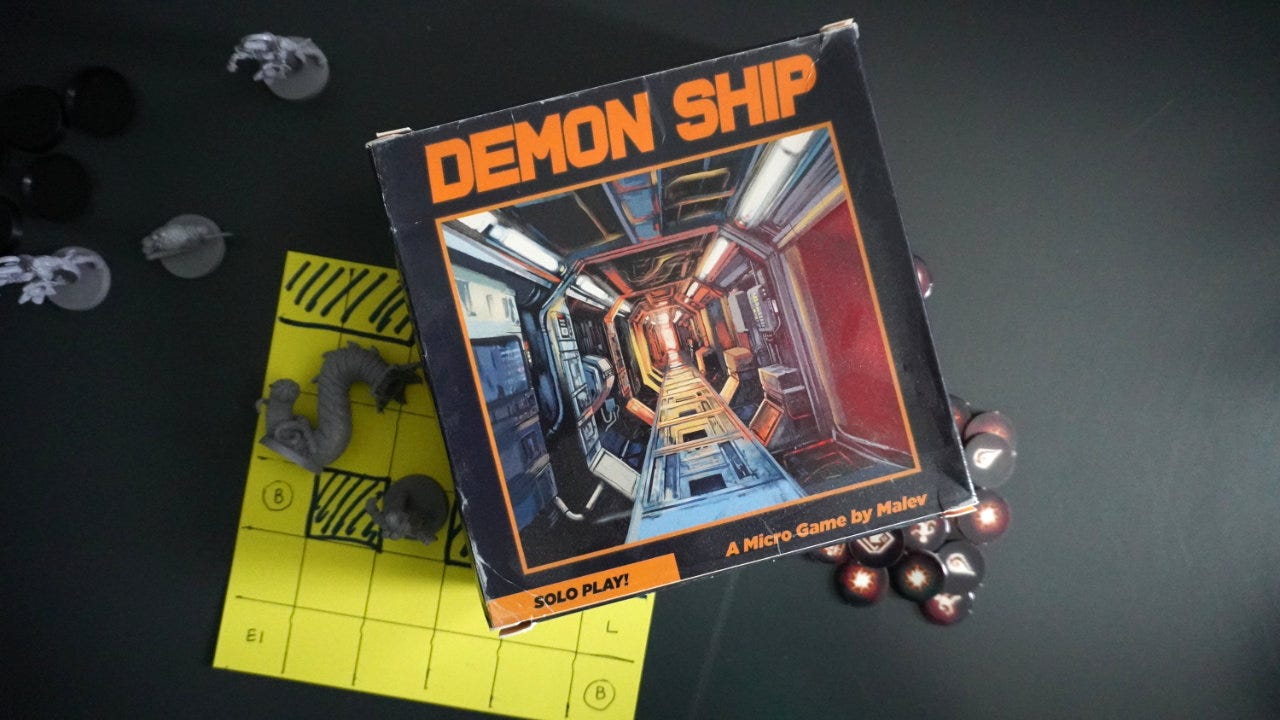
In Demon Ship (Malev Da Shinobi, 2023) you are the last survivor on a demon-infested spaceship. You have three objectives: Restore power. Start the evacuation sequence. Escape the ship.
Successfully performing those tasks won’t be easy because (of course) the ship’s self-destruct countdown will begin during the Escape state — six rounds and game over.
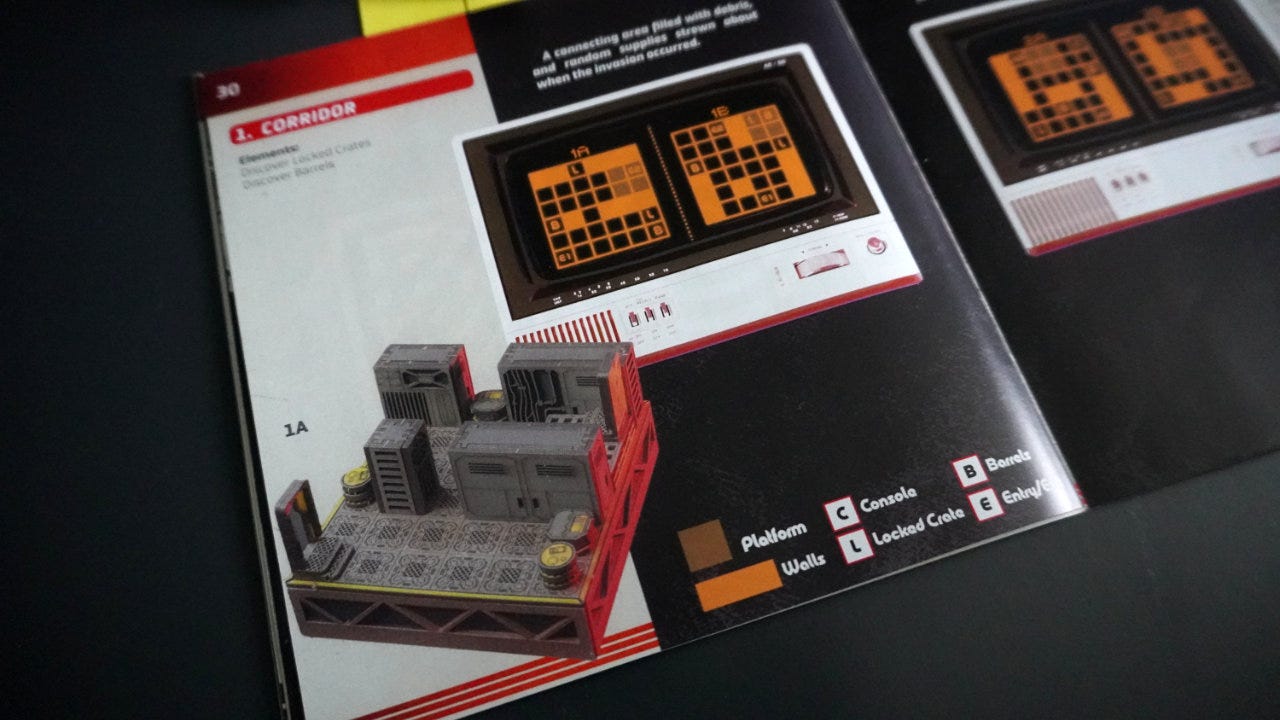
The game is played on a 6x6 grid. Each square on the grid is a “space” and distances are measured in spaces. There are line-of-sight rules, as it might be blocked by walls or demons.
During the Room Phase, you roll to see which room you’ll enter. The rulebook has a list of rooms, contents, and alternate layouts. Then you’ll roll dice to spawn some demons into the room. With the room configured, you’ll be ready to explore and shoot some demons in the face.
That’s not a full rules explanation, but I think it gives you enough info for us to dig into how the Pulse Rate damage system works in Demon Ship. It’s one of the parts of the game that really stood out as a particularly clever design.
Can you feel your heart pounding?
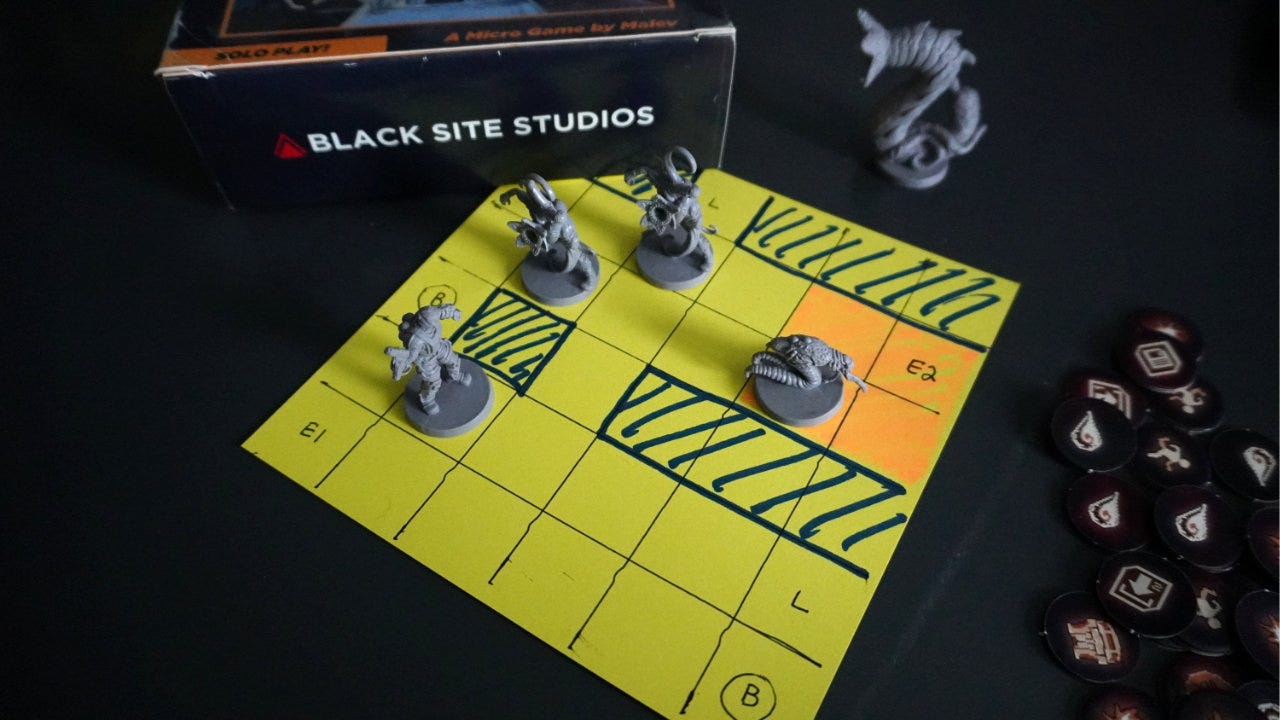
Pulse Rate is a dice pool system that Demon Ship uses to create an effective game arc of increasing action.
Here’s how the Demon Ship rulebook describes it (p. 14):
“Pulse Rate is the driving mechanic for Demon Ship, functioning as an indication of the Survivor’s health, and how much action that is going to take place during the turn. Thematically it’s the heart rate of the Survivor and it will fluctuate when they suffer damage and replace fresh bits of protective armor.”
You start with a Pulse Rate of 3 which means you have three six-sided dice (3d6) in your pool. After each Room Phase (described above), you’ll have a Wits Phase.
In the Wits Phase you roll your Pulse Rate dice and take actions. How you roll determines if you (as the Survivor) or the demons will be taking actions. Results of 4+ can be spent to take player actions while results of 1-3 will cause the demons to take actions. For example, you roll 1, 4, and 6. You would get two actions (4 & 6) and the demons will get one action (1).1
Taking damage as dice
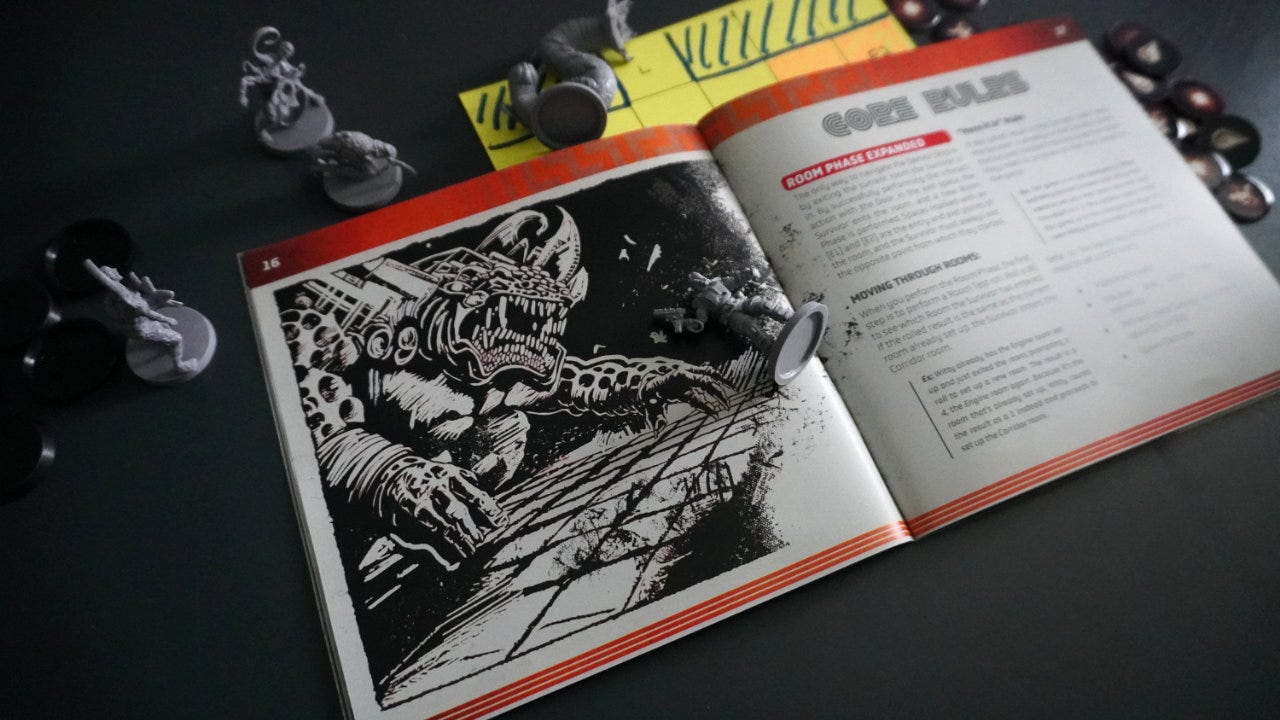
Demon Ship doesn’t have the player (directly) track hit points or health for their character. Instead, any incoming damage to the player that isn’t evaded or dodged increases the Pulse Rate. Each damage point taken increases their Pulse Rate by one.
When you start the game with a Pulse Rate of 3, it’s just three dice rolled for actions. As you take more damage, that number increases and more dice are rolled. There is an upper cap to the Pulse Rate: At a Pulse Rate of 7, the Survivor dies “a gruesome death” and the game ends.
This process continues until the Survivor dies or successfully escapes the room via the designated exit space, at which point a new Room Phase begins.
Unlike a traditional hit point (HP) system, the Pulse Rate would appear to limit garbage time in the game. If the player were simply counting down HP, they might reach a point where (with sufficiently low HP) they know they are going to die. It becomes impossible to make it out of the room, but the game would still be going. In Demon Ship, however, the damage applied to the player increases the action. They get even more chances to take actions, and more chances for incoming demon attacks.
The action escalates and rarely decreases, creating a cinematic “go out with a bang” type of feel to the game.
Conclusion
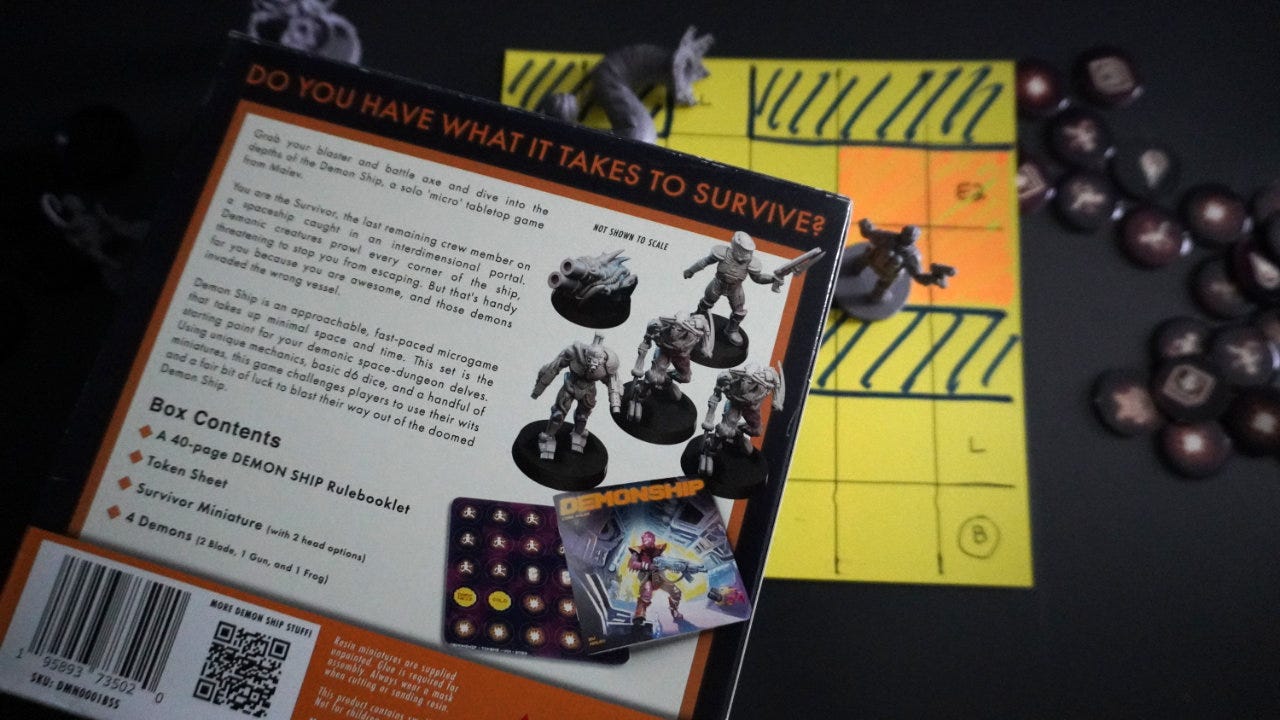
Some things to think about:
Additive vs. subtractive damage: In many games, damage is subtractive. It takes things away from the player, makes them move slower, and prevents them from taking more actions. Demon Ship flips that and damage means more player actions, although it might be more demon actions.
Solo skirmish games: I used some minis from Alone (Crespi & Silva, 2019) and a crude, hand-drawn map for Demon Ship, but check out Witty’s Demon Ship Playthrough on YouTube to see how it looks fully painted with nice terrain. The flexibility of skirmish games to be played with simple or complex components is really interesting and a strength of the genre.
The alien-infested spaceship genre: I know the “escape the alien-infested ship” thing has been done many times, but I never seem to get tired of it. Even with the same rough outline, each game seems to make it feel different. Consider Demon Ship, Nemesis (Kwapiński, 2018), The Wretched (Bissette, 2020), Alone, and the Alien RPG. Sure, they have some thematic similarities, but they each have something that makes them special.
— E.P. 💀
P.S. Want more in-depth and playable Skeleton Code Machine content? Subscribe to Tumulus and get four quarterly, print-only issues packed with game design inspiration at 33% off list price. Limited back issues available. 🩻
Skeleton Code Machine is a production of Exeunt Press. All previous posts are in the Archive on the web. Subscribe to TUMULUS to get more design inspiration. If you want to see what else is happening at Exeunt Press, check out the Exeunt Omnes newsletter.
Skeleton Code Machine and TUMULUS are written, augmented, purged, and published by Exeunt Press. No part of this publication may be reproduced in any form without permission. TUMULUS and Skeleton Code Machine are Copyright 2026 Exeunt Press.
For comments or questions: games@exeunt.press
There’s a lot more to this system than I’m describing here. For example, if the demons can’t resolve the action that was rolled, the dice automatically convert to a downward to another action. This ensures that the demons are almost always able to take their actions. There’s also a demon reaction step (Mirror Actions) that I won’t cover here.
This increasing action with damage reminds me of Fallout in the Liminal Horror RPG. There, taking Fallout is "bad" in that each one takes up one of your limited inventory slots, eventually killing you. But many (if not most) of the Fallout table entries actually give your PC a boon as well, such as increasing an attribute score, enhancing their attacks, or increasing their ability to withstand attacks. The result is the PC being slowly twisted into a powerful monster (both mechanically and thematically).